
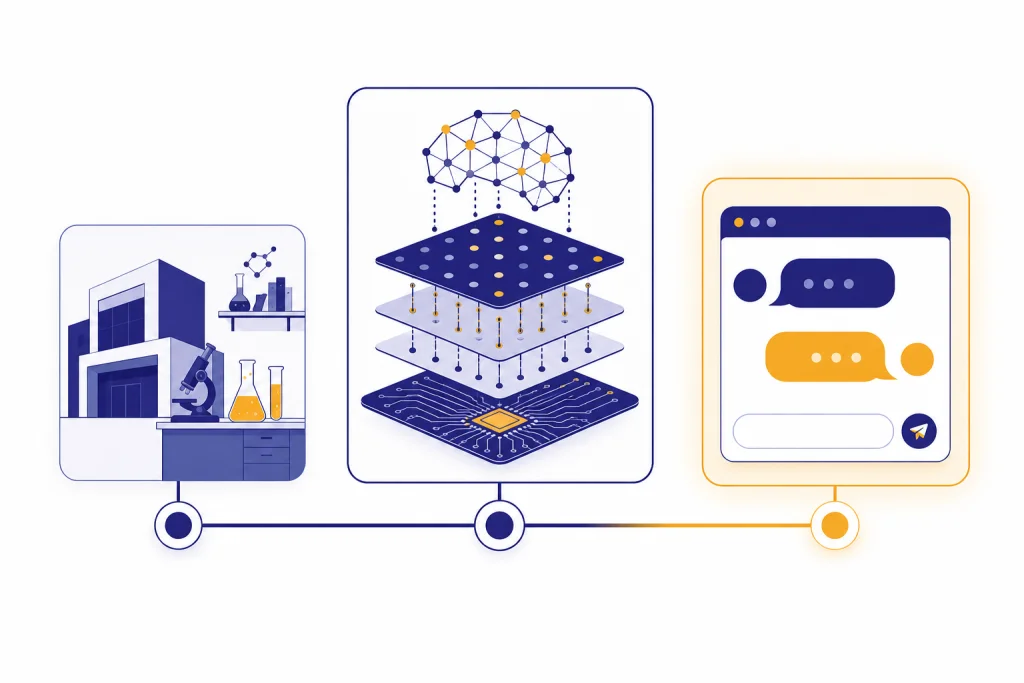
ChatGPT was publicly introduced by OpenAI on November 30, 2022, as a research preview of a conversational AI system built from the GPT-3.5 model family.[1] If you mean the company behind it, OpenAI was announced on December 11, 2015.[2] If you mean the model work that made ChatGPT possible, the origin goes back through OpenAI’s GPT research, instruction-following work, and reinforcement learning from human feedback. The short answer is simple: ChatGPT became a public product on November 30, 2022, but its technical roots were built over several years.
Short answer
ChatGPT was created as a public-facing chatbot on November 30, 2022, when OpenAI introduced it as a research release for user feedback.[1] OpenAI described the system as a model that interacts in a conversational way, can answer follow-up questions, admit mistakes, challenge incorrect premises, and reject inappropriate requests.[1]
The deeper answer depends on what you mean by “created.” The chatbot interface appeared in late 2022. The model family behind the first version, GPT-3.5, finished training earlier in 2022.[1] The company that built it, OpenAI, was announced in 2015.[2]
That is why the best answer is not one date. ChatGPT sits at the end of a chain: OpenAI’s founding, the GPT research line, instruction-following models, human-feedback training, and a simple chat interface. For a beginner-level definition of the product itself, start with what is ChatGPT. For the acronym, see what ChatGPT stands for.

Created vs. released
People ask “when was ChatGPT created” in several different ways. Some want the launch date. Some want to know when OpenAI started building it. Others want the first GPT model that made the technology possible.
For most readers, the clean answer is the public launch date: November 30, 2022.[1] That is when ordinary users could try ChatGPT and give feedback during the research preview. It was not yet the full paid ecosystem, business product, mobile app, or multimodal assistant that later versions became.
The model answer is slightly earlier. OpenAI said ChatGPT was fine-tuned from a model in the GPT-3.5 series, and that the GPT-3.5 series finished training in early 2022.[1] That means the first public ChatGPT was not trained from scratch on launch day. It was a product wrapper and safety-tuned conversational version of an existing model family.
The company answer is much earlier. OpenAI announced itself on December 11, 2015, as a nonprofit artificial intelligence research company.[2] ChatGPT was one result of years of research after that founding. If you want the ownership side, see who owns ChatGPT. If you want the full launch chronology, read when ChatGPT was released.
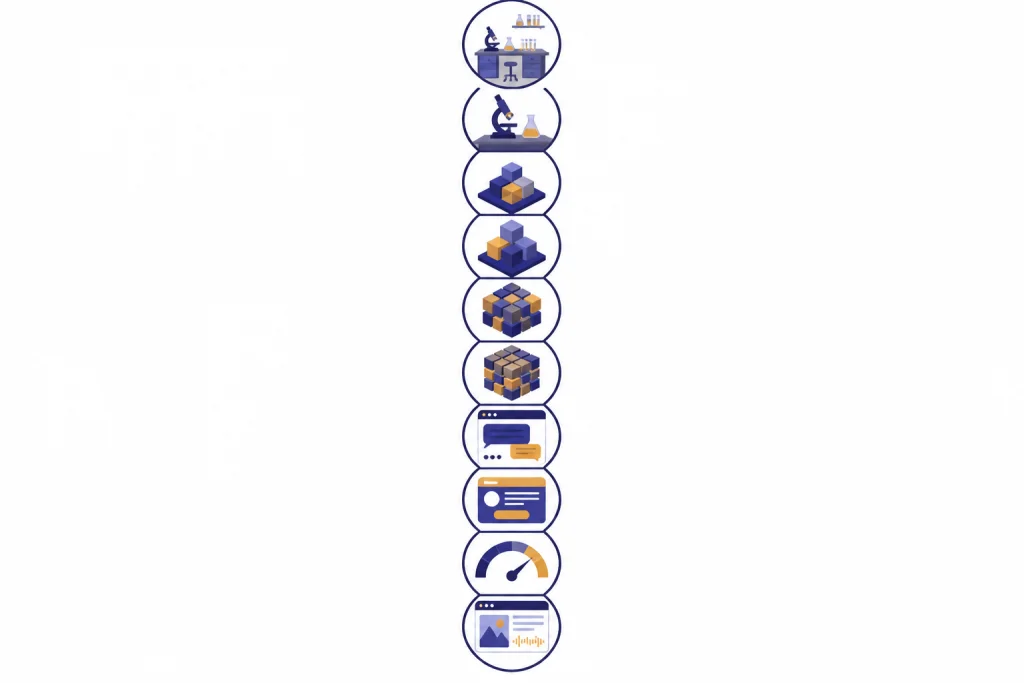
ChatGPT origin timeline
The origin story is easier to understand as a timeline. ChatGPT did not appear from a single breakthrough. It combined scaling, pretraining, instruction tuning, human feedback, deployment experience, and a consumer-friendly chat interface.
| Date or period | Milestone | Why it matters |
|---|---|---|
| December 11, 2015 | OpenAI announced | The organization that later built ChatGPT publicly launched as an AI research company.[2] |
| 2018 | Early GPT research | OpenAI showed the generative pretraining approach that became the GPT line.[3] |
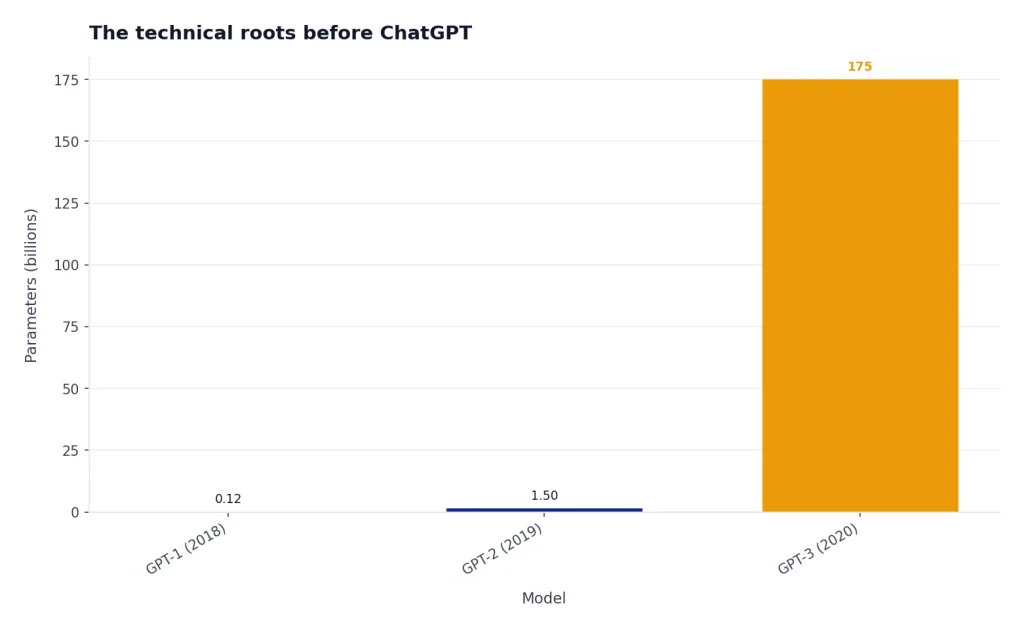
| February 14, 2019 | GPT-2 announced | GPT-2 scaled the approach to 1.5 billion parameters and used 8 million web pages in training.[4] |
| 2020 | GPT-3 published | GPT-3 scaled to 175 billion parameters and showed strong few-shot performance.[5] |
| January 27, 2022 | InstructGPT described | OpenAI described instruction-following models trained with human feedback, a key step toward ChatGPT.[6] |
| Early 2022 | GPT-3.5 training completed | The first ChatGPT was fine-tuned from the GPT-3.5 model series.[1] |
| November 30, 2022 | ChatGPT introduced | OpenAI released ChatGPT as a conversational research preview.[1] |
| February 1, 2023 | ChatGPT Plus announced | OpenAI introduced ChatGPT Plus at $20 per month with access during peak times, faster responses, and priority access to new features.[7] |
| January 2023 | Rapid adoption | Reuters reported that UBS estimated ChatGPT reached 100 million monthly active users in January 2023, about two months after launch.[8] |
| March 14, 2023 | GPT-4 announced | OpenAI introduced GPT-4 as a large multimodal model that accepted image and text inputs and produced text outputs.[9] |
This table also explains why the word “created” can be misleading. ChatGPT was not the first GPT model. It was the first version of the GPT line that reached a mass audience through a simple dialogue interface. For model-by-model differences, see all GPT models compared side by side.
The technical roots before ChatGPT
ChatGPT’s roots start with the idea behind GPT: train a model on large amounts of text so it can predict and generate language, then adapt it for tasks. GPT stands for “Generative Pre-trained Transformer.” The “pre-trained” part matters because the model first learns broad language patterns before it is adapted for specific behavior. For a plain-English definition, read what GPT means or what does GPT stand for.
OpenAI’s early GPT work showed that generative pretraining could improve performance across language tasks, but it also noted limits: models trained on text can learn incomplete or biased information about the world.[3] That warning still applies to ChatGPT. A model can produce fluent text without guaranteeing that every answer is true.
GPT-2 pushed the scale higher. OpenAI described GPT-2 as a transformer-based language model with 1.5 billion parameters, trained on 8 million web pages.[4] A parameter is an internal learned value that helps a model transform input into output. More parameters do not automatically make a system safe or useful, but GPT-2 showed that scale could produce more flexible language generation.
GPT-3 raised the scale again. The GPT-3 paper described a 175 billion-parameter autoregressive language model and tested it in few-shot settings, where the model performs tasks after seeing only a small number of examples in the prompt.[5] That capability helped make prompt-based use practical. If you want the building blocks behind prompts, see what a token is in ChatGPT and what a context window means.
The missing ingredient was not just size. Earlier GPT models could generate text, but they were not naturally optimized to follow user intent. OpenAI’s InstructGPT work focused on making models better at following instructions, more truthful, and less toxic by using human feedback.[6] That research became central to the first ChatGPT experience.

What made ChatGPT different
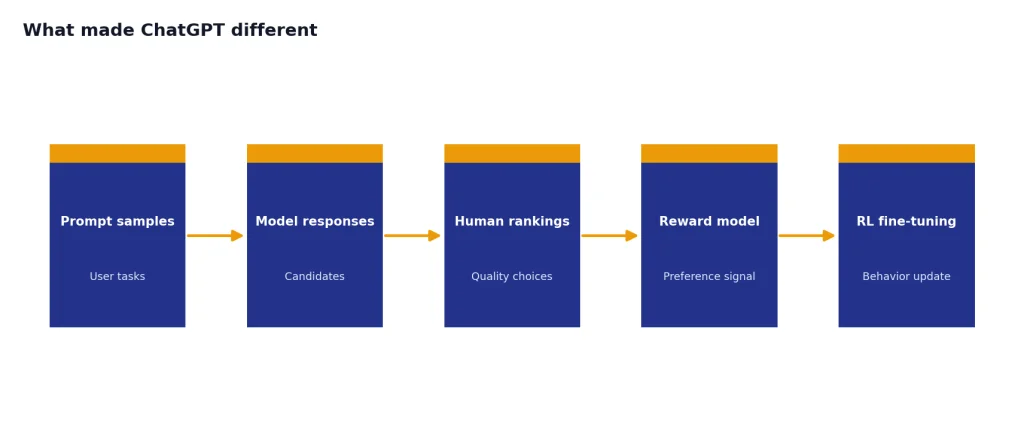
The first ChatGPT combined three practical ideas. First, it used a GPT-3.5-series model as the language engine.[1] Second, it used instruction-following and human-feedback training techniques related to InstructGPT.[6] Third, it wrapped the model in a dialogue interface that made the system feel less like a command line and more like a conversation.
OpenAI said ChatGPT was a sibling model to InstructGPT, which was trained to follow an instruction in a prompt and provide a detailed response.[1] That relationship matters. ChatGPT was not just a larger autocomplete system. It was trained and presented to answer user requests, maintain context across turns, and respond in a more conversational format.
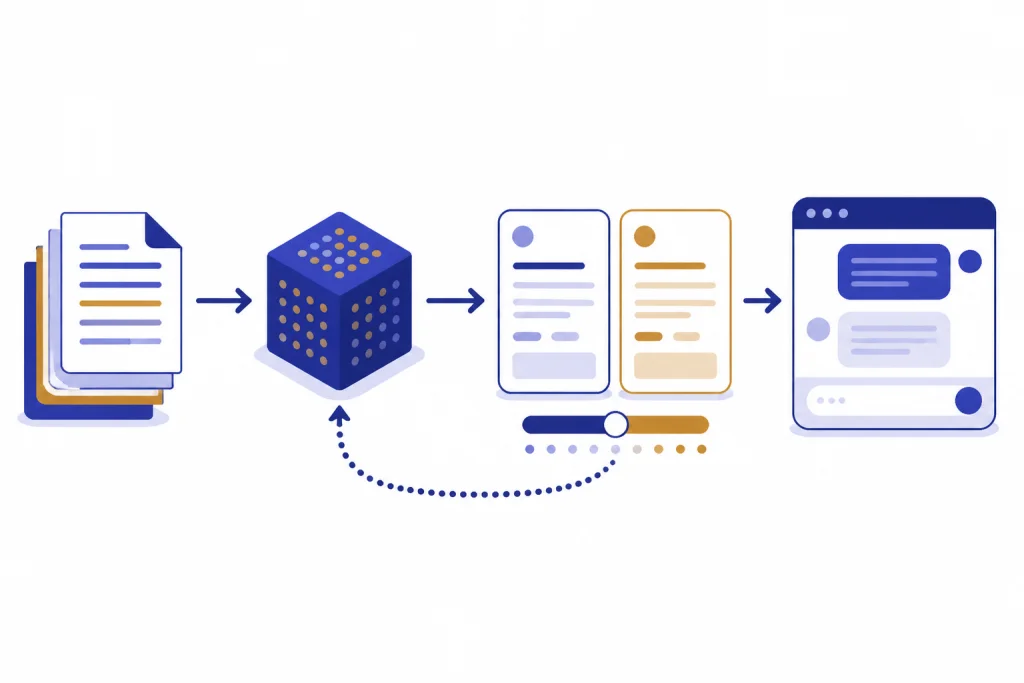
Human feedback was a major part of the recipe. OpenAI described collecting comparison data where AI trainers ranked model responses by quality, then using reward models and reinforcement learning to improve the model’s behavior.[1] For the concept behind that process, see what RLHF means.
The interface also mattered. A model that requires carefully engineered prompts feels like a research tool. A model that asks follow-up questions, handles revisions, and keeps a conversation going feels like an assistant. That design helped nontechnical users try tasks such as drafting, summarizing, coding help, brainstorming, and explaining concepts.
This is why ChatGPT became the breakout moment for generative AI. The underlying model was important, but the public interface turned it into a tool people could understand in seconds. For the broader category, see what generative AI is and what a large language model is.
What happened after launch
ChatGPT launched as a free research preview, but it quickly became a mainstream product. Reuters reported that UBS estimated ChatGPT reached 100 million monthly active users in January 2023, roughly two months after launch.[8] That growth changed how the public, schools, employers, software companies, and policymakers talked about AI.
OpenAI then introduced ChatGPT Plus on February 1, 2023.[7] The plan cost $20 per month and promised general access during peak times, faster response times, and priority access to new features and improvements.[7] That move changed ChatGPT from a research preview into a consumer subscription product.
GPT-4 arrived on March 14, 2023.[9] OpenAI described GPT-4 as a large multimodal model that accepted image and text inputs and produced text outputs.[9] That was a major shift from the original public ChatGPT, which was known mainly as a text chatbot. For the concept behind systems that work across text, images, and audio, see what multimodal AI means.
Later product changes continued to move ChatGPT away from a simple chatbot and toward an AI workspace. The core idea, however, stayed the same: a user sends a prompt, the model processes the context, and the assistant returns a generated response. More advanced workflows can add retrieval, tools, file analysis, image input, or agent-style steps. For those extensions, see what RAG is and what an AI agent is.
Who created ChatGPT
ChatGPT was created by OpenAI, not by one lone inventor. OpenAI’s founding announcement named a research and engineering group that included Ilya Sutskever, Greg Brockman, Trevor Blackwell, Vicki Cheung, Andrej Karpathy, Durk Kingma, John Schulman, Pamela Vagata, and Wojciech Zaremba, alongside supporters including Sam Altman and Elon Musk.[2]
The first ChatGPT also depended on many contributors beyond the founding group. OpenAI’s launch post described AI trainers who helped create conversations, compare model outputs, and rank responses for reward modeling.[1] That means the product was shaped by researchers, engineers, safety teams, infrastructure teams, data workers, and feedback from early users.
If you are asking who deserves credit, the most accurate answer is the organization and its teams. If you are asking for the founding story, read who created ChatGPT and what OpenAI is.
Common misconceptions
Misconception: ChatGPT and GPT-3 are the same thing
They are related, but not identical. GPT-3 was a 175 billion-parameter language model published before ChatGPT.[5] The first ChatGPT was fine-tuned from GPT-3.5, a later model series that OpenAI said finished training in early 2022.[1]
Misconception: ChatGPT was invented overnight
The public launch felt sudden, but the foundation was years in the making. OpenAI announced itself in 2015, published earlier GPT work, scaled through GPT-2 and GPT-3, and then applied instruction-following and human-feedback methods before ChatGPT reached users.[2][4][5][6]
Misconception: ChatGPT was created only to answer facts
ChatGPT generates language in response to prompts. It can answer factual questions, but it can also draft, rewrite, summarize, brainstorm, explain, and code. OpenAI’s launch post also warned that ChatGPT could produce plausible-sounding but incorrect or nonsensical answers.[1]
Misconception: The first ChatGPT was multimodal
The public breakout version of ChatGPT was known as a text conversation system. GPT-4, announced on March 14, 2023, was described by OpenAI as a large multimodal model accepting image and text inputs and producing text outputs.[9]
Frequently asked questions
When was ChatGPT created?
ChatGPT was publicly introduced on November 30, 2022.[1] That is the best single date for when ChatGPT became available as a product. Its underlying GPT-3.5 model series finished training earlier in 2022.[1]
Was ChatGPT created in 2022 or earlier?
Both answers can be true depending on meaning. The public ChatGPT research preview launched in 2022.[1] The research behind it began earlier, including OpenAI’s GPT work, GPT-2 in 2019, GPT-3 in 2020, and InstructGPT in 2022.[4][5][6]
Who created ChatGPT?
OpenAI created ChatGPT. The product was not the work of a single inventor. It came from OpenAI’s researchers, engineers, trainers, and deployment teams, building on the company’s earlier GPT and alignment work.[1][2]
What model did the first ChatGPT use?
The first ChatGPT was fine-tuned from a model in the GPT-3.5 series.[1] OpenAI described ChatGPT as a sibling model to InstructGPT, which was trained to follow instructions in prompts.[1]
When did ChatGPT become popular?
ChatGPT became popular almost immediately after launch. Reuters reported that UBS estimated it reached 100 million monthly active users in January 2023, about two months after the November 30, 2022 launch.[8] That rapid adoption made it one of the clearest mainstream moments for generative AI.
When did paid ChatGPT start?
OpenAI announced ChatGPT Plus on February 1, 2023.[7] The plan was priced at $20 per month and included access during peak times, faster responses, and priority access to new features and improvements.[7]