
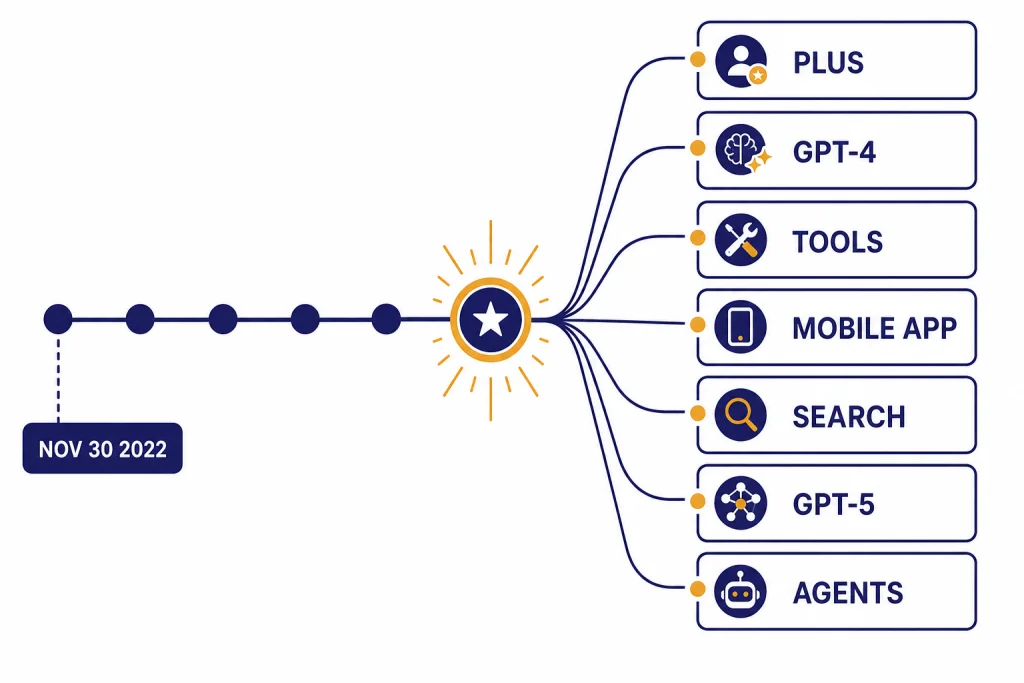
ChatGPT was released to the public on November 30, 2022, as a free research preview from OpenAI.[1][2] The first version was a browser-based conversation product: it could answer follow-up questions, admit mistakes, challenge incorrect premises, and refuse some inappropriate requests.[1][2] By January 2023, outside estimates put ChatGPT at 100 million monthly active users, roughly two months after launch.[3][4] Since then, ChatGPT has expanded through paid plans, GPT-4, plugins, official mobile apps, voice and image features, memory, custom GPTs, search, reasoning models, agents, GPT-5, and the GPT-5.5 generation available as of May 2026.
When ChatGPT was released
ChatGPT was released on November 30, 2022.[1][2] OpenAI described the launch as a research preview, not a finished general-purpose assistant.[1][2] The public release happened before ChatGPT Plus, GPT-4 in ChatGPT, official mobile apps, voice conversations, memory, custom GPTs, search, and the later GPT-5 model family.[5][7]
The short answer is the date above. The fuller answer is that ChatGPT became a product line rather than one static chatbot. The ChatGPT people tried in late 2022 was much more limited than the ChatGPT available in May 2026, when the current top chat tier includes GPT-5.5 and GPT-5.5-pro, with newer image and video systems such as GPT-image-2 and Sora-2-pro also part of OpenAI’s broader product lineup.

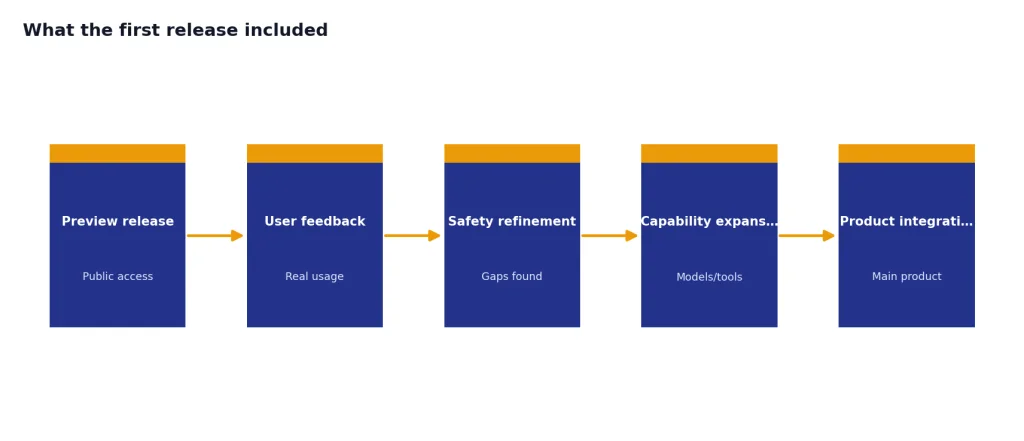
What the first release included
The original ChatGPT release was a browser-based conversational interface built around dialogue. OpenAI said the format made it possible for the system to answer follow-up questions, admit mistakes, challenge false premises, and reject inappropriate requests.[1][2] It was free during the research preview, which helped ordinary users test it without first buying a subscription.[1][2]
The first release was not a search engine, office suite, mobile app, image generator, voice assistant, agent, or developer platform. Earlier GPT systems existed, but ChatGPT made a large language model feel accessible through a simple chat box rather than an API call or research demo.
OpenAI also framed the launch as part of iterative deployment. In practice, that meant broad user feedback came before many later product decisions. The company’s feedback contest rules corroborate the public launch window: entries were accepted beginning at 8:00 a.m. Pacific time on November 30, 2022.[2][1]
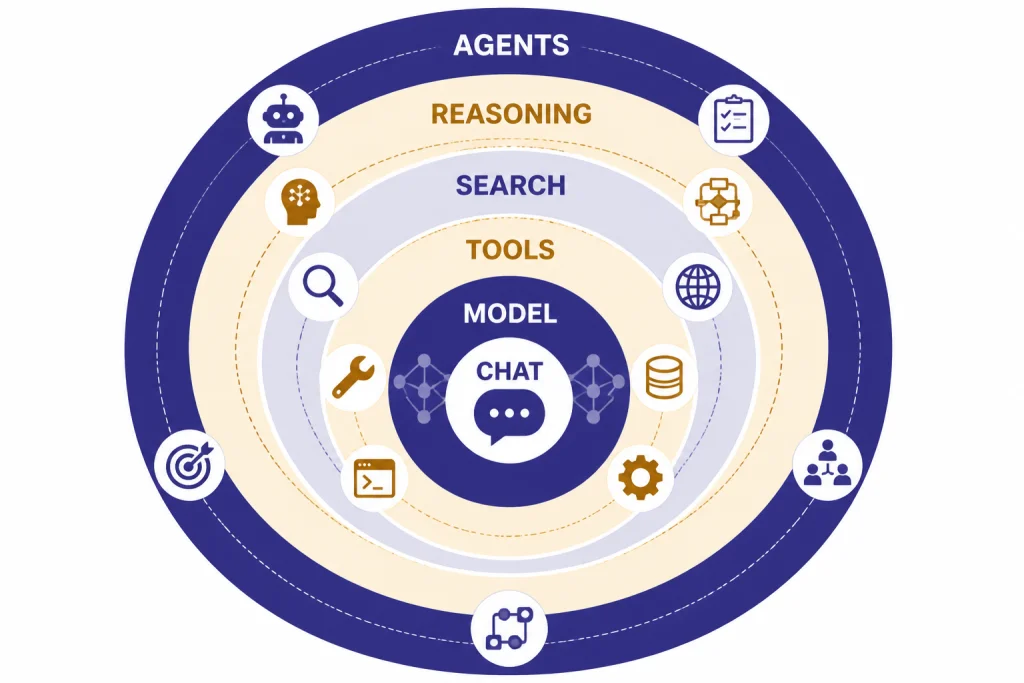
If you are comparing early ChatGPT with today’s model lineup, start with all GPT models compared side by side. ChatGPT’s name now refers to a product that can expose or route work across different model types, not just the single research-preview experience from 2022.
Full ChatGPT timeline
This timeline focuses on public ChatGPT milestones and closely related OpenAI product changes that affected what typical ChatGPT users could do. It is not a list of every API-only model release.
| Date | Milestone | What changed for users |
|---|---|---|
| November 30, 2022[1][2] | ChatGPT research preview | OpenAI released ChatGPT publicly as a free conversational AI system. |
| January 2023[3][4] | Estimated 100 million monthly active users | Outside estimates said ChatGPT reached mass adoption roughly two months after launch. |
| February 1, 2023[5][6] | ChatGPT Plus | OpenAI introduced a paid plan at $20 per month while keeping a free option. |
| March 14, 2023[7][8] | GPT-4 in ChatGPT Plus | Paid users gained access to GPT-4 with a usage cap. |
| March 23, 2023[9][10] | Plugins and browsing experiments | ChatGPT began moving beyond static text generation into tool use and web access. |
| May 18, 2023[11][12] | ChatGPT app for iOS | OpenAI released its official iPhone app for ChatGPT. |
| July 2023[39] | ChatGPT app for Android | The official Android app expanded ChatGPT from a web-and-iOS product to the other major mobile platform. |
| August 28, 2023[13][14] | ChatGPT Enterprise | OpenAI launched a business tier with enterprise security, privacy, and higher-speed GPT-4 access. |
| September 2023[39] | Voice and image features | ChatGPT began adding more natural voice conversations and image understanding features for users. |
| November 6, 2023[15][16] | GPTs and GPT-4 Turbo announced | OpenAI introduced custom GPTs and GPT-4 Turbo at its first DevDay. |
| January 10, 2024[17][18] | GPT Store and ChatGPT Team | OpenAI began rolling out the GPT Store and a smaller-business team plan. |
| February 2024[39] | Memory testing and rollout | ChatGPT began moving toward persistent user preferences and facts, with user controls for memory. |
| May 13, 2024[19][20] | GPT-4o | OpenAI brought GPT-4-level intelligence and more tools to free users. |
| July 18, 2024[21][22] | GPT-4o mini | OpenAI replaced GPT-3.5 in ChatGPT with a smaller, faster GPT-4o-family model. |
| September 12, 2024[25][26] | OpenAI o1 preview | ChatGPT added a reasoning model designed to spend more time thinking before answering. |
| September-October 2024[39] | Advanced Voice Mode | Voice became a more central interaction mode, making ChatGPT feel closer to a real-time assistant. |
| October 2024[39] | Canvas | ChatGPT added a workspace-style editing surface for writing and coding tasks. |
| October 31, 2024[23][24] | ChatGPT search | OpenAI launched web search inside ChatGPT for Plus, Team, and SearchGPT waitlist users. |
| December 5, 2024[27][28] | ChatGPT Pro | OpenAI launched a $200 monthly plan with expanded access to o1 and other tools. |
| Late 2024[39] | Projects and workspace features | ChatGPT continued adding ways to organize chats, files, instructions, and longer-running work. |
| January 23, 2025[29][30] | Operator research preview | OpenAI introduced an agent that could use a browser to perform tasks under user control. |
| February 27, 2025[31][32] | GPT-4.5 | OpenAI released GPT-4.5 as a research preview for ChatGPT users on higher tiers. |
| August 7, 2025[33][34] | GPT-5 | OpenAI introduced GPT-5 as the next major generation for ChatGPT. |
| November 12, 2025[35][36] | GPT-5.1 | OpenAI updated ChatGPT with a more conversational GPT-5.1 series. |
| December 11, 2025[37][38] | GPT-5.2 | OpenAI released GPT-5.2 for ChatGPT and the API, emphasizing long-context reasoning and work tasks. |
| February 13, 2026[39][40] | Legacy model retirements | OpenAI retired several older ChatGPT models, including GPT-4o and GPT-5 Instant and Thinking surfaces. |
| March 2026 | GPT-5.4 generation | OpenAI’s current model lineup expanded with GPT-5.4, including pro, mini, and nano variants. |
| April 2026 | GPT-5.5 and newer media models | GPT-5.5 and GPT-5.5-pro became the current top chat models, while GPT-image-2 became the current image-generation model. |
| May 2026 | Current ChatGPT-era lineup | For current comparisons, treat GPT-5.5/GPT-5.5-pro as the top chat tier, GPT-image-2 as the current image model, and Sora-2-pro as the current top video model. |
How ChatGPT changed after launch
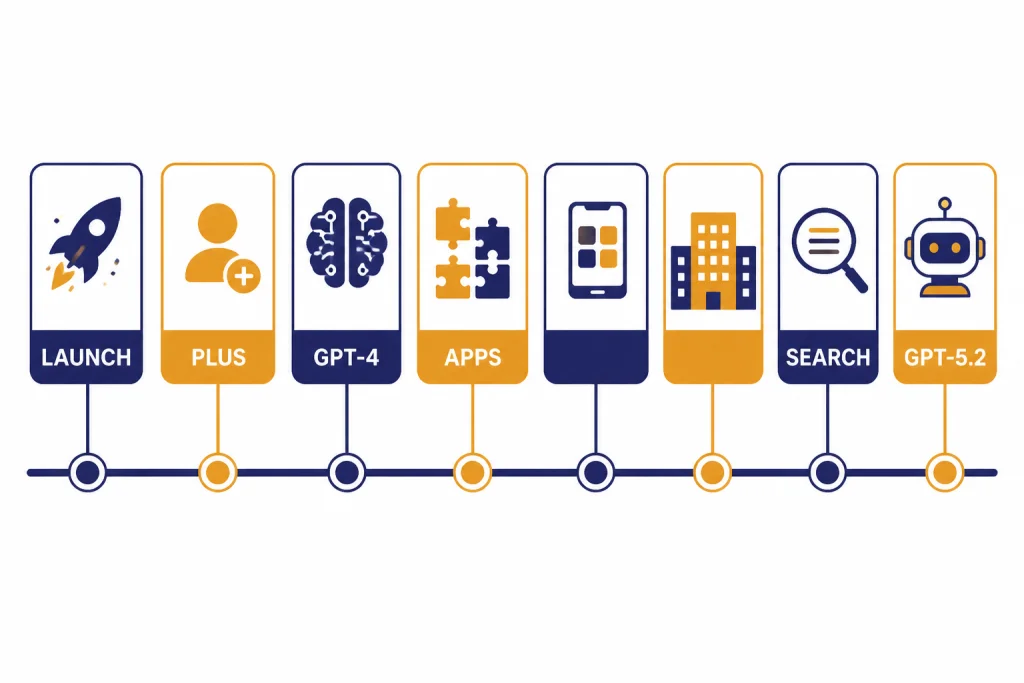
ChatGPT’s first major shift was monetization. OpenAI introduced ChatGPT Plus on February 1, 2023, at $20 per month, while keeping a free option available.[5][6] That split created the pattern ChatGPT still follows: broad free access, with paid plans for heavier use, earlier access, or more capable models. For the current subscription value question, see our ChatGPT Plus price in 2026 guide.
The second shift was model quality. GPT-4 reached ChatGPT Plus on March 14, 2023, and gave paying users a more capable model than the first public ChatGPT experience.[7][8] That was when many users began treating ChatGPT as a serious writing, coding, tutoring, and analysis assistant rather than a novelty.
The third shift was tools. Plugins and browsing experiments arrived on March 23, 2023, moving ChatGPT toward actions and external information.[9][10] Search later became a direct part of the product when OpenAI launched ChatGPT search on October 31, 2024.[23][24]
The fourth shift was distribution. OpenAI released the ChatGPT iOS app on May 18, 2023, and followed with an Android app later in 2023.[11][12][39] That mobile phase made ChatGPT feel less like a website and more like a daily utility, while also helping users distinguish the official app from look-alike apps.
The fifth shift was workplace adoption. ChatGPT Enterprise launched on August 28, 2023, with enterprise security and privacy claims, higher-speed GPT-4 access, longer context windows, and advanced data analysis capabilities.[13][14] If you are comparing ChatGPT seats with API deployment, our OpenAI API pricing guide explains why business users often separate product subscriptions from developer usage.
The sixth shift was personalization and workspace design. OpenAI announced GPTs at DevDay on November 6, 2023, launched the GPT Store on January 10, 2024, and later added memory, Canvas, and project-style organization features.[15][16][17][18][39] Instead of one generic assistant, ChatGPT increasingly became a place for custom assistants, files, instructions, drafts, code, and ongoing work.
The seventh shift was reasoning and agency. The o1 preview in September 2024 introduced models designed to spend more time on difficult tasks, ChatGPT Pro expanded premium compute access, and Operator explored browser-based task execution.[25][27][29] GPT-5 then turned ChatGPT into a new-generation model product, followed by GPT-5.1, GPT-5.2, GPT-5.4, and GPT-5.5.
Analysis: the pattern in ChatGPT’s evolution
The pattern across ChatGPT’s history is consistent: OpenAI releases a broad interface first, adds specialized capability, and then folds that capability back into the main product. The 2022 release was a plain chat interface.[1][2] The 2023 releases added paid access, stronger models, plugins, mobile apps, voice and image features, enterprise packaging, and custom GPTs.[5][7][9][13][15] The 2024 and 2025 releases added memory, multimodal access, search, reasoning, workspace features, agents, and newer model routing.[19][23][25][29][33]
This creates a useful decision framework. If you are asking when ChatGPT was released for historical purposes, use November 30, 2022.[1][2] If you are asking when ChatGPT became strong enough for many professional tasks, March 14, 2023, is a defensible marker because GPT-4 arrived in ChatGPT Plus that day.[7][8] If you are asking when ChatGPT became a multimodal mainstream assistant, May 13, 2024, matters because GPT-4o expanded GPT-4-level capability to free users.[19][20] If you are asking when ChatGPT entered its GPT-5 generation, August 7, 2025 is the marker; if you are asking what the current top chat generation is as of May 2026, use GPT-5.5 and GPT-5.5-pro.[33][34]
The tradeoff is that the ChatGPT name hides change. A screenshot from December 2022 and a session from May 2026 are both “ChatGPT,” but they do not represent the same capabilities. That matters when comparing model behavior, context limits, tool access, memory, multimodal inputs, and workspace features. For model-specific differences, use our context window comparison and most powerful GPT model breakdowns.
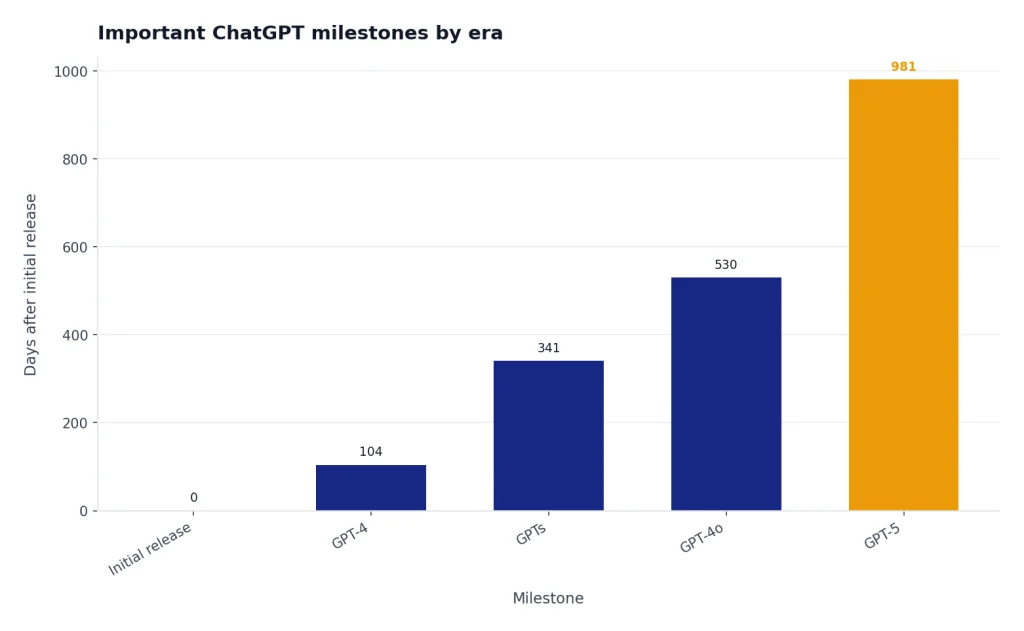
Important ChatGPT milestones by era
The timeline is easier to understand if you group it into eras. Each era changed the product in a different way: access, capability, distribution, customization, multimodality, reasoning, workspace organization, and agency.
| Era | Key release window | Main change | Representative milestones |
|---|---|---|---|
| Research preview | November 30, 2022[1][2] | Public access to conversational AI | Free ChatGPT research preview |
| Paid and stronger models | February 1 to March 14, 2023[5][6][7][8] | Subscription access and GPT-4 | ChatGPT Plus at $20 per month; GPT-4 for Plus users |
| Tools, apps, and multimodal inputs | March to September 2023[9][10][11][12][39] | ChatGPT moved beyond a website text box | Plugins, browsing experiments, iOS app, Android app, voice, and image features |
| Workplace and customization | August 2023 to January 2024[13][14][15][17] | Business use and custom assistants | ChatGPT Enterprise, GPTs, GPT Store, ChatGPT Team |
| Memory, multimodal mainstreaming, and search | February to October 2024[19][20][23][24][39] | Broader free capability, remembered preferences, web answers, and richer interaction | Memory, GPT-4o, GPT-4o mini, Advanced Voice Mode, Canvas, ChatGPT search |
| Reasoning and premium compute | September to December 2024[25][26][27][28] | Models that spend more time on hard problems | o1 preview, ChatGPT Pro, higher-compute reasoning access |
| Agents and GPT-5 generation | January to December 2025[29][30][33][37] | Browser action and next-generation model routing | Operator, GPT-4.5, GPT-5, GPT-5.1, GPT-5.2 |
| Current GPT-5.5 era | March to May 2026 | Updated top-tier chat, image, and video lineup | GPT-5.4, GPT-5.5, GPT-5.5-pro, GPT-image-2, Sora-2-pro |
The official initial release is still November 30, 2022.[1][2] But many features people now associate with ChatGPT came later: GPT-4 in March 2023, official mobile apps in 2023, GPTs in November 2023, memory and GPT-4o in 2024, search in October 2024, GPT-5 in August 2025, and GPT-5.5 in 2026.[7][11][15][19][23][33]
Developers should also separate ChatGPT from the OpenAI API. ChatGPT is the consumer and workplace product. The API is a developer platform with its own pricing, error behavior, rate limits, and deployment patterns. If you are building software, start with OpenAI API errors, OpenAI Batch API, and the OpenAI Vision API rather than assuming ChatGPT product history maps directly to API behavior.

What was not released on day one
ChatGPT did not launch with GPT-4. GPT-4 reached ChatGPT Plus on March 14, 2023, more than three months after the original ChatGPT release.[7][8] That timing matters because many people now remember ChatGPT through the GPT-4, GPT-4o, or GPT-5 eras rather than the more limited research preview.
ChatGPT did not launch with a paid plan. ChatGPT Plus arrived on February 1, 2023, at $20 per month.[5][6] The paid tier helped OpenAI offer priority access and faster responses while keeping free access available.
ChatGPT did not launch with official phone apps. OpenAI launched the official iOS app on May 18, 2023, and the Android app followed later in 2023.[11][12][39] Before then, most people used ChatGPT through the web, and app stores contained unofficial apps using similar names.
ChatGPT did not launch with voice, image understanding, or Advanced Voice Mode. Those capabilities arrived later as the product became more multimodal.[19][39] The original release was primarily a text conversation experience.
ChatGPT did not launch with plugins, browsing, or search. Plugins and browsing experiments were announced on March 23, 2023, and ChatGPT search launched on October 31, 2024.[9][10][23][24] The original product answered from model training and conversation context, not from live search results.
ChatGPT did not launch with memory, Canvas, Projects, custom GPTs, or a GPT Store. OpenAI announced GPTs at DevDay on November 6, 2023, started rolling out the GPT Store on January 10, 2024, and added memory and workspace-style features later.[15][16][17][18][39] Those changes turned ChatGPT into a more persistent work environment rather than only a disposable chat thread.
ChatGPT did not launch with autonomous browser action. Operator was introduced as a research preview on January 23, 2025.[29][30] That marked a different direction: not just answering questions, but using a browser to perform tasks under user control.
The same caution applies to corporate history. OpenAI, Microsoft, and ChatGPT are connected, but not interchangeable. For the company context, read OpenAI and Microsoft and OpenAI’s CTO and leadership team.
Frequently asked questions
When was ChatGPT released to the public?
ChatGPT was released to the public on November 30, 2022.[1][2] OpenAI described it as a research preview and made it free during that preview period.[1][2] That date is the correct answer when people ask for ChatGPT’s original release date.
Was ChatGPT released in 2022 or 2023?
ChatGPT was released in 2022, specifically on November 30, 2022.[1][2] The confusion comes from major 2023 updates, including ChatGPT Plus on February 1, GPT-4 in ChatGPT Plus on March 14, official mobile apps, and voice/image features.[5][7][11][39] The product became much more capable in 2023, but it did not start then.
When did ChatGPT Plus launch?
ChatGPT Plus launched on February 1, 2023.[5][6] OpenAI priced the plan at $20 per month and described benefits such as general access during peak times, faster response times, and priority access to new features.[5][6]
When did GPT-4 come to ChatGPT?
GPT-4 came to ChatGPT Plus on March 14, 2023.[7][8] OpenAI said GPT-4’s text input capability was being released through ChatGPT and the API, with API access starting through a waitlist.[7][8] This was one of the most important early upgrades after the November 30, 2022 launch.
When did ChatGPT get internet search?
ChatGPT first moved toward web access with plugins and browsing experiments announced on March 23, 2023.[9][10] OpenAI later launched ChatGPT search on October 31, 2024.[23][24] The later search feature was a more direct product experience for timely answers with links to web sources.[23][24]
When did ChatGPT reach 100 million users?
Outside estimates said ChatGPT reached 100 million monthly active users in January 2023.[3][4] That was about two months after the November 30, 2022 launch.[1][3] The figure came from third-party estimates reported by Reuters and other outlets, not from an official OpenAI user-count announcement.[3][4]
What is the latest major ChatGPT model release as of May 2026?
As of May 2026, the current top ChatGPT chat models are GPT-5.5 and GPT-5.5-pro. GPT-5 was the major generation change in August 2025, followed by GPT-5.1 in November 2025 and GPT-5.2 in December 2025.[33][35][37] OpenAI’s 2026 lineup then continued with GPT-5.4 in March and GPT-5.5 in April. For current comparisons, do not treat GPT-5.2 as the newest model, and do not treat the 2022 research preview as representative of modern ChatGPT.
Bottom line
Use November 30, 2022 as the official ChatGPT release date.[1][2] Use the timeline after that date to understand which version of “ChatGPT” someone means: the first research preview, the GPT-4 upgrade, the mobile and multimodal era, the GPT-4o era, the reasoning-model era, the agent era, the GPT-5 generation, or the current GPT-5.5 era.[7][19][25][33]
The main trend is integration. ChatGPT has steadily merged chat, search, files, code, voice, images, memory, workspaces, and agents into one product. That is why the release date is simple, but the timeline matters: ChatGPT started on November 30, 2022, and its capabilities have changed many times since.