

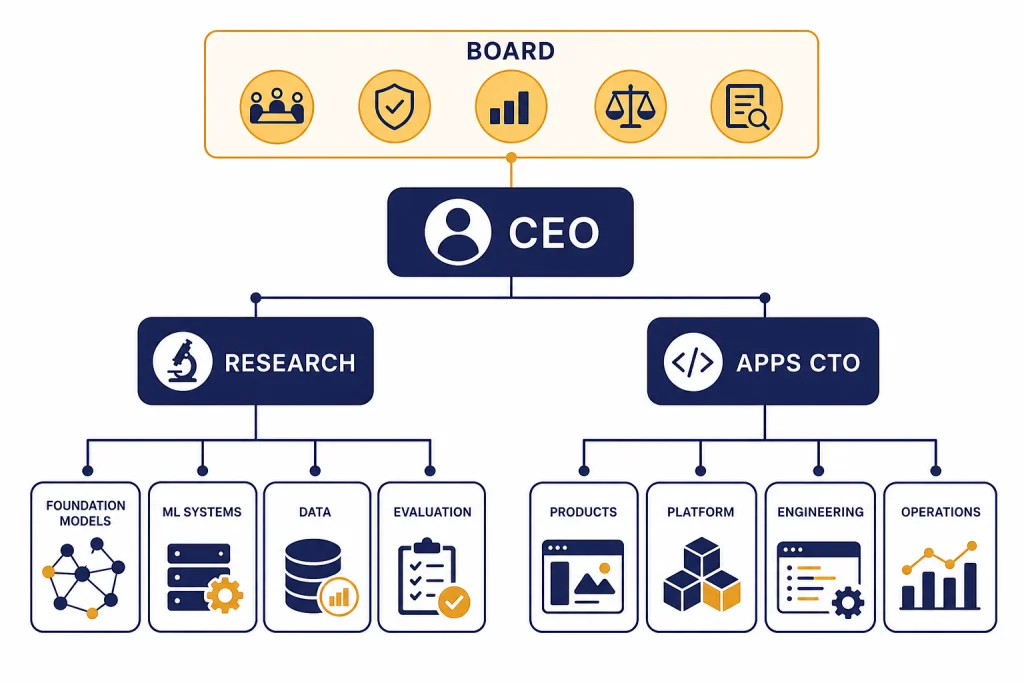
OpenAI’s CTO picture is narrower than many readers expect. As of April 3, 2026, the publicly announced technology title to know is Vijaye Raji, CTO of Applications, a role focused on product engineering for ChatGPT, Codex, infrastructure, and related application systems. OpenAI has not published a single company-wide CTO successor to Mira Murati. The broader leadership team is led by CEO Sam Altman, with Greg Brockman as president, Mark Chen as Chief Research Officer, Jakub Pachocki as Chief Scientist, Fidji Simo leading Applications, Sarah Friar as CFO, Kevin Weil as CPO, Denise Dresser as Chief Revenue Officer, and a nonprofit-controlled board chaired by Bret Taylor.
Quick answer
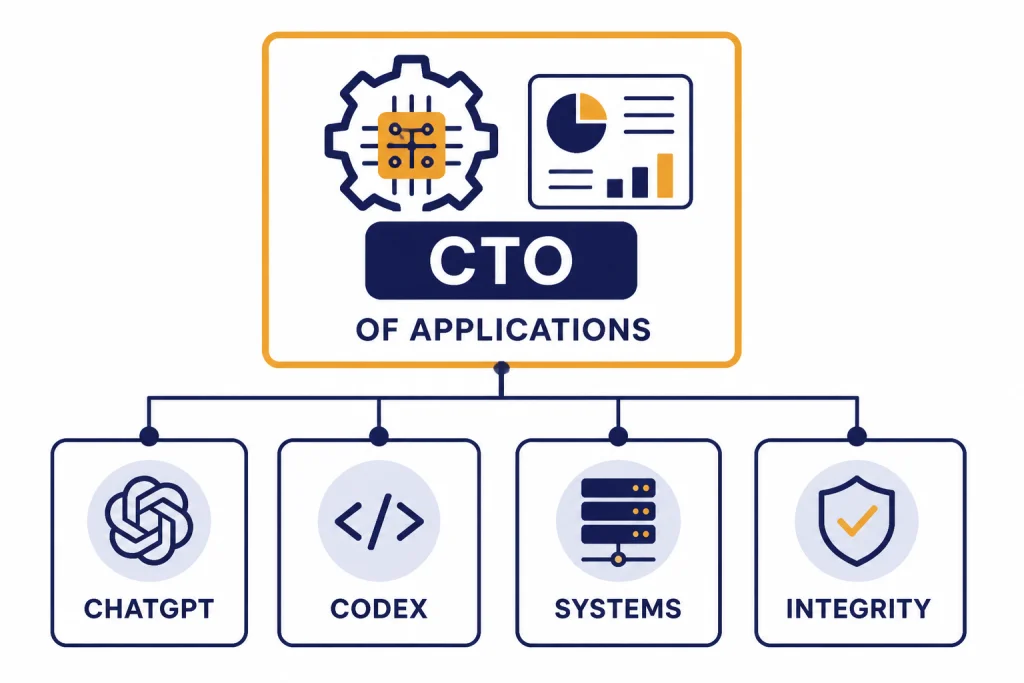
The simplest answer is that OpenAI’s public CTO title is now attached to the Applications organization, not to a single company-wide technology office. OpenAI announced on September 2, 2025, that Vijaye Raji would become CTO of Applications after the company agreed to acquire Statsig.[1] His remit covers product engineering for ChatGPT and Codex, along with core systems, product lines, infrastructure, and Integrity.[1]
That distinction matters. Many searches for openai cto and leadership still point to Mira Murati, who was OpenAI’s Chief Technology Officer before leaving in September 2024.[2] OpenAI has not published an official announcement naming one single company-wide CTO to replace that exact role. So the accurate wording is: Vijaye Raji is OpenAI’s CTO of Applications, while OpenAI’s technical leadership is split across Applications, Research, Product, Infrastructure, Safety, and executive leadership.
If you are trying to understand the company behind ChatGPT, leadership cannot be separated from structure. OpenAI now operates through the nonprofit OpenAI Foundation and the for-profit OpenAI Group PBC, with the Foundation retaining control through special governance rights.[10] For more context on how the company got here, see our OpenAI History and our guide to who owns OpenAI.
Who is OpenAI’s CTO?
OpenAI’s officially announced CTO role is Vijaye Raji, CTO of Applications. OpenAI said Raji would report to Fidji Simo and lead product engineering for ChatGPT and Codex after the Statsig acquisition was completed.[1] The announcement framed the role around the Applications organization, which OpenAI described as the group responsible for turning research into products that reach users.[1]
That role is not the same as saying OpenAI has named a single company-wide Chief Technology Officer. OpenAI has not published an official company-wide CTO appointment replacing Mira Murati’s former title. Murati’s departure created a title gap in public materials, while responsibilities moved into a more distributed leadership model.
Raji’s role is still important because Applications is where most users and developers encounter OpenAI. ChatGPT, Codex, product infrastructure, experimentation systems, and reliability work all sit close to that surface. If you use ChatGPT directly, build with the OpenAI Agents SDK, test workflows in the OpenAI Playground, or compare the Azure OpenAI Service vs OpenAI API, the Applications organization is the part of OpenAI most likely to affect your day-to-day experience.
| Question | Best current answer | Why it matters |
|---|---|---|
| Who is OpenAI’s CTO? | Vijaye Raji is CTO of Applications. | This is the CTO title OpenAI has publicly announced. |
| Is there a company-wide CTO? | OpenAI has not published an official company-wide CTO successor to Mira Murati. | It prevents confusing an Applications role with the whole company. |
| Who leads frontier research? | Mark Chen is Chief Research Officer, and Jakub Pachocki is Chief Scientist. | Research leadership is separate from product engineering leadership. |
| Who leads OpenAI overall? | Sam Altman is CEO. | Altman remains the central executive and board-linked leader. |
OpenAI executive team at a glance
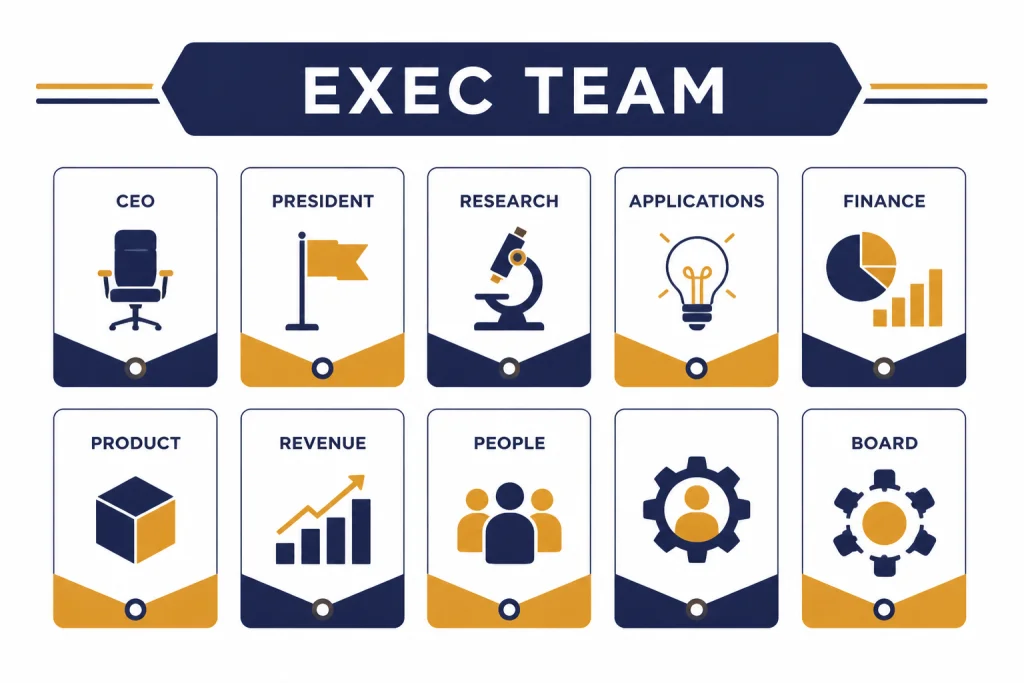
OpenAI’s leadership is best read in layers. Sam Altman leads the company as CEO. Greg Brockman, a co-founder, is president. Mark Chen and Jakub Pachocki lead the research side. Fidji Simo leads Applications, with Vijaye Raji in the CTO of Applications role. Sarah Friar, Kevin Weil, Denise Dresser, Arvind KC, and other executives cover finance, product, revenue, people, marketing, legal, policy, infrastructure, and operations.
The company has changed quickly since the 2023 board crisis. OpenAI added senior executives from consumer technology, enterprise software, finance, policy, and infrastructure as ChatGPT moved from a research breakthrough into a mass-market product and enterprise platform. That growth is also why leadership coverage can look inconsistent across public sources. Titles change. Interim responsibilities shift. Some reporting reflects internal memos before OpenAI publishes a formal page.
| Leader | Public role | Main area | Primary source note |
|---|---|---|---|
| Sam Altman | CEO | Company strategy, research-product integration, board-facing leadership | OpenAI identifies Altman as CEO in multiple official leadership posts.[4] |
| Greg Brockman | President | Technical leadership, coding, company strategy, product coverage during Simo leave | OpenAI created the president role for Brockman in 2022.[12] |
| Vijaye Raji | CTO of Applications | ChatGPT, Codex, product engineering, infrastructure, Integrity | OpenAI announced the role on September 2, 2025.[1] |
| Fidji Simo | CEO of Applications | Applications organization and product deployment | OpenAI announced Simo’s expanded leadership role on May 7, 2025.[5] |
| Mark Chen | Chief Research Officer | Frontier research, capability, safety, research-product connection | OpenAI announced Chen’s expanded role on March 24, 2025.[3] |
| Jakub Pachocki | Chief Scientist | Scientific direction and core model research | OpenAI announced Pachocki as Chief Scientist on May 14, 2024.[11] |
| Sarah Friar | Chief Financial Officer | Finance, investment support, scaling resources | OpenAI announced Friar as CFO on June 10, 2024.[4] |
| Kevin Weil | Chief Product Officer | Product strategy across consumers, developers, and businesses | OpenAI announced Weil as CPO on June 10, 2024.[4] |
| Denise Dresser | Chief Revenue Officer | Enterprise revenue and customer success | OpenAI announced Dresser as CRO on December 9, 2025.[9] |
| Arvind KC | Chief People Officer | Hiring, onboarding, development, people systems | OpenAI announced KC as CPO on February 24, 2026.[8] |
Research and technical leadership
OpenAI’s research leadership is split between scientific direction and research execution. Jakub Pachocki became Chief Scientist after Ilya Sutskever left OpenAI in May 2024.[11] OpenAI said Pachocki had previously served as Director of Research and helped lead work on GPT-4 and OpenAI Five.[11]
Mark Chen became Chief Research Officer in March 2025.[3] OpenAI said Chen would drive scientific progress, continue pushing capability and safety, and connect research more tightly with product development.[3] This gives OpenAI two visible research anchors: Pachocki for scientific direction and Chen for research organization and translation into deployed systems.
This structure is different from a traditional software company. In a normal SaaS company, a CTO might own most engineering architecture, platform decisions, and technical execution. At OpenAI, frontier model research, product engineering, infrastructure, safety, security, and deployment all need senior technical authority. The CTO of Applications handles product engineering at the application layer, but model research has its own leadership chain.
That separation explains why OpenAI can have a CTO of Applications while also having a Chief Scientist and a Chief Research Officer. The company’s core technical work is not one function. It includes training frontier models, running evaluations, managing safety systems, deploying products, serving APIs, and scaling compute. For developers, the visible result shows up in tools like the OpenAI Agent Builder, the OpenAI API pricing page, and model behavior across ChatGPT and the API.
Applications, product, and business leadership
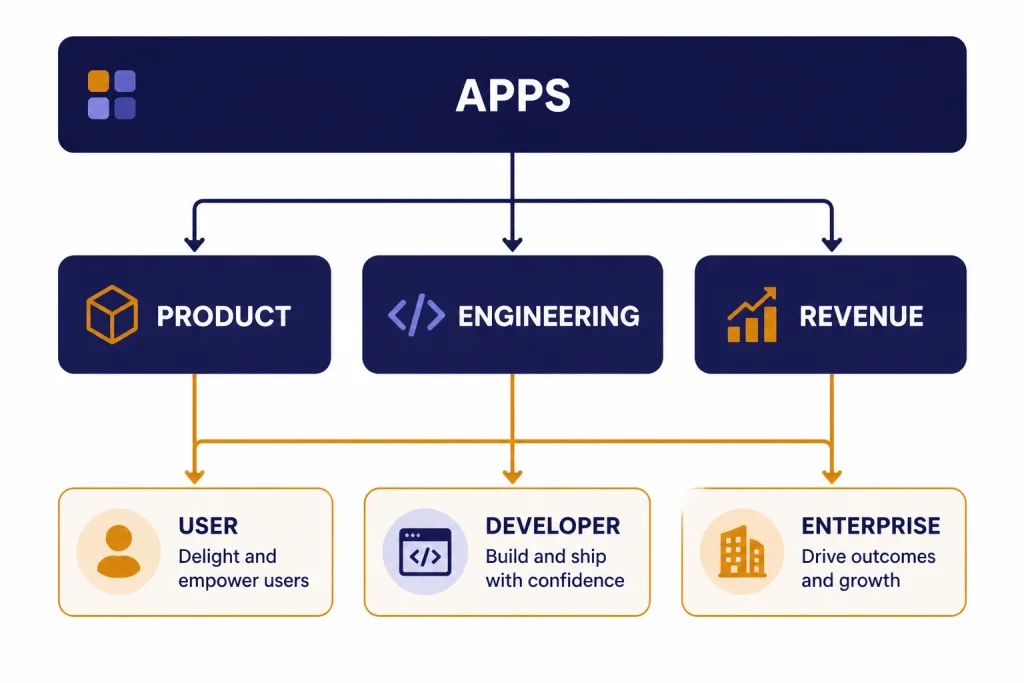
The Applications organization is OpenAI’s bridge between frontier research and user-facing products. OpenAI announced Fidji Simo’s leadership expansion on May 7, 2025, saying she would run Applications while Sam Altman remained CEO and continued overseeing Research, Compute, and Applications at the company level.[5] Simo brought experience from Instacart and Meta, and her role gave OpenAI a senior executive focused on turning research into products at large scale.
Vijaye Raji fits inside that layer as CTO of Applications. OpenAI said he would report to Simo and lead product engineering for ChatGPT and Codex.[1] In plain English, Simo owns the Applications business and product mandate, while Raji owns major parts of the engineering execution behind that mandate.
Kevin Weil’s Chief Product Officer role also sits close to this work. OpenAI announced Weil as CPO on June 10, 2024, saying he would lead product teams that apply OpenAI research to services for consumers, developers, and businesses.[4] That makes Weil central to product strategy, while Raji focuses on application engineering and Simo oversees the broader Applications organization.
On the business side, OpenAI has built a deeper executive bench. Sarah Friar joined as CFO in June 2024 to lead finance and help OpenAI scale resources for research and customers.[4] Denise Dresser joined as Chief Revenue Officer in December 2025 to oversee global revenue strategy across enterprise and customer success.[9] Arvind KC joined as Chief People Officer in February 2026 to lead hiring, onboarding, development, and people systems.[8]
This is the operating layer that affects customers most directly. It shapes subscription products, enterprise contracts, developer experience, support, reliability, and hiring. For readers tracking the commercial side, our pages on OpenAI revenue, OpenAI valuation, and OpenAI jobs add useful context.
Board and governance structure
OpenAI’s leadership cannot be explained only by executive titles. The company’s governance structure is unusual. OpenAI was founded in 2015 as a nonprofit and created a for-profit subsidiary in 2019 to help scale research and deployment.[10] With the structure announced on October 28, 2025, the nonprofit became the OpenAI Foundation, and the for-profit became OpenAI Group PBC.[10]
OpenAI says the OpenAI Foundation continues to control OpenAI Group through special voting and governance rights.[10] The Foundation appoints all members of the OpenAI Group board and can replace them at any time.[10] This means the board is not just a conventional corporate board. It is also the formal mechanism that connects OpenAI’s commercial work to its stated mission.
OpenAI’s structure page lists the OpenAI Foundation board as including Bret Taylor as chair, Adam D’Angelo, Sue Desmond-Hellmann, Zico Kolter, retired U.S. Army General Paul M. Nakasone, Adebayo Ogunlesi, Nicole Seligman, and CEO Sam Altman.[10] OpenAI also says the Safety and Security Committee remains a Foundation committee with governance over safety and security practices across OpenAI, including OpenAI Group.[10]
That governance model explains why board membership receives so much attention. The board does not merely advise management. It sits above the controlled for-profit entity. This is also why OpenAI’s partnerships, especially OpenAI and Microsoft, matter to any leadership analysis. Capital, compute, governance, and mission oversight are all connected.
Recent leadership changes to know
The most recent leadership news as of publication came on April 3, 2026. TechCrunch reported that Fidji Simo was taking medical leave for several weeks, Brad Lightcap was moving from COO into a special projects role, and Kate Rouch was stepping down from the chief marketing role to focus on cancer recovery.[6] Axios also reported that Simo’s leave set off a broader reshuffling, with responsibilities spreading across top executives.[7]
According to TechCrunch, Greg Brockman would manage product while Simo was on leave, and Denise Dresser would take over some of Lightcap’s commercial duties.[6] Axios reported that Lightcap’s new special projects work included complex deals and investments, and that he would report directly to Sam Altman.[7]
These changes do not appear to alter the core answer about the CTO role. Raji remains the publicly announced CTO of Applications. The changes do show how fluid OpenAI’s leadership structure can be. Operational authority may shift temporarily while executives take leave, change scope, or move into strategic projects.
For readers comparing leadership coverage across outlets, use dates carefully. A December 2025 article may list one reporting line. An April 2026 article may describe a temporary leave or reshuffle. An official OpenAI announcement may lag internal changes. Our OpenAI News page tracks these updates when they affect users, developers, or investors.
How to read OpenAI’s org chart
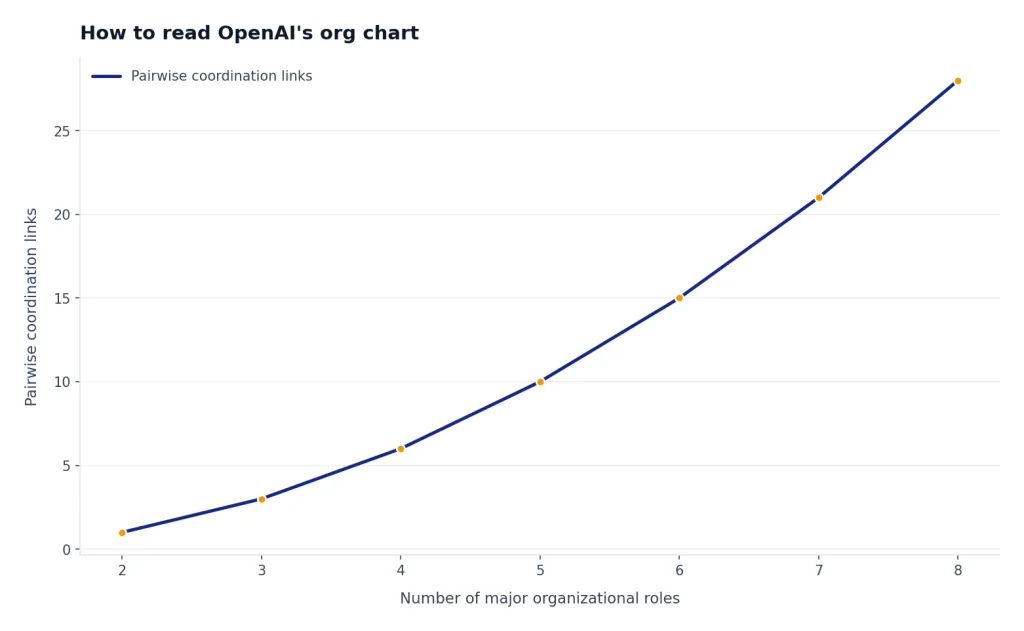
The safest way to read OpenAI’s leadership is by function, not only by title. Start with three questions. Who controls the company? Who leads the research? Who turns the research into products and revenue?
- Control: The OpenAI Foundation board controls OpenAI Group PBC through special governance rights.[10]
- Company leadership: Sam Altman is CEO, with Greg Brockman as president and senior executives running finance, product, revenue, people, policy, and operations.
- Research leadership: Jakub Pachocki is Chief Scientist, and Mark Chen is Chief Research Officer.[3][11]
- Applications leadership: Fidji Simo leads Applications, Vijaye Raji is CTO of Applications, and Kevin Weil leads product.[1][4][5]
- Business scaling: Sarah Friar leads finance, Denise Dresser leads revenue, and Arvind KC leads people systems.[4][8][9]
This model avoids the common mistake of treating OpenAI like a single-product software company. OpenAI is a research lab, consumer app company, developer platform, enterprise vendor, infrastructure buyer, policy actor, and nonprofit-controlled public benefit corporation at the same time. That is why its leadership map looks complex.
The practical takeaway is simple. If you want the CTO answer, say “Vijaye Raji, CTO of Applications.” If you want technical leadership, include Mark Chen and Jakub Pachocki. If you want corporate leadership, start with Sam Altman, Greg Brockman, Fidji Simo, Sarah Friar, Kevin Weil, Denise Dresser, and the Foundation board.
Frequently asked questions
Who is OpenAI’s CTO in 2026?
Vijaye Raji is OpenAI’s CTO of Applications. OpenAI announced the role on September 2, 2025, after agreeing to acquire Statsig.[1] OpenAI has not published an official single company-wide CTO appointment replacing Mira Murati’s former role.
What happened to Mira Murati?
Mira Murati left OpenAI in September 2024 after serving as Chief Technology Officer.[2] Her departure was part of a broader period of senior technical and research leadership change. OpenAI has not published an official company-wide CTO successor with the same title.
Who leads OpenAI research?
OpenAI’s top public research leaders are Mark Chen and Jakub Pachocki. Chen is Chief Research Officer, a role announced in March 2025.[3] Pachocki is Chief Scientist, a role announced in May 2024.[11]
Who runs ChatGPT product engineering?
OpenAI said Vijaye Raji would lead product engineering for ChatGPT and Codex as CTO of Applications.[1] Kevin Weil is Chief Product Officer, and Fidji Simo leads the Applications organization.[4][5] During Simo’s April 2026 medical leave, TechCrunch reported that Greg Brockman would manage product.[6]
Who is on OpenAI’s board?
OpenAI’s structure page lists the OpenAI Foundation board as Bret Taylor, Adam D’Angelo, Sue Desmond-Hellmann, Zico Kolter, Paul M. Nakasone, Adebayo Ogunlesi, Nicole Seligman, and Sam Altman.[10] The board matters because the Foundation controls OpenAI Group PBC through special voting and governance rights.[10]
Is OpenAI still controlled by a nonprofit?
Yes. OpenAI says the OpenAI Foundation continues to control OpenAI Group PBC.[10] The company’s current structure combines a nonprofit foundation with a for-profit public benefit corporation. That structure is central to understanding OpenAI’s leadership and governance.