

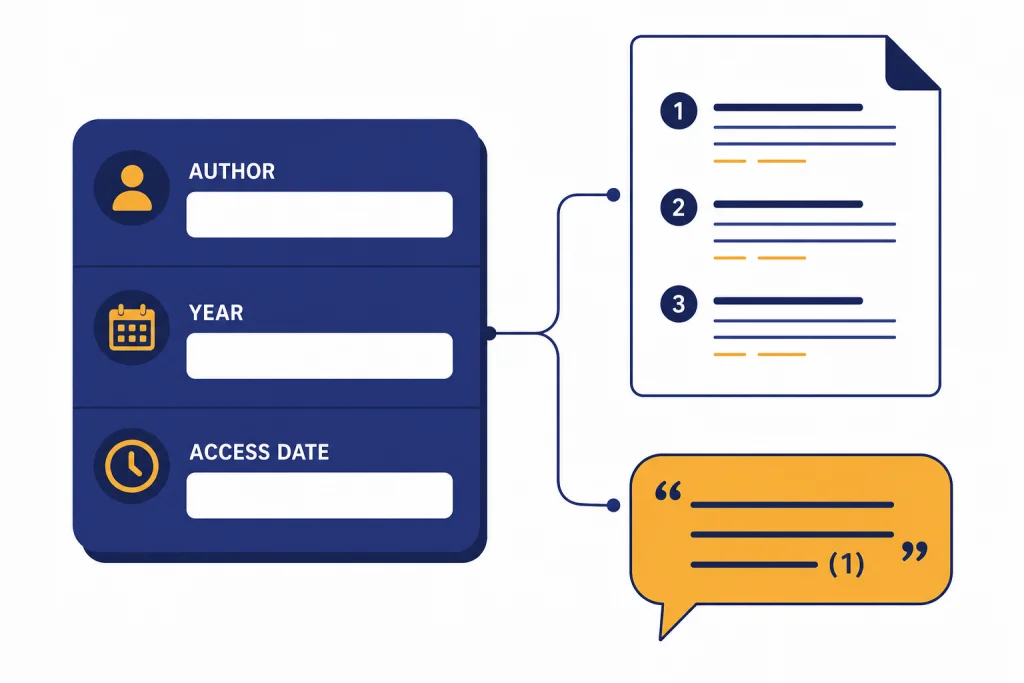
To cite ChatGPT in Harvard style, treat the response as output from a generative AI tool, name OpenAI as the creator, include the year, describe the response or tool, and add an access date or share link if your institution allows one. Harvard is not one fixed rulebook, so your university’s version matters. Some guides want a reference list entry. Others prefer an acknowledgement when ChatGPT helped with planning or editing but did not provide material you quote or paraphrase. Use the templates below as a practical starting point, then check your course handbook before submitting assessed work.
Quick Harvard format for ChatGPT
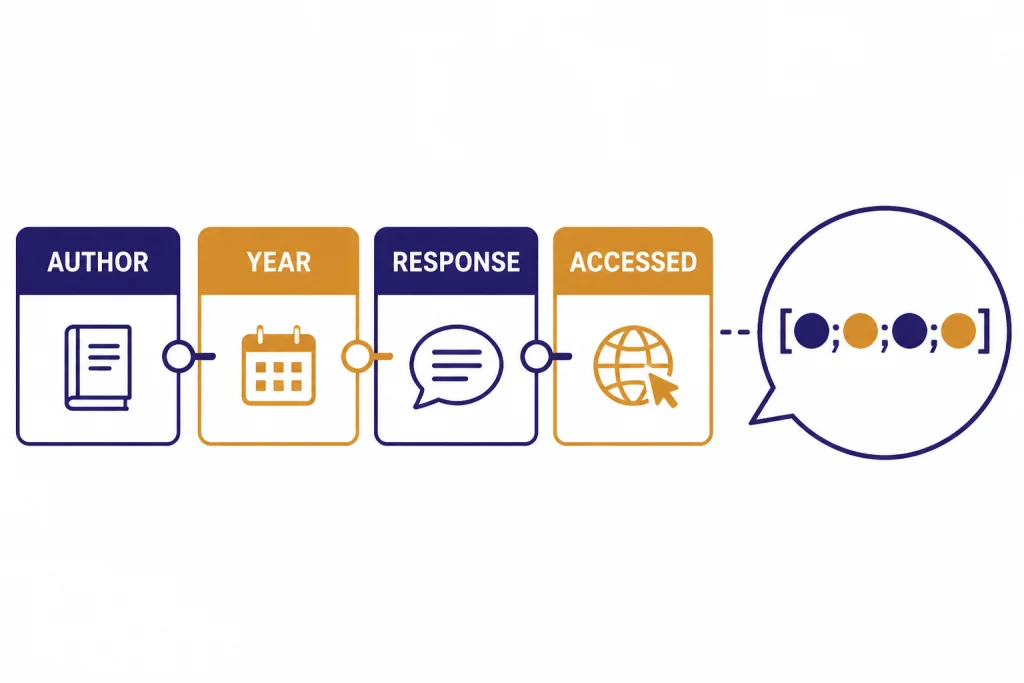
The safest general format is: OpenAI (Year) ChatGPT response to [your name or description], [day month]. Available at: [share link if available] (Accessed: Day Month Year). Use this when you quote, paraphrase, reproduce, or analyze text generated by ChatGPT. The University of Leeds advises students to check assessment rules first, acknowledge AI assistance, and cite and reference generative AI output when it is included in the work.[1]
Use an in-text citation at the point where the ChatGPT material appears. A basic parenthetical example is (OpenAI, 2026). A narrative example is OpenAI (2026) generated a summary of the interview themes. UCD Library’s Harvard guidance says AI-generated text should credit the creator of the AI tool as the author and use both an in-text citation and a reference list entry.[2]
Harvard style varies by institution. Uppsala University Library states that there is no established Harvard practice for referencing ChatGPT or other generative AI, and that generated text is generally not reliable or reproducible enough to use as a normal source.[3] Treat the examples in this guide as templates, not as a substitute for your professor’s instructions.
Before you cite ChatGPT
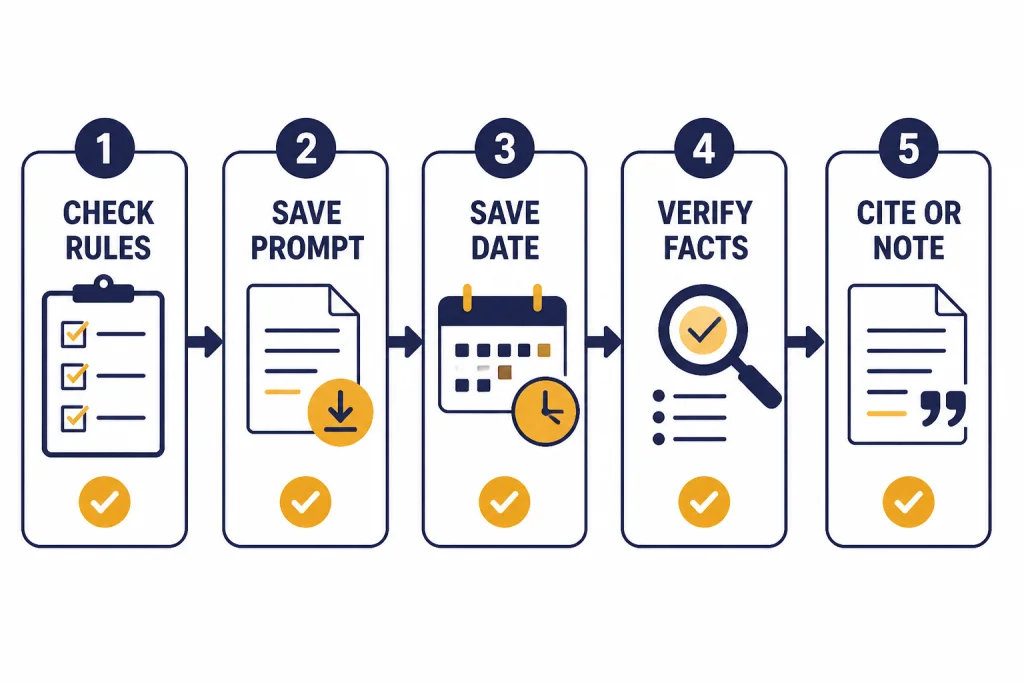
Start with permission. If your assignment says you may not use generative AI, a perfect Harvard reference will not make the use acceptable. If the rules allow AI for brainstorming, grammar help, or summarizing notes, you may need an acknowledgement rather than a source citation. If the rules allow you to quote or discuss AI output, you usually need an in-text citation and a reference list entry.
Next, decide what role ChatGPT played. A citation is most appropriate when ChatGPT produced content that appears in your paper or becomes an object of analysis. An acknowledgement is usually better when ChatGPT helped you plan, edit, translate a rough sentence, or test possible outlines. UCL’s Harvard guidance takes this acknowledgement-first approach for functional use, saying AI systems should not be treated as authors or included in the reference list when they are used as tools to assist the writing process.[4]
- Check the assessment brief. Look for words such as allowed, prohibited, acknowledge, appendix, and cite.
- Save the exact prompt and answer. Harvard citations need enough detail for a reader or marker to understand what you used.
- Record the date. AI outputs can change when the same prompt is run again.
- Do not cite ChatGPT for facts it mentions. Find and cite the original source for factual claims.
- Keep your own judgment visible. Explain how you used, checked, edited, or rejected the output.
If you are still learning how ChatGPT works, our beginner explanation of what ChatGPT is gives useful context before you decide whether it belongs in an academic reference list.
Copyable Harvard examples
Use the examples below as editable models. Replace the prompt description, date, access date, and link details with your own. If your university provides a different Harvard template, follow that template instead.
Example 1: You quote ChatGPT directly
In text: ChatGPT described the difference as a matter of “audience, tone, and evidence” (OpenAI, 2026).
Reference list: OpenAI (2026) ChatGPT response to prompt about formal and informal writing, 12 March. Available at: [share link if permitted] (Accessed: 28 March 2026).
Example 2: You paraphrase ChatGPT output
In text: A generated explanation separated customer feedback into delivery, pricing, and support themes (OpenAI, 2026).
Reference list: OpenAI (2026) ChatGPT response to prompt asking for themes in customer feedback, 10 March. Available at: [share link if permitted] (Accessed: 28 March 2026).
Example 3: You discuss ChatGPT as the object of analysis
In text: The response used confident language while qualifying several claims (OpenAI, 2026).
Reference list: OpenAI (2026) ChatGPT response to prompt about whether AI tools can reason, 14 March. Available at: [share link if permitted] (Accessed: 28 March 2026).
Example 4: You only used ChatGPT for planning
Acknowledgement: I acknowledge the use of ChatGPT, created by OpenAI, to generate possible essay subtopics and to help identify gaps in my first outline. I reviewed the suggestions and wrote the final structure myself.
You would normally not add this planning-only use to the reference list unless your course requires it. If you need other citation systems, compare this guide with how to cite ChatGPT in MLA format and how to cite ChatGPT in Chicago style.
Reference list entry or acknowledgement
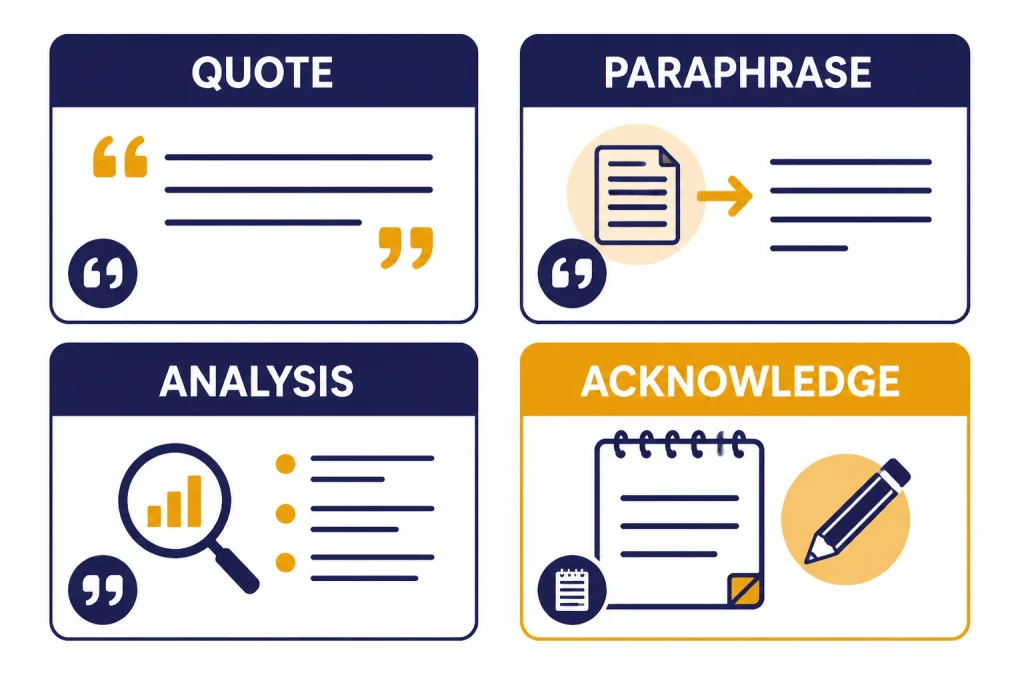
The main decision is not punctuation. It is whether the ChatGPT output functions as a source in your paper or as a tool used during the writing process. Harvard Library guidance says to cite a generative AI tool when you quote, paraphrase, or incorporate content created by it.[7] Some university Harvard guides agree with that source-like treatment. Others separate source use from process assistance.
| How you used ChatGPT | Best treatment | Example wording |
|---|---|---|
| You quote a sentence generated by ChatGPT | In-text citation and reference list entry | (OpenAI, 2026) |
| You paraphrase a generated answer | In-text citation and reference list entry | OpenAI (2026) suggested three categories |
| You analyze the response itself | In-text citation and reference list entry, often with appendix evidence | OpenAI (2026) framed the issue as a trade-off |
| You used it to brainstorm topics | Acknowledgement, if allowed or required | I used ChatGPT to generate preliminary topic ideas |
| You used it for grammar or clarity | Acknowledgement, if required by your institution | I used ChatGPT to identify unclear sentences |
| You used it to find sources | Cite the original sources you verified, not ChatGPT | Use journal, book, or web references after checking them |
This distinction also protects you from weak evidence. OpenAI’s own launch post for ChatGPT listed limitations, including plausible-sounding but incorrect or nonsensical answers.[6] If ChatGPT gives you a statistic, quotation, legal rule, medical claim, or historical statement, trace it to a real source before you cite it. For longer drafts where tone matters, see our guide to making ChatGPT write more like a human, but do not let style polishing replace source checking.
How to preserve the ChatGPT exchange
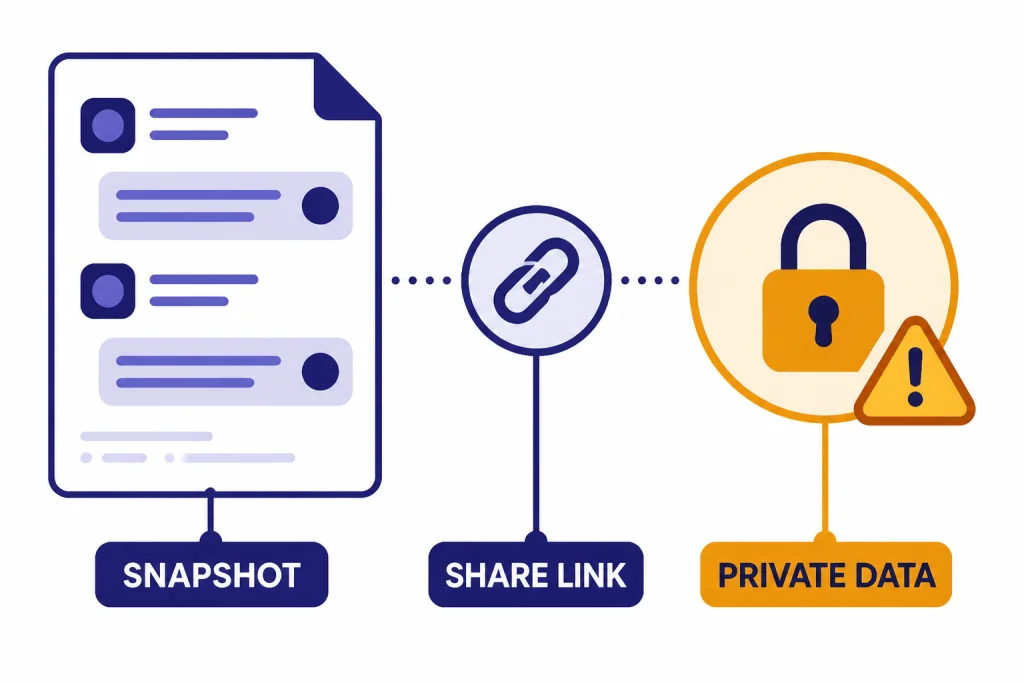
Your marker may need to see what you asked and what ChatGPT returned. OpenAI says ChatGPT shared links let users generate a unique URL for a conversation, and that anyone with access to the link can view the linked conversation.[5] A share link can therefore be useful evidence, but it is not private. Do not create a public link for sensitive, confidential, or personal material.
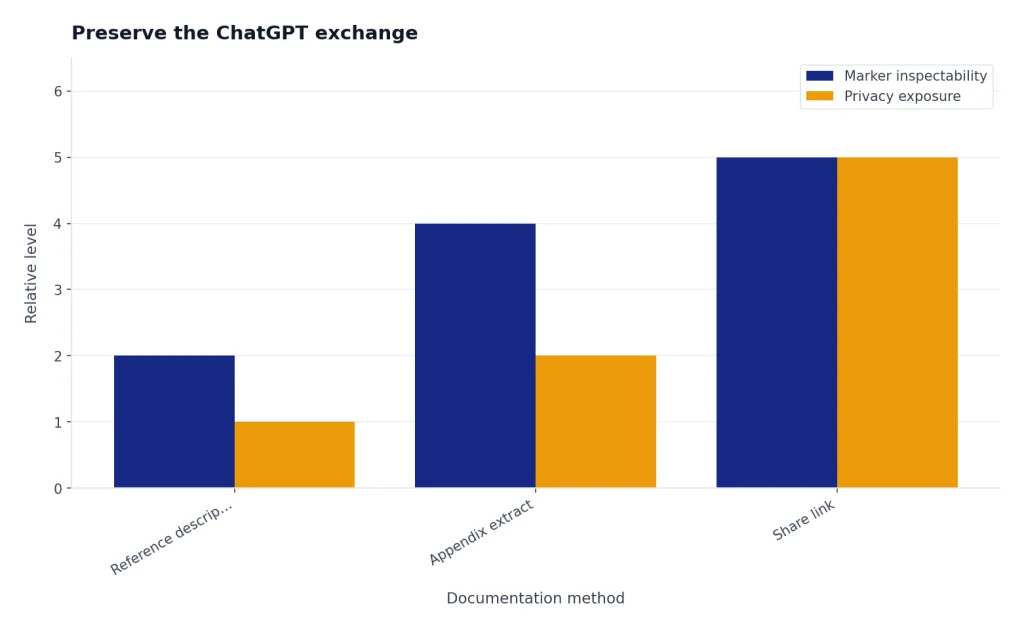
OpenAI also says a shared link is a snapshot of the entire conversation up to the point it is shared.[5] That matters for citation. If you used only one answer inside a long chat, state the prompt or response clearly in the reference entry. If your assignment rules allow an appendix, paste the exact prompt and the relevant response there, then cite the appendix or the ChatGPT reference where required.
- For short use: include the prompt description in the reference entry.
- For direct quotation: keep the exact output and add quotation marks in your paper.
- For substantial AI output: add an appendix with prompt, response, date, and tool name.
- For sensitive material: avoid share links and ask your instructor how to document the exchange.
If you need a durable copy for your own records, you can save a ChatGPT conversation, save ChatGPT conversations as PDF, or export your ChatGPT data. If you do decide to send a conversation to a tutor or group member, read our separate guide on sharing a ChatGPT conversation first.
Common mistakes to avoid
Do not list ChatGPT as a human author. In Harvard style, use OpenAI as the creator or corporate author unless your university’s guide says to use a combined name such as OpenAI ChatGPT. The point is to identify the tool creator and the generated output, not to pretend the chatbot can take responsibility for authorship.
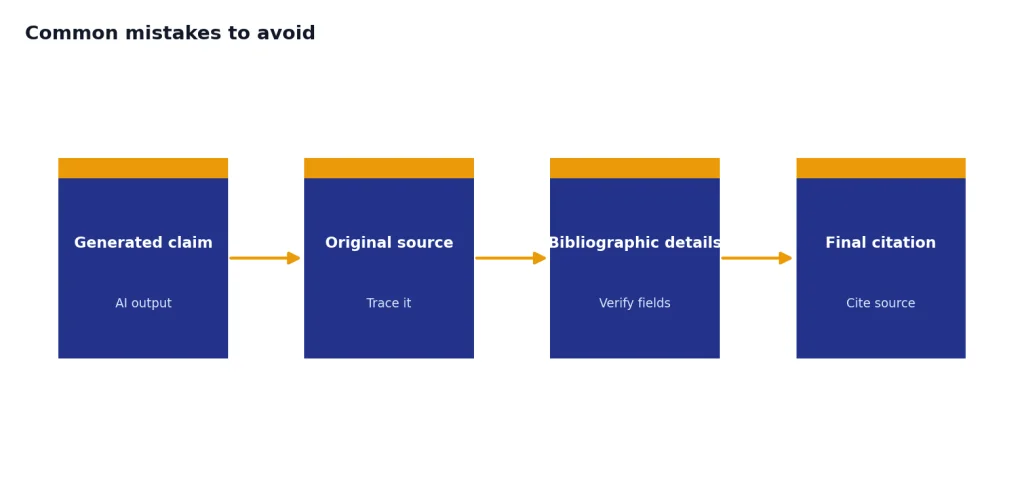
Do not cite ChatGPT for facts you could verify elsewhere. If ChatGPT summarizes a government report, cite the government report. If it names a journal article, find the article and verify the title, authors, journal, volume, issue, pages, DOI, and relevance yourself.
Do not hide AI use when your course requires disclosure. A short acknowledgement is usually better than a vague reference. Explain the task you gave ChatGPT and what you did afterward. Good wording says “used to generate possible counterarguments” or “used to identify unclear sentences,” not just “used for help.”
Do not assume one Harvard example fits every university. Leeds, UCD, UCL, Uppsala, and Monash publish noticeably different guidance for generative AI in Harvard-style work.[1][2][3][4][8] If your school has its own referencing guide, it wins.
Do not submit AI output you have not checked. ChatGPT can help you draft, compare, and revise, but you remain responsible for accuracy, academic integrity, and source quality. If you are using ChatGPT on a shared computer or mobile device, basic account hygiene also matters. See how to log in to ChatGPT if you need a quick account refresher.
Frequently asked questions
Can I cite ChatGPT in Harvard style?
Yes, if your institution allows the use you made of ChatGPT. Cite it when you quote, paraphrase, reproduce, or analyze generated output. If you only used it for planning or editing, an acknowledgement may be more appropriate.
What is the in-text citation for ChatGPT in Harvard?
A practical in-text citation is (OpenAI, 2026) or OpenAI (2026). If your institution uses “OpenAI ChatGPT” as the author name, follow that local rule. Keep the author name consistent between the in-text citation and the reference list.
Do I need a reference list entry for ChatGPT?
You usually need one if ChatGPT output appears in your work as quoted, paraphrased, or analyzed material. You may not need one if ChatGPT only helped with brainstorming, grammar, or outlining. In that case, use an acknowledgement if your course asks for disclosure.
Should I include my prompt?
Yes, include at least a short description of the prompt in the reference entry or surrounding text. For substantial use, include the exact prompt and response in an appendix if your assignment rules allow it. This gives your marker enough context to understand what was generated.
Can I use a ChatGPT share link in a Harvard reference?
Use a share link only if your institution allows it and the conversation contains no sensitive information. Shared links can make the exchange easier to inspect, but anyone with the link may be able to view the conversation. If privacy is a concern, ask your instructor whether an appendix or private submission is better.
Can ChatGPT create my Harvard references for other sources?
It can draft a reference, but you must verify every field against the original source. ChatGPT may invent or misformat source details. Use library databases, publisher pages, DOI records, or your university’s referencing guide as the final authority.