
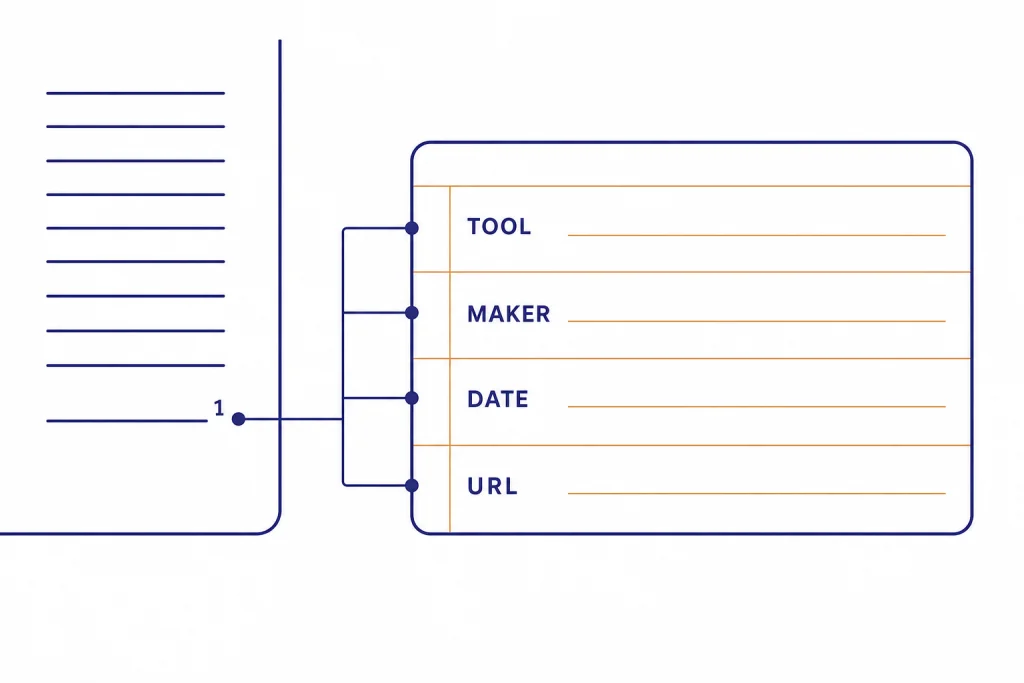
To cite ChatGPT in Chicago style, credit the tool where you use its generated text. Chicago says most writers can acknowledge ChatGPT in the text, but formal student papers and research articles may use a numbered footnote or endnote. The note should identify the content as generated by ChatGPT, name OpenAI, give the date you generated the response, and include a URL for the tool if useful. Chicago also says not to put ChatGPT in a bibliography or reference list unless you provide a publicly available link to the exact conversation.[1] This guide gives copy-ready Chicago examples for notes-bibliography and author-date papers.
Quick answer
If your instructor says “cite ChatGPT in Chicago,” use a note unless you have been told to use author-date. Chicago recognizes two citation systems: notes and bibliography, and author-date.[2] For ChatGPT, the notes approach is usually simpler because Chicago’s own AI guidance gives a numbered note example and says the tool can often be acknowledged in the text instead of listed in a bibliography.[1]
Use this basic note format:
1. Text generated by ChatGPT, OpenAI, March 16, 2026, https://chatgpt.com/.If the prompt matters, include it in the note:
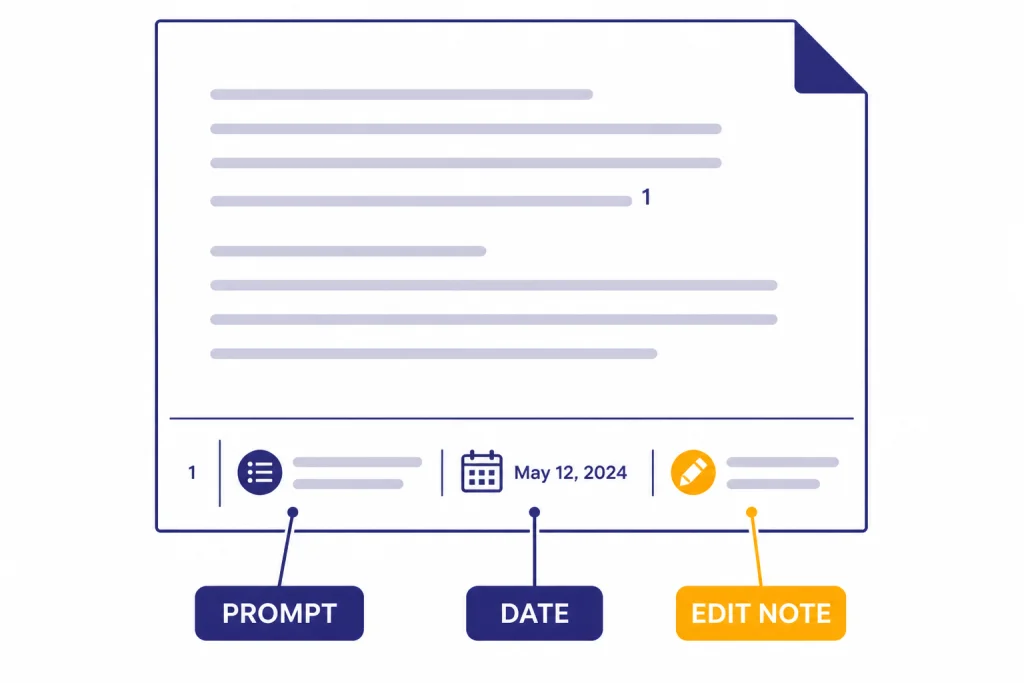
1. ChatGPT, response to “Summarize three causes of the Panic of 1873,” OpenAI, March 16, 2026, https://chatgpt.com/.If you edited the answer, say so. Chicago’s AI guidance specifically says that edited AI-generated text should be identified as edited.[1]
1. Text generated by ChatGPT, OpenAI, March 16, 2026, edited for style and length, https://chatgpt.com/.If you also need MLA or Harvard, compare this with how to cite ChatGPT in MLA format and how to cite ChatGPT in Harvard style. The styles treat AI output differently, so do not copy a citation from one system into another.
What Chicago needs from a ChatGPT citation
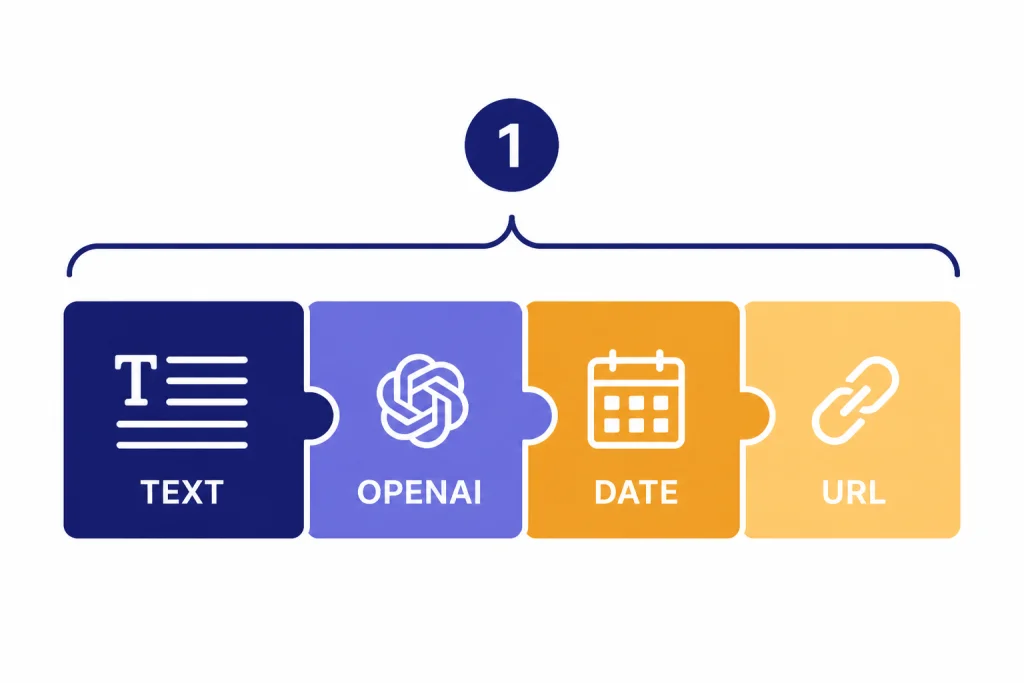
A good Chicago citation for ChatGPT does not pretend the chatbot is a conventional book, article, or website. It gives the reader the information needed to understand what you used and when you used it. That matters because a ChatGPT response can vary by prompt, date, settings, and context.
Chicago’s own Q&A says ChatGPT can stand in as the “author” of generated content, while OpenAI is the publisher or sponsor, and the date is the date the text was generated.[1] OpenAI describes ChatGPT as an AI assistant for tasks such as writing, studying, planning, coding, and analyzing files.[4] In a citation, you are not citing a stable encyclopedia page. You are citing an interaction with a tool.
| Element | What to put | Why it matters |
|---|---|---|
| Tool | ChatGPT | Names the AI system that generated the response. |
| Developer or sponsor | OpenAI | Identifies the organization behind the tool. |
| Date | The day you generated the response | Shows when the output was created. |
| Prompt or description | A short prompt quotation or phrase such as “response to…” | Clarifies which interaction you used. |
| URL | The tool URL, or a public shared conversation link if available | Helps readers locate the tool or, when public, the exact exchange. |
| Edit note | “Edited for style,” “edited for length,” or similar | Discloses that the AI output was changed. |
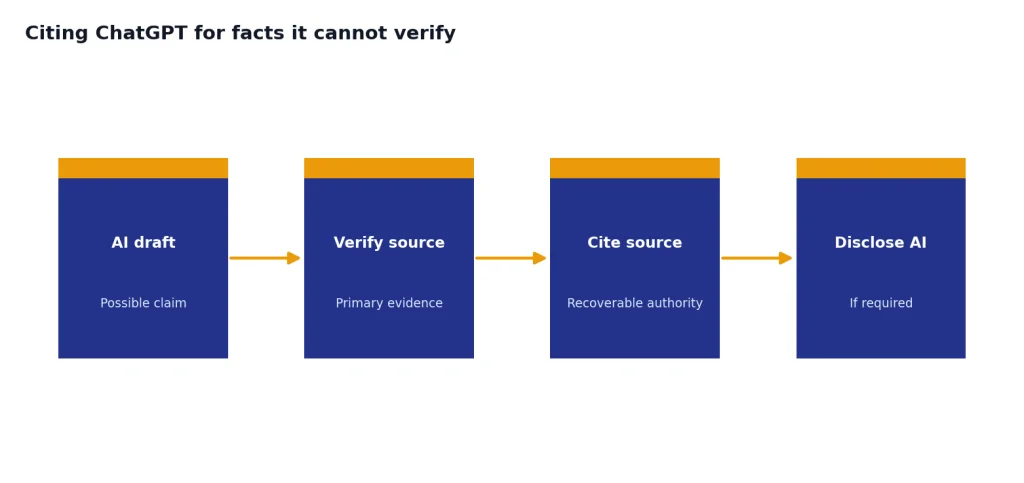
Do not treat ChatGPT as evidence for factual claims unless you independently verify those claims. If ChatGPT helped you find sources, cite the original sources instead of citing ChatGPT for the facts. If ChatGPT helped draft wording, summarize ideas, brainstorm, translate, or produce example text, cite or acknowledge that assistance according to your assignment rules.
Chicago notes-bibliography examples
Notes-bibliography is the Chicago system many humanities courses use. Chicago describes it as a system that uses numbered footnotes or endnotes, with each note tied to a superscript number in the text.[2] For ChatGPT, place the note at the sentence, paragraph, table, or passage that uses the generated material.
Basic footnote for generated text
1. Text generated by ChatGPT, OpenAI, March 16, 2026, https://chatgpt.com/.Use this when you used ChatGPT output but the exact prompt is not central to the paper. It is compact and close to Chicago’s own example.[1]
Footnote with the prompt included
2. ChatGPT, response to “Create a plain-language summary of Jane Addams’s settlement-house reform work,” OpenAI, March 16, 2026, https://chatgpt.com/.Use this when the prompt shapes the answer in a meaningful way. It is also helpful when you quote or paraphrase a specific generated response.
Footnote for an edited ChatGPT passage
3. Text generated by ChatGPT, OpenAI, March 16, 2026, edited for style and accuracy after source checking, https://chatgpt.com/.This is the safer format when ChatGPT drafted language that you later revised. It tells the reader both that AI helped generate text and that the submitted prose is not a raw chatbot answer.
Footnote for brainstorming or outline help
4. ChatGPT, response to “Suggest possible sections for a Chicago-style research paper on Progressive Era food regulation,” OpenAI, March 16, 2026, https://chatgpt.com/.If ChatGPT shaped your structure rather than your final wording, cite the help where the structure first appears or acknowledge it in a note near the beginning of the paper. If your course has an AI-use statement requirement, follow that first.
If you need to preserve the original exchange for your records, see our guide to how to save a ChatGPT conversation or save ChatGPT conversations as PDF. A saved copy can help if an instructor asks what prompt you used.
Chicago author-date examples
Author-date Chicago uses brief in-text citations, usually in parentheses, and normally pairs those citations with entries in a reference list.[2] ChatGPT is the awkward case because Chicago says not to put ChatGPT in a bibliography or reference list unless there is a publicly available link to the exact conversation.[1]
For a private ChatGPT exchange in author-date style, keep the disclosure in the sentence or parenthetical citation:
In developing the first draft of the timeline, I used text generated by ChatGPT (OpenAI, March 16, 2026).Or use a parenthetical citation directly after the AI-assisted passage:
The preliminary outline grouped the reforms into inspection, labeling, and enforcement categories (ChatGPT, March 16, 2026).If you have a public conversation link and your instructor wants a reference-list entry, use a format that makes the tool, prompt, date, developer, and link clear. Because Chicago’s public AI guidance emphasizes notes and cautions against reference-list entries unless the content is publicly available, ask your instructor before adding this entry.[1]
ChatGPT. 2026. Response to “Summarize the arguments for and against municipal ownership in the Progressive Era.” OpenAI. March 16, 2026. Public shared conversation URL.Use author-date only when the paper or class requires it. If the assignment simply says “Chicago style” and gives no more detail, ask whether the instructor expects notes-bibliography or author-date. The two systems look different on the page, even when they cite the same material.[2]
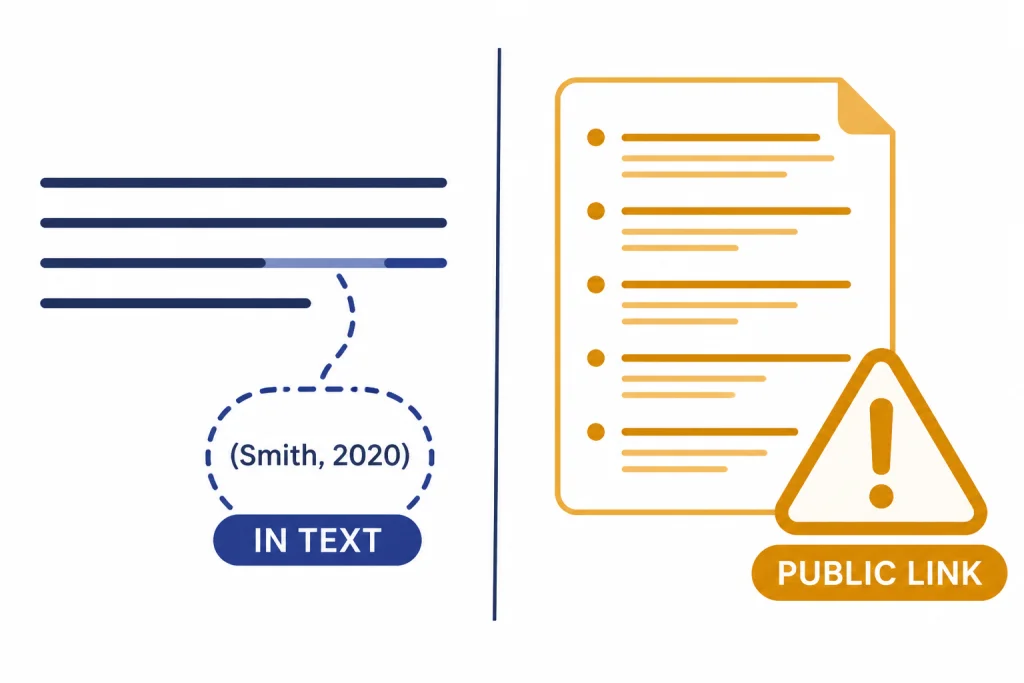
When to use a bibliography or reference-list entry
In most cases, do not include ChatGPT in a Chicago bibliography. Chicago’s AI guidance says not to cite ChatGPT in a bibliography or reference list unless you provide a publicly available link.[1] The reason is practical. A normal bibliography points to sources readers can retrieve. A private ChatGPT session usually cannot be opened by a reader.
A ChatGPT shared link is different. OpenAI says shared links generate a unique URL for a ChatGPT conversation, and anyone with access to the shared link can view the linked conversation.[5] If you create a public shared link and your instructor wants recoverable sources in the bibliography, you can include an entry. Still, consider privacy first. OpenAI warns that anyone with the link can access the conversation and recommends not sharing sensitive content.[5]
| Situation | Best Chicago treatment | Bibliography or reference list? |
|---|---|---|
| You used ChatGPT to draft a paragraph, and the chat is private. | Footnote or text acknowledgment. | No. |
| You quoted a ChatGPT answer from a private chat. | Footnote at the quotation. | No, unless your instructor says otherwise. |
| You used a public shared conversation link. | Footnote plus optional bibliography entry if required. | Yes, if your assignment requires recoverable sources. |
| You used ChatGPT to find a book, article, or dataset. | Cite the book, article, or dataset itself. | List the real source, not ChatGPT. |
| You only used ChatGPT for grammar suggestions. | AI-use statement if required by the course. | Usually no. |
If you want to show a conversation without making it broadly discoverable through your own citation list, you may be better off submitting a PDF or appendix only to your instructor. For sharing mechanics, use how to share a ChatGPT conversation, then decide whether the link belongs in the paper.
How to document prompts, edits, and proof
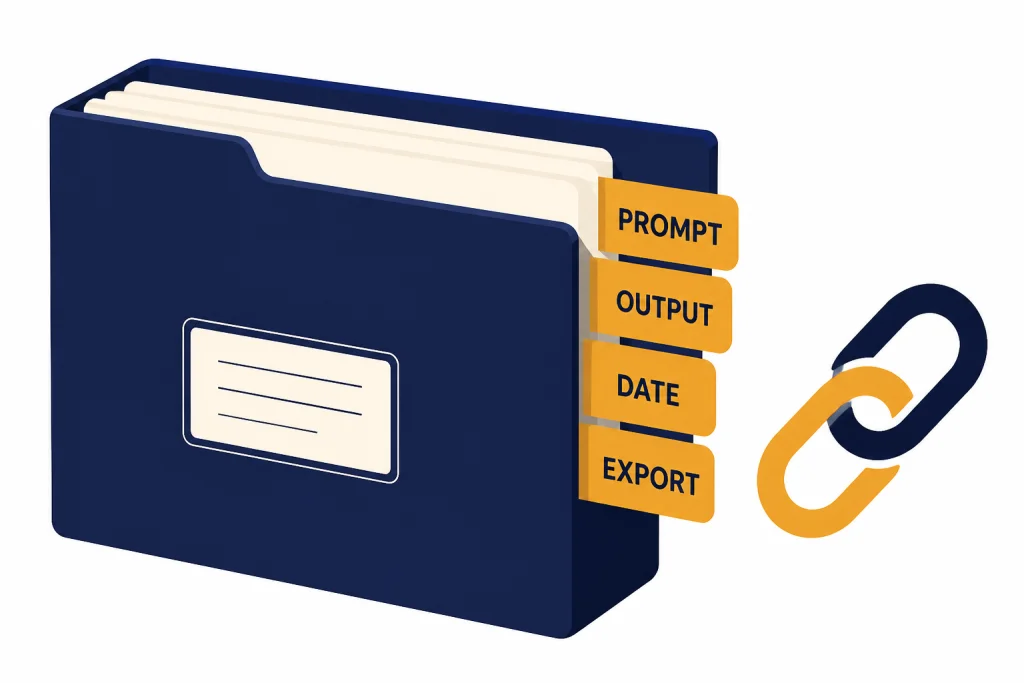
A citation is not the same thing as a record. Your paper may only need a short footnote, but you should keep enough proof to explain what ChatGPT did. Save the prompt, the output you used, the date, and a note about your edits. If your instructor or editor asks, you can show the underlying exchange without reconstructing it from memory.
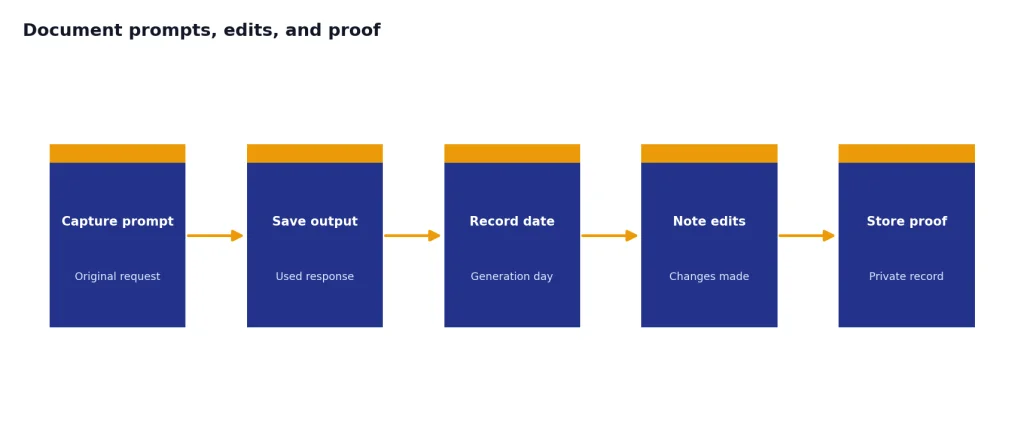
For a private record, copy the exchange into a document or export your account data. OpenAI’s data-export help says the export can include chat history and other relevant account data, and the email download link expires after 24 hours.[6] OpenAI also says data exports can take up to 7 days to arrive.[6] Do not wait until the submission deadline if you need an export.
If you plan to cite a shared conversation link, check the link before you submit. OpenAI says a shared link is a snapshot of the conversation up to the point when it is shared.[5] That means later prompts in the same chat may not appear in the shared link unless you update or recreate it.
Use a simple record like this:
Prompt: Summarize three themes in Chapter 2 of the assigned primary source.
Tool: ChatGPT
Developer: OpenAI
Date generated: March 16, 2026
Use in paper: Helped draft topic-sentence options; no generated sentences used verbatim.
Edits: Rewrote all wording and checked claims against the assigned source.
If you are still learning how ChatGPT works, read what is ChatGPT before relying on it for coursework. If you use it to polish prose, our guide to making ChatGPT write like a human can help you separate style assistance from source use.
Common mistakes to avoid
Putting ChatGPT in every bibliography by default
This is the most common Chicago mistake. If the conversation is private, a bibliography entry does not help the reader retrieve the source. Use a note or acknowledgment unless you have a public link or a contrary instruction from your teacher.
Citing ChatGPT for facts it cannot verify
ChatGPT can help draft and brainstorm, but it is not a substitute for a cited primary source, scholarly book, article, archive, dataset, or official page. If your paragraph says a law passed on a particular date, cite the law or a reliable historical source. Do not cite ChatGPT as if it were the authority.
Leaving out the date
The generation date is important because AI output is not stable in the way a printed book is stable. Chicago’s AI example includes a date for the generated text.[1] Use the date you got the answer, not the date you submitted the paper.
Hiding meaningful AI use as “grammar help”
There is a difference between spell-checking and generating a paragraph. If ChatGPT supplied structure, analysis, examples, or draft language, disclose that use. If a school policy is stricter than Chicago’s general citation advice, follow the school policy.
Sharing private information in a cited chat
Before creating a shared link, remove personal data, student names, private research notes, confidential workplace content, and any copyrighted material you do not have permission to share. OpenAI’s shared-link help says anyone with the link can view the linked conversation.[5]
Frequently asked questions
Do I cite ChatGPT in a Chicago bibliography?
Usually no. Chicago says not to put ChatGPT in a bibliography or reference list unless you provide a publicly available link to the conversation.[1] Use a footnote, endnote, parenthetical acknowledgment, or AI-use statement instead.
What date do I use for a ChatGPT citation?
Use the date when ChatGPT generated the response you used. If you generated the answer on March 16, 2026, use March 16, 2026. Do not use the publication date of this guide or the date OpenAI launched ChatGPT unless that is the date of your actual interaction.
Should I cite the prompt in the footnote?
Include the prompt when it helps the reader understand the output. A prompt is especially useful if you quote a generated answer, rely on a specific summary, or use the response as an example. For routine editing help, an AI-use statement may be enough if your instructor allows that.
Can I cite ChatGPT as a website?
Not exactly. A normal website citation points to content that readers can revisit. A private ChatGPT answer usually is not accessible to readers, so Chicago’s guidance treats it more like generated content that needs a note or acknowledgment.[1]
What if my professor bans ChatGPT?
A correct citation does not override a course policy. If the assignment bans ChatGPT, do not use it. If the policy allows limited use, cite or disclose only within the limits your instructor gives.
Do I need a citation if ChatGPT only fixed grammar?
Maybe. Chicago’s AI citation guidance focuses on generated content, but schools often have separate AI-disclosure policies. If ChatGPT only corrected typos and did not generate ideas or wording, a citation may not be necessary, but an AI-use statement may still be required by your course.