

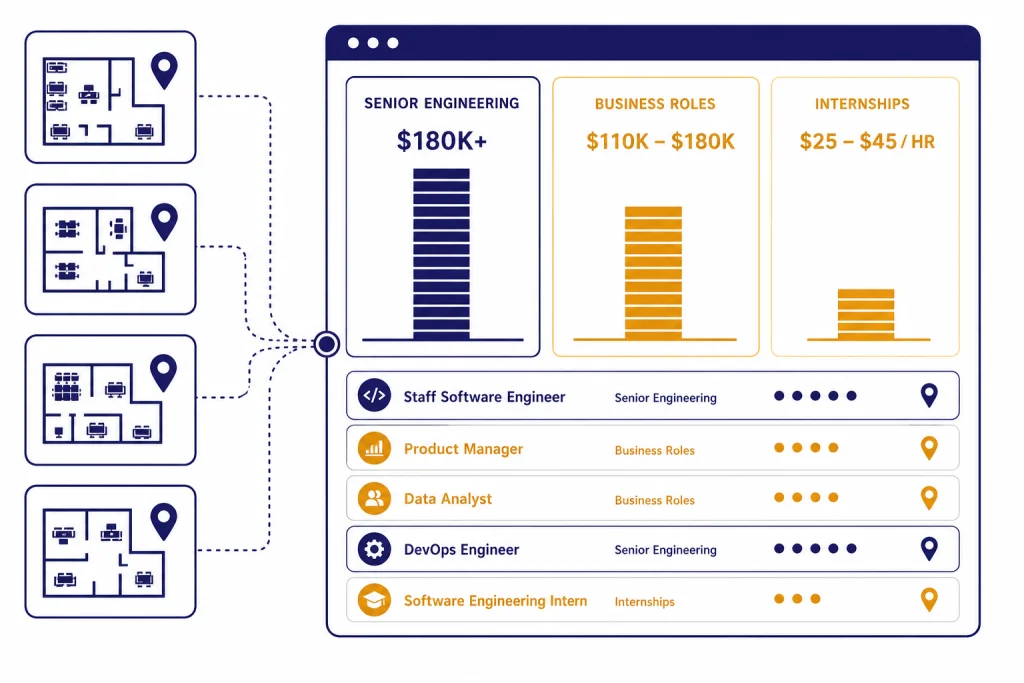
OpenAI jobs span far beyond research scientist roles. The company’s official careers pages show openings across engineering, sales, security, legal, finance, recruiting, policy, and operations, with compensation bands that can range from hourly internship pay to senior base salaries above $400,000 before equity.[2][4] The exact number of open roles moves often. Recent official snapshots of the jobs search page showed 647 roles, then 650 roles, which tells you the listing changes fast enough that any fixed count can go stale quickly.[2][11] If you want a practical view of OpenAI jobs, the useful questions are where roles are posted, which teams are hiring, what salary ranges look like, and how to tell whether a listing is realistic for your background. This guide covers each of those points using official postings and OpenAI’s own careers materials.
Where OpenAI posts jobs
The main entry point is OpenAI’s official careers page, which links into a searchable jobs index on openai.com.[1][2] That search page is the best place to start because it shows live openings by team and location, and many listings expand into full role pages that include compensation bands, office expectations, and relocation notes.[2]
OpenAI also appears to use Ashby for the application workflow. In practice, that means you may see the same job represented in two places: a public role page on openai.com and an application page on jobs.ashbyhq.com.[4][8] When both exist, the compensation details usually match. That makes the Ashby listing a useful cross-check if you want to confirm a salary band or see a location-specific breakdown.[6][10]
If you are trying to understand the bigger hiring picture, pair this article with OpenAI Careers, which goes deeper on the application process, and OpenAI Headquarters, which gives more context on the company’s office footprint.
What kinds of OpenAI jobs are open
The current jobs board makes one thing clear: OpenAI is hiring across a much wider set of functions than many applicants assume. Engineering is a large share of the list, but it is not the whole story.[2][11] Recent official listings included roles in Applied AI Engineering, Security, Sales, Technical Success, Recruiting, Finance, Legal, Product Design, Communications, Hardware, and OpenAI for Gov.[2][11]
That matters because many candidates search only for “research scientist” or “ML engineer” and miss adjacent paths. If your experience is in enterprise sales, compensation, customer deployment, product operations, security engineering, or recruiting, there may still be a plausible fit. The search page recently showed examples such as Account Director roles, Compensation Business Partner, Forward Deployed Engineer for government work, and multiple security and infrastructure positions.[2][5][6][7]
That breadth also reflects how OpenAI has evolved from a research lab into a large product and infrastructure company. For background, see OpenAI History, openai’s cto and leadership team, and openai valuation.
OpenAI salary examples from current postings
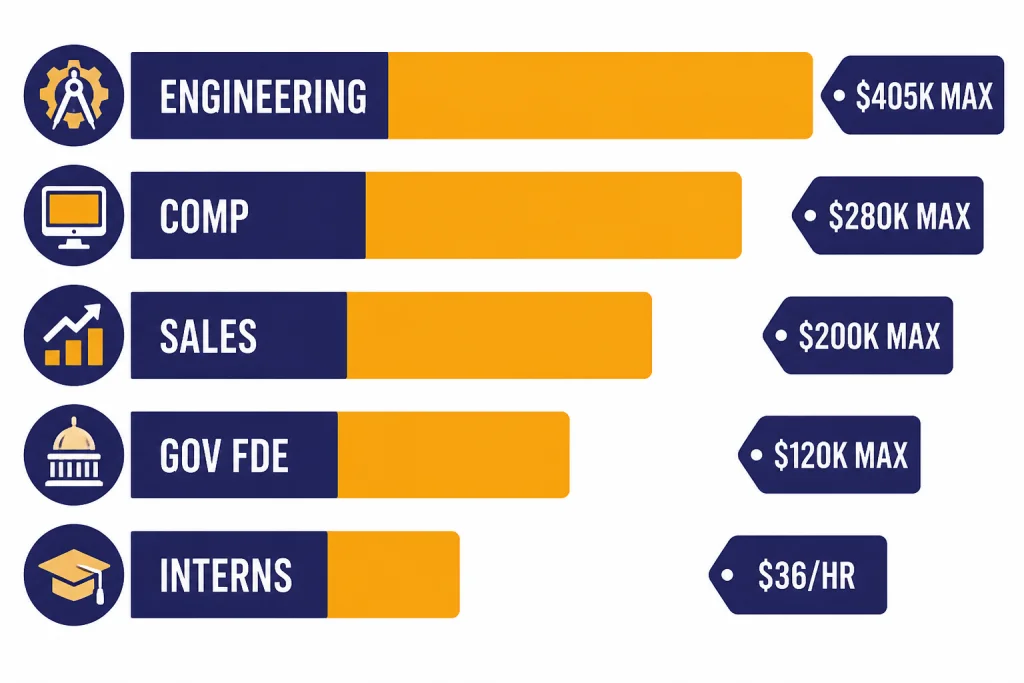
OpenAI does not publish one universal pay scale for all jobs. What it does publish, on many individual listings, is a base salary band for that specific role, often with a note that equity is also offered.[4][5][6][7] The useful way to read OpenAI salaries is by comparing examples across job families.
| Example role | Location notes | Published base pay | What it suggests |
|---|---|---|---|
| Software Engineer, ChatGPT Infrastructure | San Francisco | $255,000 to $405,000, plus equity.[4][8] | Senior technical infrastructure roles can sit at the top end of OpenAI’s published bands. |
| Compensation Business Partner | San Francisco | $180,000 to $260,000, plus equity.[5][9] | Non-engineering corporate roles can still carry very high base pay. |
| Account Director, Digital Native Large Enterprise | San Francisco, New York City, Seattle, and Remote-US | $176,000 to $350,000, with Ashby breaking out $335,000 to $350,000 for San Francisco, New York, and Seattle, plus equity.[6][10] | Go-to-market compensation can vary sharply by market and may show multiple ranges. |
| Forward Deployed Engineer, Gov | Washington, DC, Seattle, and San Francisco | $145,800 to $280,000, plus equity.[7] | Deployment and public-sector roles still sit in upper-tier tech pay bands. |
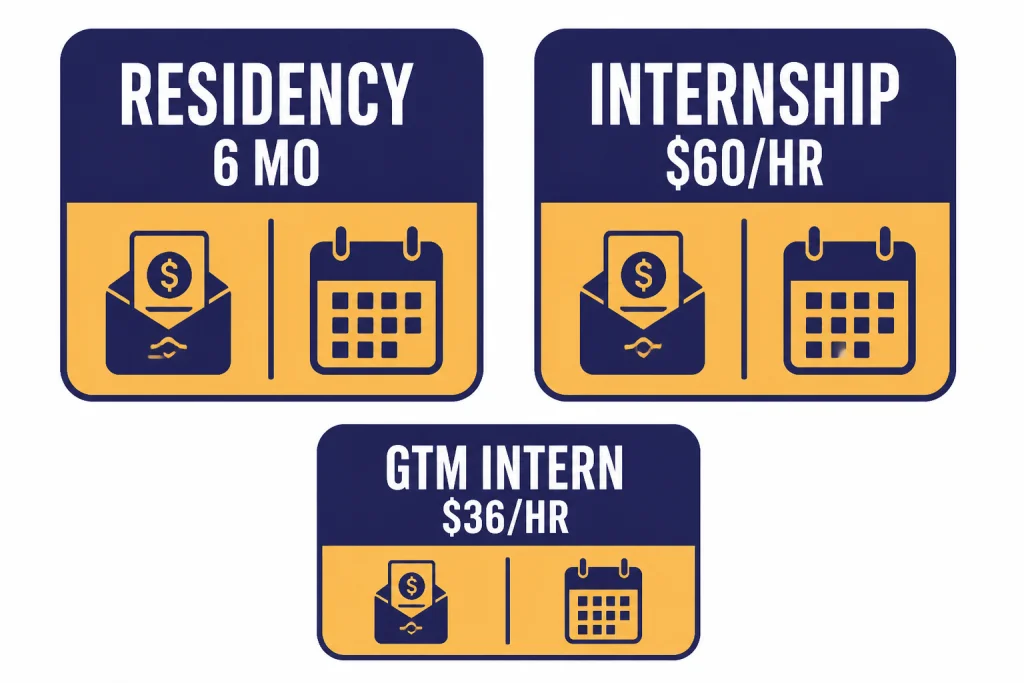
| Software Engineer Internship / Co-op, Applied Emerging Talent | Summer 2026 listing for San Francisco and Seattle; Fall 2026 Ashby listing for San Francisco | $60 per hour.[12][13] | OpenAI internships are paid at a high hourly rate by normal student-intern standards. |
| Go to Market Strategy Internship / Co-op | San Francisco | $36 per hour.[14] | Intern pay varies by function, not just by company name. |
The headline takeaway is simple. “OpenAI salary” is not one number. Published base pay spans from $36 an hour for one GTM internship to $405,000 for a senior engineering role, before any equity is added.[8][14] That spread is why you should ignore generic social posts that quote a single typical OpenAI salary.
Where OpenAI hires and how work is structured
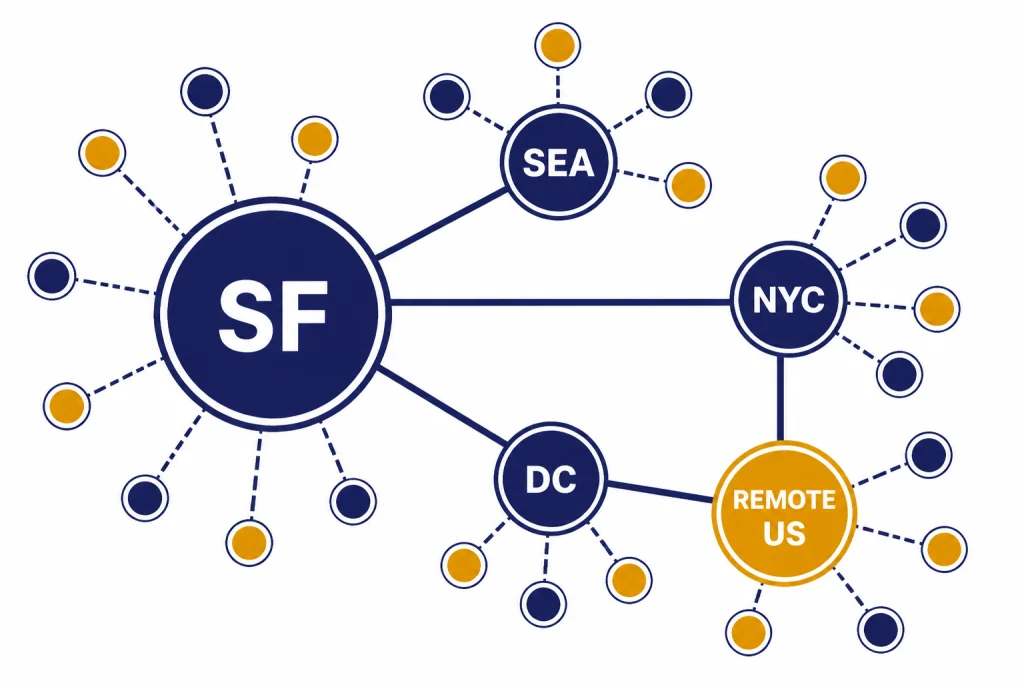
OpenAI’s roles are not all tied to one office. Recent official postings show recurring hubs in San Francisco, Seattle, New York City, and Washington, DC, with many additional openings in cities such as London, Dublin, Singapore, Tokyo, Seoul, Sydney, Paris, Munich, and Delhi.[2][11]
For U.S. roles, the working model is often hybrid rather than fully remote. Several postings explicitly say OpenAI uses a hybrid model of 3 days per week in the office, while some roles also allow Remote – US.[5][6][7][15] You should read the location line carefully because two jobs with similar titles may have different office expectations.
That distinction is especially important for people applying from outside OpenAI’s major hubs. A listing may mention relocation assistance, but that does not mean fully remote forever. The Compensation Business Partner role, for example, says San Francisco only and not remote.[5] By contrast, the Account Director listing explicitly includes Remote – US alongside San Francisco, New York City, and Seattle.[6][10]
- Best fit for local or relocation candidates: office-tied roles in San Francisco, Seattle, New York City, or Washington, DC.[5][7]
- Best fit for broader U.S. applicants: roles that state Remote – US in the official listing.[6][15]
- Best fit for international applicants: search by city first, because OpenAI is clearly hiring outside the U.S. as well.[2][11]
Benefits, residency, and internships
OpenAI’s main careers page lists a sizable benefits package. The official summary includes health, dental, and vision insurance, mental healthcare support, a company-sponsored retirement plan, a domestic conference budget, annual learning and development support, daily breakfast, lunch, and dinner, and coaching sessions for employees and dependents.[1] It also lists up to 24 weeks of paid birth-parent leave and 20 weeks of paid parental leave.[1]
For early-career applicants, two programs stand out. First, the OpenAI Residency is a 6-month program intended for researchers and engineers moving into frontier AI work, and the official residency page says residents receive a full salary.[3] Second, OpenAI’s Emerging Talent pipeline includes internships, residencies, and full-time roles for people early in their careers.[1][2]
The current residency page also says applications for the 2026 Residency are closed.[3] That is a good reminder to treat these programs as seasonal, not always-open. If you are early in your career, you should monitor the official search page regularly instead of assuming the same opening will stay live for months.[2]
If you are more interested in OpenAI’s developer side than its company roles, openai agents sdk, openai agent builder, and openai api pricing are better next reads than a jobs post.
How to read an OpenAI job posting
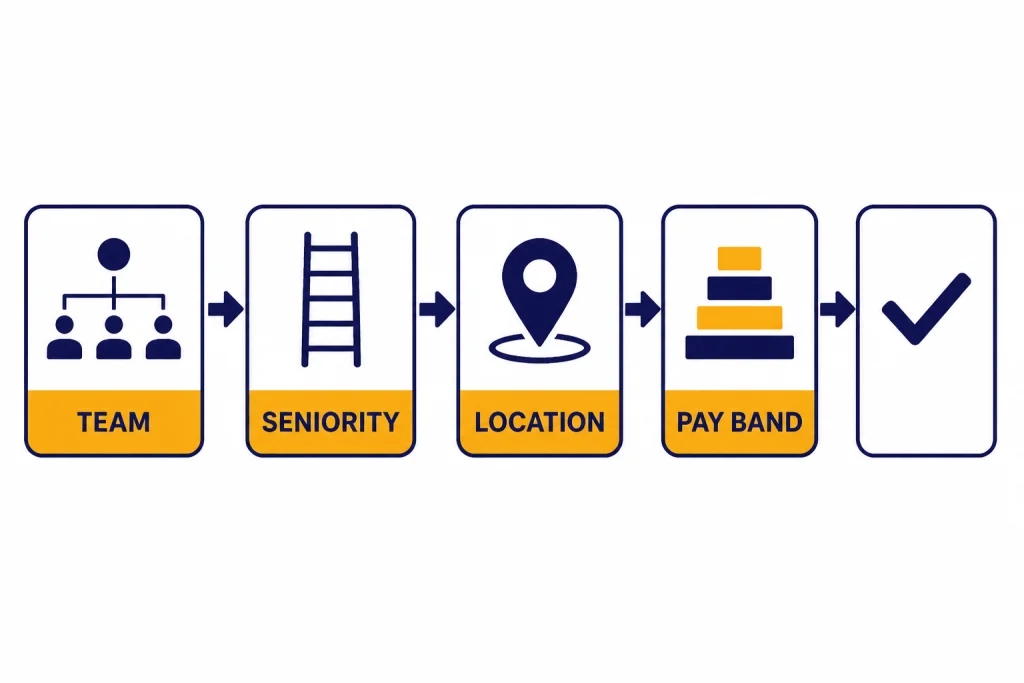
Most applicants read only the title and the compensation line. That is not enough. OpenAI postings usually give away the real hiring signal in four places: team, scope, location model, and seniority language.[4][5][6][7]
1. Team tells you what kind of company OpenAI is becoming
A role in Applied AI Engineering is different from one in Security, OpenAI for Gov, or GTM. Those team labels show whether OpenAI needs product builders, customer-facing deployers, infrastructure operators, or business staff.[2][11] This guide to openai jobs is much easier to use once you stop thinking of OpenAI as a single monolithic employer.
2. Scope tells you whether the job is truly senior
The Software Engineer, ChatGPT Infrastructure posting is explicit that it is hiring Senior and Staff engineers.[4] The Account Director listing asks for 14 or more years of relevant sales experience.[6] Those are not stretch roles for most applicants. If the posting’s scope is already written at a high-impact, cross-functional level, assume the bar is high.
3. Location language tells you whether relocation is realistic
OpenAI often states whether a role is office-based, hybrid, or remote-eligible. Read that line literally. “Remote – US” is very different from “based in our San Francisco office” even when both jobs mention relocation support.[5][6][15]
4. Compensation bands are base pay, not total compensation
Many postings say “offers equity” in addition to the published salary band.[4][5][6][7] OpenAI has not published a universal official figure for total equity grants by role, so you should not treat the base band as the whole package.
How to apply without wasting time
The openai jobs breakdown is most useful when it saves you from bad applications. The fastest filter is to ask three questions before you click apply.
- Do you match the actual seniority? If a role calls for Senior or Staff experience, or asks for 14+ years, treat that as real, not aspirational.[4][6]
- Can you meet the location requirement? Many roles are hybrid with 3 office days per week.[5][6][7]
- Is your background aligned to the team’s work? A product engineer, compensation specialist, and forward deployed engineer may all work at OpenAI, but they solve very different problems.[4][5][7]
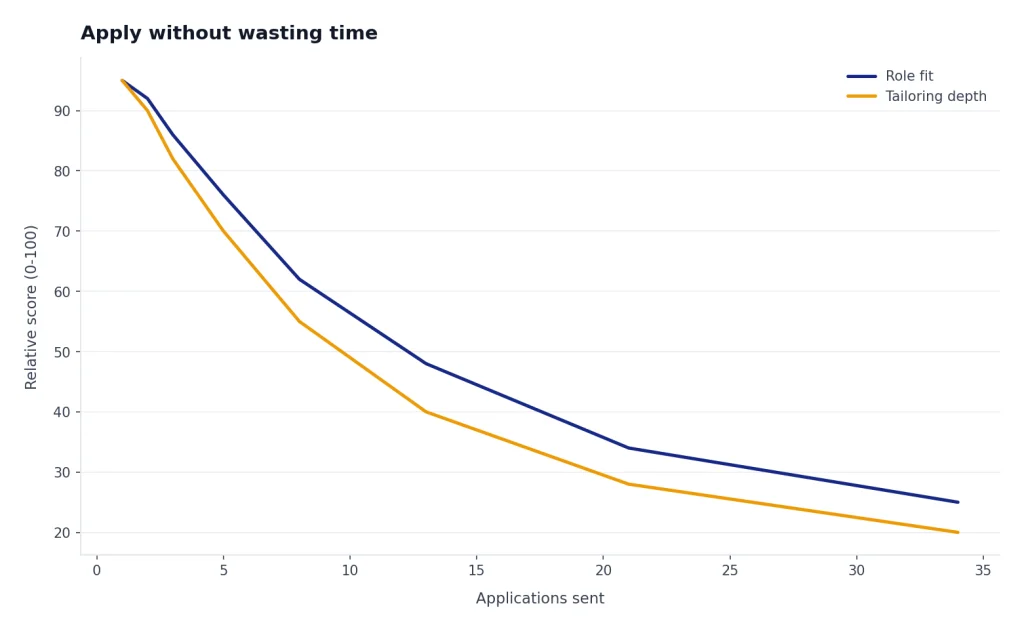
My practical advice is to apply narrowly, not broadly. Pick the few roles where your recent work mirrors the language in the listing. Then tailor your resume around measurable outcomes that match that team’s world: uptime and systems scale for infrastructure, quota and strategic account growth for sales, program design and benchmarking for compensation, or shipped deployments for forward deployed engineering.
For more company context before you apply, read our take on openai jobs, openai and microsoft, openai revenue, and OpenAI News. Those pieces help explain why certain teams keep expanding.
Frequently asked questions
How many OpenAI jobs are open right now?
The exact count changes fast. Recent official snapshots of the careers search page showed 647 jobs and then 650 jobs, so the best answer is that OpenAI has hundreds of live openings and the number moves frequently.[2][11]
What is the salary range at OpenAI?
Published pay varies a lot by function and seniority. Official postings reviewed for this article ranged from $36 per hour for a GTM internship to $405,000 base pay for a senior ChatGPT infrastructure engineering role, with many listings also noting equity.[8][14]
Does OpenAI hire remote workers?
Some roles do, but not all. Certain listings include Remote – US, while others say the role is based in a specific office and follows a hybrid schedule with 3 in-office days per week.[5][6][15]
Does OpenAI offer internships?
Yes. OpenAI’s careers materials say the company offers internships, residencies, and full-time roles through its Emerging Talent pathway.[1][2] Recent postings included software engineering and go-to-market internships with published hourly pay.[12][14]
What is the OpenAI Residency?
It is OpenAI’s 6-month program for researchers and engineers moving into frontier AI work. The official residency page says residents receive a full salary, and it notes that applications for the 2026 cohort are closed.[3]
Are non-engineering OpenAI jobs well paid?
Yes. Based on official postings, OpenAI’s non-engineering roles can still post high compensation bands. One Compensation Business Partner listing showed $180,000 to $260,000 base pay, and one enterprise sales listing showed a broader range up to $350,000 depending on market.[5][10]