

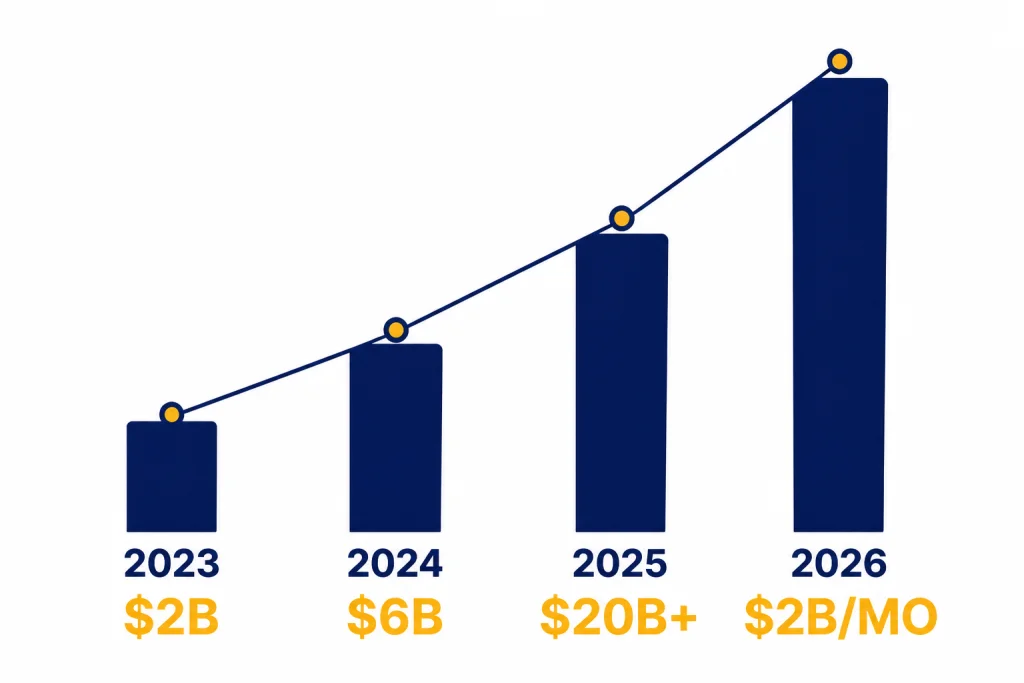
OpenAI revenue is now best understood as a fast-moving set of run-rate figures, not a conventional public-company income statement. As of April 11, 2026, OpenAI’s latest official disclosure says it is generating $2 billion in revenue per month, after reporting $2 billion in ARR in 2023, $6 billion in 2024, and more than $20 billion in 2025.[1][2] The company has not published audited annual revenue, net income, gross margin, or cash-flow statements. That distinction matters. OpenAI is growing quickly, but it is also funding one of the most expensive compute buildouts in technology history.
Latest OpenAI revenue numbers
The latest official OpenAI revenue figure is $2 billion per month. OpenAI disclosed that figure when it announced a $122 billion funding round at an $852 billion post-money valuation on March 31, 2026.[2] If that monthly revenue continued for a full year, it would imply a $24 billion annualized run rate, but that is not the same as audited annual revenue.[2]
OpenAI’s January 2026 CFO post gave the cleanest year-by-year company-provided sequence: $2 billion in ARR in 2023, $6 billion in 2024, and more than $20 billion in 2025.[1] Those numbers describe annual recurring revenue or run-rate revenue. They do not tell us how much cash OpenAI collected during each calendar year, how much it spent serving that usage, or whether the business was profitable.
That difference explains why some reports appear to conflict. Axios, citing Bloomberg, reported in March 2025 that OpenAI generated $3.7 billion in revenue in 2024 and expected $29.4 billion in 2026 sales.[3] OpenAI’s own January 2026 post, by contrast, described $6 billion in 2024 ARR.[1] Both can be true if one is annual revenue and the other is end-period run rate.
For readers tracking OpenAI revenue, the safest shorthand is this: OpenAI has crossed the $20 billion-plus annualized revenue level, reached a $2 billion monthly revenue rate by early 2026, and has not published audited financial statements.[1][2] For the company context around those private-market figures, see our guide to OpenAI valuation and who owns OpenAI.
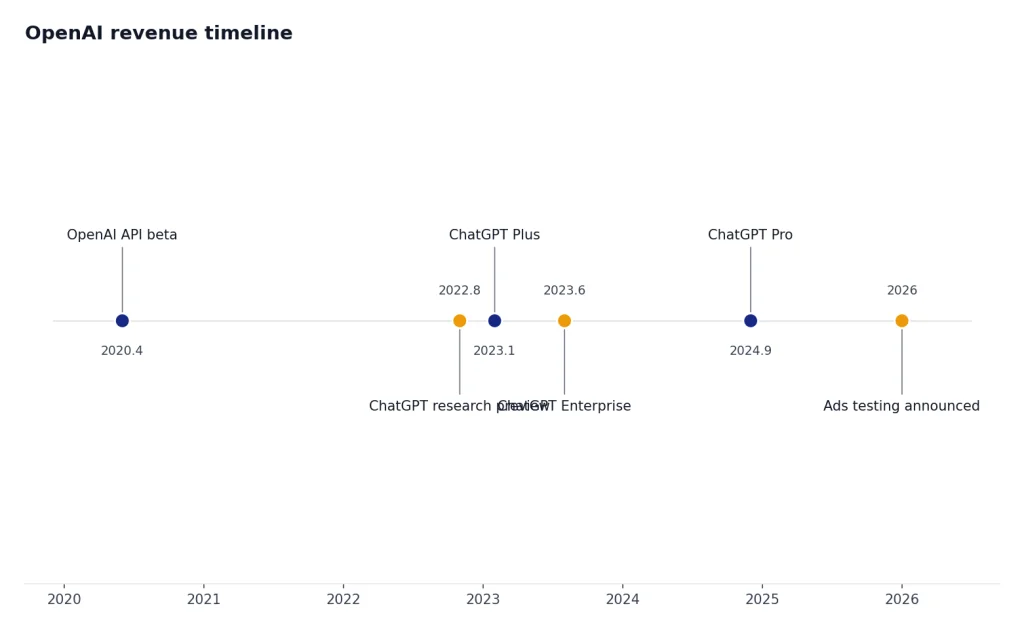
OpenAI revenue timeline
OpenAI’s commercial expansion accelerated after ChatGPT moved from a research preview into a mass-market product. The company says it reached $1 billion in revenue within a year of launching ChatGPT, was generating $1 billion per quarter by the end of 2024, and was generating $2 billion per month by March 31, 2026.[2]
| Period | Reported figure | What it means | Best source |
|---|---|---|---|
| 2023 | $2 billion ARR | OpenAI’s annual recurring revenue run rate after ChatGPT demand scaled. | OpenAI CFO post[1] |
| 2024 | $6 billion ARR | OpenAI’s reported ARR figure, separate from annual revenue. | OpenAI CFO post[1] |
| 2024 | $3.7 billion annual revenue | A media-reported annual revenue figure cited by Axios via Bloomberg. | Axios / Bloomberg[3] |
| 2025 | More than $20 billion ARR | OpenAI’s official run-rate figure for 2025. | OpenAI CFO post[1] |
| March 31, 2026 | $2 billion per month | A company-disclosed monthly revenue rate, equal to a $24 billion annualized pace if sustained. | OpenAI funding announcement[2] |
The table shows why revenue headlines need careful wording. A private company can disclose ARR, annual revenue, monthly run rate, bookings, or internal projections. Those measures overlap, but they are not interchangeable.
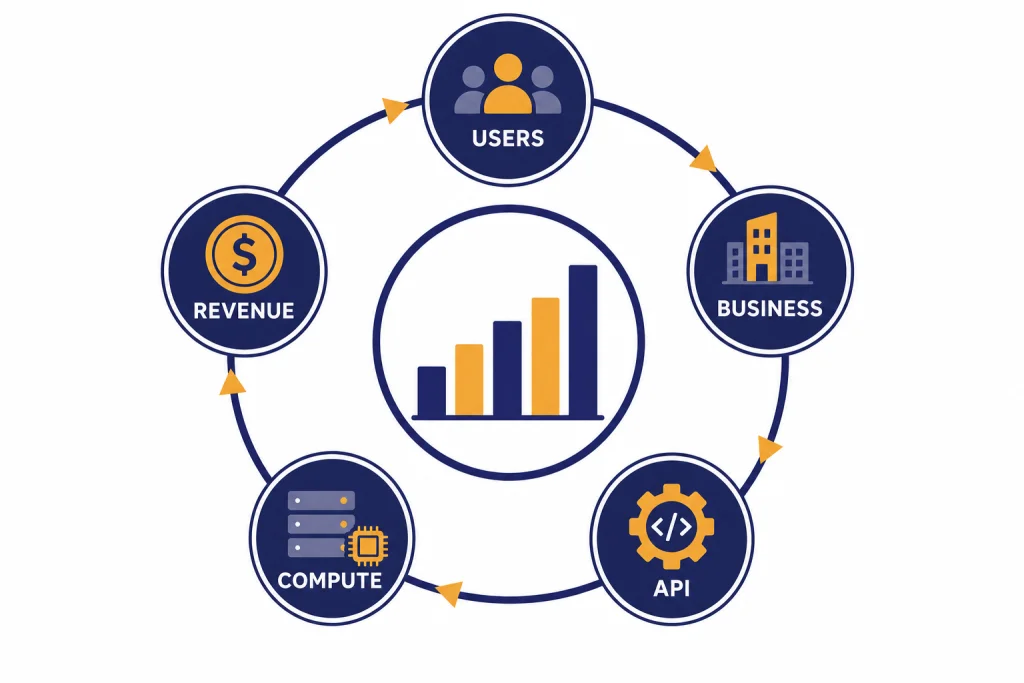
ARR is useful because it shows the scale of recurring demand. It is also incomplete. It does not show usage costs, customer concentration, deferred revenue, discounts, refunds, or the cost of compute. OpenAI’s own framing connects revenue growth directly to compute growth: it said available compute rose from 0.2 GW in 2023 to 0.6 GW in 2024 and about 1.9 GW in 2025, while ARR moved from $2 billion to $6 billion to more than $20 billion.[1]
That is the central revenue story. OpenAI is selling more access to AI systems as it adds more capacity to serve them. The same dynamic underpins the OpenAI and Microsoft partnership, Azure deployments, and infrastructure deals that make OpenAI unlike a normal software startup.
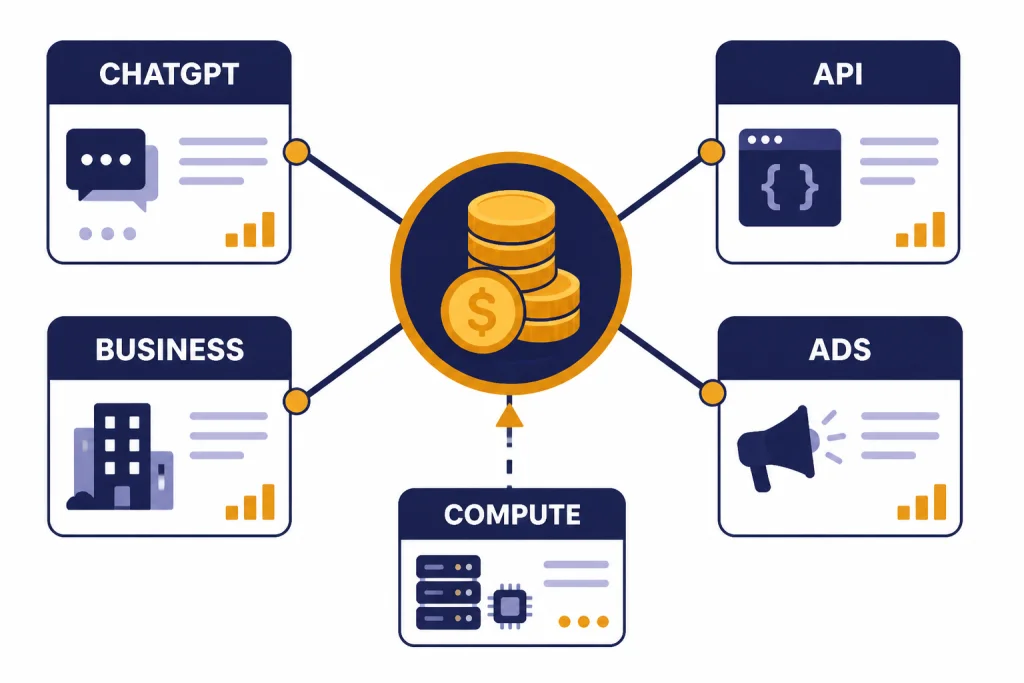
Where OpenAI revenue comes from
OpenAI has several major revenue lines. The most visible is ChatGPT subscriptions. The company said ChatGPT had more than 900 million weekly active users and more than 50 million subscribers when it announced the March 31, 2026 funding round.[2] Subscription revenue comes from consumer plans and workplace plans, including Plus, Pro, Business, and Enterprise.
ChatGPT Plus remains one of the clearest consumer revenue products. OpenAI’s Help Center describes Plus as a $20 per month plan with enhanced access to the ChatGPT web app.[8] ChatGPT Pro was introduced as a $200 monthly plan in December 2024.[11] ChatGPT Business pricing is $25 per user per month when billed monthly and $20 per user per month when billed annually in most countries, with a minimum of 2 standard seats.[9] For a user-level analysis, see our separate ChatGPT Plus price guide.
The second major line is enterprise. OpenAI said enterprise now makes up more than 40% of revenue and is on track to reach parity with consumer revenue by the end of 2026.[2] Its 2025 enterprise report also said OpenAI served more than 7 million ChatGPT workplace seats and more than 1 million business customers.[10] That makes business adoption a core part of the openai revenue story, not a side market.
The third line is the API. Developers and companies pay for model access by usage, and OpenAI’s public API price sheet shows how varied that revenue can be. GPT-5.5 standard pricing is $5.00 per 1 million input tokens and $30.00 per 1 million output tokens, while GPT-5.4 mini is $0.75 per 1 million input tokens and $4.50 per 1 million output tokens.[7] The API also includes tools such as web search at $10.00 per 1,000 calls and Batch API discounts of 50% on inputs and outputs.[7] For builders, our OpenAI API pricing and OpenAI Batch API guides cover the user-facing cost side of that business.
The fourth emerging line is advertising. OpenAI said in January 2026 that it planned to test ads in the U.S. for Free and Go users, while Plus, Pro, Business, and Enterprise subscriptions would not include ads.[5] OpenAI also said ads should be separate from answers, clearly labeled, and not based on selling user conversations to advertisers.[5]
Revenue versus costs and valuation
OpenAI revenue is large, but the company’s costs are also unusual. Frontier AI requires model research, specialized chips, data centers, networking, energy, safety work, support teams, and enterprise sales. This makes OpenAI more capital intensive than a conventional SaaS company.
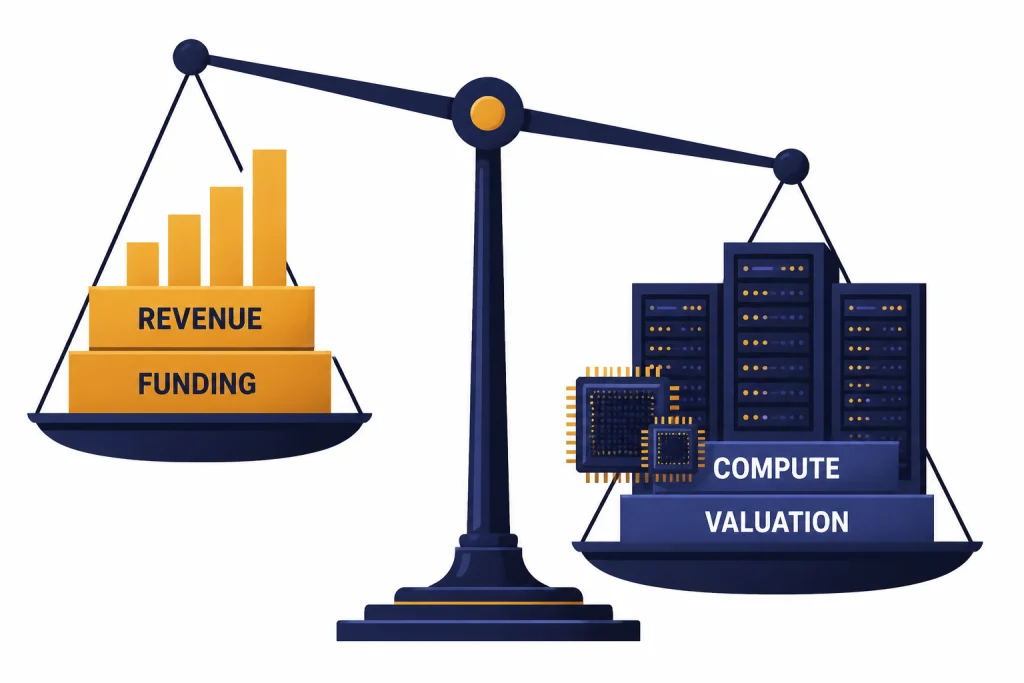
The funding numbers show the scale. OpenAI announced $40 billion in new funding at a $300 billion post-money valuation on March 31, 2025.[4] One year later, OpenAI said it had closed $122 billion in committed capital at an $852 billion post-money valuation.[2] The company also said it had expanded its revolving credit facility to about $4.7 billion, with that facility undrawn at close.[2]
Those valuations are not revenue. They are investor prices for ownership or economic exposure to OpenAI’s future. They imply that investors expect OpenAI to keep converting consumer usage, enterprise seats, API calls, agents, advertising, and possibly new devices into much larger revenue streams. They also imply tolerance for heavy near-term spending.
Axios, citing Bloomberg, reported in March 2025 that OpenAI did not expect to be cash-flow positive until 2029.[3] OpenAI has not published an official audited cash-flow forecast for this. The useful takeaway is narrower: revenue growth alone does not prove profitability. A user paying $20 per month for ChatGPT Plus may be profitable, unprofitable, or marginal depending on how much compute that user consumes.[8]
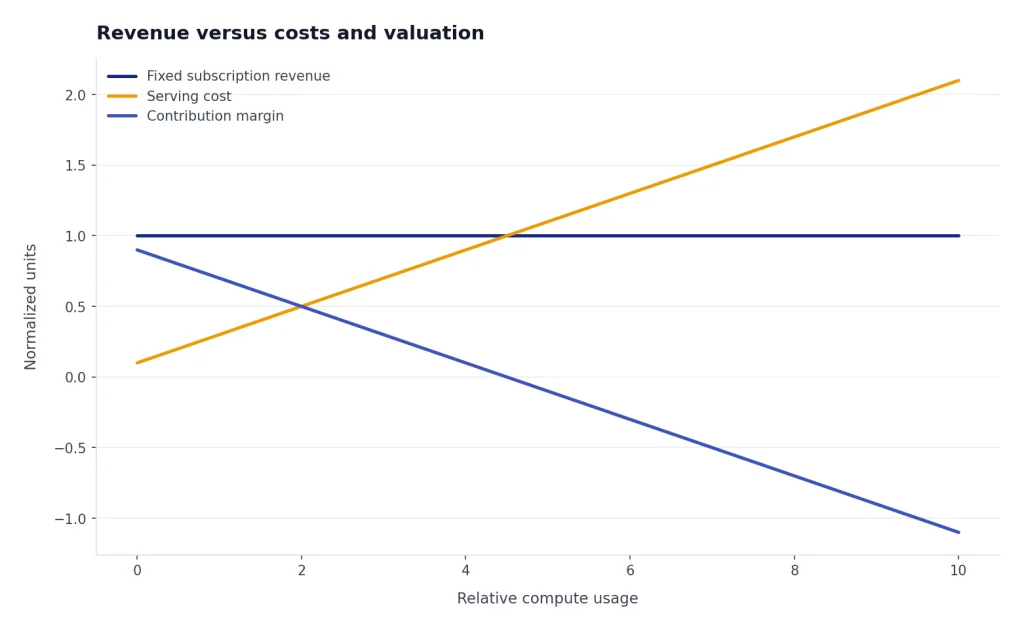
The same applies to the API. A developer may choose a lower-cost model, cached inputs, Batch API processing, or a higher-priced frontier model. GPT-5.5 output tokens cost $30.00 per 1 million tokens, while GPT-5.4 mini output tokens cost $4.50 per 1 million tokens.[7] OpenAI’s revenue depends on usage, but its margins depend on the cost of serving that usage.
This is why leadership, infrastructure strategy, and partner economics matter. The revenue line cannot be separated from the company’s product roadmap, capital access, and executive decisions. For more background, see our guides to OpenAI’s CTO and leadership team, OpenAI history, and Azure OpenAI Service vs OpenAI API.
What could change next
Several factors could change the OpenAI revenue mix in 2026. The first is enterprise growth. OpenAI says enterprise is already more than 40% of revenue and is on track to reach parity with consumer revenue by the end of 2026.[2] If that happens, OpenAI will look less like a consumer subscription company and more like a hybrid of enterprise software, cloud infrastructure, and consumer AI.
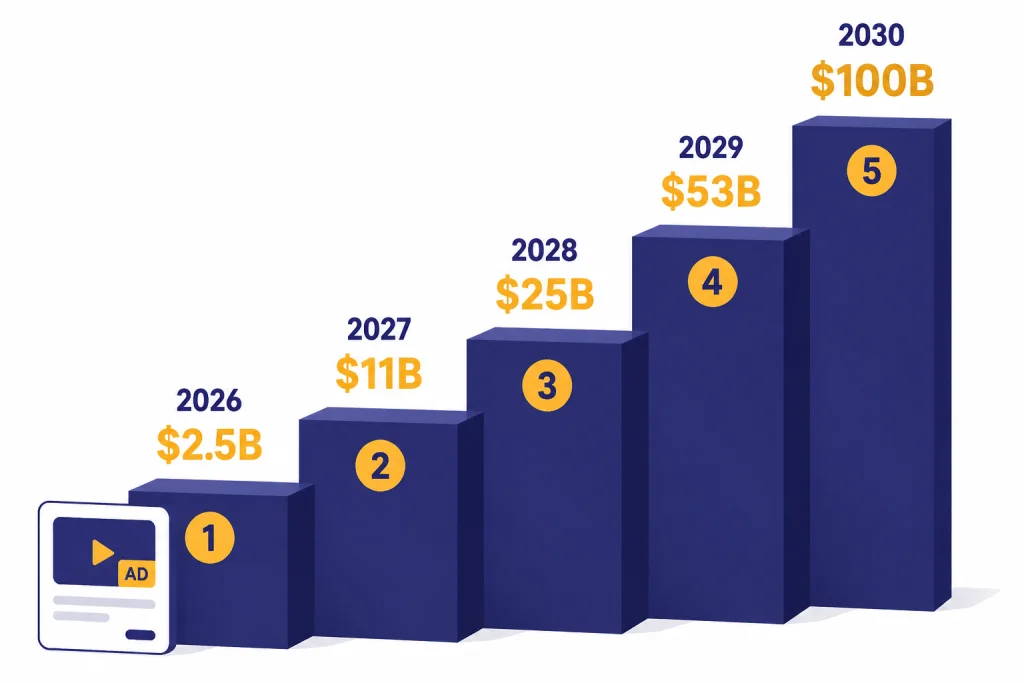
The second factor is advertising. Axios reported on April 9, 2026, that OpenAI expected $2.5 billion in ad revenue in 2026 and $100 billion by 2030, according to a source familiar with investor presentations.[6] Axios also reported intermediate projections of $11 billion in 2027, $25 billion in 2028, and $53 billion in 2029.[6] These are projections, not audited results.
OpenAI’s own disclosure is more conservative but still important. The company said its ads pilot reached more than $100 million in ARR in under six weeks.[2] OpenAI separately said it planned to test ads for logged-in adults in the U.S. on Free and Go tiers, with paid tiers remaining ad-free.[5] If ads scale, OpenAI could monetize free usage without forcing every user into a subscription plan.
The third factor is model and agent packaging. OpenAI said Codex had more than 2 million weekly users, usage was growing more than 70% month over month, and APIs were processing more than 15 billion tokens per minute at the time of the March 31, 2026 funding announcement.[2] More agentic workflows could shift spending from simple chat subscriptions toward usage-based work execution. Our OpenAI Agents SDK, OpenAI Agent Builder, and OpenAI Operator guides explain the product side of that shift.
The fourth factor is pricing. OpenAI can raise revenue through more users, higher conversion, higher-priced tiers, more business seats, higher API volume, new ad inventory, or new products. It can also lower prices if model serving costs fall. The company’s API pricing already shows this segmentation: GPT-5.5 is priced above GPT-5.4 mini, and Batch API offers a 50% discount for asynchronous workloads.[7]
How to read OpenAI revenue claims
OpenAI is private, so its revenue disclosures are selective. That does not make them useless. It means readers should label each number correctly.
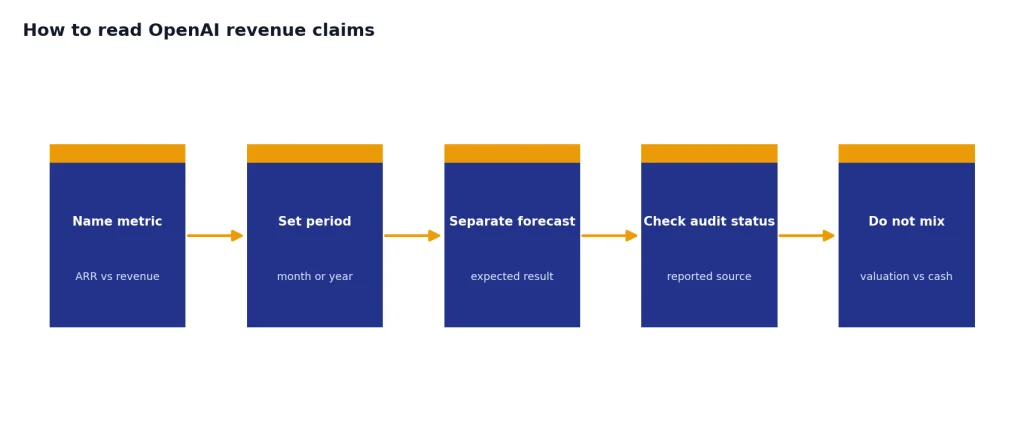
- Annual revenue is money recognized during a year. The $3.7 billion 2024 figure reported by Axios via Bloomberg appears to be this kind of number.[3]
- ARR is a recurring revenue run rate. OpenAI’s $2 billion in 2023, $6 billion in 2024, and more than $20 billion in 2025 sequence uses ARR language.[1]
- Monthly revenue rate is a current pace. OpenAI’s $2 billion per month disclosure on March 31, 2026 fits this category.[2]
- Forecasts describe what the company or investors expect. The $29.4 billion 2026 sales figure reported by Axios via Bloomberg and the $100 billion 2030 ad projection reported by Axios are forecasts, not results.[3][6]
- Valuation is what investors paid or implied in a financing. OpenAI’s $852 billion post-money valuation is not revenue.[2]
Be especially careful with phrases like “OpenAI makes” or “OpenAI is worth.” The company may be making $2 billion per month in revenue, but that says nothing by itself about profit.[2] The company may be valued at $852 billion, but that is a financing valuation, not cash in the bank for shareholders.[2]
The best reading is balanced. OpenAI has built one of the fastest-growing revenue engines in software history. It also faces enormous compute costs, uncertain margins, regulatory pressure, and competition from other AI labs and cloud providers. Both facts matter.
Frequently asked questions
What is OpenAI’s latest revenue?
OpenAI’s latest official revenue disclosure is $2 billion per month, announced on March 31, 2026.[2] That implies a $24 billion annualized pace if sustained, but it is not the same as audited annual revenue.[2] OpenAI has not published full audited financial statements.
How much revenue did OpenAI make in 2025?
OpenAI’s CFO said revenue reached more than $20 billion in ARR in 2025.[1] ARR is a run-rate measure, not necessarily calendar-year recognized revenue. OpenAI has not published an audited annual revenue figure for 2025.
Is OpenAI profitable?
OpenAI has not published audited profit or loss figures. Axios, citing Bloomberg, reported in March 2025 that OpenAI did not expect to be cash-flow positive until 2029.[3] Treat that as a reported forecast, not an audited company result.
What are OpenAI’s main revenue sources?
The main sources are ChatGPT subscriptions, enterprise seats, API usage, and emerging advertising. OpenAI said enterprise makes up more than 40% of revenue and is on track to reach parity with consumer revenue by the end of 2026.[2] Ads are still early, but OpenAI said its ads pilot reached more than $100 million in ARR in under six weeks.[2]
How does ChatGPT pricing affect OpenAI revenue?
ChatGPT pricing turns consumer and workplace usage into recurring revenue. Plus is $20 per month, Pro was introduced as a $200 monthly plan, and Business is $25 per user per month billed monthly or $20 per user per month billed annually in most countries.[8][11][9] The profitability of those plans depends on how much compute users consume.
Why do OpenAI revenue reports use different numbers?
Different reports use different measures. ARR, annual revenue, monthly run rate, bookings, and projections can all produce different numbers for the same company. The key is to check whether a number is an actual result, a run rate, or a forecast.