

If you want to land a job at OpenAI, you need more than a strong résumé and an interest in AI. OpenAI says it hires for mission alignment, collaboration, learning speed, and concrete evidence that you can do hard work in ambiguous environments.[3] The company is also not purely credential-driven, which means a polished background alone is not enough and a nontraditional path is not disqualifying either.[3] As of March 26, 2026, OpenAI’s careers site shows hundreds of open roles across research, engineering, product, go-to-market, operations, legal, security, and more, with a mix of office-based, hybrid, and remote openings depending on the team.[2][7][8] This guide explains what OpenAI appears to value, which entry points make sense, and how to present yourself like a serious candidate instead of a hopeful fan.
What OpenAI looks for in candidates
The clearest signal on this comes from OpenAI’s own interview guide. The company says it wants talented people from diverse backgrounds who are passionate about collaboratively building safe AGI for all humanity.[3] It also says it is not credential-driven and wants to understand what a candidate can contribute, not just where that candidate studied or worked.[3]
That matters because many applicants approach OpenAI the wrong way. They assume the company only hires pure researchers from a short list of elite labs. The public careers board shows something broader. Open roles span applied AI engineering, research, data science, infrastructure, security, legal, finance, policy, recruiting, technical success, and sales.[2] If you want the bigger company context first, read OpenAI History and OpenAI’s CTO and Leadership Team.
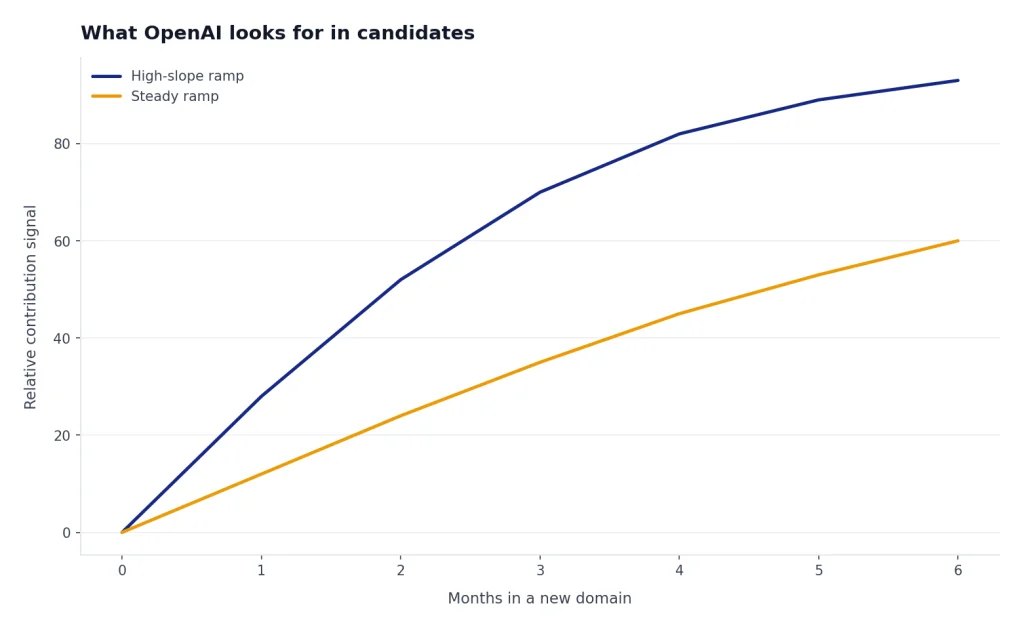
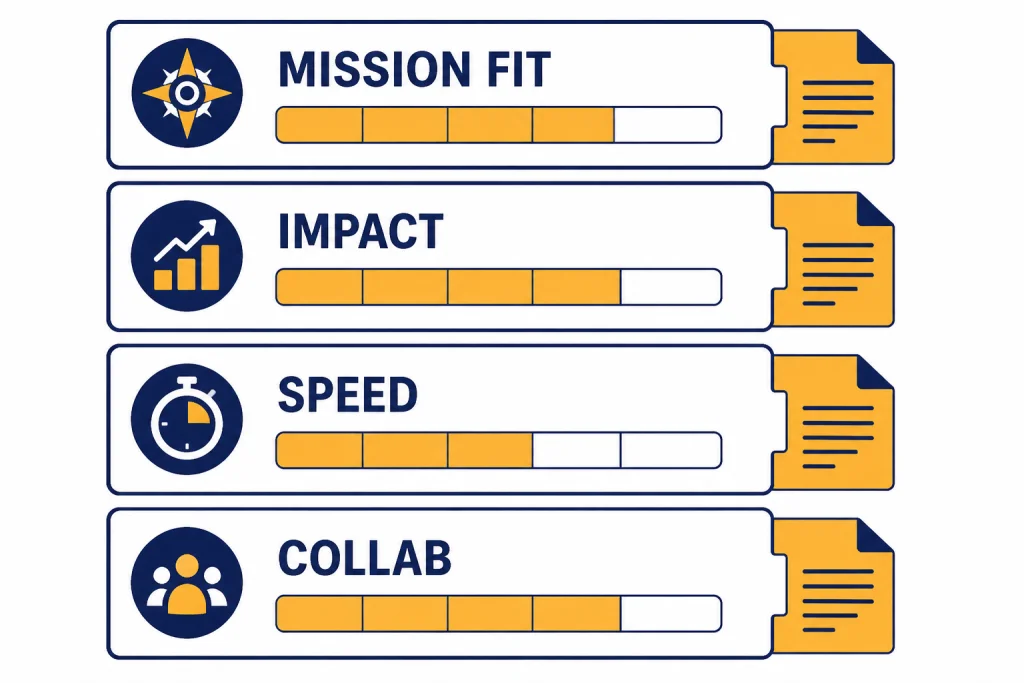
Across those functions, four themes show up again and again.
- Mission fit. OpenAI repeatedly frames its work around safe and beneficial AI, not just model capability.[1][3] Your application should show that you understand that tradeoff.
- High slope. The interview guide says OpenAI values people who ramp quickly in new domains and produce results.[3] That is a clue to emphasize learning speed, not just years of experience.
- Cross-functional execution. Many job descriptions describe work that sits between research, engineering, product, policy, customers, or operations.[2][7] Show that you can ship with people outside your specialty.
- Evidence over enthusiasm. OpenAI’s public material rewards demonstrated work. Repos, papers, prototypes, systems, launches, evals, and measurable outcomes carry more weight than general excitement about AI.[3]
The careers page also publishes company values such as “Humanity first,” “Act with humility,” “Feel the AGI,” and “Ship joy,” alongside operating principles like “Find a way,” “Creativity over control,” “Update quickly,” and “Intense focus.”[1] You do not need to quote those phrases back in an application. You do need stories that prove you already work that way.
The best entry points into OpenAI careers
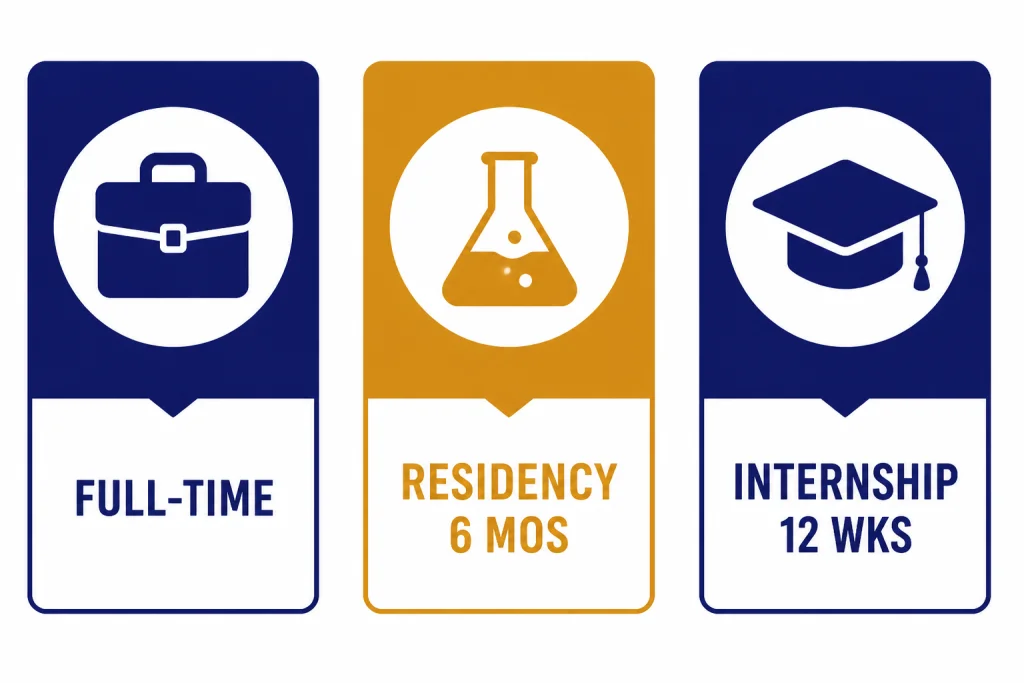
There is no single path into OpenAI. The right route depends on how much experience you already have and what kind of evidence you can show. For most people, there are three realistic on-ramps: direct full-time hiring, early-career roles, and structured programs.
| Path | Best for | What OpenAI says publicly | What to emphasize |
|---|---|---|---|
| Direct full-time role | Candidates with clear domain depth and shipped work | The careers board lists hundreds of roles across technical and nontechnical teams.[2] | Ownership, scope, measurable outcomes, mission fit |
| Early-career full-time | People near the start of their careers | OpenAI says some early-career roles are designed for people with 0–3 years of experience.[4] | Fast learning, unusually strong projects, real initiative |
| Residency | Researchers and engineers pivoting into frontier AI work | OpenAI Residency is a 6-month program and can lead to a full-time role for residents who perform well.[1][6] | Quantitative strength, research instinct, builder energy |
| Internship / co-op | Students with remaining school terms | At least one Summer 2026 software engineering internship is listed as a 12-week, paid, in-person program in San Francisco and Seattle.[5] | Technical fundamentals, side projects, ability to contribute fast |
The residency route deserves special attention. It is not an internship. OpenAI describes it as a program for researchers and engineers already exploring AI or coming from adjacent fields like mathematics, physics, or neuroscience.[6] If you are strong technically but your background is not a standard machine learning résumé, residency can be a better fit than forcing yourself into a senior research application too early.
Early-career candidates should not assume the door is closed. OpenAI’s Emerging Talent page says it offers full-time roles in research, applied engineering, and product for people with 0–3 years of experience.[4] There are also internships, residencies, and community touchpoints through the Emerging Talent program.[4] For a role-by-role snapshot, see OpenAI Jobs.
Where OpenAI hires and how work is structured
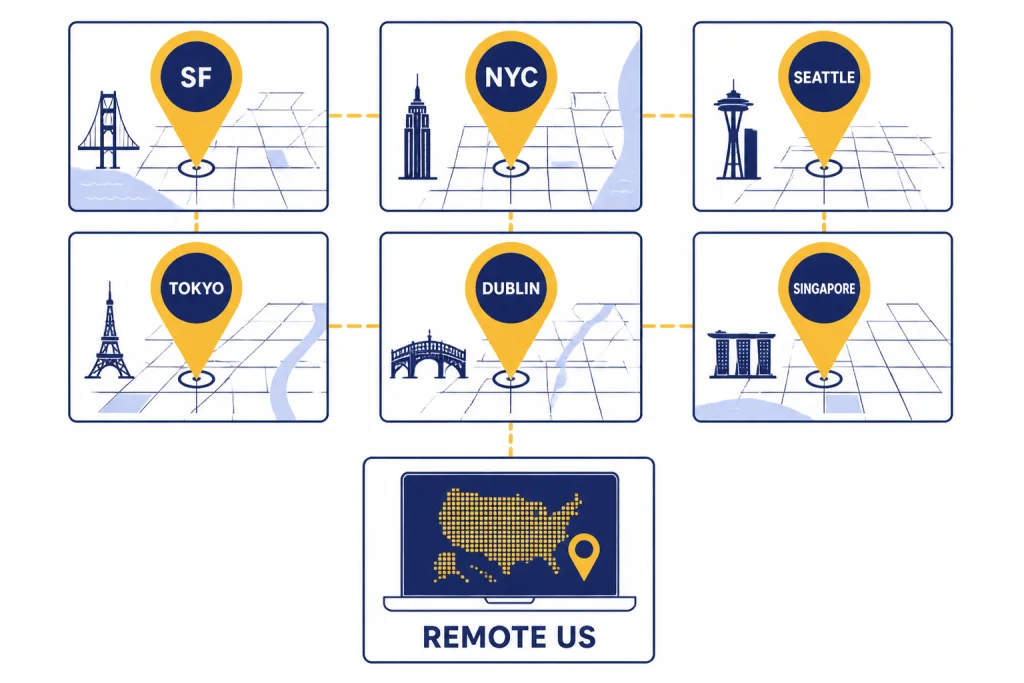
One easy way to misread OpenAI careers is to assume every role is in San Francisco and every team works the same way. The public jobs board shows a wider footprint. Current listings span locations including San Francisco, New York City, Seattle, Washington, DC, Dublin, Tokyo, Singapore, Sydney, Seoul, Paris, Munich, and Remote-US depending on the role.[2]
Work structure also varies. Some roles are explicitly remote in the United States.[7] Some roles are office-centered with a hybrid schedule of three days per week in the office.[8] Others combine a city base with partial remote flexibility or frequent travel.[7][8] That means you should read every listing literally. Do not assume that one team’s setup applies to another.
This matters for your application strategy. If a role is hybrid and tied to a specific office, say clearly that you can relocate or already live near that hub. If a role is remote, show that you can operate independently, write well, and collaborate across time zones. If you want more context on the company’s physical footprint, our piece on OpenAI Headquarters can help.
The public board also shows how much OpenAI has expanded beyond pure research. You will find customer-facing deployment roles, enterprise-facing technical success roles, policy and legal work, growth jobs, and internal platform roles alongside core engineering and research positions.[2][7] That broadening is useful for applicants because it creates more valid entry points. If you are strong at shipping AI into production, working with enterprise customers, or translating technical capability into adoption, your fit may be better than you think. Related company growth context lives in openai valuation, openai revenue, and OpenAI News.
How the OpenAI hiring process works
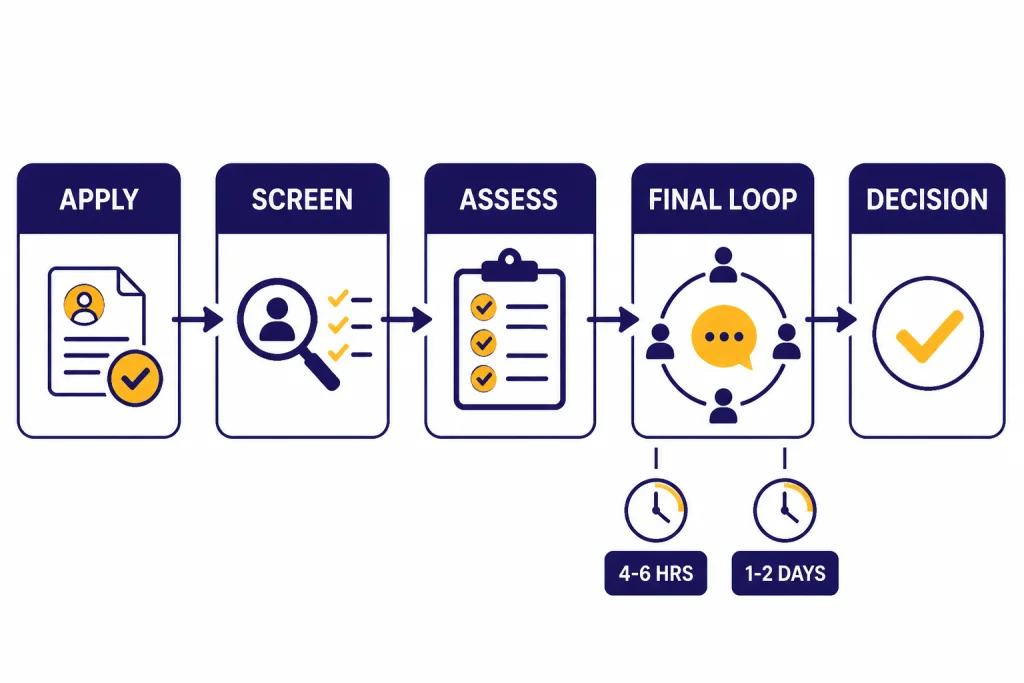
OpenAI publishes an unusually direct interview guide, and it is worth reading before you apply. The basic flow is application and résumé review, introductory calls, a skills-based assessment, final interviews, and a decision.[3]
The timing is also more specific than many companies provide. OpenAI says résumé review typically takes one week.[3] If you advance, the next stage is usually a conversation with a hiring manager or recruiter.[3] Assessment formats vary by team and may include pair coding, technical tests, or take-home work.[3] Final rounds are typically 4–6 hours with 4–6 people over 1–2 days, and OpenAI says candidates should expect to hear back within one week after the final interviews.[3]
For engineering candidates, OpenAI says it generally looks for well-designed solutions, high-quality code, strong performance, and good test coverage.[3] But the guide also emphasizes communication and collaboration.[3] In practice, that means you should not treat the loop like a solo contest. Talk through tradeoffs. Surface risks. State assumptions. Show how you think with other people, not just how you think alone.
There is another important detail in the interview guide: OpenAI recommends candidates study the company’s recent work, blog posts, and research relevant to the team they are meeting.[3] If you are interviewing for a developer-platform role, know the product surface. If you are interviewing for applied AI, understand how deployment feedback shapes product decisions. If you are interviewing for infra or enterprise work, know how OpenAI sits next to partners and customers. Our guides to openai agents sdk, openai operator, and azure openai service vs openai api are useful examples of the kind of product fluency that helps.
How to stand out before you apply
The best OpenAI applications read like evidence files. They do not read like generic big-tech applications with “AI” swapped into the summary line.
1. Tailor to a real team, not the brand
OpenAI is now large enough that “I want to work on AI” is not a useful pitch. A research systems team, a policy role, a customer deployment role, and a recruiting operations role require different kinds of evidence.[2] Your résumé and outreach should name the specific team problem you are built to solve.
2. Lead with proof of work
If you are technical, that proof might be a published package, production system, benchmark, paper, eval, tool, or unusually good side project. If you are nontechnical, it might be a program you scaled, a revenue motion you built, a hard regulatory issue you navigated, or a support workflow you redesigned. OpenAI’s own material points toward demonstrated contribution, high potential, and the ability to produce results quickly.[3]
3. Show that you can handle ambiguity
Many OpenAI roles describe fast-moving, open-ended work.[7][8] In your bullets, highlight times when the spec was incomplete, the field was changing, or success required building the playbook as you went. “Maintained service X” is weaker than “designed the rollout plan for service X under shifting constraints and improved reliability by Y.”
4. Write like a collaborator
OpenAI explicitly says it evaluates communication and collaboration, not just technical correctness.[3] Clean writing, sharp scope definition, and concise thinking are not résumé polish. They are part of the signal.
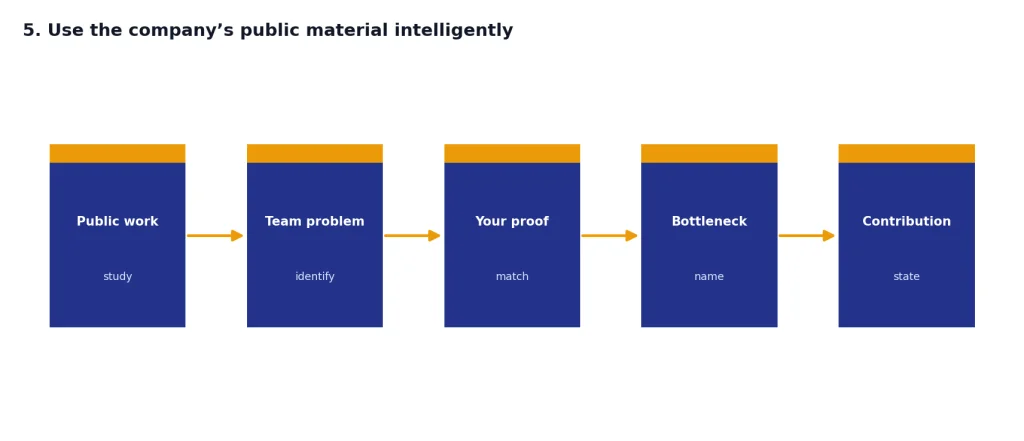
5. Use the company’s public material intelligently
Read the Charter, scan the careers values page, and study the team’s recent work.[1][3] Then reference that material only where it sharpens your case. A good line connects your background to a real OpenAI problem. A bad line sounds like fan copy.
If you are coming from outside core ML, this point matters most. Plenty of roles support how OpenAI deploys and scales products, not just how it trains models.[2] A strong application can say, in effect, “Here is the specific bottleneck I can help remove.” That is far more persuasive than “I have always admired OpenAI.”
Common mistakes that hurt OpenAI applications
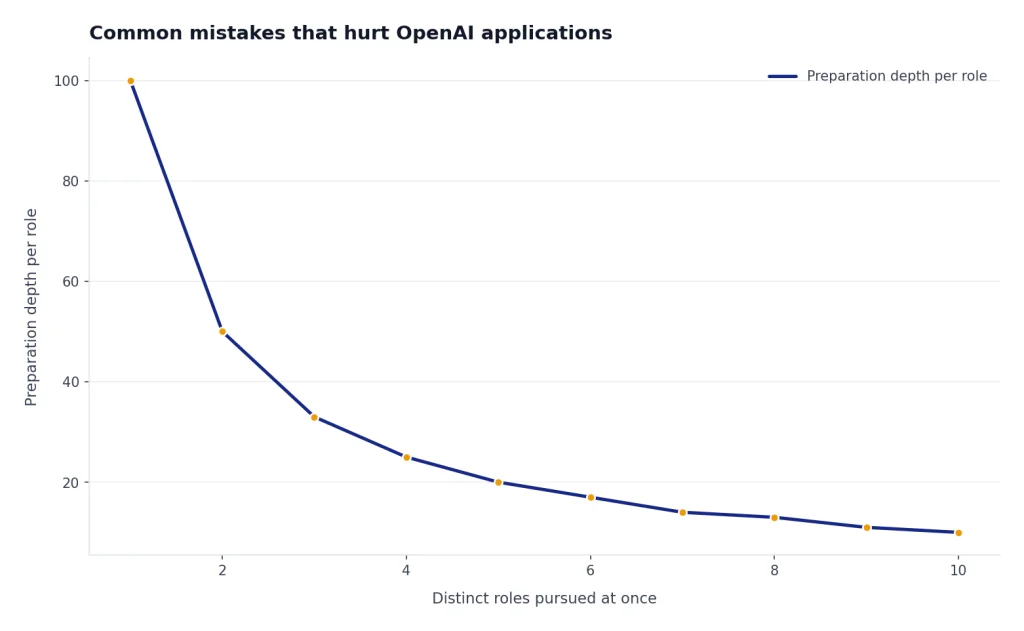
- Applying too broadly. Ten weak applications to unrelated teams usually perform worse than two tight applications to roles that genuinely match your work.
- Confusing prestige with fit. OpenAI says it is not credential-driven.[3] Brand-name employers help only if your work there maps to the job.
- Over-indexing on prompt fluency. Being a power user of ChatGPT can help, but it is rarely the main qualification. OpenAI hires people who can build, analyze, operate, sell, secure, or govern systems around AI.[2]
- Ignoring the work model. If the listing says Remote-US or hybrid three days in office, take that seriously.[7][8]
- Sounding mission-blind. OpenAI’s public materials consistently tie capability to safety and human benefit.[1][3] Candidates who talk only about speed and power can look incomplete.
- Submitting without recent context. Before interviewing, catch up on current products and company direction. Our coverage of gpt-5.3 release, sora 2 launch, and chatgpt atlas launch is one fast way to do that.
One final point: do not treat the hiring process as a puzzle to game. The interview guide is public because OpenAI wants candidates to know the shape of the process.[3] Use that transparency to prepare better examples, sharper explanations, and more relevant work samples.
Frequently asked questions
Does OpenAI only hire researchers and engineers?
No. The public careers board includes roles across research, engineering, product, security, legal, finance, recruiting, technical success, sales, and operations.[2] Many applicants miss that breadth and filter themselves out too early.
Can you get hired at OpenAI without a traditional elite background?
Possibly, yes. OpenAI says it is not credential-driven and wants to understand your unique background and contribution.[3] That does not lower the bar. It means the bar is based more on evidence and fit than on pedigree alone.
Are there entry-level OpenAI careers?
Yes. OpenAI’s Emerging Talent page says some full-time roles are designed for people with 0–3 years of experience, and it also highlights internships and residencies.[4] As of March 26, 2026, public listings also include at least one early-career research cohort role and internship postings.[2][5]
How long does the OpenAI interview process take?
OpenAI says résumé review typically takes one week, and candidates should usually hear back within one week after final interviews.[3] The final interview stage is typically 4–6 hours with 4–6 people over 1–2 days.[3] Actual timing can still vary by team and scheduling.
Does OpenAI offer remote jobs?
Yes, some roles are explicitly listed as Remote-US.[7] But other roles are tied to specific offices or use a hybrid model with three in-office days per week, so you need to read each posting closely.[8]
Is the OpenAI Residency the same as an internship?
No. OpenAI describes Residency as a 6-month program for researchers and engineers, and its residency page explicitly says it is not an internship.[6] It is better understood as a structured bridge into frontier AI work.