
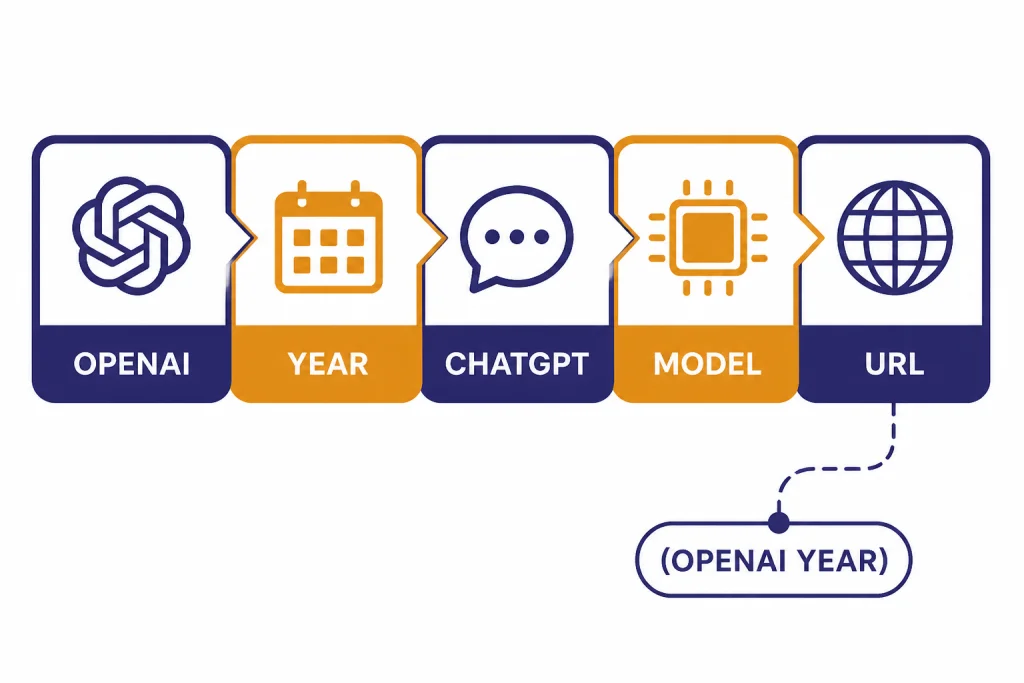
To cite ChatGPT in APA format, list OpenAI as the author, use the year of the version you used, title the work ChatGPT with the version in parentheses, add the bracketed description [Large language model], and finish with the URL. In the text, use (OpenAI, year) or OpenAI (year). APA Style treats ChatGPT output as algorithm-generated software output, so you should also preserve the prompt and response in an appendix or other retrievable record when your work depends on it.[1] The safest rule is simple. Cite ChatGPT when you quote, paraphrase, or rely on its output. Cite original sources, not ChatGPT, for factual claims.
Quick APA answer
Use this basic APA format when you quote or paraphrase ChatGPT output in a paper:
OpenAI. (Year). ChatGPT (version used) [Large language model]. URLAPA Style’s own ChatGPT example uses OpenAI as the author, the year in parentheses, ChatGPT as the italicized title, the version in parentheses, the bracketed description [Large language model], and a URL.[1] A simple example looks like this:
OpenAI. (2023). ChatGPT (Mar 14 version) [Large language model]. https://chat.openai.com/chatFor in-text citations, use either a parenthetical citation or a narrative citation:
- Parenthetical:
(OpenAI, 2023) - Narrative:
OpenAI (2023)
If you used the current ChatGPT site, use the URL where the reader can access the tool. OpenAI says ChatGPT can be accessed at chatgpt.com, including before creating an account.[2] If your school, journal, or instructor gives a different preferred URL, follow that local requirement.
When to cite ChatGPT
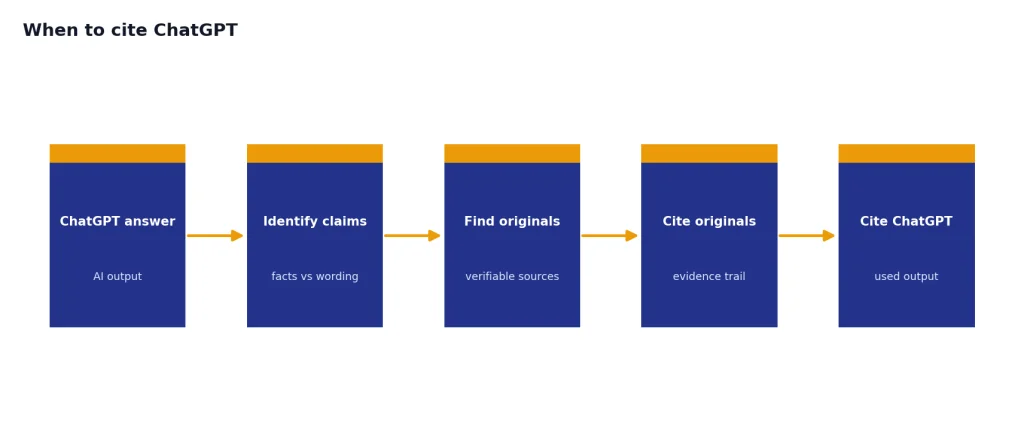
Cite ChatGPT when its output becomes part of your work. That includes a sentence you quote, a paragraph you paraphrase, a table you adapt, a summary you use, or an analysis that shapes your argument. The citation tells the reader that the wording or idea came from an AI tool rather than from you, a book, a journal article, or a website.
Do not cite ChatGPT as if it were evidence for a factual claim. If ChatGPT tells you a date, a statistic, a law, or a study finding, find and cite the original source instead. ChatGPT can help you brainstorm search terms, clarify a confusing concept, or draft a plain-language explanation, but your reference list should point readers to sources they can verify.
You may not need a formal reference entry if you used ChatGPT only for low-level editing and did not include generated content. For example, if you asked it to find awkward sentences in your own draft, your instructor may prefer an acknowledgment note rather than a citation. Policies differ. Check the assignment instructions before you submit.
If your work compares citation systems, see our related guides on how to cite ChatGPT in MLA format, how to cite ChatGPT in Chicago style, and how to cite ChatGPT in Harvard style. APA is usually more structured than a casual disclosure note because it asks you to put the tool in the reference list when its output is used.
How to build the reference entry
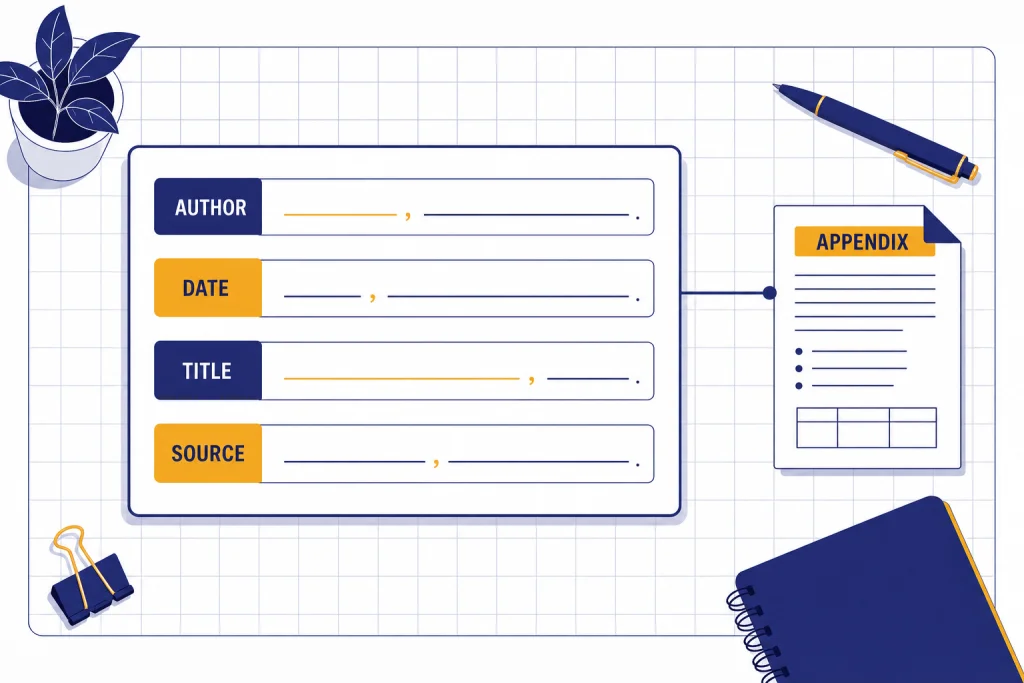
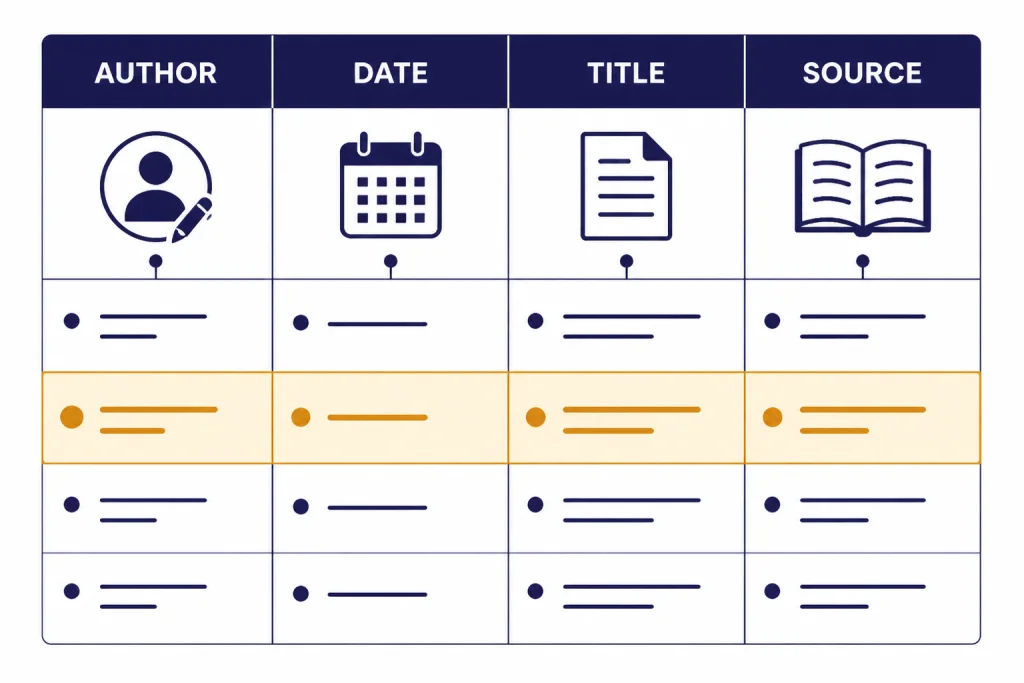
An APA reference entry has core parts. Many APA teaching guides describe the main reference elements as author, date, title, and source.[4] For ChatGPT, those parts are straightforward once you know what belongs in each position.
| APA element | What to write for ChatGPT | Example |
|---|---|---|
| Author | Use the organization that made the tool. | OpenAI. |
| Date | Use the year of the version you used. | (2023). |
| Title | Use ChatGPT, followed by the version in parentheses. | ChatGPT (Mar 14 version) |
| Description | Identify the type of work in square brackets. | [Large language model]. |
| Source | Use the URL where the tool is available. | https://chat.openai.com/chat or https://chatgpt.com/ |
Here is the full pattern again:
OpenAI. (Year). ChatGPT (version used) [Large language model]. URLAPA’s example uses a version label in parentheses after the title.[1] If you cannot identify a precise visible version in your interface, do not invent one. Use the most specific information available from your session, your export, your assignment instructions, or your institution’s AI policy.
Do not repeat OpenAI as the publisher after the title. APA examples for ChatGPT go directly from the bracketed description to the URL because the author and source organization are the same.[6] This keeps the reference concise and avoids a duplicate publisher field.
In-text citations and transcript notes
APA in-text citations for ChatGPT follow the author-date pattern. If the citation appears at the end of a sentence, write (OpenAI, 2023). If OpenAI appears in the sentence, write OpenAI (2023). APA’s ChatGPT guidance lists both parenthetical and narrative forms.[1]
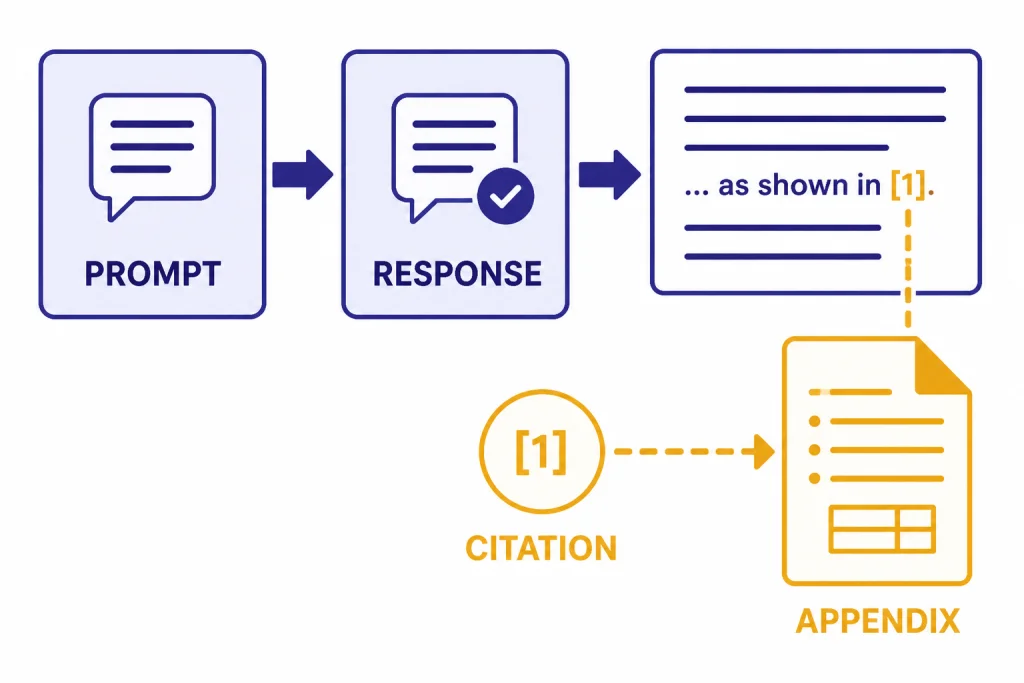
ChatGPT responses are not stable in the same way as a published article. Another reader may type the same prompt and receive a different answer. That is why APA guidance recommends preserving the prompt and full response in an appendix or supplementary material when the AI output matters to the paper.[1]
A short citation alone is usually not enough for a graded paper that depends on ChatGPT output. Add a sentence in the body that points to the transcript. For example:
The ChatGPT-generated response summarized three possible explanations for the result (OpenAI, 2023; see Appendix A for the full prompt and response).In Appendix A, include the prompt you entered, the response you received, the date you generated it, and any context needed to understand the exchange. If you edited the response before using it, say that. If you asked follow-up prompts, include the relevant follow-up prompts too.
APA examples for common ChatGPT uses
APA citations should match how you used ChatGPT. The following examples are original sample scenarios you can adapt. Replace the year, version, URL, prompt, and appendix details with the information from your own chat.
Example 1: Quoting ChatGPT directly
If you quote a short phrase or sentence from ChatGPT, cite the tool and preserve the prompt and response.
The response described a thesis statement as “a map for the reader” (OpenAI, 2023; see Appendix A).Use quotation marks around the exact words. Do not clean up the quoted wording without marking the change. If you revise the sentence heavily, treat it as a paraphrase instead.
Example 2: Paraphrasing ChatGPT
If you restate ChatGPT’s answer in your own words, cite it because the idea or organization came from the model.
OpenAI (2023) generated a three-part outline that separated the topic into access, privacy, and classroom policy concerns.This use is common when students ask ChatGPT to brainstorm sections of a paper. If you later replace that structure with your own research and original outline, the citation may no longer be necessary. If the model’s structure remains visible in the final work, cite it.
Example 3: Using ChatGPT to revise your own writing
If ChatGPT rewrote your paragraph and you used the rewritten language, cite it. If it only suggested that a paragraph was too long or unclear, an acknowledgment may be enough. A practical note might read:
I used ChatGPT to identify unclear sentences in an earlier draft. I reviewed and revised all final wording myself.For help keeping AI-assisted prose natural while still doing your own work, see how to make ChatGPT write like a human. If you are editing for tone rather than citation, our guide to making ChatGPT sound more human may also help.
Example 4: Citing ChatGPT and original sources together
Sometimes ChatGPT helps you understand a topic, but the factual evidence comes from a journal article, report, or book. In that case, cite the original source for the evidence and cite ChatGPT only if the AI-generated explanation itself appears in your work.
After reviewing the report, I used ChatGPT to create a plain-language summary of the sampling method (OpenAI, 2023; see Appendix B).The report still needs its own APA reference. ChatGPT does not replace that citation.
Common mistakes to avoid
The most common mistake is citing ChatGPT for facts that should be traced to a real source. A ChatGPT answer can mention books, articles, cases, or statistics that look plausible but need verification. If a fact matters, track it to the original source and cite that source directly.
Another mistake is using ChatGPT as the author name. In APA format, the author is OpenAI, not ChatGPT.[1] ChatGPT is the title of the tool in the reference entry.
Do not paste your full prompt into the reference title. The prompt belongs in an appendix, a footnote if your instructor allows one, or a methods section when the AI interaction is part of your research process. The reference list entry identifies the tool. The transcript shows the actual exchange.
Do not add a retrieval date unless your instructor asks for one. The better solution is to keep a transcript. If the chat is important enough to cite, it is important enough to preserve.
Do not hide meaningful AI use. Many schools treat undisclosed AI-generated text as an academic integrity problem. A clear citation and appendix note are safer than a vague statement such as “AI was used.”
How to save proof of the conversation
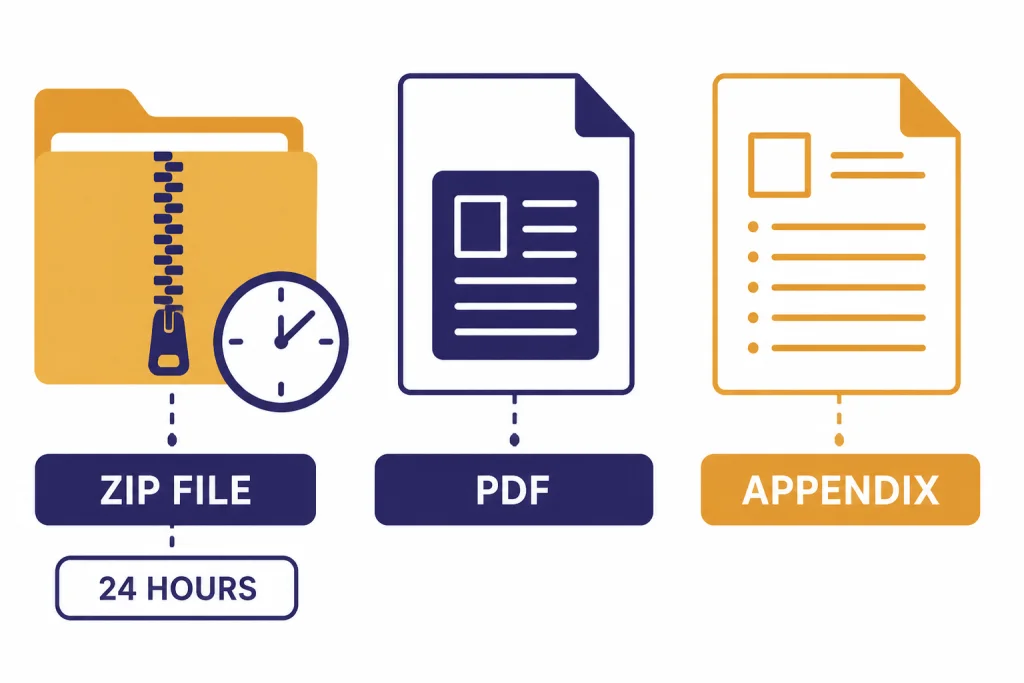
Keep a copy of the conversation before you submit the paper. You have several options. You can copy the prompt and response into an appendix, save the page as a PDF, export your ChatGPT data, or create a share link when appropriate. If the conversation contains private information, do not use a public or shared link without checking what it exposes.
OpenAI’s data export instructions say users can export ChatGPT data from Data Controls, receive an email, and download a ZIP file that includes chat history in chat.html.[3] OpenAI also says the email download link expires after 24 hours.[3] If you need a permanent record for a class, download it promptly and save a separate copy.
For step-by-step recordkeeping, use our guides on saving a ChatGPT conversation, saving ChatGPT conversations as PDF, exporting your ChatGPT data, and sharing a ChatGPT conversation. Those workflows help you preserve the prompt and response that your APA citation points to.
A good appendix entry should include four pieces: the date you generated the response, the prompt, the response, and a short note about any edits you made before using it. If you used multiple prompts, include only the prompts that affected the cited passage. Do not overload the appendix with unrelated experimentation.
Frequently asked questions
Do I cite ChatGPT as OpenAI or ChatGPT in APA?
Cite OpenAI as the author. Use ChatGPT as the title of the tool. The in-text citation is usually (OpenAI, year), not (ChatGPT, year).
Does ChatGPT go in the reference list?
Yes, if you quote, paraphrase, or incorporate ChatGPT output into your work. APA Style provides a reference list format for ChatGPT as a large language model.[1] If you only used it for minor proofreading suggestions, ask your instructor whether an acknowledgment is enough.
What year should I use when citing ChatGPT?
Use the year of the version you used. APA’s published example uses 2023 because the example version was from that year.[1] If your institution gives a specific required version label, follow that instruction.
Do I need to include my prompt?
Usually, yes. The prompt and response help readers understand what ChatGPT generated and why your citation supports the sentence. Put the transcript in an appendix or supplementary material when the AI output is important to your paper.
Can I cite ChatGPT as a source for facts?
Do not use ChatGPT as the final source for factual claims. Use it to help you understand or organize research, then cite the original article, book, report, or webpage that supports the fact. Cite ChatGPT only for the AI-generated wording, summary, structure, or analysis you used.
What if my professor bans ChatGPT?
Follow the course policy. A correct APA citation does not make prohibited use acceptable. If you already used ChatGPT before noticing the rule, ask your instructor how to proceed and keep a copy of the transcript.