


OpenAI funding history is no longer a simple startup timeline. The company began with a nonprofit commitment of $1 billion in 2015, created a capped-profit arm in 2019, built a deep Microsoft partnership, and reached a $300 billion post-money valuation in March 2025.[1][2][8] As of this March 12, 2026 publication date, the $300 billion figure is an important milestone, not the latest endpoint. OpenAI announced $110 billion in new investment on February 27, 2026, at a $730 billion pre-money valuation.[10] There is no verified official record of a $1 million seed round into OpenAI itself.
Quick answer
The clean version of OpenAI funding history starts with a correction. OpenAI did not disclose a normal $1 million seed round. Its first public financing story was a much larger nonprofit commitment: the founding funders committed $1 billion when OpenAI was introduced on December 11, 2015.[1] The company later said it expected to spend only a small fraction of that commitment in the first few years, which makes the founding pledge different from a conventional venture round.[1]
The major turning point came in 2019. OpenAI created OpenAI LP, a capped-profit structure designed to let it raise far more capital while keeping the nonprofit in control.[2] Microsoft then invested $1 billion in OpenAI in July 2019, starting the most important outside funding relationship in the company’s history.[3] For a deeper partnership view, see our guide to OpenAI and Microsoft and the running OpenAI Microsoft News tracker.
The next acceleration followed ChatGPT. Microsoft announced a new multiyear, multibillion-dollar investment in January 2023, while outside reports put the expected amount as high as $10 billion.[4][5] OpenAI then completed a reported share sale of more than $300 million at a $27 billion to $29 billion valuation in April 2023.[6] It raised $6.6 billion at a $157 billion post-money valuation in October 2024, then $40 billion at a $300 billion post-money valuation in March 2025.[7][8]
By publication date, the newest official funding milestone is larger still. OpenAI announced $110 billion in new investment on February 27, 2026, at a $730 billion pre-money valuation, including $50 billion from Amazon, $30 billion from NVIDIA, and $30 billion from SoftBank.[10] That is why the $300 billion figure should be read as the SoftBank-led 2025 milestone, not the current valuation ceiling.
OpenAI funding timeline
This timeline separates public commitments, strategic investments, funding rounds, and restructuring events. Those categories matter. A nonprofit pledge, a cloud-linked strategic investment, a share sale, and a recapitalization do not all mean the same thing for cash on the balance sheet.
| Date | Event | Amount or valuation | Why it mattered |
|---|---|---|---|
| December 11, 2015 | OpenAI introduced as a nonprofit research company | Founders and backers committed $1 billion.[1] | OpenAI began with a mission-first funding model rather than a normal seed round. |
| March 11, 2019 | OpenAI announced OpenAI LP | First investor returns were structured under a capped-profit model.[2] | The structure made large outside investment easier. |
| July 22, 2019 | Microsoft invested and partnered with OpenAI | Microsoft invested $1 billion.[3] | The partnership linked OpenAI’s model work with Microsoft cloud infrastructure. |
| January 23, 2023 | Microsoft and OpenAI extended the partnership | Microsoft called it a multiyear, multibillion-dollar investment; reports described talks around $10 billion.[4][5] | This supplied capital and compute support after ChatGPT’s breakout. |
| April 28, 2023 | Reported share sale to outside investors | More than $300 million at a $27 billion to $29 billion valuation.[6] | Traditional venture firms gained exposure to OpenAI’s ChatGPT momentum. |
| October 2, 2024 | OpenAI announced a major funding round | $6.6 billion at a $157 billion post-money valuation.[7] | The round showed investor willingness to fund frontier AI costs at large scale. |
| March 31, 2025 | OpenAI announced SoftBank-led funding | $40 billion at a $300 billion post-money valuation.[8] | This made the $300 billion valuation the defining 2025 funding milestone. |
| February 27, 2026 | OpenAI announced new strategic investment | $110 billion at a $730 billion pre-money valuation.[10] | The 2026 round moved the latest official valuation beyond the $300 billion marker. |
The table also shows why OpenAI does not map neatly onto a standard startup funding chart. Early OpenAI looked like a research nonprofit. Later OpenAI looked like a hybrid research lab, enterprise software platform, cloud infrastructure customer, and frontier model developer. That mix explains why readers often also follow ChatGPT Stock News even though OpenAI remains private.

Why OpenAI’s structure mattered
OpenAI’s funding history cannot be separated from its corporate structure. In 2015, OpenAI described itself as a nonprofit artificial intelligence research company with a goal of advancing digital intelligence for broad benefit.[1] That made sense for an open research lab, but frontier AI systems soon required far more capital, compute, and infrastructure than a normal nonprofit could easily support.
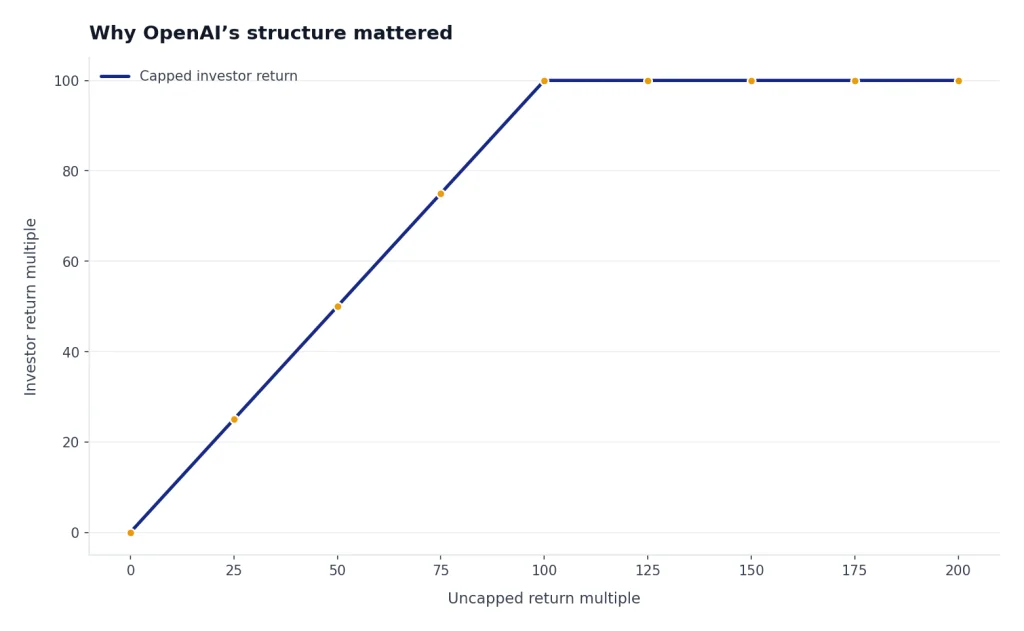
OpenAI addressed that problem in 2019 by announcing OpenAI LP, which it described as a hybrid of a for-profit and nonprofit model.[2] The idea was to let employees and investors receive economic upside while keeping the mission and governance tied to the nonprofit. OpenAI said returns for its first round of investors would be capped at 100 times their investment.[2] That cap was unusual, but it gave OpenAI a way to court capital without presenting itself as a conventional profit-maximizing company.
The structure changed again in 2025. OpenAI’s current structure page says that, with the updated structure announced on October 28, 2025, the OpenAI Foundation holds a 26% equity stake in OpenAI Group, Microsoft holds roughly 27%, and the remaining 47% is held by current and former employees and investors.[9] This matters for funding because a clearer equity structure can make large financings easier to price.
| Funding phase | Primary form | Investor logic | Main constraint |
|---|---|---|---|
| 2015 nonprofit launch | Committed philanthropic-style funding | Support long-term AI research | Not a standard equity return model |
| 2019 capped-profit era | Strategic and mission-linked investment | Fund compute-heavy research and talent | Returns were capped for early investors.[2] |
| 2023 to 2025 growth rounds | Large private financing and share sales | Back ChatGPT growth, models, products, and infrastructure | Very high capital needs |
| Post-2025 recapitalized structure | Foundation plus public benefit corporation | Make ownership and future funding easier to understand | Mission oversight and investor expectations must coexist |
This is also why funding stories often overlap with leadership, governance, and legal coverage. If you want the people side of the same story, start with OpenAI’s CTO and leadership team and our OpenAI lawsuits 2026 update.

Microsoft’s role in OpenAI funding
Microsoft is the single most important strategic backer in OpenAI funding history. The 2019 investment gave OpenAI $1 billion and tied the companies together around advanced AI systems and Azure infrastructure.[3] That deal was not just money. It connected OpenAI’s need for large-scale compute with Microsoft’s cloud platform.
The second major step came after ChatGPT became a consumer and enterprise phenomenon. On January 23, 2023, Microsoft and OpenAI announced the third phase of their partnership through a multiyear, multibillion-dollar investment.[4] Microsoft did not put an exact dollar amount in that announcement. CNBC reported that Microsoft declined to provide a specific figure, while noting that Semafor had reported talks around an investment as high as $10 billion.[5]
That distinction is important. Use “multiyear, multibillion-dollar” when citing the official Microsoft or OpenAI release. Use “reported $10 billion” only when citing a news source. OpenAI funding history includes many reported figures, but not every reported number has the same footing as an official company announcement.
Microsoft’s ownership position became clearer after the 2025 recapitalization. OpenAI says Microsoft holds roughly 27% of OpenAI Group after the updated structure announced on October 28, 2025.[9] That stake helps explain why Microsoft-related OpenAI coverage remains central to any funding analysis.
How the $300 billion valuation became a milestone
The $300 billion valuation came from OpenAI’s March 31, 2025 funding announcement. OpenAI said it raised $40 billion at a $300 billion post-money valuation, in a round it connected to frontier AI research, compute infrastructure, and more powerful tools for ChatGPT users.[8] OpenAI also said ChatGPT had 500 million weekly users at that time.[8]
That round followed the October 2024 financing, when OpenAI raised $6.6 billion at a $157 billion post-money valuation.[7] In practical terms, investors were not valuing a simple chatbot app. They were valuing a company that had become a core AI platform, an enterprise vendor, a developer API provider, a consumer subscription business, and one of the world’s largest buyers of AI compute.
The $300 billion figure still matters because it marked OpenAI’s move from very large startup to mega-cap private AI company. It also shaped coverage of the next funding cycle, including our more focused OpenAI funding round article and broader OpenAI News Today feed.
But it is not the latest official valuation in this article’s publication window. On February 27, 2026, OpenAI announced $110 billion in new investment at a $730 billion pre-money valuation.[10] OpenAI said that funding included $50 billion from Amazon, $30 billion from NVIDIA, and $30 billion from SoftBank.[10] That newer announcement means any current OpenAI funding history must treat $300 billion as a prior landmark.
What investors were buying
OpenAI’s funding rounds are best understood as bets on capacity, distribution, and model leadership. Capacity comes first. Frontier models require data centers, chips, networking, energy, and engineering teams. OpenAI’s own 2025 funding announcement said the capital would help scale compute infrastructure.[8]
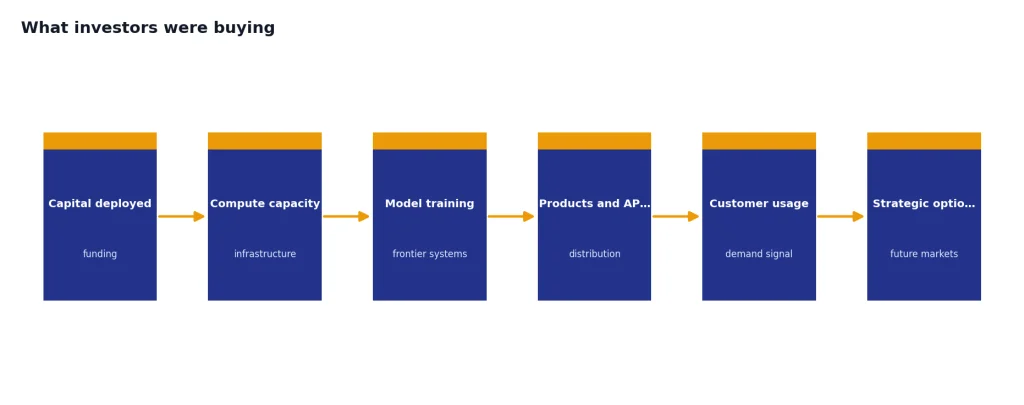
Distribution is the second piece. ChatGPT turned OpenAI from a research lab into a mainstream product company. That affects funding because investors can underwrite growth across consumer subscriptions, business seats, API usage, and partner distribution. For the product side, see ChatGPT updates 2026, OpenAI API pricing, and ChatGPT Plus price in 2026.
Model leadership is the third piece. Investors are funding the expectation that OpenAI can keep shipping models that remain commercially valuable. That expectation can change quickly as competitors release new systems, open-source models improve, and enterprise customers compare price, speed, reliability, and safety controls. Our all GPT models compared side by side guide tracks that product layer.
The fourth piece is optionality. A private OpenAI stake can represent exposure to consumer AI, enterprise AI, developer infrastructure, robotics, video generation, search, agents, and future model licensing. That optionality helps explain why funding coverage often intersects with OpenAI acquisitions, product launches, and weekly market rumors.
What remains unknown
OpenAI has not published an official, complete ledger of every dollar raised since 2015. Public announcements cover the major milestones, but they do not always disclose the full cash-versus-compute split, all investor side letters, exact ownership math for every class of holder, or every secondary transaction. When a funding figure comes only from reporting, it should be treated as reported, not official.
OpenAI also has not published an official figure for a $1 million seed round into the company. The first public launch document instead described a $1 billion commitment from funders.[1] If you see “from $1M to $300B” in a headline or social post, read it carefully. It may be using a shorthand, confusing a grant program with company funding, or simply misstating the early record.
The biggest known update is that the $300 billion milestone has already been superseded by an official 2026 announcement. OpenAI’s February 27, 2026 post states $110 billion in new investment at a $730 billion pre-money valuation.[10] That makes OpenAI funding history unusually fast-moving, even by AI industry standards. For week-by-week context, follow OpenAI News This Week.
Frequently asked questions
Did OpenAI start with $1 million?
OpenAI has not published an official $1 million seed round for the company. Its launch announcement said funders had committed $1 billion in 2015, while noting that only a small fraction was expected to be spent in the first few years.[1]
When did OpenAI reach a $300 billion valuation?
OpenAI reached the $300 billion milestone in its March 31, 2025 funding announcement. The company said it raised $40 billion at a $300 billion post-money valuation.[8]
What is OpenAI’s latest official valuation as of March 12, 2026?
OpenAI’s latest official funding announcement before this publication date is the February 27, 2026 announcement. OpenAI said it raised $110 billion in new investment at a $730 billion pre-money valuation.[10]
How much did Microsoft invest in OpenAI?
Microsoft invested $1 billion in OpenAI in 2019.[3] In 2023, Microsoft and OpenAI announced a multiyear, multibillion-dollar extension; Microsoft did not disclose an exact amount in that release, while news reports described discussions around as much as $10 billion.[4][5]
Is OpenAI public?
No. OpenAI is not a publicly traded company as of this publication date. Its 2025 structure places the OpenAI Foundation, Microsoft, current and former employees, and investors around OpenAI Group, according to OpenAI’s structure page.[9]
Why does OpenAI need so much funding?
OpenAI needs capital for frontier model research, compute infrastructure, talent, product distribution, and enterprise deployment. OpenAI’s March 2025 funding announcement specifically linked the $40 billion round to AI research, compute infrastructure, and ChatGPT tools.[8]