

ChatGPT updates in 2026 have centered on stronger frontier models, more agentic work tools, health and clinician products, bigger context windows, image generation improvements, pricing changes, and the retirement of older models. As of April 25, 2026, the biggest release is GPT-5.5, followed closely by ChatGPT Images 2.0, ChatGPT for Clinicians, the expanded Thinking context window, deep research upgrades, Codex app improvements, and new Pro plan options. This changelog tracks the confirmed 2026 changes in order, with emphasis on updates that affect everyday ChatGPT users, developers, coders, students, clinicians, and business workspaces.
Quick summary of ChatGPT updates in 2026
The short version: ChatGPT is becoming less like a single chat box and more like a set of workspaces, models, tools, and connected apps. OpenAI has shipped visible user-interface changes, but the larger story is capability consolidation. GPT-5.5 is now the headline model for professional work, Images 2.0 is the new image model inside ChatGPT, and OpenAI has pushed deeper into coding, research, health, and enterprise workflows.[1][2][3]
The most important user-facing updates so far are easy to group. Model updates changed what appears in the model picker and what happens when users hit limits. Work updates improved deep research, projects, code blocks, file uploads, and Codex. Interface updates added more visual answers, better memory sourcing, pinned chats, mobile layout changes, location sharing, and Voice improvements. Policy and product updates added age prediction, ads in selected countries, a Health space, and a clinician-specific workspace.[1]
If you follow model launches closely, read this alongside our GPT-5 launch, GPT-5.1 update, GPT-5.2 release notes, and GPT-5.3 release coverage. For a broader live feed, see OpenAI News Today and openai news this week.
Full ChatGPT 2026 changelog by date
This table lists the major ChatGPT updates confirmed through April 25, 2026. It focuses on product changes that affect ChatGPT users, not every API-only release or minor bug fix.
| Date | Update | Who it affects | Why it matters |
|---|---|---|---|
| January 7, 2026 | Health in ChatGPT began rolling out, along with pinned chats. | Early Health users; all users with pinned chats | Health conversations, memory, and files are separated from the rest of ChatGPT.[1] |
| January 15, 2026 | Memory improved for finding details from past chats. | Plus and Pro users | Past chats used in an answer can appear as sources for review.[1] |
| January 20, 2026 | Paid Voice improved instruction following, and age prediction began rolling out. | Paid Voice users; consumer plan users | OpenAI added teen-safety routing based on account and behavioral signals.[1] |
| January 30, 2026 | ChatGPT responses became more visual. | iOS, Android, and web users | Answers can include at-a-glance visuals and highlighted entities with side panels.[1] |
| February 2, 2026 | Codex app for macOS launched. | Users with ChatGPT plans that include Codex | The app manages multiple coding agents and longer background tasks.[1] |
| February 10, 2026 | Deep research gained trusted-site focus, broader app sources, planning, and progress controls. | Plus and Pro first; Free and Go later | Research became easier to steer before and during a run.[5] |
| February 13, 2026 | GPT-4o, GPT-4.1, GPT-4.1 mini, OpenAI o4-mini, and GPT-5 Instant and Thinking retired from ChatGPT. | ChatGPT users | Older models moved out of normal ChatGPT use, while API access was handled separately.[8] |
| February 20, 2026 | Thinking context window expanded to 256k tokens. | Users manually selecting Thinking | The total context window rose from 196k to 256k tokens, split as 128k input and 128k max output.[1] |
| March 11, 2026 | GPT-5.1 models retired from ChatGPT. | Users with older GPT-5.1 chats | Existing GPT-5.1 conversations move to current corresponding models.[1] |
| March 17, 2026 | Model picker simplified into Instant, Thinking, and Pro choices. | Plus, Pro, Business, Enterprise, and Edu users | The picker now emphasizes level of reasoning instead of long model lists.[1] |
| March 27, 2026 | Box, Notion, Linear, and Dropbox apps were updated. | Connected app users | OpenAI added newer app actions, including write capabilities where supported.[1] |
| April 2, 2026 | ChatGPT in Apple CarPlay began rolling out. | Supported iPhone and car users | Users can start or resume voice conversations from CarPlay with iOS 26.4 or newer.[1] |
| April 9, 2026 | GPT-5.3 Instant mini became the fallback model, and new Pro plan options appeared. | Users hitting GPT-5.3 Instant limits; Plus and Pro users | The fallback model changed, and OpenAI added a $100/month Pro option alongside the $200/month Pro plan.[1][7] |
| April 16, 2026 | Ads began rolling out to Free and Go users in Australia, New Zealand, and Canada. | Free and Go users in those countries | Plus, Pro, Business, Enterprise, and Education plans are not included in that ad rollout.[1] |
| April 21, 2026 | ChatGPT Images 2.0 launched in ChatGPT. | All ChatGPT plans; paid users for images with thinking | Images 2.0 is available on all plans, while images with thinking are available on paid plans when using Thinking and Pro models.[3] |
| April 22, 2026 | ChatGPT for Clinicians launched in the U.S. | Verified U.S. physicians, nurse practitioners, physician assistants, and pharmacists | OpenAI made the clinician workspace free for verified individual clinicians in the U.S.[4] |
| April 23, 2026 | GPT-5.5 began rolling out in ChatGPT and Codex. | Plus, Pro, Business, and Enterprise users; Codex users on several plans | OpenAI describes GPT-5.5 as its smartest frontier model for professional work.[2] |
April updates: GPT-5.5, Images 2.0, clinicians, ads, and CarPlay
April is the densest month in the 2026 ChatGPT changelog so far. OpenAI shipped a new frontier model, a new image-generation model, a clinician workspace, a new Pro price point, ads in selected markets, CarPlay support, and Outlook shared-resource improvements within three weeks.[1][2][3][4]
GPT-5.5 is the biggest change. OpenAI says GPT-5.5 is built for complex work that spans coding, online research, data analysis, document creation, spreadsheets, software operation, and tool use.[2] In ChatGPT, GPT-5.5 Thinking is available to Plus, Pro, Business, and Enterprise users, while GPT-5.5 Pro is available to Pro, Business, and Enterprise users.[2] For Codex, OpenAI says GPT-5.5 is available to Plus, Pro, Business, Enterprise, Edu, and Go plans with a 400K context window.[2]
OpenAI also published API pricing for GPT-5.5. The company said gpt-5.5 would be available in the Responses and Chat Completions APIs at $5 per 1M input tokens and $30 per 1M output tokens, with gpt-5.5-pro priced at $30 per 1M input tokens and $180 per 1M output tokens.[2] For a broader pricing comparison, see our OpenAI API pricing guide.
ChatGPT Images 2.0 arrived on April 21, 2026.[3] OpenAI says Images 2.0 is available on all ChatGPT plans, while images with thinking are available on paid plans when users select Thinking and Pro models.[3] This matters because image creation is no longer just a creative add-on. It is becoming part of planning, editing, and work review.
ChatGPT for Clinicians arrived one day later, on April 22, 2026.[4] OpenAI says the product is designed for clinical work such as documentation and medical research, and that it is free for verified individual physicians, nurse practitioners, physician assistants, and pharmacists in the United States.[4] This is separate from the January Health space for consumers, which was built around personal health and wellness conversations.[1]
April also changed the business model around ChatGPT. On April 9, 2026, OpenAI introduced a $100/month Pro plan and kept a $200/month Pro option.[1][7] The same Pro help article describes Plus at $20, Pro $100 as 5x higher limits than Plus with a limited-time 10x Codex usage comparison, and Pro $200 as 20x higher limits than Plus.[7] For plan-level analysis, see our ChatGPT Plus price in 2026 article.
Model changes, context windows, and retirements
The 2026 model story is not only about new names. It is also about simplifying how users choose models. On March 17, 2026, OpenAI said paid and organizational users would see model options framed as Instant for everyday answers, Thinking for deeper reasoning, and Pro for the most advanced reasoning models.[1] That change reduces the need for most users to know every model suffix.
Several model retirements happened early in the year. OpenAI retired GPT-4o, GPT-4.1, GPT-4.1 mini, OpenAI o4-mini, and GPT-5 Instant and Thinking from ChatGPT on February 13, 2026.[8] Then GPT-5.1 Instant, GPT-5.1 Thinking, and GPT-5.1 Pro became unavailable in ChatGPT on March 11, 2026.[1] If you are trying to understand the sequence, our GPT-5.1 update, GPT-5.2 release notes, and GPT-5.3 release pages break down those transitions in more detail.
The biggest context-window change came on February 20, 2026. ChatGPT Thinking increased to a 256k-token total context window when manually selected, up from 196k total tokens.[1] OpenAI listed the new split as 128k input tokens and 128k max output tokens.[1] For side-by-side model limits, see our context window sizes for every GPT model reference.
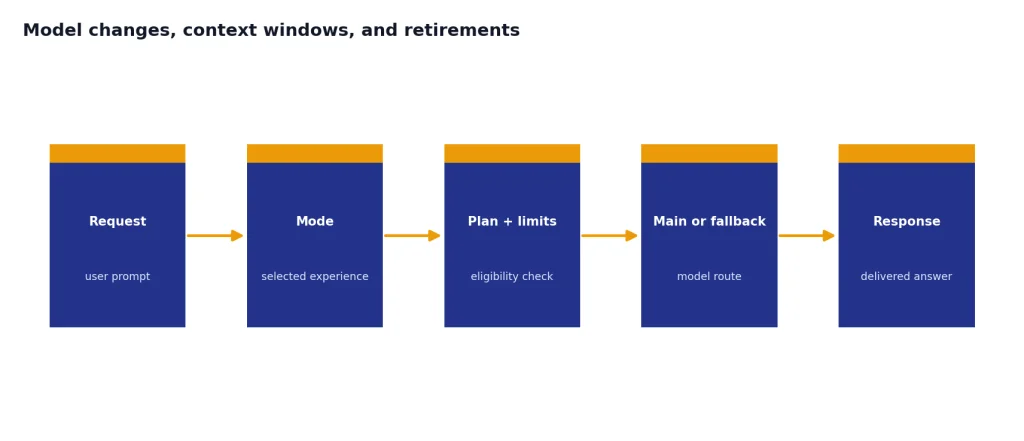
OpenAI also changed fallback behavior. GPT-5.3 Instant mini replaced GPT-5 Instant Mini as the fallback model after users hit rate limits for GPT-5.3 Instant.[1] OpenAI says it does not appear in the model picker because it is a fallback model.[1] That means some users will experience the model indirectly without selecting it.
The practical result is a cleaner but more dynamic ChatGPT. Users see fewer model labels, but the system still routes between main models, fallback models, and reasoning modes based on plan, limits, and the selected experience. If you compare model behavior often, keep a separate eye on our all GPT models compared side by side guide.
Work, research, coding, and file updates
Many 2026 updates target people who use ChatGPT as a work system. Deep research received a major refresh on February 10, 2026.[5] OpenAI says users can connect deep research to MCP or apps, restrict web searches to trusted sites, track progress in real time, and interrupt a run with follow-up prompts or new sources.[5] That makes deep research less like a one-shot report and more like a controlled research workflow.
Projects also became more useful. On February 25, 2026, OpenAI added ways to save sources into projects from apps, chats, and pasted text.[1] Examples include Slack channels, Google Drive files or folders, useful ChatGPT responses, and ad-hoc notes.[1] This matters for teams and individuals who want ChatGPT to reuse context without rebuilding a prompt from scratch every time.
Coding received several changes. The Codex app for macOS launched on February 2, 2026 as a command center for managing multiple coding agents, long-horizon tasks, isolated worktrees, reusable skills, and automations.[1] On February 19, 2026, interactive code blocks added inline editing, previews for diagrams and mini apps, and split-screen code review.[1] These are small interface changes with large workflow effects.
File handling improved too. On February 13, 2026, web users could attach up to 20 files in a single message, up from 10.[1] OpenAI also added more text and code file formats, cleaner Cmd+A selection behavior, Android quick tools, a simplified Android composer, iOS performance improvements, and better reliability for long Thinking chats.[1]
The pattern is clear. ChatGPT is being optimized for longer sessions, more connected data, richer code editing, and fewer restarts. GPT-5.5 then extends that direction by emphasizing agentic coding, tool use, and multi-step professional work.[2]
Personalization, safety, voice, and everyday UX
Not every 2026 update is about frontier models. ChatGPT also changed how it remembers, speaks, displays answers, and handles user safety. On January 15, 2026, OpenAI improved memory for Plus and Pro users so ChatGPT can more reliably find specific details from past chats when reference chat history is enabled.[1] Past chats used to answer can appear as sources, which gives users a way to check the original context.[1]
Voice improved twice in the first two months. Paid Voice received better instruction following on January 20, 2026, along with a fix for a bug where Voice could repeat custom instructions.[1] A February 12, 2026 update improved instruction following and tool use, including web search, for the Voice version used mainly by Free users and by Plus users after main-model limits are reached.[1] Dictation also improved for logged-in users on January 12, 2026, with OpenAI saying it reduced empty transcriptions and improved accuracy.[1]
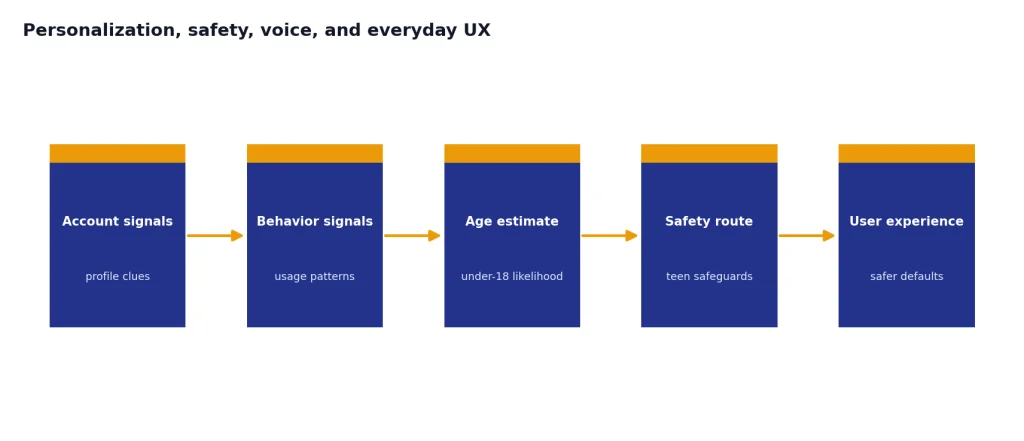
Safety changes were more visible in 2026. OpenAI began rolling out age prediction on January 20, 2026 for ChatGPT consumer plans, using behavioral and account-level signals to estimate whether an account likely belongs to someone under 18.[1] On February 13, 2026, OpenAI also introduced Lockdown Mode and Elevated Risk labels as protections against prompt injection attacks.[11]
Everyday interface updates filled in the rest. Pinned chats became available on January 7, 2026.[1] More visual responses rolled out globally on iOS, Android, and web on January 30, 2026.[1] On March 26, 2026, OpenAI simplified the mobile sidebar and added optional device location sharing for more relevant local recommendations, news, and weather.[1]
These changes will not get the same attention as GPT-5.5, but they affect daily use. A better memory citation, cleaner mobile navigation, or more reliable dictation can save more time than a benchmark gain for many users.
Business, Enterprise, and Edu updates
Business and school workspaces saw their own track of changes. OpenAI’s Enterprise and Edu release notes list 2026 updates for connectors, data residency, admin controls, surveys, and workspace features.[9] These do not always appear in the same place as consumer ChatGPT updates, so admins should monitor both sets of notes.
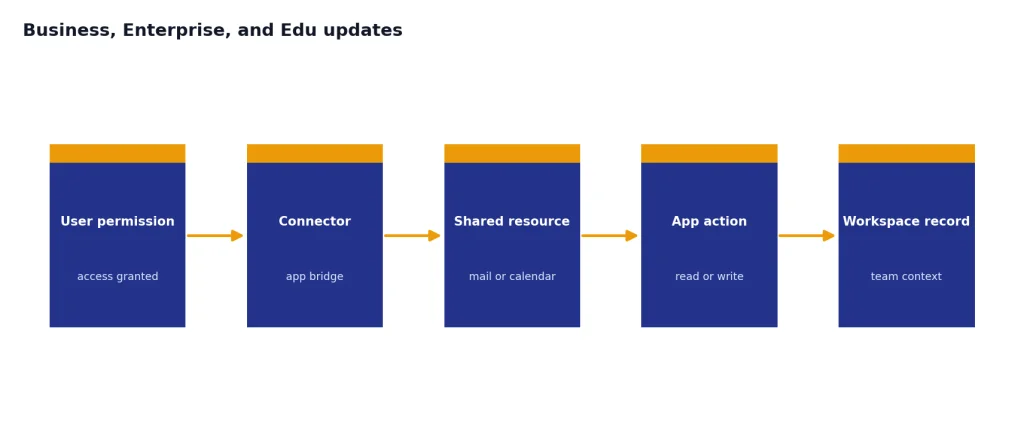
Connected apps became more important in March and April. OpenAI updated Box, Notion, Linear, and Dropbox apps in ChatGPT on March 27, 2026, including new write capabilities where supported.[1] Outlook shared mailboxes and calendars followed on April 8, 2026, allowing users with permissions to work with shared Outlook resources in ChatGPT.[1]
OpenAI also added flexible pricing details for business plans. A Help Center article says that, as of April 2, 2026, ChatGPT Business and ChatGPT Enterprise include two seat types: a standard ChatGPT seat and a Codex-only seat.[10] The same article says those seats are not available to ChatGPT Edu, Teachers, or Healthcare plans.[10]
Admins should also note the model retirement dates. OpenAI said ChatGPT Business, Enterprise, and Edu customers retained access to GPT-4o within Custom GPTs until April 3, 2026, after the broader February 13 retirement.[8] If your team depends on older Custom GPT behavior, that date matters more than the consumer model picker change.
For company-level context, see our coverage of OpenAI Microsoft News, OpenAI acquisitions, and OpenAI funding history. Product updates often connect to infrastructure, licensing, and enterprise strategy.
What to watch next
The next thing to watch is how quickly GPT-5.5 becomes the default work model across ChatGPT, Codex, and the API. OpenAI’s April 23, 2026 post says GPT-5.5 and GPT-5.5 Pro were rolling out to ChatGPT and Codex, with API availability addressed in the same release cycle.[2] If you build on OpenAI models, watch pricing, rate limits, and the balance between GPT-5.5 and GPT-5.5 Pro.
The second thing to watch is image generation. Images 2.0 is on all ChatGPT plans, but images with thinking are tied to paid plans and Thinking or Pro models.[3] That split suggests OpenAI may keep using plan tiers to separate basic creation from more deliberate, multi-step image work.
The third thing to watch is monetization. Ads are now rolling out only to Free and Go users in Australia, New Zealand, and Canada, while Plus, Pro, Business, Enterprise, and Education plans are excluded from that specific rollout.[1] That makes ads a limited test, not a universal ChatGPT change as of April 25, 2026.
The fourth thing to watch is regulated and specialized work. Health, ChatGPT for Clinicians, Lockdown Mode, and enterprise controls show that OpenAI is separating higher-risk workflows from ordinary chats.[1][4][11] That direction may matter as much as raw model intelligence in the rest of 2026.
Frequently asked questions
What is the biggest ChatGPT update of 2026 so far?
The biggest ChatGPT update so far is GPT-5.5, released on April 23, 2026.[2] It is the clearest shift toward ChatGPT as an agentic work system for coding, research, data analysis, documents, spreadsheets, and tool use.
Is ChatGPT Images 2.0 available to free users?
Yes. OpenAI says ChatGPT Images 2.0 is available on all ChatGPT plans.[3] Images with thinking are different; OpenAI says they are available on paid plans when selecting Thinking and Pro models.[3]
Did OpenAI retire GPT-4o from ChatGPT in 2026?
Yes. OpenAI retired GPT-4o, GPT-4.1, GPT-4.1 mini, OpenAI o4-mini, and GPT-5 Instant and Thinking from ChatGPT on February 13, 2026.[8] Business, Enterprise, and Edu customers had a separate Custom GPT extension for GPT-4o until April 3, 2026.[8]
What changed in ChatGPT pricing in April 2026?
OpenAI introduced a $100/month Pro plan and kept a $200/month Pro option on April 9, 2026.[1][7] OpenAI’s Pro help article describes Plus at $20, Pro $100 for real projects, and Pro $200 for heavier continuous workflows.[7]
What is the new ChatGPT Thinking context window?
When users manually select Thinking, ChatGPT now has a 256k-token total context window.[1] OpenAI describes that as 128k input tokens and 128k max output tokens, increased from a previous 196k total-token window.[1]
Are ads now in ChatGPT?
Ads began rolling out on April 16, 2026, but only for Free and Go users in Australia, New Zealand, and Canada.[1] OpenAI says Plus, Pro, Business, Enterprise, and Education plans are not included in that rollout.[1]