


OpenAI news this week centered on a product surge: GPT-5.5 reached ChatGPT and the API, ChatGPT Images 2.0 arrived for image generation, workspace agents moved team automation into ChatGPT, and ChatGPT for Clinicians launched for verified U.S. clinicians. The week also brought a bigger Codex enterprise push and a new open-weight Privacy Filter for masking personal information. The pattern is clear. OpenAI is shifting from single chat responses toward models and agents that can operate across tools, documents, codebases, business systems, and regulated workflows. This roundup covers the main stories as of April 24, 2026, and what each one means for ChatGPT users, developers, and enterprise buyers.
The short version
The biggest OpenAI news this week was not one isolated launch. It was the combination of model, image, agent, healthcare, developer, and privacy releases in the same seven-day window. GPT-5.5 shipped as the headline model update. ChatGPT Images 2.0 pushed image generation deeper into ChatGPT. Workspace agents gave business teams a way to create shared, repeatable agents. ChatGPT for Clinicians added a healthcare-specific workspace. Codex gained more enterprise distribution. Privacy Filter gave developers a local redaction model for personally identifiable information.
If you follow OpenAI only for consumer ChatGPT changes, the practical takeaway is simple. ChatGPT is becoming less like a chat box and more like a work environment. If you follow OpenAI as a developer or buyer, the week’s news points toward more structured product lines: frontier models, workplace agents, healthcare workflows, Codex deployments, and privacy infrastructure. For a daily feed, use OpenAI News Today. For a running product changelog, see ChatGPT updates in 2026.
| Story | What changed | Who should care first |
|---|---|---|
| GPT-5.5 | OpenAI released GPT-5.5 in ChatGPT on April 23, 2026, and said GPT-5.5 and GPT-5.5 Pro were available in the API on April 24, 2026.[1][2] | Power users, developers, researchers, enterprise teams |
| ChatGPT Images 2.0 | OpenAI introduced ChatGPT Images 2.0 on April 21, 2026, with availability across all ChatGPT plans and a paid-plan “images with thinking” option.[1][3] | Design, marketing, education, content, product teams |
| Workspace agents | OpenAI introduced shared workspace agents in ChatGPT for Business, Enterprise, Edu, and Teachers plans in research preview.[4] | Operations, sales, IT, finance, support, admins |
| ChatGPT for Clinicians | OpenAI launched a free U.S. version for verified physicians, NPs, PAs, and pharmacists.[6] | Clinicians, health systems, healthcare compliance teams |
| Codex enterprise push | OpenAI said weekly Codex developers grew from more than 3 million in early April to more than 4 million two weeks later, and named major global systems integrators as partners.[7] | Developers, CIOs, engineering leaders, consultants |
| Privacy Filter | OpenAI released an open-weight PII redaction model with a 128,000-token context limit and 1.5B total parameters.[8] | Developers, data teams, security teams, legal teams |
GPT-5.5 became the week’s model story
GPT-5.5 was the main model release of the week. OpenAI described it as its “smartest and most intuitive to use model yet” and positioned it for coding, online research, data analysis, document work, spreadsheets, software operation, and tool use.[2] The ChatGPT release notes say GPT-5.5 is built to understand complex goals, use tools, check its work, and carry more tasks through to completion.[1]
The important shift is not just raw intelligence. OpenAI is presenting GPT-5.5 as a more agentic model. That means it should be better at breaking a messy request into steps, using tools, checking outputs, and continuing work without constant user steering. This matters for people who ask ChatGPT to build reports, debug code, compare documents, analyze data, or work across connected apps.

OpenAI said GPT-5.5 matches GPT-5.4 per-token latency in real-world serving while performing at a higher level, and said it uses fewer tokens to complete the same Codex tasks.[2] Those claims matter because model upgrades often come with a speed tradeoff. If the claim holds in production, users should feel the upgrade most in long, multi-step work rather than simple one-shot questions. For model-by-model context, see all GPT models compared side by side and context window sizes for every GPT model.
OpenAI’s own evaluation table shows GPT-5.5 at 84.9% on GDPval wins or ties, 78.7% on OSWorld-Verified, 84.4% on BrowseComp, 93.6% on GPQA Diamond, and 81.8% on CyberGym.[2] Treat those numbers as OpenAI-reported benchmarks, not independent consumer guarantees. Benchmarks can be useful, but they do not replace testing on your own workflows.
What users should test first
The best way to evaluate GPT-5.5 is to give it a real task that previously needed several prompts. A good test is a messy folder of notes, a spreadsheet, and a desired output. Ask it to produce a plan, inspect the data, identify gaps, draft the final document, and explain what it could not verify. A weak model will summarize too early. A stronger agentic model should keep track of assumptions, use tools, and ask for missing information only when needed.
Developers should test codebase navigation, issue triage, test generation, and pull request cleanup. Knowledge workers should test PDF-heavy research, spreadsheet analysis, slide outlines, and policy comparison. Do not judge the release only by casual chat style. The release is aimed at work that needs persistence.
ChatGPT Images 2.0 expanded visual work
OpenAI introduced ChatGPT Images 2.0 on April 21, 2026.[3] The ChatGPT release notes say the new image generation model is available on all ChatGPT plans, while “images with thinking” is available on paid ChatGPT plans when users select Thinking and Pro models.[1]
The practical story is that image generation is moving closer to structured work. OpenAI’s examples emphasize posters, desktop scenes, infographics, product grids, academic-style visuals, and visual math explanations.[3] That is different from treating image generation as a novelty or social trend. It fits a broader OpenAI pattern: the same chat workspace should help users write, code, research, generate visuals, and refine artifacts.
For everyday users, this could make ChatGPT more useful for presentation drafts, lesson materials, concept boards, product mockups, and social visuals. For professionals, the key test is control. Can the model follow layout constraints, preserve structure, revise a specific element, and keep a consistent visual direction across iterations? Those are the tasks that separate a usable production assistant from a fun generator.
The release also matters for viral ChatGPT visual trends. Image tools often spread through social formats before they settle into work use. If you track those trends, compare this launch with the ChatGPT action figure trend, the ChatGPT caricature trend, and other visual formats that move from novelty prompts into repeatable templates.
Where Images 2.0 fits
Images 2.0 is most interesting when paired with ChatGPT’s other work modes. A user can ask for a campaign outline, generate a visual concept, revise the copy, compare design options, and turn the result into a presentation outline. That is not a full design system, and it does not remove the need for human review. But it reduces the distance between idea, draft, and revision.

Workspace agents moved shared workflows into ChatGPT
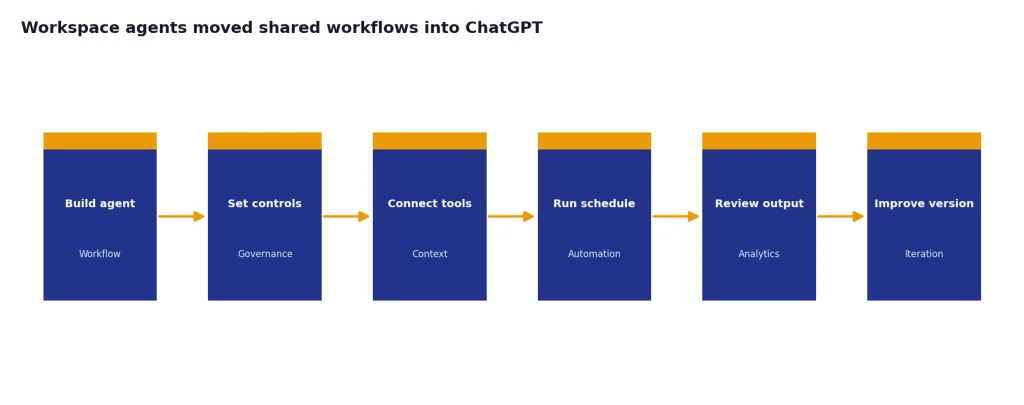
Workspace agents may be the most important business release of the week. OpenAI introduced them on April 22, 2026, as Codex-powered agents for teams.[4] They are shared agents that can handle complex tasks and long-running workflows inside the permissions and controls set by an organization.[4]
OpenAI says workspace agents are an evolution of GPTs. They can prepare reports, write code, respond to messages, run in the cloud, and keep working when the user is away.[4] The launch blog says teams can use agents in ChatGPT or Slack, and can create an agent by clicking Agents in the ChatGPT sidebar and describing a repeated workflow.[4]
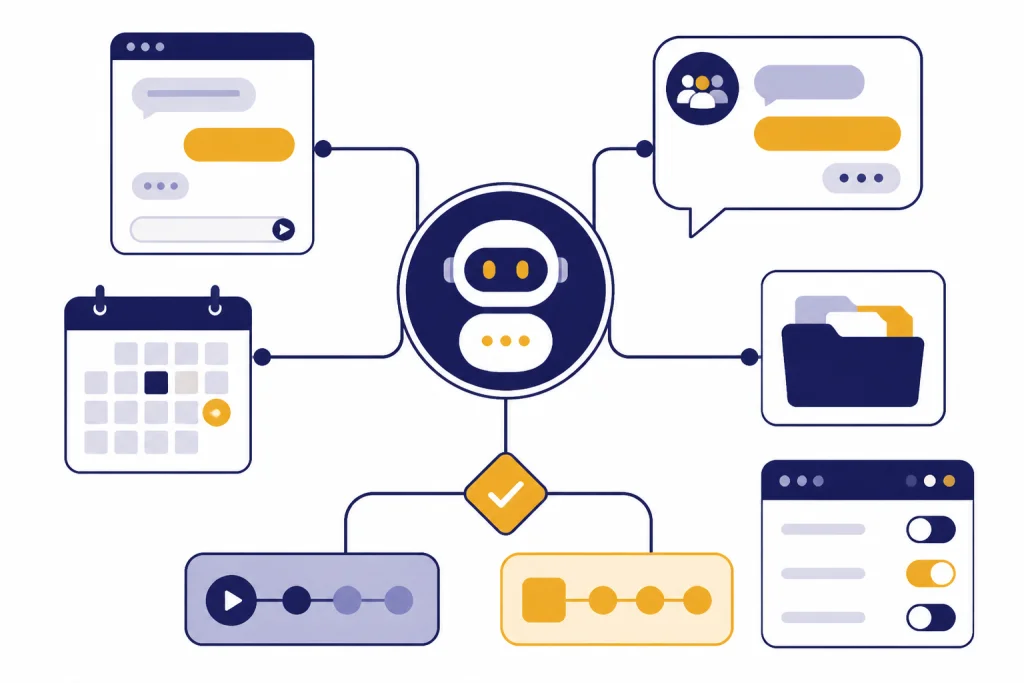
The Enterprise and Edu release notes add operational detail. Eligible workspaces can create agents from templates or from scratch, connect tools such as Google Drive, Google Calendar, Slack, and SharePoint, add skills, files, and custom MCP servers, share agents privately or in a workspace directory, schedule recurring runs, use agents in Slack channels, and view version history and analytics.[5] Admins can manage building, publishing, and Slack usage, and workspace agents are off by default at launch.[5]
This is a clear move from individual productivity to organizational automation. A custom GPT usually helps one person or one team ask better questions. A workspace agent is meant to sit inside a business process. It can be governed, reused, scheduled, and improved over time. That matters for companies that need auditability, access control, and repeatable outputs.
| Feature | Custom GPTs | Workspace agents |
|---|---|---|
| Main purpose | Reusable chat behavior | Repeatable business workflows |
| Run style | User starts a conversation | Can run in ChatGPT, Slack, and on schedules[5] |
| Tools | Depends on GPT setup | Can connect to workplace apps, files, skills, and custom MCP servers[5] |
| Governance | Workspace controls vary by plan | Admin controls for building, publishing, Slack usage, and connected actions[5] |
| Best fit | Prompted help and reusable assistants | Cross-tool tasks that repeat across teams |
Pricing is not fully settled in the public launch post. OpenAI says workspace agents are free until May 6, 2026, and that credit-based pricing starts on that date.[4] OpenAI has not published an official credit rate for workspace agents in the launch post. Buyers should wait for the rate card before modeling total cost.
ChatGPT for Clinicians put healthcare on the product roadmap
OpenAI launched ChatGPT for Clinicians on April 22, 2026.[6] The product is free for verified U.S. physicians, nurse practitioners, physician assistants, and pharmacists.[6] OpenAI says it is designed to support documentation, evidence review, medical research, trusted clinical search, citations, reusable skills, deep research across medical literature, and CME credit support on eligible clinical questions.[1]
This is a major vertical move. OpenAI is not just releasing a general model and telling clinicians to adapt it. It is creating a separate workspace for a regulated professional setting. The release notes say clinicians can use the same ChatGPT account to sign up, and that ChatGPT for Clinicians appears as a separate workspace under the same login.[1]
OpenAI also introduced HealthBench Professional, an open benchmark for clinician chat tasks across care consult, writing and documentation, and medical research.[6] OpenAI says physician advisors tested 6,924 conversations before release and rated 99.6% of responses as safe and accurate overall.[6] Those are OpenAI-reported development figures. They should be read as launch evidence, not a reason to remove clinician judgment.
The most important sentence in the release is also the most cautious one: OpenAI says ChatGPT for Clinicians is designed to support clinicians with information, not replace their judgment or expertise.[6] That framing matters. Medical tools need careful deployment, patient privacy controls, institution-level policy, and human responsibility. This release is best understood as clinical support, not autonomous care.
For readers who are new to the company behind these releases, start with what OpenAI is. For broader legal and policy context around OpenAI’s business and risks, follow OpenAI lawsuits in 2026.
Codex became a broader enterprise push
Codex was not only a coding story this week. OpenAI said on April 21, 2026, that more than 3 million developers were using Codex every week in early April, and that the number had grown to more than 4 million two weeks later.[7] The company also launched Codex Labs and named Accenture, Capgemini, CGI, Cognizant, Infosys, PwC, and Tata Consultancy Services as global systems integrator partners.[7]
The Codex enterprise push has two sides. First, OpenAI wants engineering teams to use Codex across the software development lifecycle. Second, it wants large consultancies to help deploy Codex inside complex companies that need change management, integrations, security review, and procurement support. That is how many enterprise software platforms move from pilots to standard tools.

OpenAI’s separate Codex product update on April 16, 2026, said Codex can operate a computer alongside a user, work with more tools and apps, generate images, remember preferences, learn from previous actions, and take on ongoing and repeatable work.[9] It also said the Codex app added deeper developer workflow support such as reviewing pull requests, viewing multiple files and terminals, connecting to remote devboxes over SSH, and using an in-app browser.[9]
This explains why Codex keeps appearing across OpenAI’s product announcements. Workspace agents are powered by Codex. GPT-5.5 is positioned partly around agentic coding. Codex itself is expanding beyond code into browser-based work, memory, ongoing tasks, and tool use. For a deeper company-finance view of why enterprise adoption matters, see OpenAI funding history, the OpenAI funding round breakdown, and ChatGPT stock news.
Privacy Filter added an open-weight safety tool
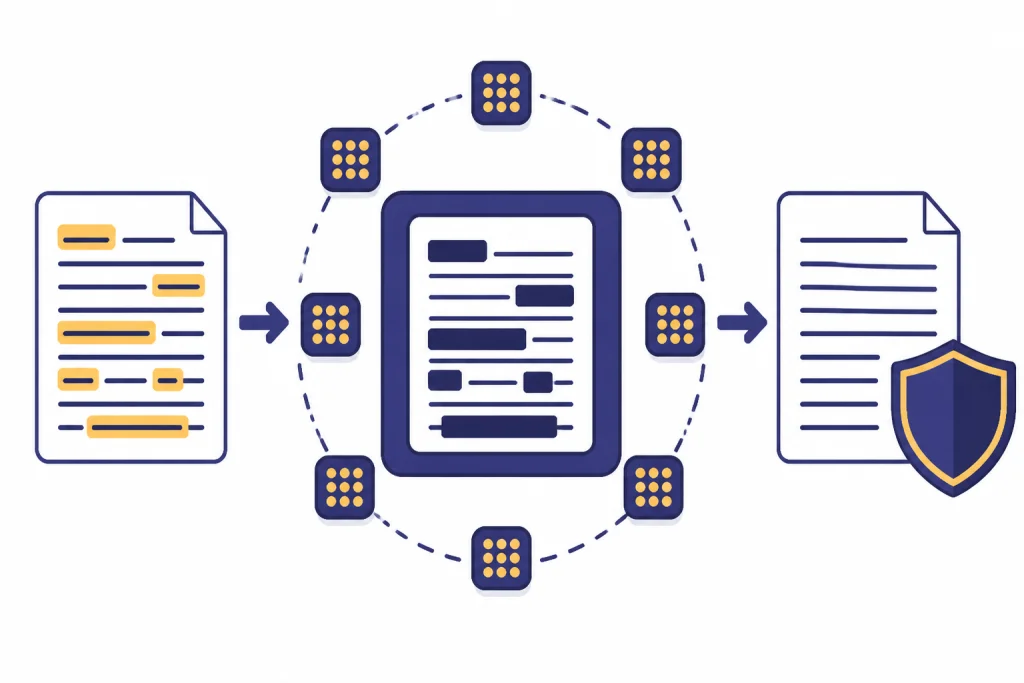
OpenAI also released OpenAI Privacy Filter on April 22, 2026.[8] It is an open-weight model for detecting and redacting personally identifiable information in text.[8] OpenAI says it can run locally, which means data can be masked or redacted without leaving the user’s machine.[8]
The details are useful for developers. Privacy Filter is a bidirectional token-classification model with span decoding. OpenAI says it supports up to 128,000 tokens of context, has 1.5B total parameters, and uses 50M active parameters.[8] It predicts spans across eight categories: private person, private address, private email, private phone, private URL, private date, account number, and secret.[8]
OpenAI reported an F1 score of 96% on PII-Masking-300k, with 94.04% precision and 98.04% recall, and a 97.43% F1 score on a corrected version of that benchmark.[8] It also said fine-tuning on a small amount of domain data improved F1 from 54% to 96% on the domain-adaptation benchmark it evaluated.[8] These are promising figures, but teams should test the model on their own data before relying on it in high-sensitivity workflows.
This release fits the week’s larger pattern. As OpenAI pushes agents into documents, business tools, codebases, and healthcare workflows, privacy infrastructure becomes more important. A local PII redaction model can help teams build safer training, logging, indexing, and review pipelines. It is not a compliance certificate, and OpenAI says it is not a substitute for policy review in high-stakes settings.[8]
What to watch next
The next OpenAI news to watch is adoption, not just launch volume. GPT-5.5 needs production feedback from ChatGPT users and API developers. ChatGPT Images 2.0 needs evidence that it can handle controlled revisions and repeatable visual work. Workspace agents need pricing details, admin feedback, and real examples of reliable scheduled work. ChatGPT for Clinicians needs careful scrutiny from clinicians, hospitals, regulators, and patient privacy experts.
For business buyers, the workspace agent rate card is the immediate question because OpenAI says credit-based pricing starts on May 6, 2026.[4] For developers, the immediate question is how GPT-5.5 performs in the API against existing production workloads. For healthcare readers, the immediate question is how verification, data handling, and clinical governance work in practice.
It is also worth watching Microsoft and OpenAI partnership updates, because cloud access, enterprise distribution, and API availability can change how quickly new OpenAI features reach businesses. Follow OpenAI Microsoft news and OpenAI API pricing for the commercial side of these releases.
The broad direction is easier to see than the exact timeline. OpenAI is building toward a platform where models, agents, files, apps, code, images, and specialized workspaces are connected. This week’s releases made that strategy more visible.
Frequently asked questions
What was the biggest OpenAI news this week?
The biggest story was GPT-5.5, because it affects ChatGPT, the API, Codex-style work, and OpenAI’s broader agent strategy. OpenAI released GPT-5.5 in ChatGPT on April 23, 2026, and said GPT-5.5 and GPT-5.5 Pro were available in the API on April 24, 2026.[1][2]
Is ChatGPT Images 2.0 available to free users?
OpenAI’s release notes say ChatGPT Images 2.0 is available on all ChatGPT plans.[1] The “images with thinking” feature is different. OpenAI says that option is available on paid plans when users select Thinking and Pro models.[1]
Who can use workspace agents?
OpenAI says workspace agents are available in research preview for ChatGPT Business, Enterprise, Edu, and Teachers plans.[4] The Enterprise and Edu release notes say eligible workspaces can build agents, connect workplace apps, schedule recurring runs, and use agents in connected Slack channels.[5] Admins control access, and the feature is off by default at launch.[5]
Is ChatGPT for Clinicians a replacement for doctors?
No. OpenAI says ChatGPT for Clinicians is designed to support clinicians with information, not replace their judgment or expertise.[6] It is best understood as a clinical support workspace for tasks such as evidence review, documentation, medical research, and citation-backed lookup.
What is OpenAI Privacy Filter?
OpenAI Privacy Filter is an open-weight model for detecting and redacting personally identifiable information in text.[8] OpenAI says it can run locally and supports up to 128,000 tokens of context.[8] It is useful infrastructure, but it is not a complete compliance program.
Did OpenAI announce new ChatGPT pricing this week?
OpenAI did not announce a new general ChatGPT consumer price in the launches covered here. It did say workspace agents will be free until May 6, 2026, with credit-based pricing starting after that.[4] OpenAI has not published an official workspace agent credit rate in the launch post.