
ChatGPT roast prompts work best when they give the model a clear target, a comic angle, a boundary, and a format. The goal is not to make ChatGPT meaner; it is to make the joke sharper, more specific, and still safe to share. This guide gives you copy-paste prompts for self-roasts, friend roasts, group chat jokes, bios, outfits, brands, fictional characters, social posts, and image descriptions. It also includes real before-and-after examples so you can see the difference between a lazy roast, a funny roast, and a safer rewrite. Use these prompts when everyone involved has opted in and the tone is clearly playful.
What makes a good ChatGPT roast prompt
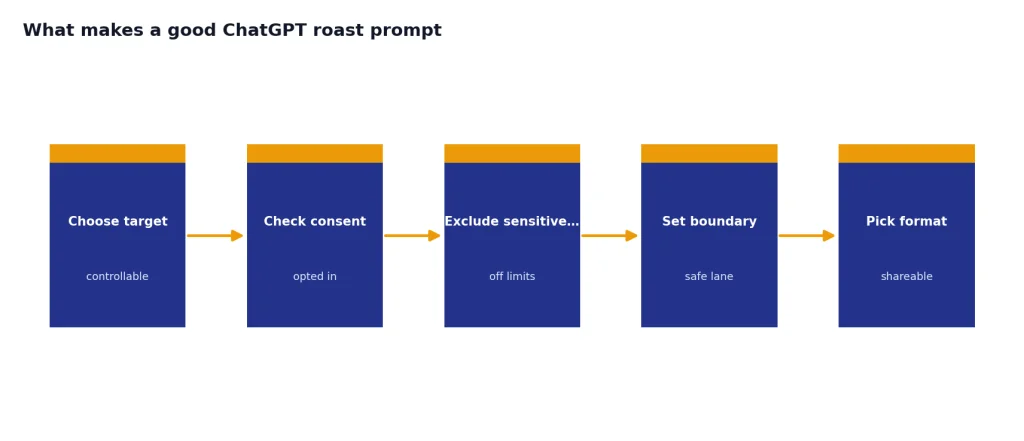
A good roast prompt is specific, playful, and bounded. It tells ChatGPT what to tease, what to avoid, and what kind of joke shape you want. A roast, in the comedy sense, is humorous criticism or jokes made about someone for entertainment, not a serious attack.[5] That distinction matters: ChatGPT usually produces better jokes when the target is a choice, habit, object, writing style, public persona, fictional flaw, or obvious contradiction rather than a sensitive personal trait.
The best chatgpt roast prompts include consent. Write as if the person being roasted asked for it. OpenAI’s usage policies prohibit using its services for threats, intimidation, harassment, or defamation, so your prompt should not ask ChatGPT to humiliate, threaten, or target someone in a way that crosses that line.[2]
Use this simple safety filter: roast the thing, not the person’s dignity. Good targets include an overstuffed calendar, a vague bio, a dramatic coffee order, a brand slogan that says nothing, a fictional villain’s terrible planning, or your own habit of opening 47 tabs and calling it “research.” Avoid race, religion, disability, body type, sexuality, age, private trauma, medical conditions, and anything the person cannot reasonably control.
If you want a broader prompt library, start with our chatgpt prompt generator. For entertainment prompts beyond roasts, try Fun ChatGPT Prompts to Try Today. For character-driven jokes and bits, pair this guide with ChatGPT Creative Prompts for Storytellers.
Quick-start roast prompt template
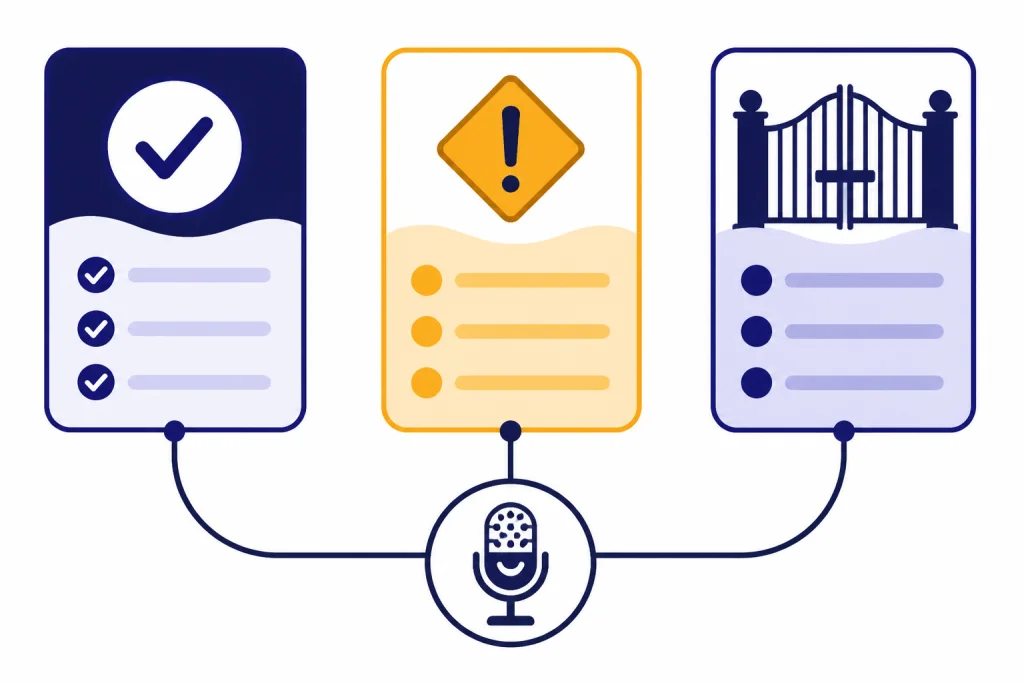
Use this template when you want a fast roast without rebuilding the prompt each time. It gives ChatGPT the target, joke lane, boundary, and output format. OpenAI’s prompting guidance recommends clear instructions, helpful context, and details about tone, format, length, audience, and constraints.[1]
Roast the following [bio / outfit description / hobby / workspace / brand copy / fictional character] in a playful way.

Keep it clever, specific, and light. Focus only on choices, habits, wording, style, or obvious contradictions. Do not mention protected traits, body type, medical issues, money, trauma, family, or anything private.

Give me [short one-liners / a paragraph / a mock award speech / a group chat reply / captions].

Target: [paste target here]
That template is intentionally plain. You can make it funnier by adding a voice: “dry sitcom narrator,” “supportive friend who has had enough,” “overly serious museum curator,” “sports commentator calling a disaster,” or “HR-safe stand-up comic.” ChatGPT’s personality settings can influence style, but OpenAI says ChatGPT still matches tone and style to the user’s instructions and the context of the request.[4]
Here is a safer version for roasting yourself.
Roast me based only on the details I provide.

Make it funny, self-aware, and oddly affectionate. Avoid appearance, identity, family, trauma, health, money, or anything cruel. The roast should sound like a friend who knows me well but still wants to be invited back.

Details: [paste details]
Here is a stronger version for a roast battle between fictional personas.
Create a playful roast battle between these fictional personas.

Keep the jokes witty, fast, and non-hateful. Each line should target decisions, habits, dramatic flaws, or contradictions, not identity or protected traits.

Personas: [paste personas]
Example 1: weak prompt → roast → safer/funnier rewrite
| Step | Illustrative example |
|---|---|
| Weak prompt | Roast my desk. |
| Likely generic output | Your desk looks like productivity walked in, saw the situation, and quietly backed out. |
| Better prompt | Roast my desk like a mock-serious museum curator. Details: three cold coffee cups, a notebook labeled “important,” sticky notes on top of other sticky notes, and a plant fighting for custody of the sunlight. Keep it self-directed and workplace-safe. |
| Safer, funnier output | Here we see “The Modern Knowledge Worker, Unsupervised,” a mixed-media installation featuring fossilized coffee, a notebook boldly titled “important” with no visible evidence, and a plant bravely photosynthesizing through what can only be described as administrative fog. |
Copy-paste ChatGPT roast prompts
Use the prompts below as starting points. Replace the bracketed text with your own details. If a prompt asks for a person, use it only when that person has opted in or when you are roasting yourself. If you need prompts for captions, scripts, or short-form posts, our chatgpt social media prompts for every platform and ChatGPT for YouTubers guides pair well with this one.
Self-roast prompts
Roast my daily routine like a disappointed productivity coach who still believes in me.

Keep it funny and specific. Do not mention appearance, health, money, or family.

Routine: [paste routine]
Turn these facts about me into a kind but savage self-roast.
Make it sound like a friend giving a wedding toast after one espresso too many.
Facts: [paste facts]Roast my taste in hobbies.
Focus on the choices, the contradictions, and the overly dramatic commitment. Keep it affectionate.
Hobbies: [paste hobbies]Example 2: self-roast with contrast and escalation
| Step | Illustrative example |
|---|---|
| Weak prompt | Roast my routine. |
| Better prompt | Roast my routine using contrast and escalation. Details: I wake up early to journal, then spend 40 minutes choosing a productivity playlist, then answer one email and reward myself with a break. Keep it affectionate. |
| Example output | You built a whole executive morning routine so you could arrive, spiritually prepared, at the heroic act of answering one email. The playlist selection had the intensity of a film score meeting, and the reward break really tied the empire together. |
Bio and profile roast prompts
Roast this social bio.

Focus on clichés, vague phrases, humblebrags, and main-character energy. Keep it playful and avoid anything personal or identity-based.

Bio: [paste bio]
Rewrite this profile as a roast that still makes the person sound likable.
Give me a short paragraph, then three punchier one-liners.
Profile: [paste profile]Roast this dating profile as if you are a brutally honest but kind editor.
Target wording, clichés, and contradictions only. Do not insult appearance, age, identity, job, or lifestyle.
Profile: [paste profile]Outfit and room roast prompts
Roast this outfit description like a fashion critic who is trying very hard to be invited to brunch afterward.

Keep it witty, not cruel.

Outfit: [paste description]
Roast this room setup based only on decor choices and organization.
Avoid income, cleanliness shaming, or personal attacks. Make it sound like a home makeover show with zero budget and too much confidence.
Room: [paste description]Brand and business roast prompts
Roast this brand slogan like a sharp but constructive creative director.

Explain what makes it generic, then give better alternatives. Keep the roast about the copy, not the people.

Slogan: [paste slogan]
Roast this landing page copy as if it is trying to win an award for saying everything and nothing at once.
After the jokes, give practical edits.
Copy: [paste copy]Business roasts can be useful because humor exposes weak wording. If you want the constructive version without jokes, use ChatGPT Business Prompts for Owners, ChatGPT Sales Prompts for Closers, or chatgpt customer service prompts and templates.
Example 3: brand-copy roast that still helps
| Input | Illustrative output |
|---|---|
| Slogan: “Empowering tomorrow through innovative solutions.” | This slogan just walked into a conference room, clicked to slide one, and immediately forgot what company it works for. It has the confidence of a mission statement and the nutritional value of packing peanuts. Better alternatives: “Turn messy team updates into clear next steps,” “Launch projects without the status-meeting spiral,” or “Less chasing. More shipping.” |
Fictional character roast prompts
Roast this fictional character for their decisions, dramatic habits, and obvious blind spots.

Do not use slurs or hateful jokes. Make it sound like a recap host who cannot believe what just happened.

Character: [paste character and context]
Create a roast monologue about this villain.
The joke should be that their plan is wildly overcomplicated. Keep it clever and theatrical.
Villain: [paste villain]
Roast prompt formulas that work
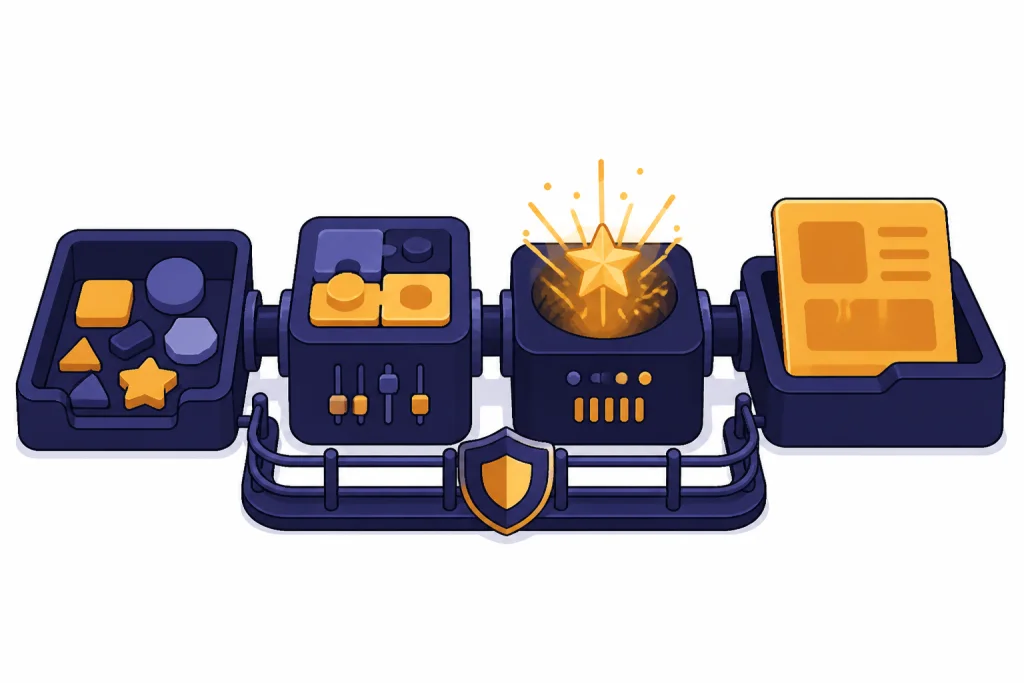
A roast prompt is easier to control when you build it from parts. The most reliable formula is: target, angle, boundary, format. The target tells ChatGPT what to joke about. The angle tells it what kind of comedy to use. The boundary tells it what not to touch. The format tells it how the output should look.
| Formula part | What to write | Example |
|---|---|---|
| Target | The object, text, habit, or persona being roasted | My overpacked travel itinerary |
| Angle | The comic lens | Airport dad with a clipboard |
| Boundary | Topics ChatGPT must avoid | No appearance, money, family, health, or identity jokes |
| Format | The shape of the answer | Short one-liners followed by a kinder rewrite |
Here is the same formula as a reusable prompt.
Target: [what to roast]
Angle: [comic voice or situation]
Boundary: [topics to avoid]
Format: [one-liners, paragraph, captions, mock review, speech]
Task: Write a funny roast that stays inside the boundary and uses the angle consistently.
To get less generic jokes, ask for a specific comedy technique. These are easy to request directly.
| Comedy technique | How it works | Prompt phrase to use |
|---|---|---|
| Misdirection | Starts like a compliment, then swerves into the joke | Use misdirection: begin each line as praise, then reveal the absurd flaw. |
| Contrast | Compares the target’s ambition with the underwhelming reality | Use contrast between how serious this seems and how low-stakes it actually is. |
| Callback | Repeats a detail later for a stronger final punchline | Use one detail as a callback in the last line. |
| Mock-serious framing | Treats something silly like a major cultural event | Describe this like a museum curator, courtroom expert, or breaking-news analyst. |
| Escalation | Each line gets slightly more dramatic | Write five one-liners that escalate from mild teasing to theatrical exaggeration. |
| Absurd analogy | Compares the target to an unexpected image or situation | Use absurd but harmless analogies; avoid insults about the person’s body or identity. |
You can also ask ChatGPT to generate roast angles before writing the roast. This works well when the first output feels obvious.
Before writing the roast, give me several possible comic angles for this target.

Avoid cruel or personal angles. After I choose one, write the roast in that style.

Target: [paste target]
For image-based humor, use this same structure with a visual target. If you want a broader library for visual prompting, see Best ChatGPT Image Prompts. If you want exaggerated but friendly visual satire, ChatGPT Caricature Prompts is the better companion guide.
How to tune the roast tone
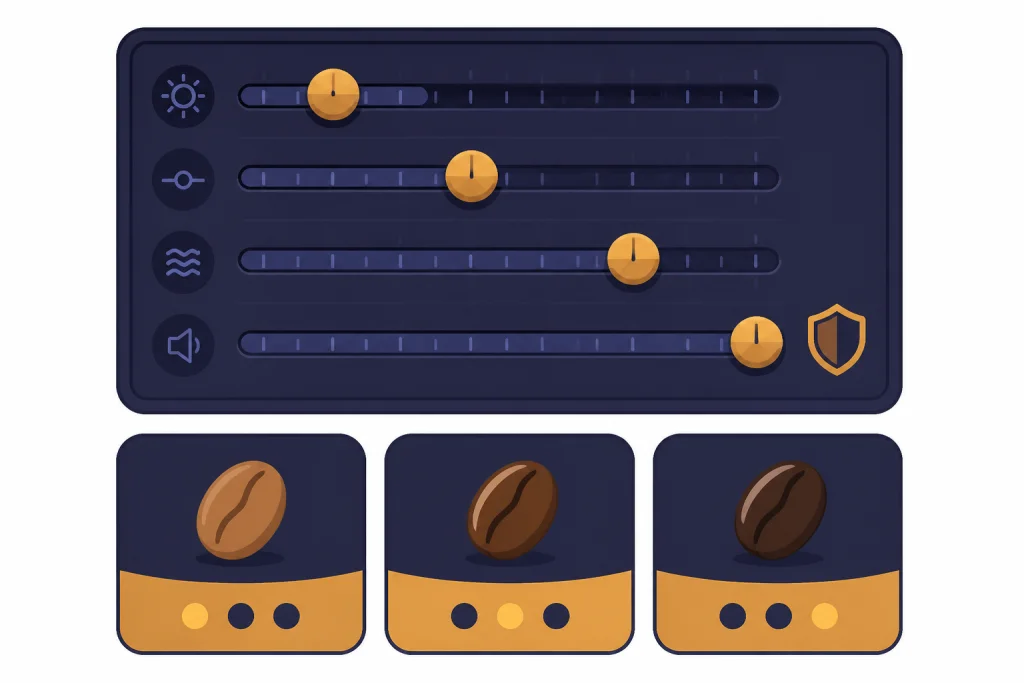
Tone is the difference between funny and uncomfortable. Ask for the intensity you want before ChatGPT writes the roast. Do not use vague words like “savage” unless you also define the boundaries. “Savage but affectionate” is better. “Spicy but safe for a work chat” is better. “Mean about the bad slide deck, not about the person” is clearer still.
| Tone lane | Best for | Prompt phrase | Avoid |
|---|---|---|---|
| Gentle | Friends, family, classrooms, first attempts | Make it affectionate and low-stakes | Anything that could embarrass someone publicly |
| Dry | Bios, work habits, brand copy | Use deadpan humor and understatement | Overly dramatic insults |
| Spicy | Self-roasts and opt-in group chats | Be sharper, but keep the joke about choices | Identity, appearance, health, family, trauma, money |
| Constructive | Marketing, writing, resumes, presentations | Roast the weak parts, then give useful edits | Roasting the person behind the work |
When a roast will be shared at work, choose dry or constructive. A workplace roast should target a slide deck, a calendar habit, or jargon, not a coworker’s personal life. The same principle applies to school settings: keep the target fictional, self-selected, or clearly educational. For safer classroom-style prompting, see ChatGPT Teacher Prompts and ChatGPT Student Prompts for Better Grades.
You can also ask ChatGPT to produce multiple intensity levels, then choose the one that fits the room.
Write three versions of this roast: gentle, dry, and spicy.

All versions must avoid appearance, identity, health, family, money, trauma, and private information.

Target: [paste target]
Mini example: same target, different tone
| Tone | Illustrative roast of “a 38-tab research session” |
|---|---|
| Gentle | You opened 38 tabs because apparently one question needed a small academic conference. |
| Dry | The browser is not a filing system, but it is brave of you to keep testing the theory. |
| Spicy | At this point your laptop is less a computer and more a museum of abandoned intentions. |
Roast prompts for social media and images
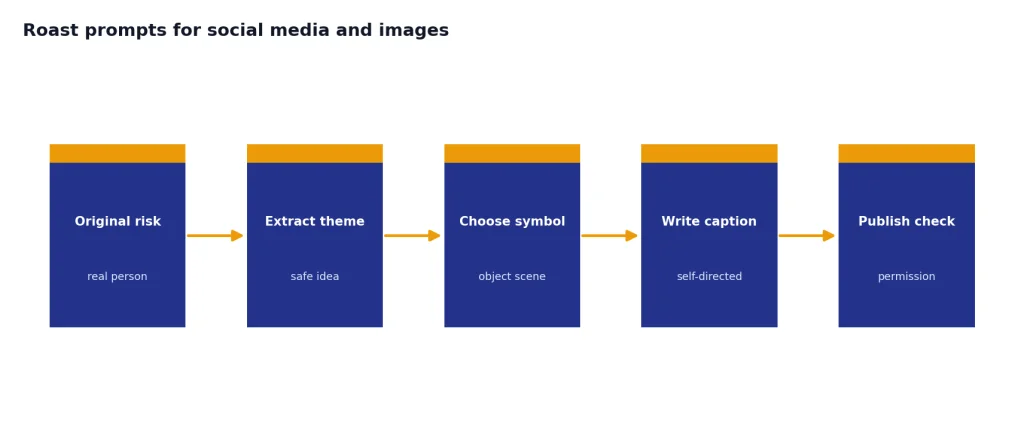
Roast prompts can work well for captions, comment replies, short videos, and image descriptions, but public sharing raises the stakes. Keep the target broad or self-directed. Roast your own messy desk, your brand’s overcomplicated launch plan, a fictional archetype, or a common internet behavior. Do not turn a private person into content without permission.
Try these public-safe versions.
Write playful roast captions about my own messy desk.

Keep the humor self-directed, clever, and safe for a professional audience.

Desk details: [paste details]
Create short roast-style video hooks about common productivity mistakes.
Do not insult viewers. Make the joke about the habit, then offer a useful fix.Write a light roast of this fictional influencer archetype.
Keep it broad, satirical, and not about any real person.
Archetype: [paste archetype]For image prompts, avoid asking for humiliating depictions of real people. Ask for a symbolic scene instead. “A calendar buried under sticky notes” is safer and more useful than “make my coworker look chaotic.” If you like trend-based visual prompting, compare this with ChatGPT Action Figure Prompts or ChatGPT Studio Ghibli Style Prompts.
Image-safe rewrite example
| Instead of | Use this |
|---|---|
| Make a roast image of my coworker looking chaotic. | Create a symbolic cartoon scene of a calendar buried under sticky notes, three coffee cups, and a tiny flag that says “this could have been an email.” Make it playful, not personal. |
When not to use roast prompts
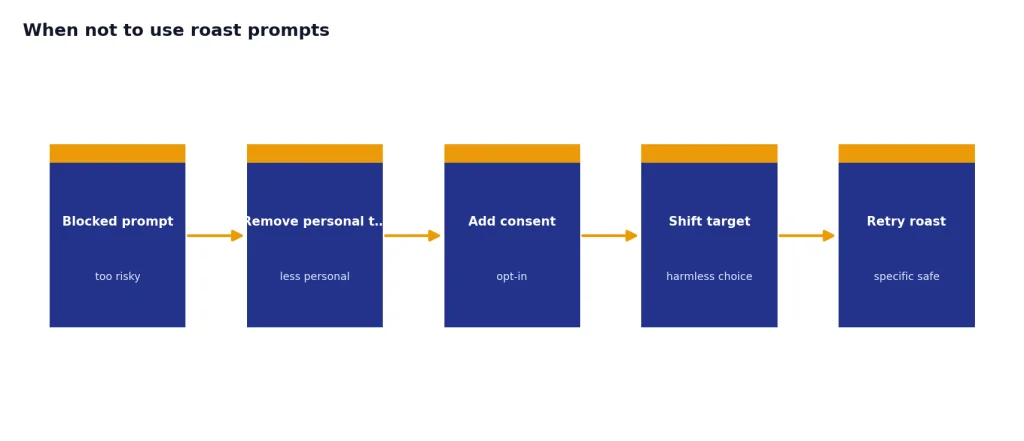
Do not use roast prompts when the target has not opted in and could reasonably feel attacked. Do not use them during conflict, performance reviews, disciplinary conversations, customer complaints, hiring, grading, or any situation where the person has less power than you. Humor does not erase context.
Do not use roast prompts to pressure ChatGPT around safety filters. OpenAI’s Help Center says prompts can be blocked when they may encourage activity against its Terms of Use or Usage Policies, include potentially harmful or inappropriate content, or appear to manipulate or circumvent content policies.[3] If your roast prompt gets blocked, rewrite it to be more specific, less personal, and clearly consent-based.
Also avoid roast prompts for legal, medical, financial, or HR decisions. A joke can expose weak writing, but it should not replace professional judgment. If your real goal is a sensitive workplace document, use chatgpt hr prompts for hiring and onboarding or ChatGPT Legal Prompts instead.
Troubleshooting bad roasts
Bad roasts usually fail in predictable ways. They are too generic, too mean, too long, or too dependent on clichés. Fix the prompt instead of asking ChatGPT to “try again” with no guidance.
| Problem | Why it happens | Better follow-up prompt |
|---|---|---|
| The roast sounds generic | The target lacks details | Use only the specific details I gave. No generic jokes or filler. |
| The roast is too harsh | The prompt asked for intensity without limits | Rewrite it as affectionate teasing. Keep the punchlines about choices, not the person. |
| The roast is not funny | The angle is flat | Give me alternate comic angles before rewriting. |
| The roast is too wordy | The format was undefined | Make each line short enough to send in a group chat. |
| The roast feels unsafe | The target is too personal | Shift the joke to the object, habit, wording, or fictional scenario. |
Here is a follow-up prompt that fixes most weak outputs.
Revise the roast.

Make it more specific, less cruel, and more surprising. Remove any joke that depends on appearance, identity, money, family, health, trauma, or private information.

Add a clever twist at the end.
Before-and-after troubleshooting example
| Version | Illustrative text |
|---|---|
| Weak output | Your bio is boring and basic. |
| Follow-up prompt | Make the roast specific and playful. Focus on the phrases “building cool things,” “coffee enthusiast,” and “DM for collabs.” Use mock-serious framing and one callback. Do not insult the person. |
| Improved output | This bio says “building cool things” with the confidence of a product launch and the detail level of a fog machine. “Coffee enthusiast” is doing a lot of emotional labor here, and “DM for collabs” arrives like a velvet rope outside an empty conference room. Still, the mystery is consistent: even the cool things signed an NDA. |
If you want to build your own reusable set, save your best templates in a prompt library. Our Best ChatGPT Prompt Generator Tools guide can help if you want software support for organizing and improving prompts.
Frequently asked questions
What are ChatGPT roast prompts?
ChatGPT roast prompts are instructions that ask ChatGPT to write playful criticism, jokes, or mock commentary about a chosen target. The target can be a bio, habit, outfit description, brand slogan, fictional character, or your own routine. The best prompts tell ChatGPT what to joke about, what tone to use, and what to avoid.
How do I make a roast funny without being cruel?
Focus on choices, habits, wording, contradictions, and situations. Add a technique such as misdirection, contrast, callback, mock-serious framing, escalation, or absurd analogy. Use a line such as “make it affectionate, not humiliating” to keep the tone clear.
Can I use these prompts to roast a friend?
Use them only if your friend has opted in or you know the context is clearly playful. Even then, keep the target light and avoid sensitive details. A good friend roast should sound like teasing from someone who wants the friendship to continue.
Why did ChatGPT refuse or block my roast prompt?
ChatGPT may block prompts that look harmful, inappropriate, harassing, illegal, or designed to bypass safeguards. Rewrite the request so it is consent-based, non-hateful, and focused on harmless targets. If the prompt names a real person, make the joke about public wording, a self-selected habit, or a fictionalized scenario instead.
What is the best roast prompt for beginners?
Start with: “Roast this in a playful, affectionate way. Focus only on choices, wording, habits, and contradictions. Use misdirection and one callback. Avoid appearance, identity, family, health, money, trauma, and private information.” Then paste the target and ask for short one-liners.
Can ChatGPT roast images?
ChatGPT can respond to image descriptions or uploaded images when your version supports image input. Keep image roasts self-directed or permission-based. Ask it to roast decor, layout, composition, styling choices, or a symbolic scene rather than a person’s body or identity.