


ChatGPT business prompts work best when they help an owner turn a messy task into a clear draft, checklist, decision memo, or customer message. This guide gives you copy-paste prompts for planning, marketing, sales, customer service, operations, finance, hiring, and decisions, but the bigger value is knowing which prompts deserve weekly use, which ones are risky, and which ones produce the highest return for a small team.
Use these prompts as working drafts, not final authority. Add your actual business details, ask ChatGPT to state assumptions, and review anything involving money, legal obligations, hiring, health, taxes, customer promises, or current facts before you act. The goal is not to make ChatGPT run your company. The goal is to build a repeatable prompt library that saves time on first drafts, structured thinking, and follow-through.
How to use these ChatGPT business prompts
These ChatGPT business prompts are built for owners, founders, freelancers, operators, and small teams that need usable drafts quickly. They assume you know your business better than the model does. Your job is to supply the facts. ChatGPT’s job is to organize those facts, spot gaps, generate options, and give you something concrete to edit.
OpenAI describes prompt engineering as the process of designing and optimizing prompts to guide a language model’s responses, and its guidance emphasizes clear, specific instructions, context, iteration, and tone direction.[1] That is the logic behind every prompt in this article.
For most owners, the highest-ROI prompts are not the cleverest ones. They are the repeatable prompts used every week: a weekly priority review, a customer objection analyzer, a campaign draft from one offer, an SOP builder, a cash-flow question list, and a hiring scorecard. These turn recurring bottlenecks into reusable workflows.
The riskiest prompts are the ones that sound authoritative but depend on facts ChatGPT may not know: tax treatment, employment rules, refund promises, medical or safety claims, legal clauses, competitor pricing, and current policy details. Use ChatGPT to organize your thinking, then verify the facts with your records, professional advisors, and current sources.
Start by replacing the bracketed fields. Add your product, customer type, location, price range, constraints, examples, and desired tone. If you do not have the details yet, ask ChatGPT to interview you first. The model performs better when it has real inputs instead of guessing.
For a broader system, use a reusable ChatGPT prompt generator to turn rough ideas into cleaner instructions. If your business work happens in spreadsheets, keep these ChatGPT Excel prompts for power users nearby. For daily planning, meetings, and personal workflow, pair this guide with ChatGPT productivity prompts for daily workflow.
The owner prompt framework
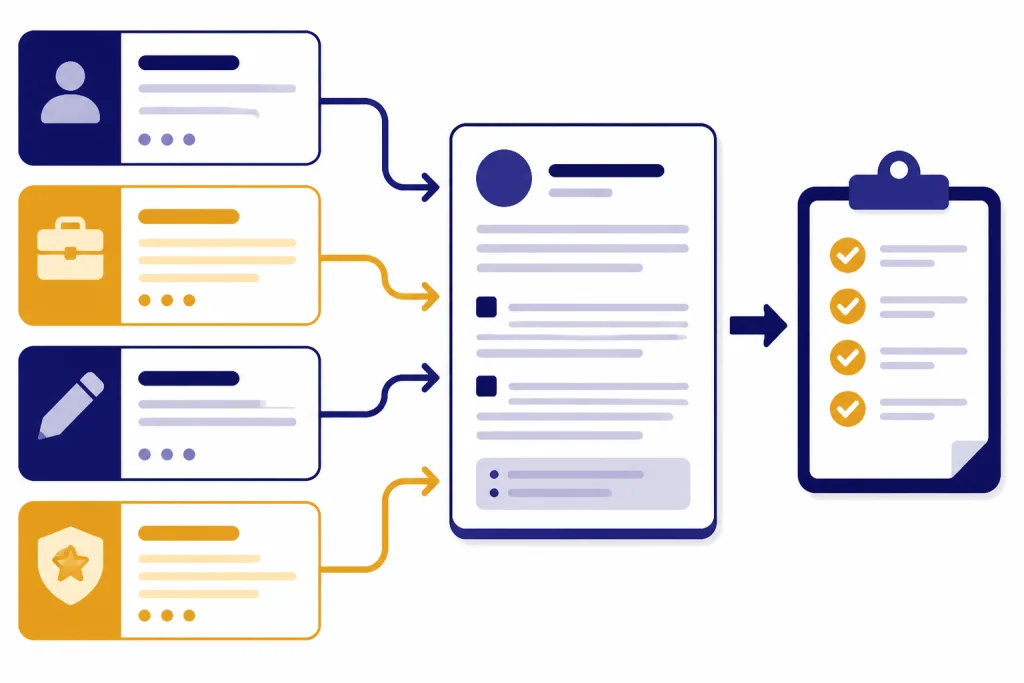
A strong business prompt has five parts: role, context, task, output format, and review standard. Leave out one of those pieces and the answer usually becomes generic. Include all five and ChatGPT has a practical lane to stay in.
| Prompt part | What to include | Owner example |
|---|---|---|
| Role | The viewpoint ChatGPT should use | Act as a practical operations advisor for a local service business. |
| Context | Your business facts and constraints | We sell recurring home maintenance plans to homeowners in Phoenix. |
| Task | The exact job | Find the top objections and write responses for each one. |
| Output format | The structure you want | Use a table with objection, likely cause, response, and follow-up question. |
| Review standard | How the answer should be checked | Flag claims that need legal, pricing, or policy review. |
Use this master prompt when you do not know where to begin:
Act as a practical business advisor for a [type of business]. My business sells [offer] to [customer type] in [market]. My current goal is [goal]. My constraints are [budget, time, team, tools, legal limits, brand standards]. Ask me up to five clarifying questions if needed. Then give me: a concise diagnosis, three practical options, the tradeoffs for each option, the first action I should take, and a checklist of facts I must verify before acting.OpenAI Academy’s small-business prompt material frames ChatGPT as useful for tasks such as drafting proposals, marketing copy, and customer communications; summarizing contracts and reports; organizing project plans; exploring opportunities; and generating templates for finance, HR, and compliance work.[2] That scope is broad, but it still requires owner judgment.
Here is how a vague owner prompt becomes useful.
| Weak prompt | Better prompt | Why it works |
|---|---|---|
| Help me get more customers. | Act as a marketing advisor for a two-person residential cleaning company in Denver. We sell recurring monthly cleanings to busy homeowners, have 10 open slots next month, and can spend only five hours per week on outreach. Create three low-cost acquisition ideas, rank them by effort and likely speed to first lead, draft one follow-up message, and list claims I should verify before publishing. | It gives the business type, market, capacity, budget constraint, desired output, and review standard. |
Illustrative ChatGPT output from the better prompt:
Fastest first lead: Reactivation outreach to past one-time customers. Effort is low because you already have context. Draft message: Hi [Name], we have a few recurring cleaning spots opening next month and thought of you because we already know your home preferences. Would you like me to send the current schedule options? Verify pricing, availability, and any discount language before sending.
The example is not a measured benchmark or a guaranteed result. It shows the practical difference between asking for growth advice and asking for a constrained, reviewable next action.
Strategy and planning prompts
Use strategy prompts when you need a clearer view of the business, not a prettier document. These prompts help with positioning, offers, pricing logic, competitive research, business planning, and decision-making. They work best when you provide specific facts, not aspirational language.
Owner POV: run one strategic prompt weekly, not ten at random. The best weekly strategy prompt is the decision memo because it forces tradeoffs. The riskiest strategy prompt is market research if you treat ChatGPT’s general knowledge as current fact. Ask for a research plan, then verify.
Business model review prompt
Act as a skeptical but constructive business model reviewer. Here is my business: [describe offer, customer, price, sales channel, fulfillment model, costs, team size, and current monthly revenue if you are comfortable sharing it]. Review the model in plain English. Identify the strongest part, the weakest part, the biggest hidden risk, the easiest improvement, and the metric I should watch weekly. Do not invent numbers. If a conclusion depends on missing data, ask for it.Offer positioning prompt
You are a positioning strategist for a small business. My offer is [offer]. My best customers are [customer type]. They usually buy because [main reason]. Competitors include [competitors or alternatives]. Create five positioning angles. For each angle, include the promise, who it is for, who it is not for, proof I would need, and one headline. Keep the claims realistic and avoid hype.Decision memo prompt
Help me make a business decision. The decision is: [decision]. The options are: [options]. My goals are: [goals]. My constraints are: [constraints]. Create a one-page decision memo with context, options, pros, cons, costs to verify, risks, reversible versus irreversible parts, and your recommendation. End with the questions I should answer before deciding.Illustrative scenario: a bakery owner deciding whether to add wholesale cafe accounts could paste three options: stay retail-only, test two wholesale accounts, or hire part-time production help first. A useful output would not simply say to grow. It would separate reversible tests from commitments, identify capacity risk, and list the numbers to verify before signing anything.
Market research prompt
Act as a research assistant. I run [business] for [customer type] in [location or market]. Build a research plan to understand demand, competitors, pricing signals, and customer objections. Separate what can be learned from customer interviews, public web research, reviews, competitor websites, and my own sales data. Do not claim facts unless I provide them or you can verify them.OpenAI’s small-team business guide includes ready-to-use prompts for comparing tools and services with features, pricing, integrations, and pros and cons.[4] Treat that as a pattern: ask for a structured comparison, then verify the current facts yourself before buying.

Marketing, sales, and customer prompts
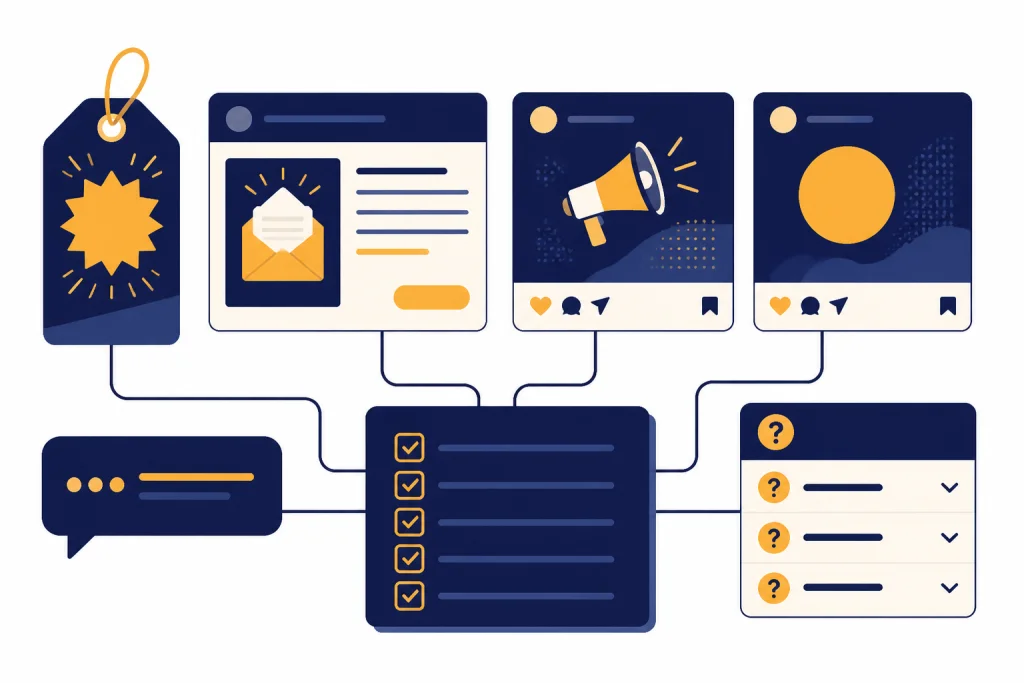
Marketing prompts should turn one real offer into usable assets. Sales prompts should clarify the buyer’s problem and the next step. Customer prompts should help you respond faster without sounding robotic. For channel-specific work, use ChatGPT social media prompts for every platform, ChatGPT SEO prompts that help you rank, and ChatGPT sales prompts for closers.
Highest ROI for small teams: use ChatGPT to repurpose one offer into several drafts, then edit only the versions you will actually publish. Highest risk: publishing claims about savings, guarantees, eligibility, medical outcomes, legal benefits, or competitor comparisons without verification.
Customer persona from real notes
Analyze these customer notes and create a practical buyer profile. Notes: [paste anonymized customer notes, call notes, reviews, survey answers, or sales emails]. Output: buyer situation, main pain points, desired outcome, objections, words customers actually use, buying triggers, and messages to avoid. Do not overgeneralize. Separate direct evidence from your interpretation.Campaign from one offer
Turn this offer into a simple campaign: [offer details]. Audience: [audience]. Channel options: [email, Instagram, LinkedIn, SMS, flyer, website banner, phone script]. Brand voice: [voice]. Create a core message, three headlines, one short email, two social captions, one SMS, one FAQ answer, and a checklist of facts to confirm before publishing.Illustrative input: A local gym offers a six-week beginner strength program for adults who feel intimidated by traditional gyms. The owner wants friendly, non-shaming copy and needs to avoid medical or guaranteed weight-loss claims.
Illustrative ChatGPT output:
Core message: Start strength training in a small, coached group where beginners are expected and questions are welcome.
Email subject: New to strength training? Start with a coach beside you.
SMS: Beginner strength group opens soon. Small class, coached sessions, no experience needed. Want the schedule?
Verify before publishing: start date, price, class size, refund policy, coach credentials, and any health or results-related wording.
Sales objection response prompt
Act as a sales coach for [business type]. My prospect said: [objection]. Context: [deal size, buyer type, stage, offer, previous conversation]. Explain what the objection might really mean. Give me three response options: direct, consultative, and soft follow-up. Include one question that moves the conversation forward without pressure.Customer service reply prompt
Draft a customer service reply. Customer message: [paste message]. Situation: [what happened]. Our policy: [policy]. Desired outcome: [refund, replacement, explanation, escalation, apology, next step]. Tone: calm, accountable, and concise. Write the reply, then list any policy or legal claims I should verify before sending.For a larger support library, use ChatGPT customer service prompts and templates. If you manage agents, recruiting, onboarding, or internal employee issues, ChatGPT HR prompts for hiring and onboarding will be more targeted than a general owner prompt.
Operations, finance, and hiring prompts
Operations prompts help you make repeatable work visible. Finance prompts help you ask better questions about cash, margins, and priorities. Hiring prompts help you define the work before you post a job. None of these replaces an accountant, attorney, payroll provider, or HR professional. Use the outputs as drafts and check them before implementation.
Owner POV: the SOP builder is often the most underrated prompt because it removes knowledge from one person’s head. The cash-flow prompt is useful, but risky if you let it become financial advice. The hiring scorecard is high leverage before you hire and much less useful after you have already written a vague job post.
SOP builder prompt
Create a standard operating procedure for this task: [task]. Business context: [business type]. Current process: [steps, tools, people involved]. Common mistakes: [mistakes]. Desired quality standard: [standard]. Output a clear SOP with purpose, owner, trigger, materials, step-by-step process, quality checks, escalation rules, and a short training checklist.Weekly owner dashboard prompt
Help me design a weekly owner dashboard. Business type: [business]. Goals: [goals]. Current data sources: [spreadsheets, POS, CRM, accounting software, manual notes]. Suggest the fewest useful metrics for sales, cash, delivery, customer satisfaction, and team capacity. For each metric, explain why it matters, how to calculate it, what a warning sign looks like, and who should own it.Make this a standing Monday prompt. Paste last week’s numbers, ask for exceptions and follow-up questions, and end by choosing no more than three owner priorities. If the dashboard becomes a giant report nobody reads, the prompt failed.
Cash flow pressure prompt
Act as a cash flow planning assistant. Here is my situation: [cash on hand, expected receivables, expected bills, payroll dates, inventory needs, debt payments, seasonal issues]. Create a plain-English cash flow risk summary. Identify the most urgent questions, possible levers, tradeoffs, and what I should ask my accountant or bookkeeper. Do not give tax or legal advice.Hiring scorecard prompt
Help me define a role before I hire. Business context: [business]. Problem this hire should solve: [problem]. Tasks I want off my plate: [tasks]. Outcomes I need in the first 90 days: [outcomes]. Create a role scorecard with mission, responsibilities, required skills, nice-to-have skills, interview questions, work-sample exercise, and red flags. Flag anything that should be reviewed for employment law compliance.If your team works with contracts, policies, or regulated language, use ChatGPT legal prompts only as a drafting aid and have a qualified professional review the final language. If your business uses property listings, buyer follow-up, or lead nurturing, ChatGPT real estate prompts for agents gives more industry-specific examples.

Prompt library by business function
Use this table when you know the business area but not the exact wording. Pick the row, copy the prompt pattern, and add your details. A prompt library becomes more useful when you save the versions that worked and delete the ones that produced vague answers.
| Business function | Best use | Prompt starter | Human review focus | Suggested cadence |
|---|---|---|---|---|
| Strategy | Choosing priorities | Compare these options against my goals, constraints, risks, and reversibility. | Assumptions, missing data, opportunity cost | Weekly or before major decisions |
| Marketing | Turning offers into campaigns | Convert this offer into messages for each channel and audience segment. | Claims, price, dates, brand voice | Before each campaign |
| Sales | Handling objections | Analyze this objection and give me three response styles with follow-up questions. | Accuracy, pressure level, promise made | Weekly, using real objections |
| Customer service | Replying with empathy | Draft a calm reply using our policy and the facts of this situation. | Policy match, legal risk, tone | As needed, then save approved versions |
| Operations | Documenting repeatable work | Turn this process into an SOP with checks, owners, and escalation rules. | Real-world feasibility, tool access, accountability | One process per week until core work is documented |
| Finance | Preparing questions for experts | Summarize my cash flow concern and list questions for my bookkeeper. | Numbers, tax treatment, professional advice | Weekly during pressure periods |
| Hiring | Defining roles | Create a role scorecard from these outcomes, tasks, and constraints. | Employment law, fairness, compensation | Before every hire |
| Learning | Getting up to speed | Teach me this concept using examples from my business and quiz me after. | Current facts, source quality, application | When entering a new topic |
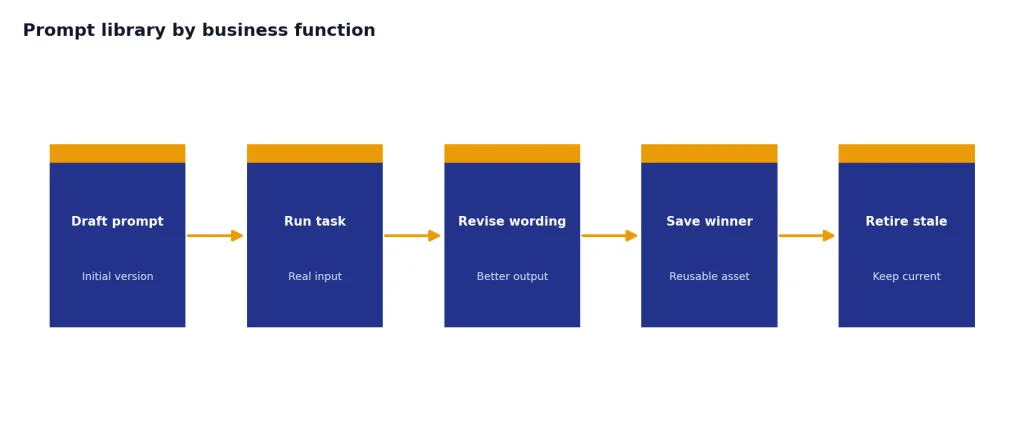
OpenAI’s prompt guidance recommends iterative refinement, which means your first prompt is rarely the final prompt.[1] Save the revised version after you get a useful answer. That turns one good interaction into a reusable business asset.
A practical owner library can be small: one prompt for Monday priorities, one for customer recovery, one for campaign drafts, one for SOPs, one for cash-flow questions, and one for hiring. If a prompt has not saved time or improved quality after a few uses, retire it.
How to improve weak outputs
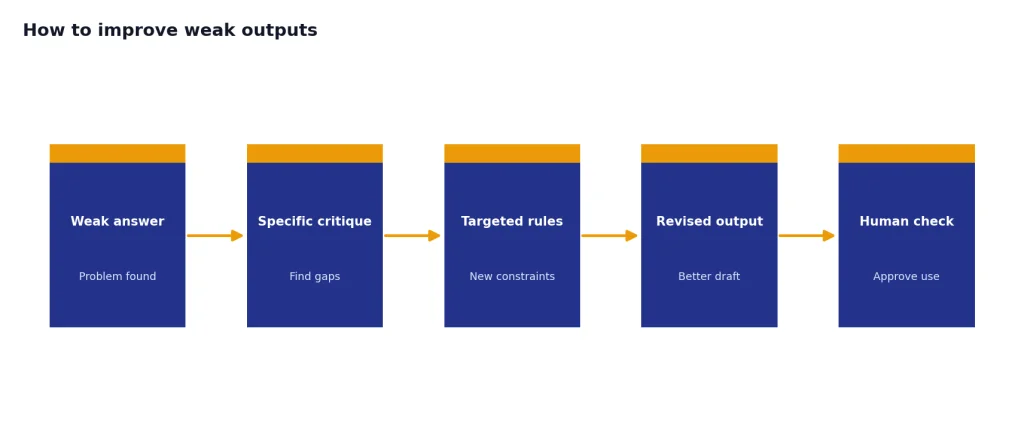
Weak ChatGPT answers usually come from weak inputs. If the output sounds generic, add real examples. If it sounds too confident, ask it to separate facts from assumptions. If it misses your tone, provide a sample of writing you like. If it gives too much, ask for a shorter format. If it gives too little, ask for options and tradeoffs.
Use this repair prompt after a bad answer:
Your previous answer was not useful because [reason]. Revise it using these rules: [rules]. Use only the facts I provided. Ask questions instead of guessing. Make the output more specific to [business, customer, offer, channel]. Format it as [format]. End with a short list of assumptions and items I must verify.Revision example:
| Problem | Repair instruction | Expected improvement |
|---|---|---|
| The draft says our service is the best and guarantees results. | Remove unverified superiority and guarantee claims. Rewrite in a helpful, specific tone using only the facts provided: licensed team, same-week scheduling when available, and written estimates. | The copy becomes safer, more believable, and easier for an owner to approve. |
| The SOP is too broad for staff to follow. | Convert it into a checklist with trigger, owner, exact steps, quality checks, and escalation rules. Keep each step to one action. | The output becomes operational instead of motivational. |
For current facts, do not rely on memory. OpenAI Academy’s small-business GPT template guidance says to use stable references for knowledge such as hours, policies, menus, FAQs, and tone examples, to put fresh inputs into the chat, and to verify current facts manually or with web search when the answer depends on them.[5]
You can also ask ChatGPT to critique its own draft. The best critique prompt is specific: ask it to find vague claims, unsupported promises, missing risks, unclear ownership, and parts that sound unlike your business. Then ask it to revise only after the critique.
If you build a larger library, group prompts by function and outcome. For example: sales follow-up, customer recovery, weekly planning, hiring, SOPs, vendor comparison, and campaign drafts. A simple naming system beats a folder full of random prompt snippets.
Business data and safety checks
Business prompts often involve sensitive information. Before pasting anything into ChatGPT, remove unnecessary personal data, confidential customer details, private employee information, payment data, credentials, and documents you do not have permission to use. An anonymized summary is often enough.
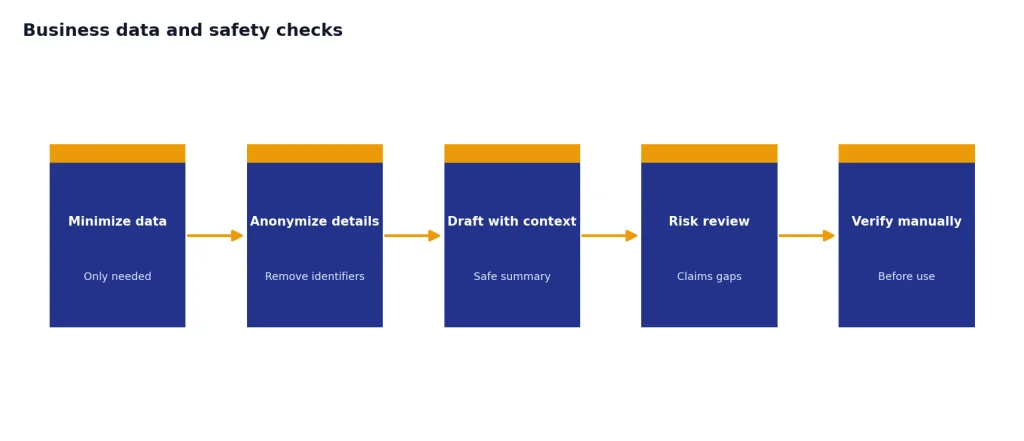
OpenAI says it does not train its models on ChatGPT Business, ChatGPT Enterprise, ChatGPT Edu, ChatGPT for Healthcare, ChatGPT for Teachers, or API platform inputs and outputs by default, and says business data is encrypted at rest and in transit.[3] That is useful for organizations, but it does not remove your responsibility to follow your own privacy, legal, and client obligations.
Use this safety check prompt before you rely on a business output:
Review this draft for business risk before I use it. Draft: [paste draft]. Business context: [context]. Identify unsupported claims, legal or tax issues, privacy concerns, customer promise risks, pricing ambiguity, operational gaps, and facts that must be verified. Do not rewrite yet. Give me a risk checklist first.For public-facing work, add a final review step. Check dates, prices, links, refund terms, warranties, eligibility rules, regulated claims, and anything that could create a promise to customers. For internal work, check whether the output assigns real owners, fits your tools, and can be followed by the people who will use it.
Frequently asked questions
What are the best ChatGPT business prompts for owners?
The best prompts are the ones tied to a real business decision or deliverable. Start with prompts for weekly priorities, customer objections, campaign drafts, SOPs, cash-flow questions, and hiring scorecards. Add your business facts and ask ChatGPT to flag assumptions before giving advice.
Can ChatGPT write a business plan?
ChatGPT can help outline and draft a business plan, but you should provide the market, costs, customer evidence, pricing, and operating assumptions. Ask it to separate confirmed facts from guesses. Treat the plan as a working document, not proof that the business will work.
Should I paste customer data into ChatGPT?
Use the minimum data needed for the task. Remove names, contact details, payment information, account numbers, and unnecessary private facts unless you have a clear business reason and permission. A summary of the situation is usually safer than a raw customer record.
How do I make ChatGPT sound like my business?
Give it examples of your existing writing, customer emails, website copy, or brand rules. Tell it what to avoid, such as hype, jargon, slang, or long sentences. Then ask for a revision that matches the examples without copying them word for word.
Can ChatGPT help with legal, tax, or HR tasks?
It can help you organize questions, draft plain-language summaries, and prepare documents for review. It should not replace a lawyer, accountant, payroll provider, or HR professional. Use it to get clearer before you talk to an expert.
How should I save my best business prompts?
Create a simple library by business function, not by random topic. Save the prompt, the input fields it needs, the output format, and an example of a good result. Review the library every few months and remove prompts that no longer match how your business works.