

The best ChatGPT sales prompts do not ask for generic persuasion. They give ChatGPT the deal context a closer actually uses: buyer role, pain, stage, objections, proof, pricing rules, next step, and tone. This guide gives you copy-paste prompts for prospect research, discovery prep, follow-up emails, objection handling, proposal cleanup, negotiation planning, and closing language. Use them as working templates, not scripts to read word for word. The goal is to sharpen your thinking, prepare cleaner questions, and write faster follow-up while keeping your judgment, ethics, CRM facts, and company AI policy in the loop.
How to use ChatGPT sales prompts
ChatGPT works best for sales when you treat it like a deal-prep assistant, not a replacement for a closer. Give it the account context, the buyer’s likely priorities, the stage of the opportunity, the proof you are allowed to use, and the action you want the buyer to take next. OpenAI’s prompt guidance recommends clear instructions, relevant context, and a specific desired format; in sales, that translates directly into better call plans, cleaner follow-up, and fewer unsupported claims.[1]
For closers, the prompt should usually include a short brief before the task. A weak prompt says, “Write a follow-up email.” A stronger prompt says, “Write a follow-up email to a CFO after a pricing call where the main concern was implementation risk. Keep it concise, reference the promised security checklist, and end with a meeting-confirmation question.”
Use these prompts in three ways: before calls to prepare discovery questions and likely objections, after calls to turn messy notes into clean follow-up, and between stages to pressure-test the deal. If you want a broader framework for building reusable templates, pair this article with our chatgpt prompt generator.
Before you paste anything into ChatGPT, check your company’s AI policy. Some organizations require approved enterprise settings, disabled training on business data, specific retention controls, SSO access, audit logs, or vendor review before customer information can be used. If you are not sure, redact. Replace sensitive details with placeholders such as [buyer role], [industry], [current vendor], and [approved proof point]. Do not paste private contact information, unredacted contracts, payment data, health information, confidential pricing terms, or regulated personal data unless your company has explicitly approved that workflow.
The sales prompt brief that improves every answer
Most bad sales outputs come from thin inputs. ChatGPT cannot know your buyer’s urgency, political risk, buying committee, or discount boundaries unless you say them. Before using any of the copy-paste prompts below, fill in a compact deal brief.
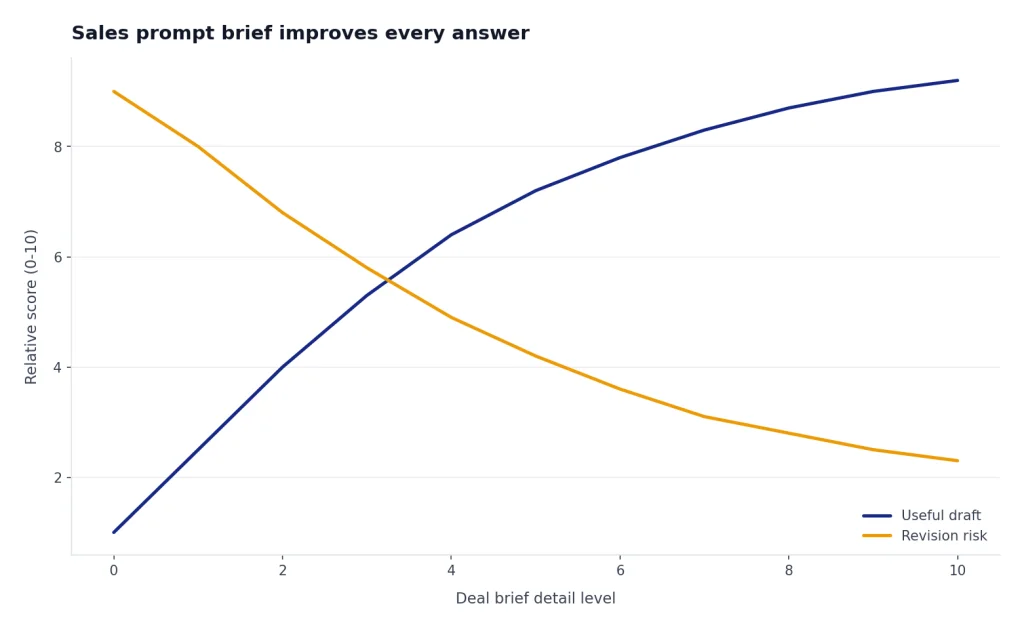
Use this structure when accuracy matters:
- Offer: What you sell and which use case matters in this deal.
- Buyer: Role, company type, maturity, likely metrics, and current pain.
- Stage: Prospecting, discovery, demo, proposal, negotiation, close, renewal, or expansion.
- Evidence: Approved customer proof, ROI claims, case studies, integrations, security details, or implementation notes.
- Constraints: Tone, length, compliance limits, discount rules, and claims to avoid.
- Next step: The specific action you want from the buyer.
OpenAI’s platform documentation also describes using examples to steer model output.[2] In sales work, examples are especially useful because tone matters. Paste one approved email that sounds like your company, then ask ChatGPT to match the structure without copying the wording.
Worked example 1: turning a weak prompt into a usable follow-up
Weak prompt: “Write a follow-up email after my demo.”
Improved brief and prompt:
Offer: Customer onboarding platform for mid-market SaaS teams.
Buyer: VP Customer Success. Main pain is slow handoff from sales to onboarding.
Stage: Post-demo.
Evidence: Buyer said their current handoff takes 10–14 days and creates churn risk. We showed CRM handoff automation and onboarding task templates.
Constraints: Do not mention ROI numbers. Keep under 140 words. No hype.
Next step: Confirm a 30-minute implementation review with RevOps.

Task: Draft a concise follow-up email that recaps what mattered, names the open implementation question, and asks for the implementation review.
Illustrative output:
Subject: Next step on onboarding handoff
Hi Maya — thanks for walking through your current sales-to-onboarding handoff today. I heard two priorities: reducing the 10–14 day delay before kickoff and giving CSMs a clearer view of what was promised during sales. The demo focused on those two areas: CRM handoff automation and reusable onboarding task templates.
The main open question seems to be how RevOps would want the CRM fields mapped. Would it make sense to schedule a 30-minute implementation review with your RevOps lead next week so we can confirm what would be required before you decide?
If you sell across multiple functions, build a small library of role-specific briefs. A CFO brief should emphasize financial exposure, predictability, and risk. A VP of Sales brief should emphasize pipeline, adoption, coaching, and forecast quality. A technical evaluator brief should emphasize implementation, security, integrations, and support ownership. For broader operating prompts outside the sales motion, see our ChatGPT Business Prompts for Owners.
Copy-paste sales prompts by stage
The prompts below are written for closers who already have a real opportunity or target account. Replace the bracketed fields. Add your deal brief above the prompt when the output needs to reflect a specific buyer, account, or stage.
| Sales stage | Use ChatGPT for | Best output format |
|---|---|---|
| Account research | Hypotheses, triggers, stakeholder questions | Bullet brief |
| Discovery | Question planning and pain mapping | Call plan |
| Demo | Talk track and proof alignment | Agenda plus transitions |
| Proposal | Executive summary and risk framing | Decision memo |
| Negotiation | Trade planning and concession guardrails | Options table |
| Close | Mutual action plan and final follow-up | Email or checklist |
Prospect research prompt
Prompt: “Act as a senior account executive preparing for a first conversation. I sell [offer] to [buyer type]. The target account is a [company type] in [industry]. Based only on the information I provide below, create a concise account hypothesis. Include likely business priorities, possible pain points, relevant stakeholders, smart discovery questions, and risks in my assumptions. Do not invent facts. If the input is thin, say what I should research next. Here is the account context: [paste notes].”
Discovery call plan prompt
Prompt: “Build a discovery call plan for a [buyer role] who agreed to discuss [problem area]. My goal is to understand business impact, current process, decision criteria, stakeholders, timeline, budget process, and next step. Give me an opening, question sequence, follow-up probes, and a respectful close. Make the questions consultative, not interrogating.”
Pain-to-value mapping prompt
Prompt: “Turn these discovery notes into a pain-to-value map. Separate stated pain, implied pain, business impact, emotional concern, current workaround, buyer language I should reuse, and the feature or service that maps to each pain. Flag any unsupported claims. Notes: [paste notes].”
Demo agenda prompt
Prompt: “Create a demo agenda for [buyer roles]. The buyer cares most about [priorities]. The demo should prove [outcomes] and avoid feature dumping. Give me an opening recap, agenda, transition lines, proof moments, questions to ask during the demo, and a closing question that confirms whether the demo addressed the buying criteria.”
Champion enablement prompt
Prompt: “Help me prepare my champion to sell this internally. Create a short internal business case they can adapt for executives. Include the problem, why now, expected impact, implementation concerns, decision criteria, and requested next step. Keep the tone credible and not promotional. Deal context: [paste brief].”
Sales conversations often reveal language that marketing can reuse, but keep that as a separate workflow from closing. If you own both motions, adapt the voice-of-customer insights with chatgpt social media prompts for every platform or chatgpt seo prompts that help you rank after the deal work is done.
Objection handling and negotiation prompts
Objection prompts should help you diagnose, not bulldoze. A closer needs to know whether an objection is about fit, trust, timing, authority, priority, money, or risk. ChatGPT can draft responses, but your job is to choose the honest path.
Gartner has reported that B2B buying teams often struggle with internal conflict during decisions.[5] The practical takeaway: do not answer only the loudest objection. Ask who else needs to align, what each stakeholder is worried about, and what evidence would help the group make a confident decision.
Objection diagnosis prompt
Prompt: “Analyze this buyer objection: [paste objection]. Classify the likely root cause as budget, timing, trust, authority, fit, status quo, legal, procurement, implementation risk, or unclear value. Give me clarifying questions before giving responses. Then draft three response options: direct, consultative, and executive-level. Keep the tone calm and respectful.”
Price objection prompt
Prompt: “The buyer says our price is too high. Do not suggest discounting first. Help me respond by reframing value, confirming decision criteria, asking about budget process, and identifying whether this is a price, priority, or risk objection. Include a short email version and a live-call version. Deal context: [paste brief].”
Worked example 2: better price-objection handling
Weak prompt: “Reply to a buyer who says we are too expensive.”
Improved brief and prompt:
Buyer: COO of a 300-person logistics company.
Context: They like the workflow automation but worry about implementation disruption.
Objection: “Your price is higher than the other vendor.”
Approved proof: We can mention included onboarding support and integration planning. Do not claim guaranteed savings.
Goal: Diagnose whether this is budget, risk, or vendor comparison. Keep the response calm and practical.

Task: Draft a live-call response and a short follow-up email. Ask at least one clarifying question before defending value.
Illustrative live-call response:
That is fair to raise. Before I respond on price, can I ask whether the gap is mainly a budget constraint, or is the concern that the implementation effort may not justify the difference? The reason I ask is that the proposals may not be comparing the same level of onboarding and integration planning. If disruption risk is the bigger concern, it may be worth reviewing what support is included and where your team would need to carry work internally.
Competitor comparison prompt
Prompt: “Help me prepare for a buyer comparing us with [competitor]. Use only the facts I provide. Create a fair comparison that avoids attacking the competitor. Organize by buyer priorities, tradeoffs, risks, and questions the buyer should ask both vendors. If I have not provided enough evidence, list the missing information. Facts: [paste approved facts].”
Negotiation trade prompt
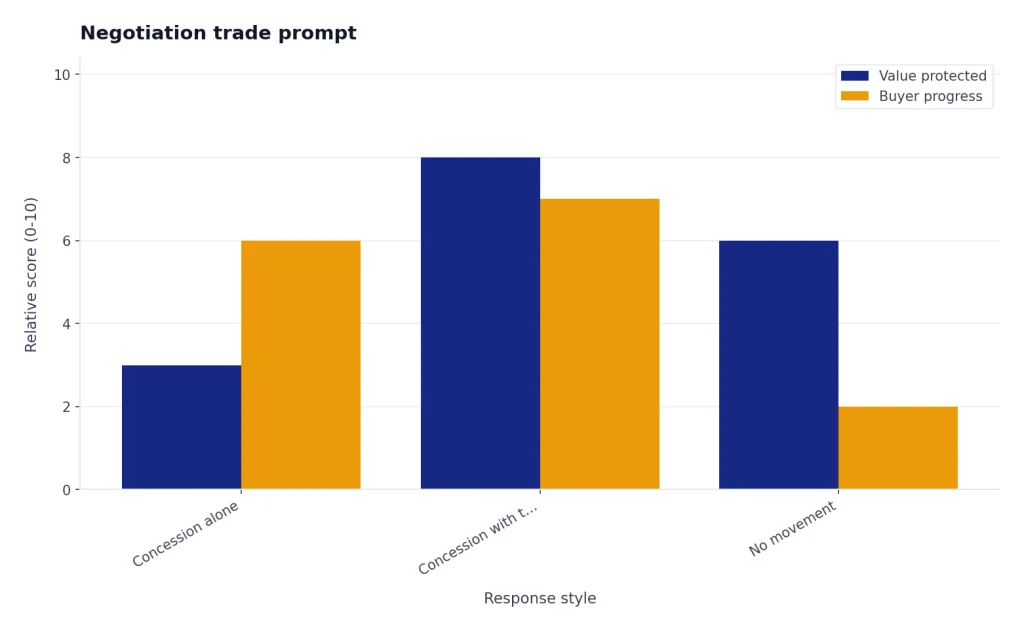
Prompt: “Act as a negotiation coach. The buyer is asking for [request]. Our constraints are [constraints]. Suggest fair trades that protect value, such as term length, payment timing, scope, rollout plan, reference rights, executive access, or mutual action deadlines. Do not recommend concessions without a trade. Give me a table with buyer ask, possible trade, risk, and recommended language.”
Procurement email prompt
Prompt: “Draft a procurement response that is firm, professional, and collaborative. Procurement asked for [request]. Our approved position is [position]. We can offer [allowed trade]. We cannot offer [not allowed]. Write a concise email that preserves the relationship and moves toward signature.”
If your deals touch legal review, use AI carefully. ChatGPT can summarize business intent and identify questions to ask counsel, but it should not replace legal advice. For safer wording patterns, see our ChatGPT Legal Prompts.
Follow-up and closing message prompts
Follow-up is where ChatGPT can save time without taking over the sale. The best use is turning raw call notes into buyer-centered messages that confirm what was heard, name the business issue, and make the next step easy.
McKinsey’s B2B research emphasizes that buyers use a mix of in-person, remote, and digital self-service interactions.[4] The practical recommendation is simple: write follow-up that can stand on its own when it is forwarded internally. Include the business issue, the agreed next step, and the unresolved question instead of relying on the buyer to remember your live conversation.
Post-call recap prompt
Prompt: “Turn these call notes into a concise follow-up email. Use the buyer’s language where possible. Structure it as: thanks, what I heard, business impact, agreed next step, open questions, and calendar-friendly close. Do not add claims that are not in the notes. Notes: [paste notes].”
Executive summary prompt
Prompt: “Create an executive summary for a decision maker who did not attend the calls. Keep it short and credible. Include the business problem, current cost of inaction, proposed approach, expected outcomes, implementation plan, risks, and decision needed. Avoid hype. Deal context: [paste brief].”
Mutual action plan prompt
Prompt: “Build a mutual action plan from these deal details. Include buyer tasks, seller tasks, dependencies, decision owners, legal or security steps, implementation kickoff, and signature target. Make it collaborative and buyer-friendly. Do not make the timeline sound forced. Details: [paste details].”
Stalled deal prompt
Prompt: “Help me re-engage a stalled opportunity without sounding needy. The last interaction was [last interaction]. The buyer cared about [priorities]. The likely stall reason is [reason]. Draft three options: value-add follow-up, direct status check, and graceful breakup email. Keep each message short.”
Final close prompt
Prompt: “Draft a final close email for a buyer who has completed evaluation and is deciding whether to sign. Confirm the agreed value, summarize remaining steps, address the main risk, and ask for a clear decision or final meeting. Tone: confident, respectful, low-pressure. Deal context: [paste brief].”
These follow-up patterns also work for customer handoffs. If your closing role overlaps with support, onboarding, or renewals, compare them with ChatGPT Customer Service Prompts and Templates. If you sell property or local services, adapt the same structure with examples from ChatGPT Real Estate Prompts for Agents.
Quality control before you send
Never send a sales message straight from ChatGPT. Treat the draft as a starting point. Check facts, tone, claims, buyer names, dates, contract terms, and promises. Remove anything that sounds too polished, too pushy, or too broad for the real conversation.
Use this prompt before any important message:
Prompt: “Review this sales message before I send it. Identify unsupported claims, vague language, pressure tactics, missing context, compliance concerns, and places where the message does not sound human. Then rewrite it to be clearer, shorter, and more specific. Do not add new facts. Message: [paste draft].”
A practical sales prompt workflow looks like this:
- Write or paste the deal brief.
- Confirm that your company allows the data you plan to use in the AI tool and that the correct enterprise settings are enabled.
- Ask for a structured draft.
- Ask ChatGPT to critique its own draft against your constraints.
- Verify every factual claim against your CRM, notes, proposal, and approved collateral.
- Edit the final version in your own voice.
Salesforce’s recent State of Sales coverage frames AI as a major growth tactic for sales organizations.[3] The practical lesson for closers is not to automate judgment; it is to create a repeatable review habit so AI-assisted work still follows the team’s messaging, privacy, and approval rules. A closer owns the relationship. ChatGPT only helps prepare the words, options, and structure.
If you use ChatGPT for daily workflow beyond sales emails, see chatgpt productivity prompts for daily workflow. If you need to translate follow-up for international buyers, use chatgpt translation prompts for quality output and have a fluent speaker review important messages before sending.
Frequently asked questions
What are the best ChatGPT sales prompts for closers?
The best prompts give ChatGPT the buyer role, deal stage, pain, proof, objection, constraints, and desired next step. Use prompts for discovery planning, follow-up, objection diagnosis, negotiation trades, and mutual action plans. Avoid prompts that ask ChatGPT to “sell harder” without context.
Can ChatGPT write my sales emails?
Yes, but you should edit every email before sending it. ChatGPT can turn call notes into a clean recap, shorten a long message, or create alternate versions for different stakeholders. You still need to verify facts, remove unsupported claims, and make the message sound like you.
Should I use ChatGPT during a live sales call?
Use caution. It can help with preparation before the call and summaries after the call. During a live call, focus on listening, asking follow-up questions, and reading the room. If your company records, transcribes, or analyzes calls, follow its consent, privacy, and retention rules.
How do I make sales prompts sound less robotic?
Give ChatGPT an example of an approved message in your normal voice. Ask for concise language, fewer adjectives, and a direct business tone. Then edit the draft by adding one specific detail from the real conversation.
Can ChatGPT help with objections?
Yes. Ask it to classify the objection first, then produce clarifying questions before response language. This prevents shallow answers. Good objection prompts separate price, priority, risk, authority, and timing instead of treating every objection as a negotiation problem.
What should I avoid putting into ChatGPT?
Avoid confidential customer data unless your company has approved that use and the correct product settings are in place. Do not paste private contact information, unredacted contracts, payment details, sensitive legal terms, regulated personal data, or confidential pricing into a general prompt. Use placeholders when the exact detail is not required.