

ChatGPT legal prompts can help lawyers turn a blank page into a structured draft, checklist, research plan, client memo, or negotiation outline. They should not replace professional judgment, source checking, confidentiality review, or jurisdiction-specific legal analysis. The best prompts give ChatGPT a narrow role, identify the jurisdiction, separate known facts from assumptions, request uncertainty flags, and require a verification checklist before any work product leaves the firm. This guide gives copy-paste prompts for common legal tasks, plus a review workflow that keeps the lawyer in control. It is written for attorneys and legal teams, not for consumers seeking legal advice.
Safe use rules for legal prompts
Use ChatGPT as a drafting and analysis assistant, not as an authority. OpenAI’s own terms say users should not rely on output as a sole source of truth or as a substitute for professional advice.[3] That warning matters more in legal work than in most routine writing tasks because small errors can change deadlines, duties, remedies, and client risk.
The American Bar Association’s Formal Opinion 512, issued on July 29, 2024, identifies several ethical duties lawyers should consider when using generative AI, including competence, confidentiality, communication, supervision, candor to tribunals, meritorious claims, and reasonable fees.[1] The opinion does not ban generative AI. It treats the tool like other legal technology: useful when the lawyer understands the risks and supervises the work.
The State Bar of California approved practical guidance for generative AI use in legal practice on November 16, 2023.[2] That guidance is jurisdiction-specific, but the larger point travels well. Lawyers should check their own state bar rules, court standing orders, client guidelines, and firm policies before feeding legal work into any AI system.
Before you use any of the prompts below, apply these safeguards.
- Remove confidential facts unless your approved tool and client arrangement allow them. Use placeholders such as [CLIENT], [COUNTERPARTY], [DATE], and [JURISDICTION].
- Never ask ChatGPT to invent authority. Ask for research paths, issue lists, and questions to verify in a trusted legal database.
- Tell the model to flag uncertainty. A confident tone is not the same as a correct answer.
- Keep the final legal judgment with a lawyer. The output is a draft, not a conclusion.
- Document meaningful use. If AI materially affects a filing, client communication, or billing entry, follow the applicable rule, order, and engagement terms.
If you need a reusable prompt system beyond legal work, start with our chatgpt prompt generator. For law firm operations, pair this library with chatgpt productivity prompts for daily workflow so administrative drafting does not get mixed with privileged analysis.
The prompt structure lawyers should use
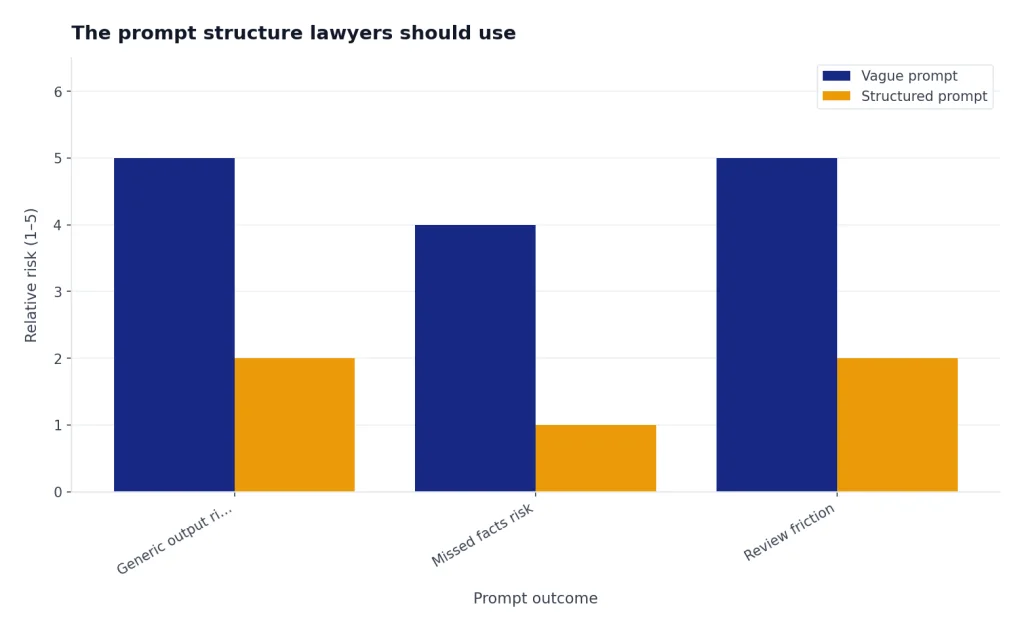
A good legal prompt narrows the task before the model starts writing. Vague prompts invite generic answers. A better prompt tells ChatGPT what role to play, what jurisdiction controls, what facts are known, what sources may not be assumed, what output format you need, and how the answer should be reviewed.
Use this frame for most legal tasks:
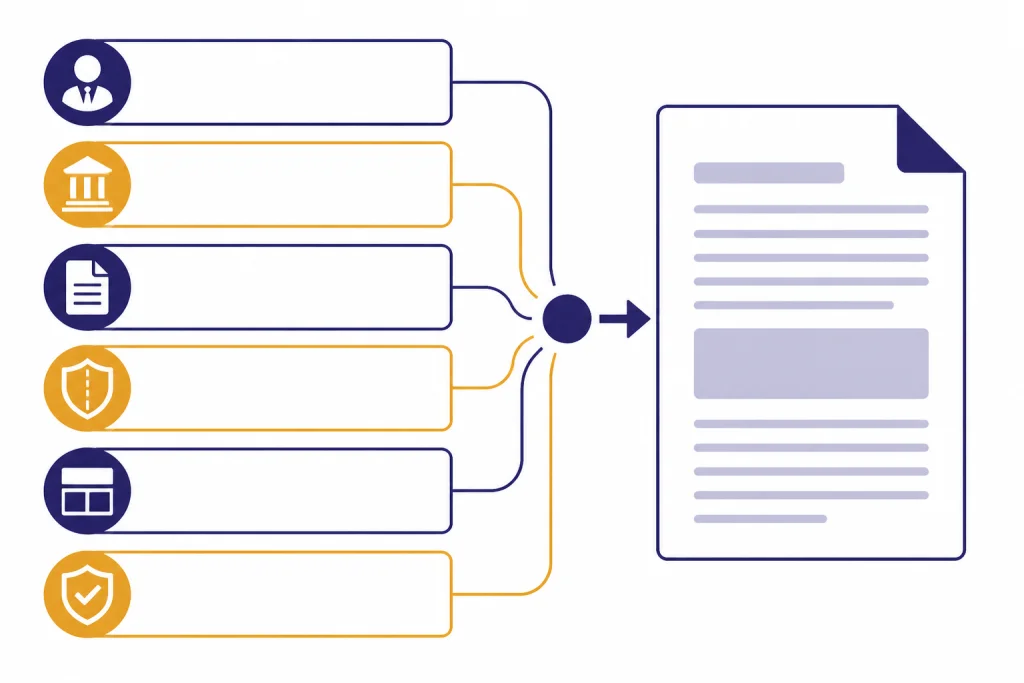
You are assisting a licensed attorney. Do not provide final legal advice. Work only from the facts I provide. If a fact, rule, deadline, citation, or jurisdictional point is missing, say so. Do not invent cases, statutes, quotes, or citations. Produce [OUTPUT TYPE] for [AUDIENCE] under [JURISDICTION]. Separate: known facts, assumptions, legal issues to research, draft language, and verification checklist.That frame has three practical benefits. It makes the model ask for missing information. It discourages false precision. It produces an audit trail the lawyer can review quickly. You can adapt the same approach to contract drafting, motion outlines, client emails, policy comparisons, and due diligence checklists.
| Prompt element | Why it matters | Example instruction |
|---|---|---|
| Role | Limits the model to assistant work. | Act as a drafting assistant to a licensed attorney. |
| Jurisdiction | Prevents generic national answers. | Analyze under New York law unless a federal issue is unavoidable. |
| Facts | Separates record facts from assumptions. | Use only the facts below and list anything missing. |
| Source boundary | Reduces fabricated authority. | Do not cite cases. Give search queries and issues to verify. |
| Output format | Makes review faster. | Return a table with issue, risk, question, and next step. |
| Review gate | Keeps the lawyer responsible for final work. | End with a checklist for attorney verification. |
The same structure also works outside law. For example, ChatGPT Business Prompts for Owners uses role, context, and output constraints for operational tasks. Legal work simply needs a stricter verification layer.
Copy-paste ChatGPT legal prompts
These prompts are written for lawyers who will review the output. Replace bracketed text with your facts. If you are working with client-sensitive material, anonymize first or use an approved firm environment.
Client intake issue spotting
You are assisting a licensed attorney with preliminary issue spotting. Use only the facts below. Do not provide final legal advice. Identify potential legal issues, missing facts, documents to request, urgent deadlines to verify, and questions for the client. Jurisdiction: [JURISDICTION]. Matter type: [MATTER TYPE]. Facts: [FACTS]. Output a table with issue, why it matters, missing information, and next step.Research plan without fake citations
Create a legal research plan for a lawyer. Do not cite cases, statutes, treatises, or articles unless I provide them. Do not invent authority. For the issue below, list the governing questions, likely search terms, possible primary sources to check, negative authority to look for, and jurisdiction traps. Issue: [ISSUE]. Jurisdiction: [JURISDICTION]. Return a concise research roadmap and verification checklist.Case summary from supplied text
Summarize the case text I provide. Do not use outside knowledge. If the text does not answer a point, say not stated in supplied text. Extract: procedural posture, material facts, issue, holding, reasoning, rule language, limits of the holding, and how the case could be distinguished. Text: [PASTE CASE EXCERPT].Contract clause risk review
You are assisting counsel reviewing a contract clause. Do not rewrite unless asked. Identify business risk, legal ambiguity, missing definitions, one-sided terms, negotiation options, and questions for the client. Clause: [CLAUSE]. Deal context: [CONTEXT]. Jurisdiction or governing law: [LAW]. Output: risk table, suggested fallback positions, and lawyer verification checklist.Rewrite a clause in plain English
Rewrite the clause below in plain English for a business client. Preserve legal meaning as much as possible, but do not add obligations or rights not already present. Flag any term that may require lawyer review. Clause: [CLAUSE]. Audience: [AUDIENCE]. Return the plain-English version, then a bullet list of legal terms that should not be simplified without attorney approval.Demand letter first draft
Draft a first-pass demand letter for attorney review. Use a professional tone. Do not threaten claims not listed by the attorney. Do not cite statutes or cases unless supplied. Client: [CLIENT PLACEHOLDER]. Counterparty: [COUNTERPARTY PLACEHOLDER]. Facts: [FACTS]. Desired remedy: [REMEDY]. Deadline to verify: [DATE]. Include a section labeled attorney review notes with assumptions and missing support.Deposition outline from known facts
Create a deposition outline for attorney review. Use only the facts and documents I provide. Organize by topic. For each topic, list the purpose, foundation questions, key admissions sought, exhibit references, and follow-up questions. Witness: [WITNESS]. Claims or defenses: [CLAIMS]. Known facts: [FACTS]. Documents: [DOCUMENT LIST]. Do not invent testimony.Motion outline
Prepare a motion outline, not a final brief. Do not invent legal authority. Based only on the facts and authorities provided, organize arguments, identify factual gaps, list elements that need support, and suggest places where authority should be researched. Motion type: [MOTION]. Jurisdiction: [JURISDICTION]. Facts: [FACTS]. Authorities provided: [AUTHORITIES].Client email explaining risk
Draft a client email for attorney review. Explain the risk in clear business language without giving conclusions beyond the attorney notes below. Tone: calm, direct, and practical. Attorney notes: [NOTES]. Client goal: [GOAL]. Include: summary, practical options, information we still need, and recommended next call agenda.Settlement term sheet checklist
Create a settlement term sheet checklist for attorney review. Matter type: [MATTER]. Known settlement points: [POINTS]. Identify terms to confirm, tax or payment issues to flag for specialists, confidentiality and non-disparagement considerations, release scope questions, enforcement provisions, and implementation deadlines to verify.For multilingual client communications, use a separate translation review process. Our chatgpt translation prompts for quality output explains how to ask for register, glossary consistency, and back-translation checks. For damages schedules or deadline tracking, ChatGPT Excel Prompts for Power Users may be more useful than a legal drafting prompt.
A lawyer review workflow for AI drafts
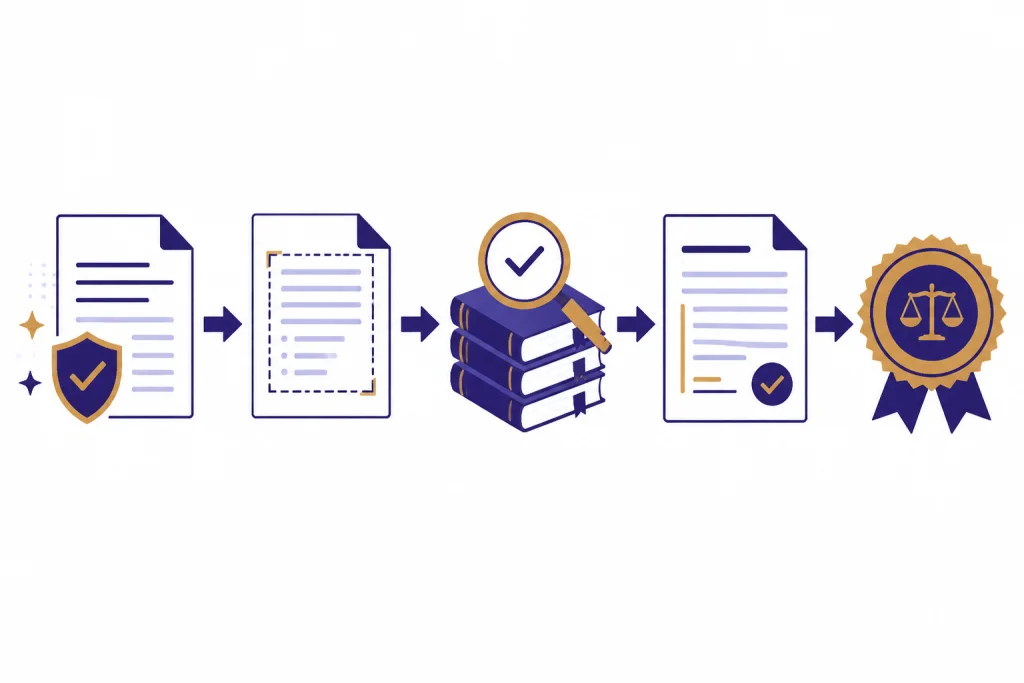
The review process matters as much as the prompt. OpenAI has explained that language models can produce confident answers that are not true, and that hallucinations remain a hard problem even as models improve.[6] In legal work, the practical response is not to ask the model to be more careful. The practical response is to design a workflow that assumes review is mandatory.
Use this workflow for any AI-assisted legal draft:
- Classify the task. Decide whether the work is administrative, drafting, analysis, or authority-dependent. Authority-dependent tasks need the strictest review.
- Sanitize the input. Remove client names, personal identifiers, trade secrets, privileged communications, and strategy notes unless your approved tool and matter rules permit them.
- Generate a constrained draft. Ask for structure, issues, questions, and checklist items before polished prose.
- Verify every legal proposition. Use official sources, paid research tools, court rules, statutes, and the record. Do not rely on model citations.
- Revise in lawyer voice. Remove generic phrasing, overstatements, and invented confidence.
- Document the final basis. Keep the authorities, record cites, and client instructions that support the final work product.
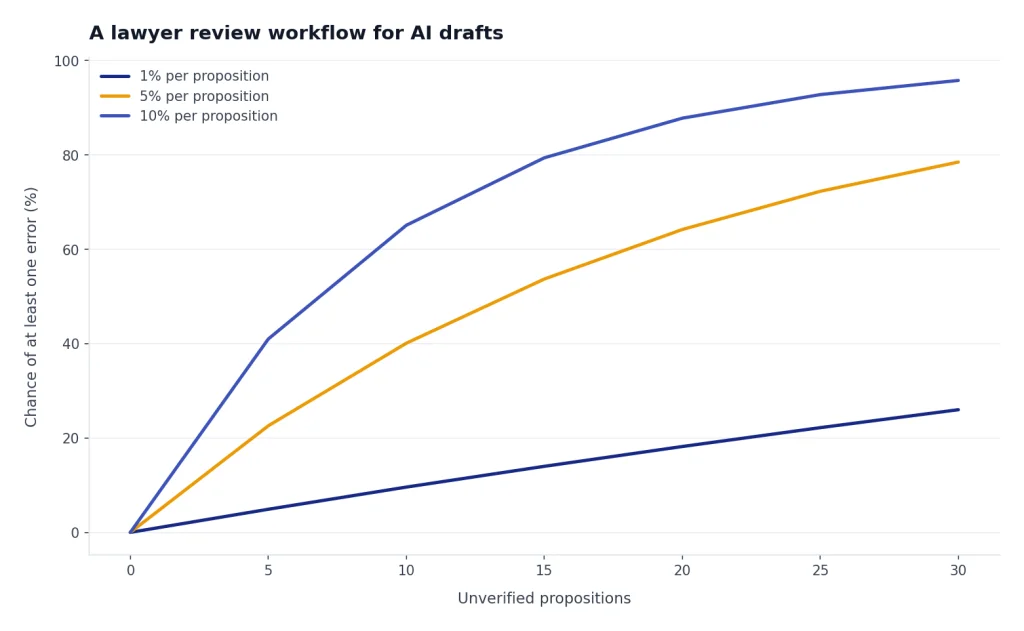
The sanctions order in Mata v. Avianca, filed on June 22, 2023, shows why this workflow is necessary. The court found that lawyers submitted non-existent judicial opinions with fake quotes and citations created by ChatGPT, and it imposed a $5,000 penalty payable into the court registry.[7] The lesson is not that lawyers can never use AI. The lesson is that a lawyer must verify legal authorities before presenting them to a court.
For litigation teams, add a standing prompt at the end of every AI-generated draft:
List every legal proposition in this draft that requires independent verification. For each proposition, identify what type of source would verify it: statute, rule, case, contract, record cite, transcript, expert material, or client fact. Do not provide citations. Do not claim verification has been completed.That prompt turns ChatGPT into a review assistant instead of a fake authority generator. It also helps junior lawyers and paralegals separate writing tasks from research tasks. If your firm uses AI for standardized business processes, review our chatgpt hr prompts for hiring and onboarding and ChatGPT Customer Service Prompts and Templates to see how prompt constraints change by audience and risk level.
Confidentiality and tool choice
Confidentiality is not solved by a better prompt. It is solved by choosing the right tool, contract, settings, access controls, and matter policy before the prompt is sent. ABA Formal Opinion 512 says lawyers should read and understand the terms of use, privacy policy, and related contractual terms of any generative AI tool they use to learn who can access the information entered into it.[1]
OpenAI’s ChatGPT Data Controls FAQ says signed-in users can turn off Improve the model for everyone, and that conversations will remain in chat history but will not be used to train ChatGPT.[4] The same FAQ says Temporary Chats are deleted from OpenAI systems after 30 days, are not used to train models, may be reviewed only for abuse monitoring, and do not create memories.[4] Those settings may help for low-risk work, but they are not a substitute for a firm-approved confidentiality analysis.
OpenAI states that, by default, it does not use data from ChatGPT Enterprise, ChatGPT Business, ChatGPT Edu, ChatGPT for Healthcare, ChatGPT for Teachers, or the API platform, including inputs or outputs, for training or improving models.[5] OpenAI also says that, as of March 1, 2023, data sent to the OpenAI API is not used to train or improve OpenAI models unless the customer explicitly opts in.[8] Lawyers still need to review the actual agreement, retention settings, administrator controls, client requirements, and any applicable court order.
A practical rule is simple: do not paste confidential client material into a consumer AI account just because the prompt is well written. If the matter involves privileged communications, nonpublic M&A facts, employee medical information, trade secrets, criminal exposure, immigration status, family law details, or sealed litigation materials, escalate to the firm’s approved AI process.
Legal teams that serve real estate clients can adapt many of these prompts to transaction summaries, inspection issue lists, and closing checklists. For non-legal agent workflows, see ChatGPT Real Estate Prompts for Agents. Keep legal advice and business marketing prompts in separate workspaces.
When not to use ChatGPT for legal work
Some legal tasks are poor fits for a general-purpose chatbot. Do not use ChatGPT as the final source for court deadlines, jurisdictional rules, filing requirements, local judge practices, current law, legal citations, conflict checks, privilege determinations, settlement authority, or client-specific advice. Use primary sources, docket systems, court rules, official agency materials, trusted legal research platforms, and lawyer review.
Avoid prompts that ask for definitive answers without facts. Also avoid prompts that ask for emotionally satisfying but legally unsupported arguments. A model can make weak positions sound polished. That is dangerous if the reader mistakes polish for merit.
Use ChatGPT when the task benefits from structure: turning notes into an agenda, summarizing supplied text, drafting a neutral client update, creating a checklist, comparing clause options, or preparing questions for a witness interview. Do not use it when the task depends on unverified authority or confidential facts that your tool is not approved to process.
If your work crosses into marketing, sales, or public education, use separate prompt libraries with different risk controls. Our chatgpt seo prompts that help you rank and chatgpt social media prompts for every platform are designed for public-facing content, not legal advice. If you need a broad beginner explanation for a client or staff member, send them to what is ChatGPT? the complete beginner explanation.
Frequently asked questions
Can lawyers use ChatGPT for legal work?
Yes, but only with professional supervision, confidentiality review, and independent verification. ABA Formal Opinion 512 frames generative AI use through existing duties such as competence, confidentiality, supervision, candor, communication, and reasonable fees.[1] Lawyers should also check their jurisdiction’s ethics opinions and court orders.
Can ChatGPT write a legal brief?
ChatGPT can help outline a brief, reorganize arguments, simplify language, and identify missing proof. It should not be trusted to supply final legal authority. Any case, statute, rule, quote, record citation, or procedural statement must be verified outside ChatGPT before filing.
Should I ask ChatGPT for case citations?
Do not rely on ChatGPT for citations. Ask for research questions and search terms instead. The Mata v. Avianca sanctions order is a clear warning that fake authorities can create serious professional consequences.[7]
Is it safe to paste client facts into ChatGPT?
Not by default. Safety depends on the tool, account type, contract, settings, client consent, retention policy, access controls, and professional rules. When in doubt, anonymize the facts or use only a firm-approved AI environment.
What is the best legal prompt format?
The best format states the lawyer-supervised role, jurisdiction, known facts, missing-fact rule, source boundary, output format, and verification checklist. A strong prompt tells ChatGPT not to invent authorities and to separate assumptions from facts. That structure makes the output easier to review.
Can paralegals use these prompts?
Paralegals can use prompts if the work is within their role, firm policy allows it, and a lawyer supervises the final output. They should not use ChatGPT to make legal judgments or communicate advice independently. The safest tasks are formatting, summarizing supplied text, checklist creation, and question drafting.