


OpenAI is not owned by Sam Altman, Microsoft, or any single outside investor. As of March 25, 2026, OpenAI is controlled by the nonprofit OpenAI Foundation, while the commercial business operates as OpenAI Group PBC, a public benefit corporation. OpenAI says the Foundation holds a 26% equity stake, Microsoft holds roughly 27%, and current and former employees plus investors hold the remaining 47%.[1] The important distinction is control versus economics. Microsoft is a major shareholder, but OpenAI says the Foundation appoints and can replace all OpenAI Group board members.[1]
Short answer
The cleanest answer is this: the OpenAI Foundation controls OpenAI, and OpenAI Group PBC is the operating company where the economic ownership sits. OpenAI describes the Foundation as the continuing controller of the Group, even though the Group has stockholders that participate in the company’s financial upside.[1]
That makes the OpenAI ownership structure unusual. It is not a normal venture-backed startup with one class of founders, employees, and investors voting through a standard board. It is also not a pure nonprofit lab. OpenAI began as a nonprofit in 2015, created a for-profit subsidiary in 2019, and announced its updated structure on October 28, 2025.[1] For the wider company timeline, see our OpenAI history guide.
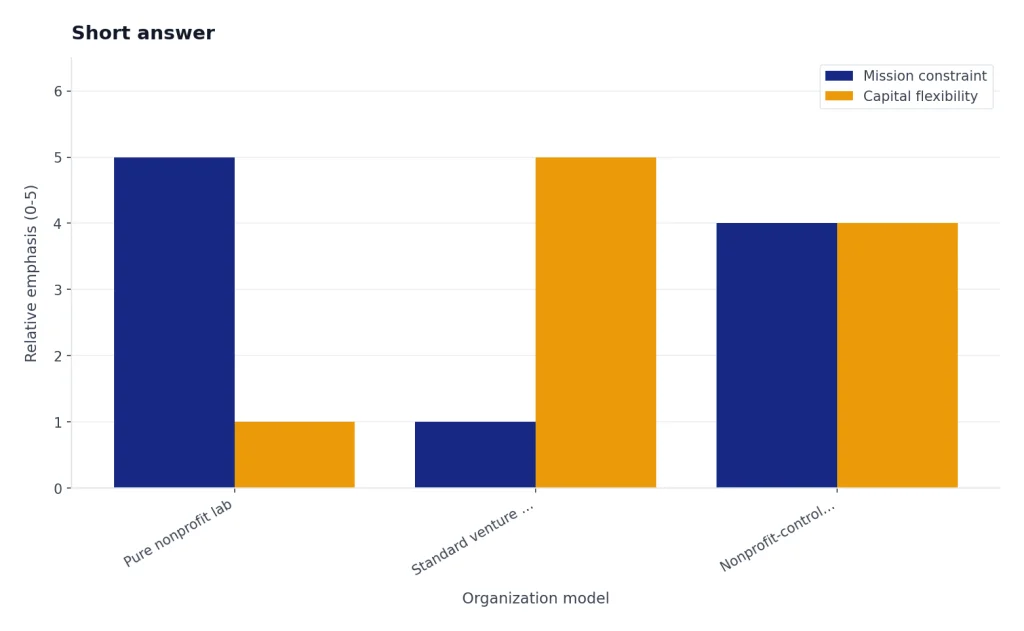
The practical takeaway is simple. Microsoft owns a large economic stake. Employees, former employees, and other investors own another large block. But the nonprofit Foundation sits above the business and holds special governance rights. Those rights matter more than the percentage table if the question is who ultimately controls OpenAI.
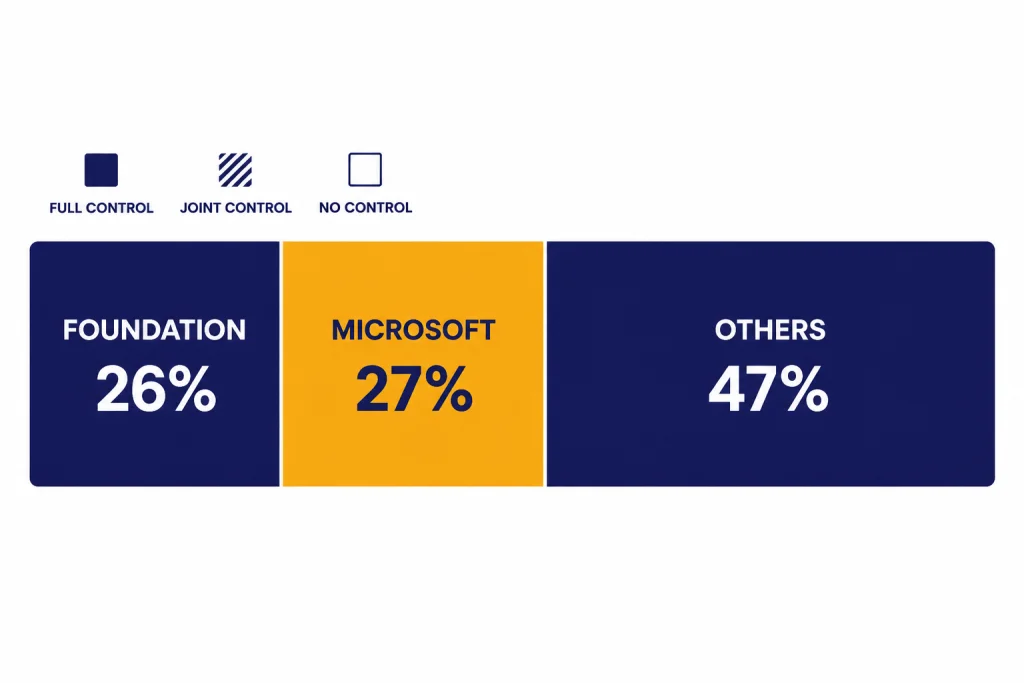
OpenAI ownership at a glance
OpenAI’s published structure separates equity ownership from board control. The equity split explains who participates financially in OpenAI Group PBC. The governance section explains who has the power to appoint directors and shape the company’s mission obligations.
| Holder or group | Published economic stake | What that means | Control rights |
|---|---|---|---|
| OpenAI Foundation | 26% of OpenAI Group PBC, valued by OpenAI at about $130B at recapitalization.[1] | The nonprofit participates directly in OpenAI Group’s value growth. | OpenAI says the Foundation appoints all OpenAI Group directors and can replace them.[1] |
| Microsoft | Roughly 27% of OpenAI Group PBC after recapitalization.[1] | Microsoft is a major shareholder and commercial partner. | OpenAI has not said Microsoft controls the Group board. |
| Current and former employees plus investors | 47% in total.[1] | This category includes the employee and investor ownership pool. | OpenAI has not published a full holder-by-holder cap table. |
The Foundation also holds a warrant that can give it additional shares if OpenAI Group reaches a valuation milestone. OpenAI says the warrant can produce additional equity if OpenAI Group’s share price increases more than tenfold after 15 years.[1]
These numbers are enough to answer the basic ownership question, but they are not the same as a complete cap table. OpenAI has not published an official holder-by-holder breakdown for every investor, employee, former employee, or executive. For the financial side, compare this structure with our OpenAI valuation and OpenAI revenue explainers.
How control works
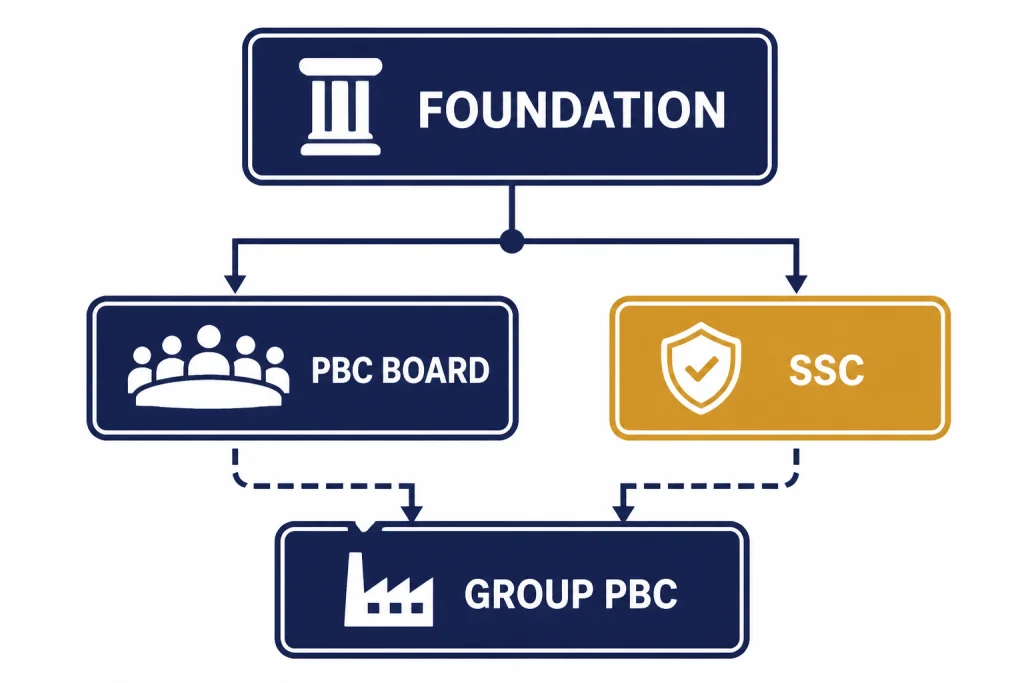
OpenAI’s control structure runs through the OpenAI Foundation. OpenAI says the Foundation holds special voting and governance rights, appoints every member of the OpenAI Group board, and can replace those directors at any time.[1] That is why Microsoft can be a major shareholder without being the owner that controls OpenAI.
The Foundation board is the top governance body. OpenAI lists Bret Taylor as chair and names Adam D’Angelo, Sue Desmond-Hellmann, Zico Kolter, Paul Nakasone, Adebayo Ogunlesi, Nicole Seligman, and CEO Sam Altman as directors.[1] For a deeper look at executives and board roles, read our guide to OpenAI’s leadership team.
The Safety and Security Committee remains a Foundation committee. OpenAI says it continues to govern safety and security practices across OpenAI, including OpenAI Group.[1] The California memorandum of understanding also says the committee has authority to require mitigation measures, including halting model or AI system releases where applicable risk thresholds would otherwise permit release.[6]
This setup creates a hierarchy. The Foundation controls the Group. The Group runs the commercial business. Equity holders participate economically in the Group. The design tries to keep mission control at the nonprofit level while allowing the operating business to raise capital and compensate workers with conventional equity.
Microsoft’s role
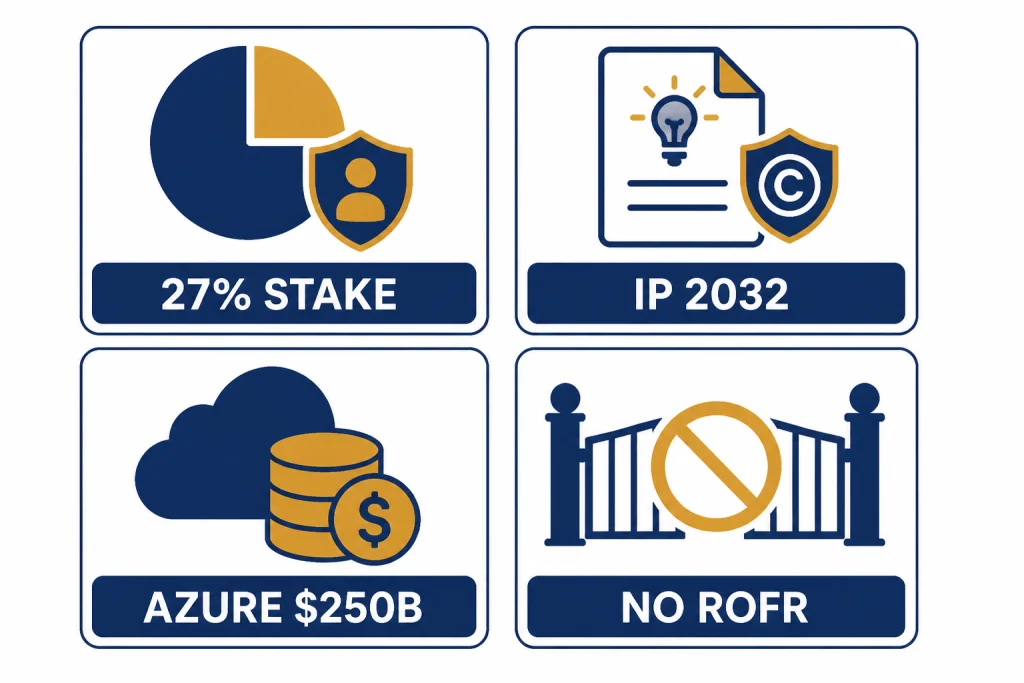
Microsoft is OpenAI’s most important outside strategic partner, but OpenAI’s published structure does not make Microsoft the controlling owner. OpenAI says Microsoft holds roughly 27% of OpenAI Group PBC after the recapitalization.[1] Microsoft separately said its investment in OpenAI Group PBC was valued at about $135B and represented roughly 27% on an as-converted diluted basis, inclusive of employees, investors, and the OpenAI Foundation.[4]
The two companies also signed a new definitive agreement in October 2025. OpenAI said Microsoft supported the formation of the PBC and the recapitalization, while Microsoft said the agreement preserved key partnership elements.[3][4] For more context on the commercial relationship, see our full OpenAI and Microsoft partnership breakdown.
The agreement included several operational terms. Microsoft said its IP rights for OpenAI models and products were extended through 2032, and research IP rights would remain until either an independent expert panel verifies AGI or through 2030, whichever comes first.[4] Microsoft also said OpenAI contracted to purchase an incremental $250B of Azure services, while Microsoft would no longer have a right of first refusal to be OpenAI’s compute provider.[4]
Those rights are commercially significant. They do not equal full ownership. Microsoft has financial exposure, product rights, cloud commitments, and a deep partnership with OpenAI. The Foundation retains governance control under OpenAI’s published structure.
What OpenAI Group PBC changes
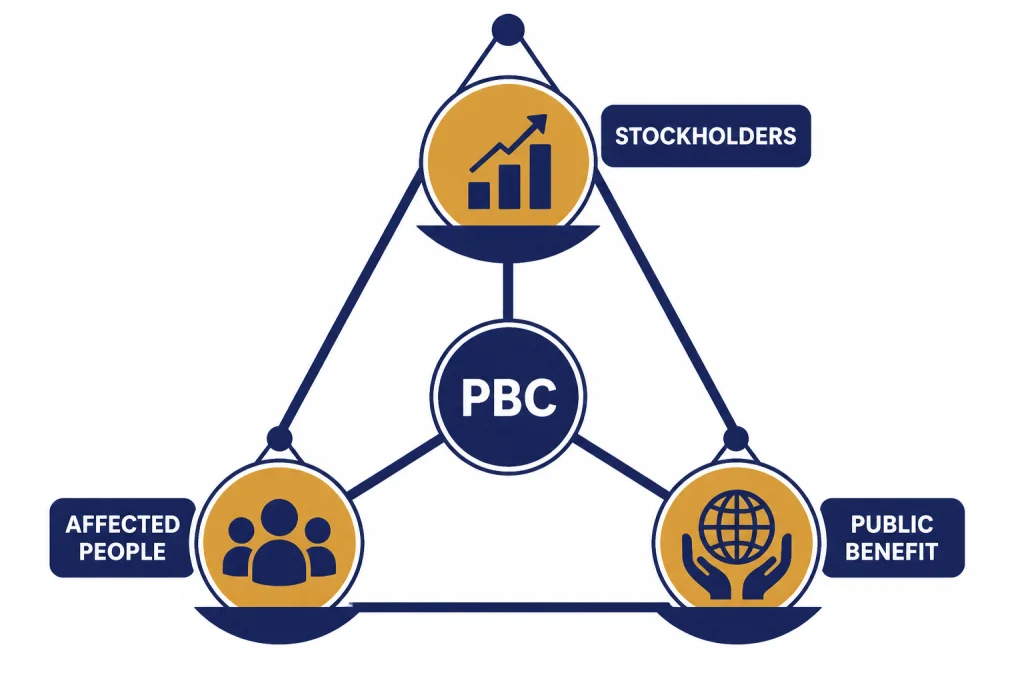
OpenAI Group PBC is a public benefit corporation. Under Delaware law, a public benefit corporation must be managed in a way that balances stockholders’ financial interests, the best interests of people materially affected by the corporation’s conduct, and the public benefit named in its certificate of incorporation.[8] OpenAI says its PBC has the same mission as the Foundation.[1]
A PBC is still a for-profit corporation. It can issue stock, hire employees, raise capital, buy companies, and sell products. The public benefit requirement adds a mission balancing obligation, but it does not make every shareholder a charity donor or make the company publicly owned.
OpenAI’s PBC structure is more specific than the generic Delaware PBC model because regulators required additional commitments. Delaware’s attorney general said the nonprofit would retain control and oversight over the PBC, including the sole power to appoint and remove PBC directors.[7] California’s memorandum similarly described the nonprofit retaining control and oversight through Class N Common Stock.[6]
That is the key difference between OpenAI Group PBC and a typical venture-backed private company. OpenAI Group has shareholders, but the nonprofit Foundation has special governance rights that sit above ordinary economics.
Why OpenAI changed its structure
OpenAI says the recapitalization simplified its corporate structure and gave the nonprofit a direct path to major resources before AGI arrives.[2] It also says the new structure helps OpenAI Group raise capital and attract and retain talent while keeping mission-focused governance.[1]
The capital point matters. Frontier AI development requires large spending on talent, data centers, chips, infrastructure, and distribution. A conventional equity structure makes it easier to raise private capital and compensate employees with stock that behaves like normal startup equity. If you track OpenAI’s hiring market, our OpenAI jobs and OpenAI careers guides cover how that talent competition shows up in recruiting.
The governance point matters just as much. OpenAI faced review from the California and Delaware attorneys general. California’s attorney general said his office secured concessions tied to charitable assets, safety, and OpenAI’s California presence.[5] Delaware’s attorney general said her review focused on keeping the public safety mission primary, maintaining nonprofit control over the PBC, and ensuring the nonprofit was treated fairly in the transaction.[7]
The result was a compromise. OpenAI did not become a standard public company. It did not stay a classic nonprofit research lab either. It became a nonprofit-controlled commercial group, with a PBC as the operating business and conventional stock for equity holders.
What changed from the old capped-profit model
OpenAI’s older model was often described as capped-profit. The updated structure moved the commercial arm into OpenAI Group PBC and gave all equity holders the same type of traditional stock that participates proportionally in OpenAI Group’s value growth.[1] That means the equity now looks more like conventional startup equity, even though the Foundation still controls the Group.

This is also why older statements about OpenAI’s ownership can be misleading. If a source says Microsoft receives a capped return, or that OpenAI is simply a nonprofit lab, it may be describing a prior era. For disputes around the founding vision and later changes, see our Sam Altman vs. Elon Musk explainer and Sam Altman biography.
Can the public buy OpenAI stock?
OpenAI is not a normal public stock available on a public exchange. Its equity is held through private ownership in OpenAI Group PBC. That means most ordinary investors cannot simply buy OpenAI shares the way they buy shares of Microsoft or another listed company.
Be careful with products that claim to give direct exposure to OpenAI equity. In July 2025, OpenAI said Robinhood’s “OpenAI tokens” were not OpenAI equity, that OpenAI did not partner with Robinhood on them, and that any transfer of OpenAI equity requires OpenAI approval.[9]
Microsoft shares are not the same as OpenAI shares. Buying Microsoft gives exposure to Microsoft as a public company, including its OpenAI partnership and other businesses. It does not give the buyer direct ownership of OpenAI Group PBC. If OpenAI later pursues an IPO, the ownership picture could change, but OpenAI has not published final IPO terms in the structure materials cited here.
Frequently asked questions
Who owns OpenAI?
OpenAI Group PBC is economically owned by the OpenAI Foundation, Microsoft, employees, former employees, and investors. OpenAI says the Foundation holds 26%, Microsoft holds roughly 27%, and the remaining 47% is held by current and former employees and investors.[1] The nonprofit Foundation controls the Group through special governance rights.
Does Microsoft own OpenAI?
No. Microsoft is a major shareholder and partner, but OpenAI says the Foundation controls OpenAI Group and appoints its board.[1] Microsoft said its stake is roughly 27% on an as-converted diluted basis after the recapitalization.[4]
Does Sam Altman own OpenAI?
No public OpenAI structure document says Sam Altman owns OpenAI. OpenAI lists Altman as CEO and a Foundation board member, not as the controlling owner.[1] OpenAI has not published an official personal equity percentage for Altman in the ownership materials cited in this article.
What is the OpenAI Foundation?
The OpenAI Foundation is the nonprofit entity that controls OpenAI Group PBC. OpenAI says the Foundation has the same mission as the Group and holds a 26% equity stake in the Group.[1] It also holds a warrant that may give it additional equity if a future valuation milestone is met.[1]
What is OpenAI Group PBC?
OpenAI Group PBC is the for-profit public benefit corporation that runs OpenAI’s commercial business. OpenAI says the for-profit arm became OpenAI Group PBC under the updated structure announced on October 28, 2025.[1] The PBC is controlled by the nonprofit Foundation, even though it has stockholders.
Is OpenAI publicly traded?
No. OpenAI Group PBC is privately held, and OpenAI has warned that third-party “OpenAI tokens” are not OpenAI equity.[9] If OpenAI pursues a public listing later, investors should rely on official filings and company statements rather than secondary-market claims.