

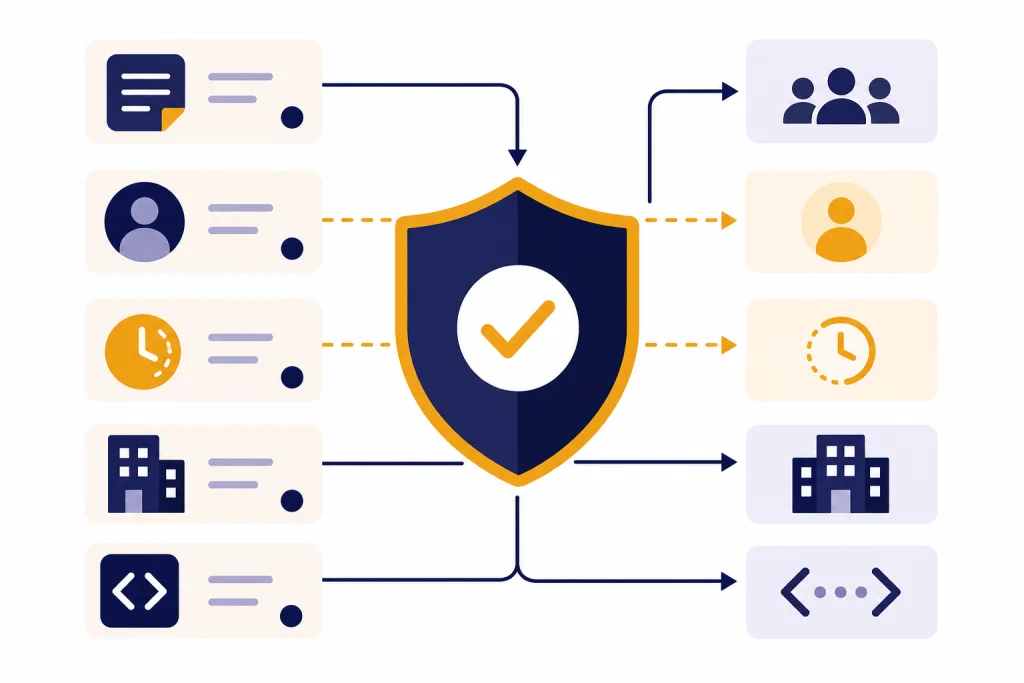
ChatGPT is safe enough for everyday drafting, brainstorming, learning, coding help, and summarization when you keep sensitive data out and verify important outputs. It is not a private vault, a password manager, a licensed professional, or a legally privileged channel. OpenAI says it collects content you provide, including prompts and uploads, and consumer content may be used to improve models unless you change the relevant controls.[1][2] Business and API offerings have stronger default data rules.[7][13] The practical answer is conditional: use ChatGPT for low-risk work, reduce what you share, turn off training if appropriate, use Temporary Chat for one-off sessions, and keep human review for consequential decisions.
Quick verdict
ChatGPT is safe for many ordinary tasks if you use it like a cloud-based assistant, not like a locked private diary. The safer uses are low-stakes: rewriting public text, brainstorming ideas, explaining a concept, creating study questions, or helping debug code after you remove secrets. The riskier uses involve passwords, API keys, Social Security numbers, payment data, unreleased business plans, client files, medical records, legal strategy, or anything you would not want stored, reviewed, compelled in legal process, or accidentally exposed.
The best safety test is simple. Ask what harm would occur if the prompt were stored longer than expected, reviewed for abuse, used for model improvement, sent to a third-party tool, or answered incorrectly. If the harm is meaningful, do not paste the information into personal ChatGPT. Use a properly governed business account, an API setup with approved controls, a local/private system, or no AI tool at all. For a deeper security-only view, see our security-focused ChatGPT guide.
OpenAI’s own documents support this cautious approach. Its privacy policy says no internet or email transmission is fully secure and advises care in deciding what to provide to the services.[1] Its terms say users should not rely on output as the sole source of truth or as a substitute for professional advice.[11] That is the right framing for this review: ChatGPT can be useful and reasonably protected, but it is not risk-free.
What ChatGPT collects and how data may be used
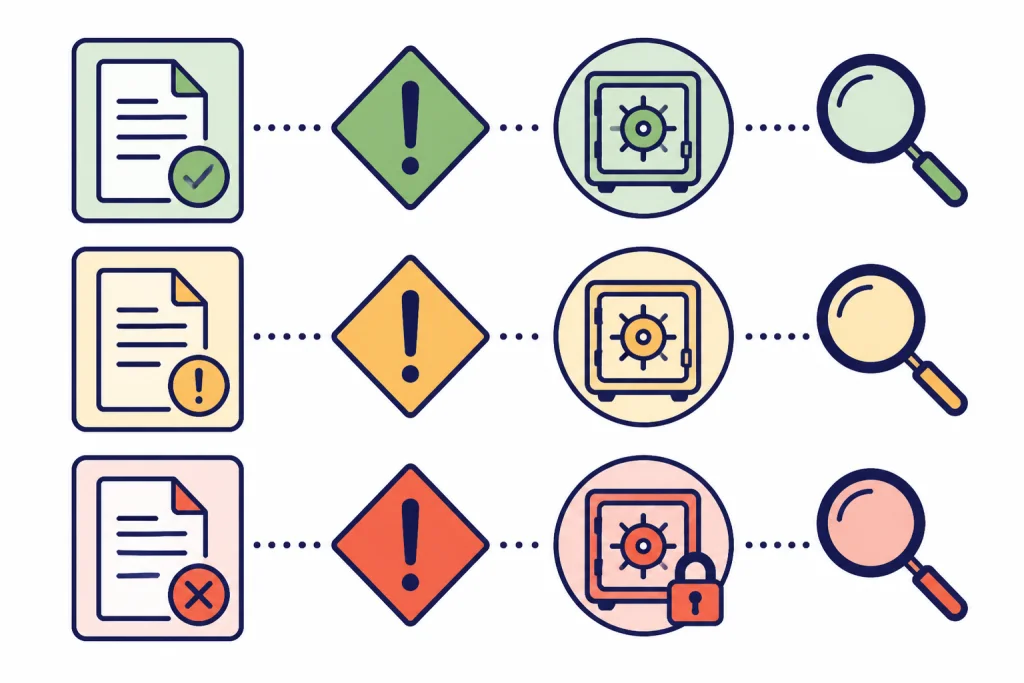
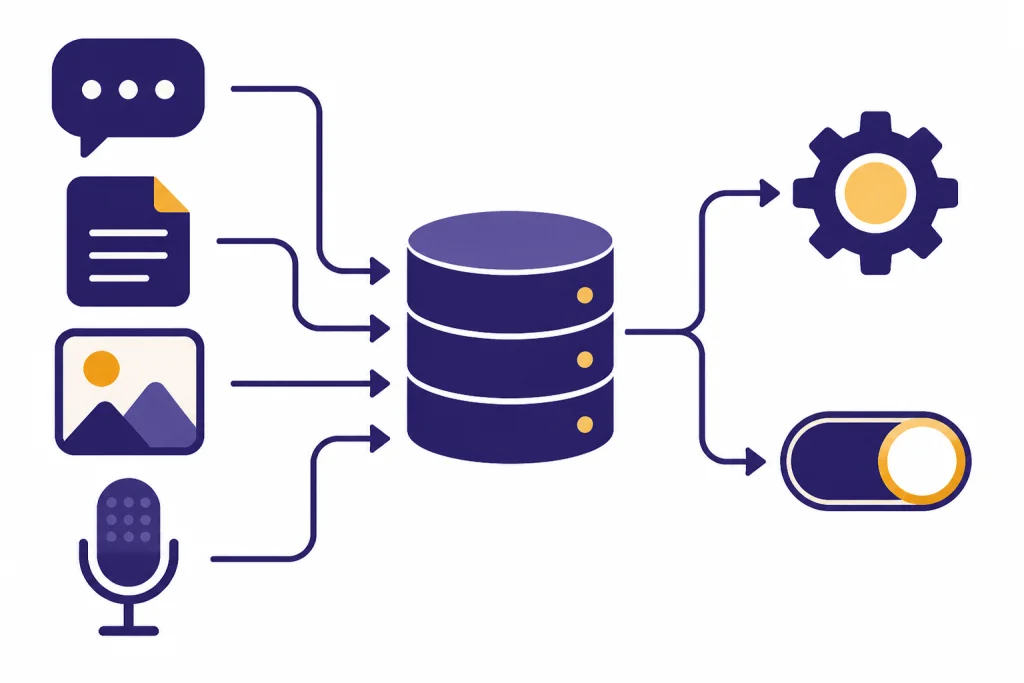
OpenAI says it collects personal data that users provide in the input to its services. That includes prompts and uploaded content such as files, images, audio, video, and data from connected services, depending on which features you use.[1] It also describes categories such as identifiers, account information, transaction information, network activity, usage data, and general location data based on information like IP address.[1] If you want the privacy-policy version in plainer language, read our plain-English privacy policy guide.
For individual services, OpenAI says content may be used to train models, and ChatGPT may improve from conversations unless the user opts out.[2] You can opt out through the privacy portal or ChatGPT data controls; OpenAI says new conversations will not be used for training after that change.[2] The Data Controls FAQ also says you can turn off “Improve the model for everyone,” while keeping chat history visible in your account.[3]
This distinction matters. Turning off model training is not the same as deleting chat history. It changes how new content is used for model improvement. It does not make existing conversations vanish, and it does not make ChatGPT a confidential channel. For more detail, see our ChatGPT privacy overview and ChatGPT data protection practices.
Retention, deletion, and memory are separate
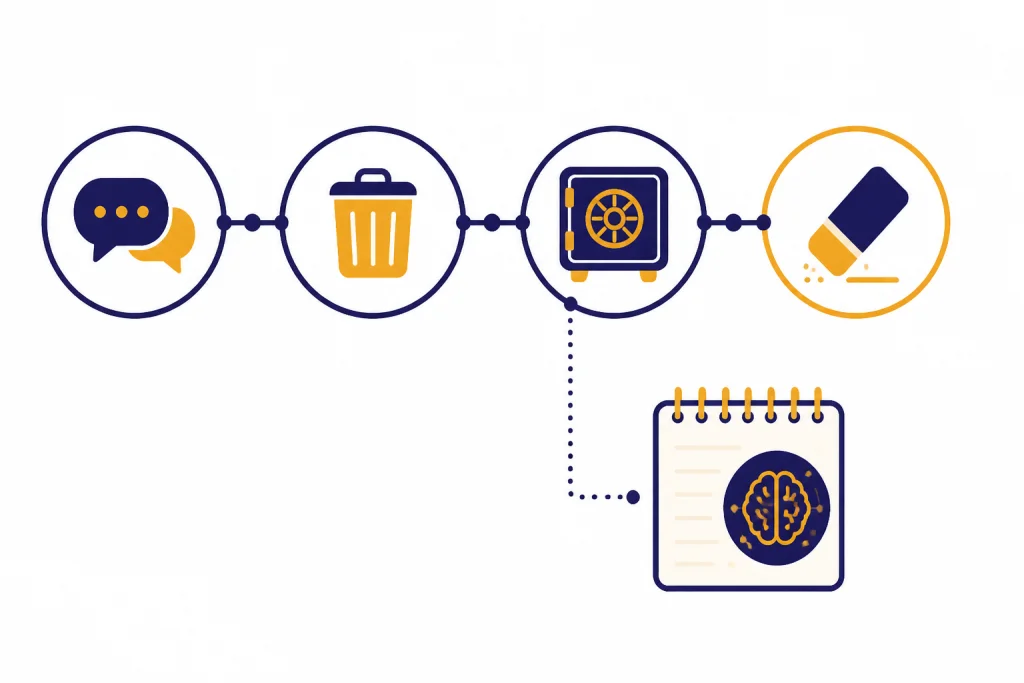
Normal ChatGPT chats are saved to your account until you delete them. OpenAI says that when you delete a chat or account, the chat is removed from your account immediately and scheduled for permanent deletion from OpenAI systems within 30 days, unless an exception applies.[4] OpenAI’s privacy policy also says it may retain information longer for legitimate security, safety, legal, financial-record, or erasure-audit reasons.[1]
Temporary Chat is safer for one-off prompts because it does not appear in history, does not create or use memories, and is not used to improve OpenAI’s models. OpenAI still says it may keep a copy for up to 30 days for safety purposes.[5] Temporary Chat is useful, but it is not a secret mode. If you use a GPT with actions, data sent to third parties may be kept longer by the recipient and used under that recipient’s privacy policy.[5]
Memory adds a separate layer. OpenAI says saved memories are stored separately from chat history, so deleting a chat does not necessarily remove a saved memory from that chat. To fully remove something remembered, delete both the saved memory and the chat where you shared it.[6] OpenAI also says it may retain a log of deleted saved memories for up to 30 days for safety and debugging.[6] For step-by-step retention questions, see whether ChatGPT saves your chats and what ChatGPT saves about you.
Security and encryption reduce risk, but do not remove it
OpenAI publishes security controls for its services, including independent SOC 2 Type 2 examination for its API and ChatGPT business product services, plus ISO certifications for systems supporting the OpenAI API, ChatGPT Enterprise, and ChatGPT Edu services.[8] OpenAI also says infrastructure serving its products uses encryption in transit and at rest, change management, and strict access controls.[8] For business data, OpenAI specifically lists AES-256 encryption at rest and TLS 1.2 or higher in transit.[9]
Those are meaningful controls. They reduce common security risks such as interception, unauthorized infrastructure access, and unmanaged enterprise use. They do not mean the model can answer without receiving your prompt, and they do not mean consumer ChatGPT chats are end-to-end encrypted. OpenAI has not published an official statement saying ordinary ChatGPT chats are end-to-end encrypted. Axios reported in August 2025 that Sam Altman said OpenAI was considering encryption for ChatGPT, but that there was no timeline to ship it.[22] For the encryption distinction, see our ChatGPT encryption explainer.
The practical rule is this: encryption protects the path and storage layer; it does not make unsafe sharing safe. You should still remove secrets, limit file uploads, use a strong account password, enable available account protections, avoid suspicious “ChatGPT” installers, and use managed business controls for workplace data.

Consumer, business, and API safety profiles differ
The most common mistake is treating all ChatGPT access as the same. Personal ChatGPT, Temporary Chat, ChatGPT Business, ChatGPT Enterprise, ChatGPT Edu, and the API have different privacy defaults and administrative controls. The table below gives a practical comparison.
| Use mode | Training default | Retention and control | Best fit | Main caution |
|---|---|---|---|---|
| Personal ChatGPT with training on | Consumer content may be used to train models.[2] | Chats stay in history until deleted.[4] | Low-risk personal productivity. | Do not paste secrets or regulated data. |
| Personal ChatGPT with training off | OpenAI says new conversations are not used for training after opt-out.[2] | Chat history can still remain visible until deleted.[3] | Everyday work with reduced training exposure. | Not the same as confidential storage. |
| Temporary Chat | Not used to improve OpenAI’s models.[5] | May be kept for up to 30 days for safety.[5] | One-off prompts you do not want in history. | Third-party GPT actions can create separate retention. |
| ChatGPT Business, Enterprise, or Edu | OpenAI says it does not train on business data by default.[7] | Organizations get stronger ownership, access, and retention controls.[7] | Company use with admin governance. | Workspace admins and policies may apply. |
| OpenAI API | OpenAI says API data is not used to train models unless you opt in.[13] | Abuse monitoring logs are retained up to 30 days by default, unless an exception applies.[13] | Custom apps with security review. | Your app must handle privacy, consent, and access controls. |
For workplaces, the safe path is usually not “use personal ChatGPT carefully.” It is a governed plan, a signed data-processing arrangement when needed, an internal policy, and a clear list of approved use cases. If GDPR is part of your review, start with our ChatGPT and GDPR compliance guide.

Data can leave through GPTs, apps, files, and sharing
ChatGPT safety is not only about OpenAI. It is also about what you connect to ChatGPT. OpenAI says GPT builders cannot view individual conversations with their GPTs, but GPTs can integrate with apps and external APIs. When you interact with a GPT that uses those integrations, relevant parts of your input may be sent to the third-party service, and OpenAI says it does not audit or control how those services use or store the data.[10]

This is the reason “safe to paste” depends on context. A prompt that is acceptable in a plain chat may become risky if a custom GPT sends parts of it to a travel API, CRM, spreadsheet connector, code tool, browser action, or another app. Files add another layer because documents may include hidden metadata, comments, tracked changes, customer names, and embedded identifiers. Before uploading, strip what the model does not need.
Shared links and exports also deserve caution. If you share a conversation, you may expose prompts, files, and answers to other people. If you export data, protect the export like any other archive of personal records. For a focused breakdown, see how ChatGPT may share data.
Accuracy, professional advice, and mental health safety
Safety includes output reliability. OpenAI’s terms say the services are provided as is, that OpenAI does not warrant uninterrupted, accurate, error-free, secure, or loss-free operation, and that users should not rely on output as a sole source of truth or as a substitute for professional advice.[11] This warning matters even when the answer sounds confident.
High-stakes uses need human review. OpenAI’s usage policies restrict tailored legal or medical advice without appropriate involvement by a licensed professional, and they restrict automation of high-stakes decisions in sensitive areas without human review.[12] That includes areas such as housing, employment, finance, insurance, law, medical care, essential government services, and safety-critical decisions.[12]
Mental health use deserves extra care. ChatGPT may help you organize thoughts or prepare questions for a clinician, but it should not replace therapy, crisis care, or a qualified professional. If a conversation becomes about self-harm, paranoia, delusions, coercion, or intense emotional dependency, stop using the chatbot as the main support and contact a human professional or local emergency resource. We cover this topic separately in our guide to ChatGPT mental health concerns.
Children and teens need supervision. OpenAI says ChatGPT is not meant for children under 13, and users ages 13 to 18 need parental consent.[17] OpenAI also says ChatGPT may produce output that is not appropriate for every audience or age group.[17] In September 2025, the FTC issued orders to companies including OpenAI seeking information about AI chatbot companion products, children and teens, safety testing, negative impacts, disclosures, and data handling.[18]
Incidents and regulators show the risk is real
ChatGPT’s safety record is not just theoretical. OpenAI reported a March 20, 2023 outage caused by a bug in an open-source library that allowed some users to see titles from another active user’s chat history and may have exposed the first message of some newly created conversations.[14] OpenAI also said the same issue may have exposed payment-related information for 1.2% of active ChatGPT Plus subscribers during a nine-hour window; Help Net Security separately reported the same basic incident details.[14][15]
Regulators have also scrutinized ChatGPT. The European Data Protection Board said in April 2023 that it launched a dedicated ChatGPT task force after Italian data-protection enforcement action against OpenAI.[19] ANSA reported that Italy’s privacy authority issued a 15 million euro fine in December 2024, and that the Rome court annulled that fine on March 20, 2026 after OpenAI appealed.[20] That sequence does not prove ChatGPT is unsafe for all users. It does show that privacy, age controls, transparency, and training-data questions remain live governance issues.
Legal process can also affect retention. OpenAI’s response to New York Times data demands says deleted ChatGPT chats and API content are normally removed from OpenAI systems within 30 days, but it also describes legal demands and notes exceptions when OpenAI is required to retain data for legal or security reasons.[16] The lesson is conservative: deletion controls help, but they are not an absolute guarantee against every legal, security, or compliance exception.
A practical ChatGPT safety checklist
Use ChatGPT with a risk-based workflow. NIST describes AI risk management as a way to identify unique risks and choose actions that fit an organization’s goals and priorities.[21] The same idea works for individuals: match the tool to the sensitivity of the data and the consequence of the answer.

- Classify the prompt first. If it contains secrets, regulated data, client records, or anything embarrassing if exposed, do not paste it into personal ChatGPT.
- Turn off training if you use personal ChatGPT for anything beyond casual prompts. OpenAI says users can opt out so new conversations are not used for model training.[2]
- Use Temporary Chat for one-off sessions. It avoids history, memory, and model-training use, but OpenAI may still keep a copy for up to 30 days for safety.[5]
- Review Memory. Ask ChatGPT what it remembers, delete saved memories you do not want, and delete the source chat if needed.[6]
- Redact before uploading files. Remove names, account numbers, comments, hidden metadata, and unnecessary pages.
- Do not paste credentials. Passwords, private keys, API tokens, recovery codes, and production secrets should never go into a chatbot.
- Avoid untrusted GPTs and actions. External APIs and apps may receive relevant parts of your input, and OpenAI says it does not control how those third parties store or use that data.[10]
- Use business or API controls for workplace data. OpenAI says business products and the API are not used for training by default, but your organization still needs access controls, retention rules, and user training.[7][13]
- Verify important answers. For legal, medical, financial, employment, education, and safety decisions, treat ChatGPT as a drafting aid and use qualified human review.
- Keep your own records. Do not rely on ChatGPT history as your only copy of important work. Export or save critical drafts in your own governed storage.
The safest everyday habit is data minimization. Give ChatGPT the least sensitive version of the problem that still lets it help. Replace real names with roles, use ranges instead of exact numbers when precision is not required, and ask for templates you can fill in offline.
Frequently asked questions
Is ChatGPT safe to use for personal information?
It is safe enough for low-risk personal information, but you should not treat it as a private vault. OpenAI says it collects content you provide, including prompts and uploads, and it may use consumer content to improve models depending on your settings.[1][2] Avoid highly sensitive personal data unless you are using an approved business setup with the right controls.
Does ChatGPT save my chats?
Yes. Normal chats are saved to your account until you delete them, and deleted chats are scheduled for permanent deletion within 30 days unless an exception applies.[4] Temporary Chats do not appear in history, but OpenAI says it may keep a copy for up to 30 days for safety.[5]
Can OpenAI use my ChatGPT conversations to train models?
For individual services, OpenAI says it may use content to train models unless you opt out.[2] After you opt out, OpenAI says new conversations will not be used for training.[2] Business and API offerings are different: OpenAI says those are not used for training by default.[7][13]
Is ChatGPT encrypted?
OpenAI says its infrastructure uses encryption in transit and at rest, and its business data page lists AES-256 at rest and TLS 1.2 or higher in transit.[8][9] That is not the same as end-to-end encryption for consumer ChatGPT conversations. Do not use encryption claims as a reason to paste secrets.
Is ChatGPT safe for children?
Not without age-appropriate supervision. OpenAI says ChatGPT is not meant for children under 13, and users ages 13 to 18 need parental consent.[17] OpenAI also warns that ChatGPT may produce output that is not appropriate for every audience or age group.[17]
Can I rely on ChatGPT for medical, legal, or financial advice?
No, not as the only source. OpenAI’s terms say not to rely on output as a sole source of truth or as a substitute for professional advice.[11] Use ChatGPT to draft questions, summarize non-sensitive material, or prepare for a professional conversation, then verify with a qualified human.