


Sam Altman’s biography is the story of a founder who moved from startup operator to startup kingmaker and then to one of the most powerful executive roles in technology. Born in 1985, Altman left Stanford to build Loopt, later ran Y Combinator from 2014 to 2019, co-founded OpenAI in 2015, and became OpenAI’s CEO in 2019.[1][2][3][5][6] His career matters because it tracks the rise of modern AI itself: early consumer apps, venture networks, lab building, corporate governance fights, and the commercialization of large models. If you want the short version, Altman is not just the public face of OpenAI. He is one of the people who helped build the institutional path that made OpenAI possible.[5][10]
Quick timeline
If you only need the outline, this is the cleanest way to read a Sam Altman biography. He was born on April 22, 1985, in Chicago and grew up in the St. Louis suburbs.[1] He studied computer science at Stanford, left before graduating, and in 2005 started Loopt, a location-sharing app.[1][4] In February 2014, Paul Graham announced that Altman would become president of Y Combinator.[2] In December 2015, he co-founded OpenAI and served as one of its co-chairs.[5] In March 2019, OpenAI’s new LP structure listed Altman as CEO, the same period when he stepped away from day-to-day leadership at Y Combinator.[6][3]
| Year | Role or event | Why it matters |
|---|---|---|
| 1985 | Born in Chicago on April 22 | Places him in the generation that came of age with the consumer internet.[1] |
| 2005 | Leaves Stanford and starts Loopt | His first major startup run as an operator.[1][4] |
| 2012 | Loopt acquired by Green Dot for $43.4 million | Ends his first company and expands his investor network.[1][4] |
| 2014 | Becomes president of Y Combinator | Moves from founder to ecosystem builder.[2][3] |
| 2015 | Co-founds OpenAI | Enters AI institution-building.[5] |
| 2019 | Named CEO in OpenAI LP structure | Begins leading OpenAI full time.[6] |
| 2023 | Fired by OpenAI board on November 17 | Triggers the biggest governance crisis in company history.[7] |
| 2023 | Returns as CEO on November 29 | Reasserts his control over OpenAI’s direction.[8] |
| 2024 | Rejoins OpenAI board on March 8 | Restores formal board role after the crisis.[9] |
That timeline explains why Altman is usually discussed in more than one frame at once. He is a founder, an investor, a lab builder, and a corporate leader. If you want the personal-side details that this article only touches briefly, see sam altman age, background, and religion and sam altman wife and personal life.
Early life and Loopt
Altman’s early biography is less about AI than about standard Silicon Valley founder formation. Britannica says he was born in Chicago, moved as a child to the St. Louis suburbs, showed an early aptitude for computing, and later attended John Burroughs School.[1] Y Combinator’s own author bio later noted that he studied computer science at Stanford and worked in the AI lab while he was there.[3]
The first decisive break came in 2005. After leaving Stanford, Altman founded Loopt, an app built around location sharing on mobile phones.[1] That matters historically because it placed him in one of the earliest waves of mobile-social founders, well before the smartphone platform matured. Loopt did not become a breakout consumer giant, but it gave Altman what many later AI executives never had: direct experience running a product company through fundraising, distribution problems, and an exit.[1]
Loopt was acquired by Green Dot in 2012 for total consideration of $43.4 million, according to Green Dot’s press release, which matches Britannica’s summary of the deal.[4][1] In biography terms, that exit is important less for its size than for what followed. It gave Altman credibility with investors and founders, and it moved him closer to the Y Combinator network that would define the next phase of his career.[2]

How Y Combinator changed Altman’s career
Altman became president of Y Combinator in 2014. Paul Graham announced the transition on February 21, 2014, writing that Altman would lead YC starting with the next batch.[2] A Y Combinator page published later summarized the period more plainly: Altman was president of YC from 2014 to 2019.[3]
This is the section of a Sam Altman biography that most clearly explains his later power. Running YC meant he was no longer only one founder with one startup. He became a central node in Silicon Valley’s startup pipeline. He worked with founders, investors, and technical talent across hundreds of companies. That role helped him build a broad coalition of relationships that later mattered at OpenAI, especially when OpenAI needed money, senior operators, recruiting reach, and public legitimacy.
It also changed the way Altman thought. A founder usually focuses on product-market fit. A startup accelerator president spends years spotting patterns across categories, funding cycles, and talent markets. That shows up later in how Altman talks about AI deployment, compute, infrastructure, and company formation. He often sounds less like a lab scientist than like someone who has spent years allocating scarce attention across many bets at once.
When people describe Altman as unusually effective at building networks around ambitious technical projects, the YC years are the clearest explanation. They are also why he became a bigger figure than a normal startup founder. He was shaping the startup ecosystem itself, not just participating in it. For more on the executives around him today, see openai’s cto and leadership team and OpenAI Careers.

Co-founding OpenAI
OpenAI announced its launch on December 11, 2015.[5] The founding post named Sam Altman and Elon Musk as co-chairs and listed the original founding team and advisers.[5] It also said the early funders had committed $1 billion, a figure echoed in Britannica’s OpenAI history entry.[5][11]
That moment turned Altman from a startup ecosystem operator into an AI institution builder. OpenAI was not presented as a normal startup. It was framed as a nonprofit research company with a public-interest mission.[5] Whatever one thinks of how OpenAI evolved later, that launch matters because Altman helped create an organization designed from the start to sit at the intersection of research, policy, talent, and capital.
The founding choice also explains why Altman is so often paired with bigger structural debates. His biography cannot be separated from questions about mission, safety, governance, and commercialization. If you want the full company-side story, OpenAI History and who owns OpenAI? ownership structure explained are the best next reads.
It is also the starting point for the long-running conflict with Elon Musk. At launch, they were aligned enough to serve as co-chairs.[5] Later disagreements over control, structure, and direction became one of the defining public feuds in AI. We cover that separately in sam altman vs elon musk.
Why 2019 was the turning point
The most important career shift in Altman’s biography came in March 2019. OpenAI announced the LP structure on March 11, 2019, and the post identified Sam Altman as CEO.[6] Around that same period, Altman stepped away from Y Combinator’s presidency to focus on OpenAI full time, a move summarized both by Y Combinator’s own author bio and by later reporting on the transition.[3][12]
This was the point where Altman stopped being mainly a founder-investor who advised an AI lab from the side. He became the executive responsible for scaling OpenAI as an operating company. The LP announcement also made clear that OpenAI was changing structure so it could raise capital while keeping nonprofit governance above the operating entity.[6] That governance design became central to every later debate about control, mission, and commercialization.
In other words, if 2015 explains why Altman entered AI, 2019 explains why he became one of its most important executives. After that point, his biography and OpenAI’s history become almost impossible to separate. The same is true of the company’s later relationship with Microsoft, which you can trace in openai and microsoft.

The 2023 firing and return
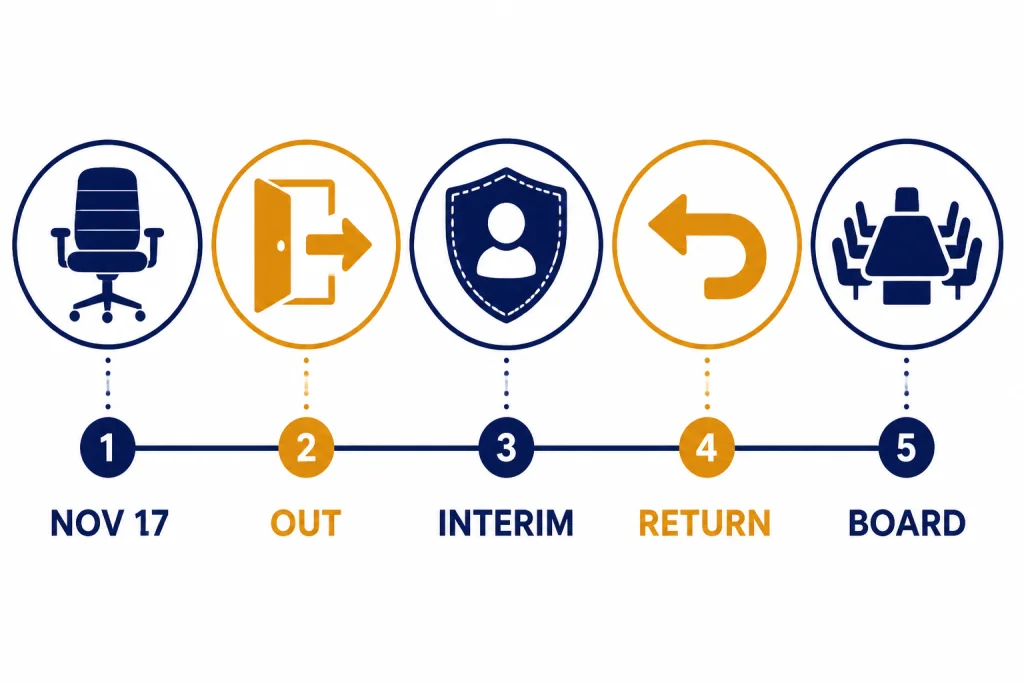
No Sam Altman biography is complete without the five-day crisis in November 2023. On November 17, 2023, OpenAI announced that Altman would depart as CEO and leave the board, and named Mira Murati interim CEO.[7] The official post is brief, but its effect was enormous. It turned a fast-growing AI company into a governance story overnight.
Then came the reversal. In OpenAI’s November 29, 2023 statement, Altman wrote, “I am returning to OpenAI as CEO,” and the company said the new initial board would consist of Bret Taylor, Larry Summers, and Adam D’Angelo, with Mira Murati returning to CTO and Greg Brockman returning as president.[8] In March 2024, OpenAI said Altman would rejoin the board of directors.[9]
This episode matters for biography because it showed two things at once. First, Altman was removable under OpenAI’s unusual governance structure.[7] Second, he had built enough organizational and partner support to return almost immediately and emerge stronger.[8][9] Many executive biographies have a setback chapter. Few have one where the setback becomes a consolidation of power within days.
The crisis also changed how outside readers interpret the rest of his life story. Earlier chapters that once looked like standard startup success now get reread through the lens of governance, trust, and control. That is why modern coverage of Altman tends to treat biography and corporate structure as the same subject.
Why Sam Altman’s biography matters now
As of April 9, 2026, Altman remains OpenAI’s CEO on current OpenAI materials.[10] That is the simplest reason his biography matters. He is still in the role. But the deeper reason is that his career maps onto the three big phases of modern tech power: startup building, platform-level investing, and AI institution control.
Loopt gave him founder credibility. Y Combinator gave him network power. OpenAI gave him geopolitical and industrial relevance. That sequence helps explain why Altman is discussed not only as a tech executive but also as a figure in policy, infrastructure, and corporate governance. If you are trying to understand OpenAI’s scale, its current shape, or why leadership decisions there ripple across the wider market, a biography of Altman is not background reading. It is a core document.
It also helps explain why adjacent topics keep attracting reader interest. People who start with a Sam Altman biography often continue to sam altman net worth, OpenAI Jobs, OpenAI Headquarters, or OpenAI News because the person and the institution are now tightly linked.
The short conclusion is this: Sam Altman did not simply rise alongside OpenAI. He helped create the organizational route from founder culture to frontier-AI company. That is why his biography keeps getting updated in real time.
Frequently asked questions
When was Sam Altman born?
Britannica lists Sam Altman’s birth date as April 22, 1985, and says he was born in Chicago.[1] On this article’s publication date, April 9, 2026, that makes him 40 years old.[1]
Did Sam Altman finish college?
No. Sources used here say he studied computer science at Stanford but left to work on Loopt.[1][3] That move fits a familiar Silicon Valley pattern, but in Altman’s case it led first to a mobile startup and later to Y Combinator.
What company did Sam Altman found before OpenAI?
Before OpenAI, Altman founded Loopt in 2005 after leaving Stanford.[1][4] Green Dot later acquired Loopt in 2012 for $43.4 million.[4][1]
When did Sam Altman run Y Combinator?
Paul Graham announced in February 2014 that Altman would become president of Y Combinator.[2] Y Combinator’s own later bio page summarizes his term as 2014 to 2019.[3]
When did Sam Altman become OpenAI CEO?
OpenAI’s March 11, 2019 LP announcement listed Sam Altman as CEO.[6] That is the clearest official marker for the point when he moved into the full-time chief executive role.
Was Sam Altman fired from OpenAI?
Yes. OpenAI announced on November 17, 2023 that Altman would depart as CEO and leave the board.[7] On November 29, 2023, OpenAI announced that he was returning as CEO.[8] He later rejoined the board in March 2024.[9]