


A ChatGPT business plan generator can turn a rough idea into a structured first draft, but the useful plan is the edited version you build after the draft: specific customer evidence, plain-language positioning, realistic sales assumptions, and numbers a reader can trace. Use the free tool below to outline your executive summary, customer problem, offer, target market, marketing plan, operations, and financial assumptions. Then use the copyable templates in this guide to create a lean startup plan, a traditional lender-style plan, or an internal operating plan. These are not downloadable legal or SBA forms; they are practical starting documents you can paste into a doc, customize, and review with an adviser.
Business Plan Outliner
Describe your idea; get a complete one-page business plan outline you can hand off, fund-raise on, or paste into a longer document.
What the ChatGPT business plan tool does
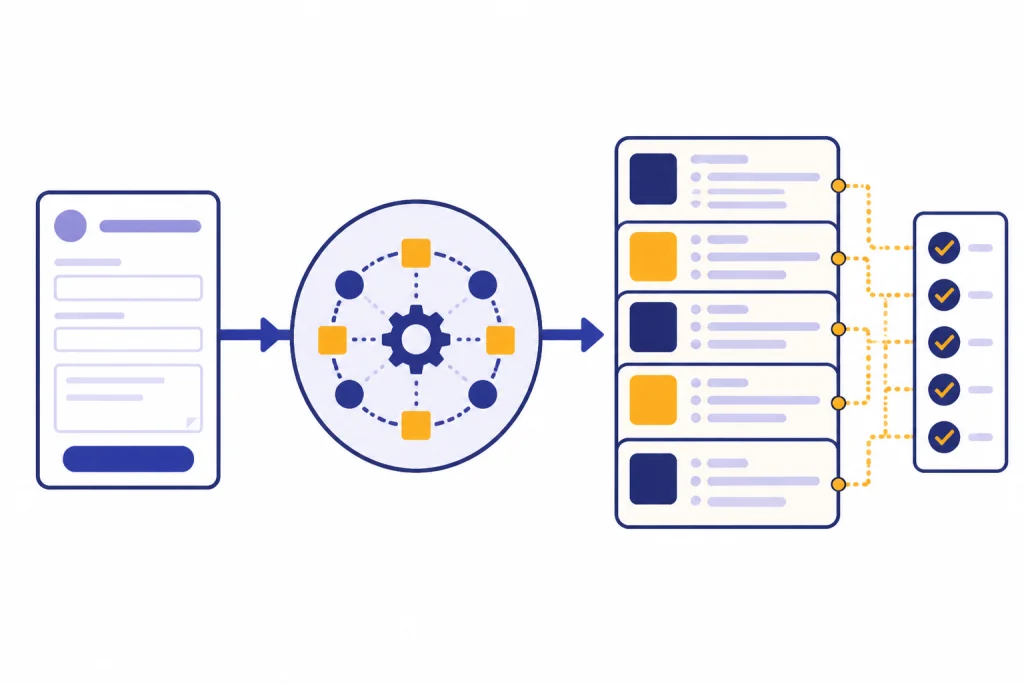
The tool above creates a structured business plan draft from your answers. It is designed for founders, freelancers, local service businesses, creators, online sellers, consultants, and early-stage teams that need a clean starting point rather than a blank page.
Its main value is organization. It can help you describe the customer problem, define your offer, summarize competitors, outline a marketing approach, and list the assumptions that belong in your financial plan. It is especially helpful when your notes are scattered across a spreadsheet, a notebook, customer emails, and half-finished pitch language.
The U.S. Small Business Administration says a business plan can guide how you structure, run, and grow a business, and it can also help when seeking funding or partners.[1] That is the right standard for this tool. A good AI-generated plan should help you think clearly, not give you a document you trust without review.
In practice, the strongest AI-assisted plans usually have three layers: a concise narrative, a visible assumption table, and proof notes. For example, “we will sell to local homeowners” is weak. “We will start with homeowners in three zip codes where we have completed 14 paid repairs and received 9 referral inquiries” is much stronger. The generator can help turn the second sentence into a plan section, but it cannot invent the proof.
The generator is not a magic investor deck, loan approval shortcut, or accounting model. It gives you a draft. You still need to verify the market, talk to customers, update numbers, and remove anything that sounds confident but unsupported. OpenAI also tells users to verify important information from reliable sources when using ChatGPT.[5]
How to use the generator step by step
Start with a narrow business idea. A focused input produces a better plan than a broad one. “Mobile car detailing for apartment residents in Austin” is better than “car business.” “Meal prep for busy nurses working night shifts” is better than “food startup.”
- Choose the plan type. Use a lean plan if you need a fast internal strategy. Use a traditional plan if you expect a lender, investor, landlord, partner, or grant committee to read it.
- Describe the customer. Name the buyer, the urgent problem, and the situation that makes them pay. Avoid demographic-only descriptions such as “busy people.”
- Explain the offer. List the product or service, delivery method, price logic, and why the offer is different from common alternatives.
- Add evidence. Include interviews, waitlist data, past sales, competitor observations, search demand, local market facts, or pilot results. Mark untested ideas as assumptions.
- State financial assumptions. Enter startup costs, expected revenue drivers, gross margin assumptions, monthly expenses, capacity limits, and funding needs if you have them.
- Generate the draft. Treat the output as a working document. Cut vague language. Add sources. Rewrite anything that does not sound like your business.
- Run a downside pass. Ask what happens if sales take twice as long, prices are lower, churn is higher, or labor costs rise.
After you generate the draft, save a clean copy and a working copy. Use the clean copy as the current version. Use the working copy to test different assumptions, such as a lower conversion rate, slower launch, higher rent, or smaller first-year customer base.

If you are still naming the business, pair this workflow with our chatgpt business name generator. A clear name will not fix a weak plan, but it can make your positioning easier to explain.
Free business plan templates you can copy
The right format depends on who will read the plan. The SBA describes two common formats: traditional plans and lean startup plans. Traditional plans are more detailed and can be requested by lenders and investors, while lean startup plans focus on the most important points and can be as short as one page.[1]
Use the templates below as copyable working drafts. Replace the bracketed text with your facts, delete sections that do not apply, and add a spreadsheet for projections. The sample language is illustrative, not a claim about your business.
| Template | Best for | What to include | What to avoid |
|---|---|---|---|
| Lean startup plan | Testing an idea, explaining strategy, internal planning | Problem, audience, solution, channels, revenue model, costs, next milestones | Long biographies, unsupported market-size claims, inflated projections |
| Traditional business plan | Loans, grants, investor review, partner review, lease applications | Executive summary, company description, market analysis, management, product line, marketing, operations, funding request, projections | Generic AI copy, missing assumptions, financial tables with no explanation |
| Operating plan | Running the business after launch | Weekly tasks, owners, suppliers, customer support process, metrics, risks | Investor language that does not help daily execution |
| Financial assumptions sheet | Checking whether the plan can work economically | Startup costs, revenue drivers, cost of goods, fixed expenses, cash flow timing, break-even logic | One revenue number with no driver behind it |
Lean startup template
This version is for a founder who needs a one-page operating strategy. Keep it short enough that you can update it after customer calls.
Business idea:
[One sentence: what you sell, to whom, and where/how.]

Customer segment:
[Primary buyer, user, location, buying trigger, and budget range if known.]

Customer problem:
[The expensive, frustrating, risky, or time-consuming problem.]

Current alternatives:
[Competitors, substitutes, DIY methods, or doing nothing.]

Our solution:
[Product/service, delivery method, turnaround time, and customer outcome.]

Why customers will switch:
[Specific reason: faster, cheaper, safer, more convenient, better fit, trusted relationship, or bundled service.]

Revenue model:
[Price, frequency, average order value, subscription/retainer/project fee, and payment timing.]

Main costs:
[Startup costs, variable costs per sale, fixed monthly expenses, owner labor, contractors, software, supplies.]

Marketing channels:
[First 2-3 channels, why they match the buyer, and how success will be measured.]

Proof so far:
[Interviews, paid pilots, waitlist, letters of intent, past clients, marketplace sales, referrals, or relevant experience.]

First milestone:
[Example: 10 paying customers, 3 signed retainers, 50 preorders, or first profitable month.]

Key risk:
[The assumption most likely to break the plan.]

What we will test next:
[The next experiment, owner, deadline, and decision rule.]
Illustrative filled-in example: “Business idea: weekend mobile bike repair for commuters in central Denver. Customer segment: apartment residents who bike to work but lack tools, storage, or time to visit a shop. Revenue model: tune-up packages plus add-on parts. First milestone: book 30 paid appointments in 60 days through building manager referrals and local cycling groups.”
Traditional business plan template
This version is more useful when an outside reader needs context. Do not make it longer by adding filler. Make it stronger by adding evidence, assumptions, and clear risks.
Executive summary
[Write this last. Summarize the business, customer, offer, traction, funding need if any, and near-term milestones.]

Company description
[Legal name if formed, location, ownership, mission, stage, and what the company does.]

Customer problem and solution
[Describe the buyer's pain in plain language, then explain how your product or service solves it.]

Industry and market analysis
[Define the reachable market you can actually sell to first. Include sources, local facts, trends, and limits.]

Competitor review
[List direct competitors and substitutes. Explain where you are different and where competitors are stronger.]

Product or service line
[Packages, features, delivery process, pricing logic, warranties, service boundaries, and future offerings.]

Marketing and sales plan
[Channels, sales process, conversion assumptions, partnerships, referral plan, and retention strategy.]

Operations plan
[Location, suppliers, equipment, fulfillment, staffing, quality control, customer support, and key systems.]

Management and staffing
[Founder roles, relevant experience, hiring plan, advisers, and gaps the business must fill.]

Funding request, if any
[Amount requested, use of funds, timing, repayment or investor logic, and owner contribution if applicable.]

Financial assumptions
[Revenue drivers, cost of goods or service delivery, fixed expenses, payroll, taxes, cash timing, and seasonality.]

Financial projections
[Monthly forecast, income statement, cash flow, balance sheet if needed, break-even analysis, and scenario notes.]

Risks and mitigation
[Top risks, early warning metrics, and what you will do if assumptions are wrong.]

Appendix
[Licenses, resumes, quotes, supplier agreements, research notes, charts, leases, product images, or supporting documents.]
Sample executive summary language you can adapt: “Company Name will provide [specific product/service] for [specific customer] who struggle with [specific problem]. The business will begin in [initial market] using [sales channel] and will measure early demand through [paid pilot, preorders, signed contracts, bookings, or retention]. The first-year goal is to prove repeatable acquisition and positive contribution margin before expanding into [next market/channel].”
The SBA lists common traditional business plan sections that include executive summary, company description, market analysis, organization and management, service or product line, marketing and sales, funding request, and financial projections.[1] The SBA also offers sample traditional and lean business plans for new small business owners.[2]
SCORE’s startup business plan template takes a question-driven approach. SCORE says its template includes a narrative and financial worksheets, and that the narrative contains more than one hundred fifty questions divided across business plan sections.[3] SCORE also offers a financial projections template with worksheets for startup funds, wages, operating expenses, sales forecasts, cash flow, income statement, balance sheet, financial ratios, break-even analysis, and debt amortization.[4]
The inputs that make the draft better
A ChatGPT business plan is only as good as the facts you give it. If you provide vague inputs, you will get a polished but vague draft. If you provide real constraints, the output becomes easier to review and improve.
Use this input list before you run the generator:
- Customer: Who pays, who uses the product, and who influences the decision.
- Problem: The costly, annoying, risky, or time-consuming issue you solve.
- Offer: What you sell, how it is delivered, what the buyer receives, and what is out of scope.
- Proof: Interviews, preorders, past client work, marketplace sales, traffic, email signups, or pilot results.
- Competition: Direct competitors, substitutes, do-it-yourself options, and why customers switch.
- Pricing logic: One-time purchase, subscription, retainer, hourly service, project fee, commission, or hybrid model.
- Costs: Startup costs, fixed monthly expenses, variable costs, labor, software, supplies, contractor fees, and refunds or warranty costs.
- Sales motion: Local outreach, paid ads, organic search, referrals, partnerships, marketplaces, events, or outbound sales.
- Capacity: How many customers, orders, projects, or appointments you can handle before hiring or adding equipment.
- Constraints: Licenses, regulations, seasonality, staffing limits, supplier risks, location limits, or platform dependence.
The easiest way to improve the output is to add real examples. Instead of saying “customers need convenience,” write “parents in the neighborhood want after-school tutoring that starts after work hours and does not require driving across town.” Instead of saying “we will use social media,” write “we will publish short repair videos for homeowners and use them to book free estimates.”
A useful prompt should ask the model to separate what is known from what is assumed. For example: “Draft the market analysis in two parts: confirmed evidence and assumptions to test. Do not state an assumption as a fact. Add questions I should answer before sharing this with a lender.” That one instruction usually improves the plan more than asking for a “professional tone.”
If you want to build better reusable prompts for planning, review our Best ChatGPT Prompt Generator Tools guide. If your actual business is selling AI workflow help, the related guides on prompt engineering certification, Prompt Engineering Jobs, and prompt engineering salary in 2026 are more relevant when you write the staffing, skills, and service-positioning parts of that plan.

When not to use a ChatGPT business plan generator
Do not use a generator as your final source of truth. A business plan can affect loans, leases, taxes, employment decisions, investor conversations, and personal savings. Those decisions need evidence and human review.
Do not rely on the tool for legal structure, tax treatment, securities compliance, franchise obligations, payroll rules, health regulations, lending eligibility, or insurance coverage. Use an attorney, accountant, lender, insurance broker, or local business adviser for those topics.
Do not paste confidential information into a tool unless you understand the privacy terms for the product you are using. OpenAI says its enterprise privacy commitments cover business data for ChatGPT Business, ChatGPT Enterprise, ChatGPT Edu, ChatGPT for Teachers, and the API Platform, including ownership and control of business data.[6] If you use a different AI tool, read its policy before entering customer lists, trade secrets, medical data, financial records, employee data, or unreleased product details.
Do not use the generator to invent market research. A strong plan separates facts from assumptions. If you do not know the average order value, say it is an assumption. If you have not interviewed customers, say that. If your revenue forecast depends on a conversion rate you have not tested, mark it as a risk.
This is especially important if the plan supports a funding request. The SBA notes that investors want confidence that they will see a return, and the business plan is the tool used to make that case.[1] A confident claim without support does not make that case stronger. It makes the plan easier to challenge.
How it compares to alternatives
A ChatGPT business plan generator is best for fast structure and drafting. It is not always the best option for financial modeling, lender packaging, or regulated industries. The table below shows where it fits.
| Option | Best use | Strength | Weakness |
|---|---|---|---|
| ChatGPT business plan generator | Creating a first draft and organizing messy notes | Fast, flexible, easy to revise | Needs fact-checking, financial review, and source support |
| SBA templates | Learning standard plan structure and reviewing sample formats | Reliable public guidance for small business planning | Still requires you to write and research the details |
| SCORE templates and mentors | Building a more complete plan with worksheet support | Strong question-driven planning process | Can take more time than a quick AI draft |
| Spreadsheet financial model | Testing unit economics, cash flow, and funding needs | Better for numbers and assumptions | Does not write the narrative for you |
| Consultant or adviser | High-stakes funding, acquisitions, franchises, or complex launches | Human judgment and accountability | Costs more and still requires founder input |
For many founders, the best approach is not either-or. Use the generator for the first narrative draft. Use SBA or SCORE materials to check the structure. Use a spreadsheet to test the numbers. Use a human adviser before you send the plan to someone who can say yes or no to money.
If your plan depends on selling AI-related services, keep the business model concrete: who pays, what deliverable they receive, how long fulfillment takes, and what proof you have that buyers want it. Our guides on how to use ChatGPT to make money online, how to make money with ChatGPT in 2026, and how does ChatGPT make money? business model are best used as background when your plan is specifically about an AI service, content, automation, or software idea.
If your plan includes support automation, read chatgpt customer service before you write the operations section. Customer support plans need escalation rules, quality review, privacy controls, and clear boundaries for what AI can answer.
Review checklist before you share the plan
Use this checklist after the tool creates your draft. The goal is to make the plan credible, specific, and useful.
- Replace generic claims. Delete phrases such as “large market opportunity” unless you add evidence.
- Separate facts from assumptions. Label assumptions clearly in the financial section.
- Check every number. Tie revenue to drivers such as customers, orders, visits, retention, capacity, or billable hours.
- Add competitor detail. Name alternatives and explain why customers would change behavior.
- Check capacity. A service business forecast should not assume more appointments, projects, or billable hours than the team can deliver.
- Write the executive summary last. It should reflect the finished plan, not the first idea.
- Read the plan aloud. If a sentence sounds like a brochure, rewrite it in plain language.
- Ask for an outside review. A mentor, accountant, lender, operator, or experienced founder can find gaps faster than the author can.

The financial section deserves extra care. A projection should show how the business works, not just where you hope it ends up. If the plan says monthly revenue will grow, explain what causes that growth. If margins improve, explain whether the reason is volume purchasing, higher prices, better labor utilization, or a different product mix.
Mini financial example, illustrative only: suppose a mobile detailing business expects 40 jobs per month at an average price of $120. Monthly revenue would be 40 × $120 = $4,800. If supplies, payment fees, and direct labor average $45 per job, variable cost would be 40 × $45 = $1,800, leaving $3,000 in gross profit before fixed expenses. If fixed monthly expenses are $2,400 for insurance, software, marketing, fuel base costs, phone, and storage, the plan shows about $600 before owner taxes and debt payments. Break-even jobs would be fixed expenses divided by gross profit per job: $2,400 ÷ ($120 − $45) = 32 jobs. A lender or adviser can now challenge the actual assumptions: Can the owner sell 40 jobs? Is $120 realistic? Are labor and travel fully counted? What happens in a slow month?
That is the level of logic your plan should expose. Do not hide behind a single “Year 1 revenue” number. Show the drivers: customers, order frequency, average price, variable cost, fixed cost, capacity, and cash timing. If the drivers are weak, fix the business model before polishing the wording.
Finally, make the plan usable. A short plan that guides decisions is better than a long plan that no one opens. The SBA says there is no single right or wrong way to write a business plan; what matters is that the plan meets your needs.[1] That is the best test for any AI-generated draft.
Frequently asked questions
Can ChatGPT write a complete business plan?
ChatGPT can draft a complete business plan structure, but it cannot independently verify your market, pricing, competitors, legal requirements, or financial assumptions. Treat the draft as a starting point. Replace generic sections with evidence from your own research.
Is a ChatGPT business plan good enough for a loan?
Not by itself. A lender will care about the business model, borrower profile, repayment ability, financial assumptions, collateral if required, and the credibility of the plan. Use the generator for drafting, then review the plan with a lender, accountant, or small business adviser.
What should I enter into the business plan generator?
Enter the customer, problem, offer, location or market, competitors, pricing idea, startup costs, monthly expenses, sales channels, capacity limits, and any proof you already have. The more concrete the input, the less generic the output. Avoid entering confidential customer or employee data unless you have reviewed the tool’s privacy terms.
What is the difference between a lean plan and a traditional plan?
A lean plan is a short working document for strategy, testing, and internal alignment. A traditional plan is more detailed and is more common when outsiders need to evaluate the business. The SBA describes traditional plans as more comprehensive and lean startup plans as focused on key points.[1]
Can I use the plan for an investor pitch?
You can use it to prepare the narrative behind a pitch, but investors usually expect a sharper story than a generic business plan. Build a separate pitch deck after the plan is clear. Keep the deck focused on problem, solution, traction, market, business model, go-to-market plan, team, and funding use.
Should I include financial projections?
Yes, if the plan will guide spending, fundraising, lending, hiring, or inventory decisions. Keep projections tied to assumptions that a reader can understand. SCORE’s financial projection materials include worksheets for core planning items such as sales forecasts, cash flow, income statements, balance sheets, break-even analysis, and debt amortization.[4]