


Prompt engineering salary data in 2026 is real, but it is noisy. The best public U.S. numbers do not point to one clean salary. They show several markets using the same phrase. ZipRecruiter lists “Prompt Engineer” at $97,940 a year as of March 11, 2026, while its broader “Prompt Engineering” category lists $62,977. Coursera cites Glassdoor’s $126,000 median total pay figure from December 2025. The practical answer is this: standalone prompt-writing jobs often pay less than hybrid AI engineering roles, while senior roles that combine prompts, evaluation, product judgment, and coding can still pay well into six figures.
What the salary data actually says
The honest prompt engineering salary answer starts with disagreement. Public salary trackers use different job-title buckets, different samples, and different definitions of “prompt engineering.” That matters because a content operations job using prompts is not the same labor market as a product engineer building LLM evaluation systems.
ZipRecruiter’s “Prompt Engineer” page reports an average annual U.S. salary of $97,940 as of March 11, 2026, with most salaries between $74,500 and $126,500 and a 90th percentile of $163,500.[1] ZipRecruiter’s broader “Prompt Engineering” category reports a lower average of $62,977 on the same date, with most salaries between $47,000 and $72,000.[2] Coursera’s 2026 guide cites Glassdoor data showing $126,000 in median total pay for prompt engineers as of December 2025, while also warning that salary information for the role is limited.[3]
Those three figures are not interchangeable. They describe different slices of the market. A useful reading is that lower numbers often capture broad “prompting” work, midrange numbers capture specialized prompt engineer roles, and higher numbers capture total compensation or more technical AI roles.
| Source and category | Reported U.S. figure | What it likely captures | How to use it |
|---|---|---|---|
| ZipRecruiter, “Prompt Engineering” | $62,977 average salary as of March 11, 2026[2] | Broad roles that mention prompt engineering, including less technical work | Use as a floor for generalist roles |
| ZipRecruiter, “Prompt Engineer” | $97,940 average salary as of March 11, 2026[1] | More direct prompt engineer job titles | Use as a mid-market benchmark |
| Coursera citing Glassdoor | $126,000 median total pay as of December 2025[3] | Salary plus possible bonus, equity, or other pay | Use as an upper mainstream benchmark, not a guaranteed base salary |
This is why salary screenshots can mislead. One person may be looking at a low-code content role. Another may be looking at a senior AI systems role. Both may use the same keyword.
Why the range is so wide
The range is wide because prompt engineering is not a standardized occupation. The U.S. Bureau of Labor Statistics does not publish a dedicated “prompt engineer” occupation. OpenAI has not published an official figure for prompt engineer salaries as a category. Salary sites therefore infer pay from job titles, job postings, and user submissions.
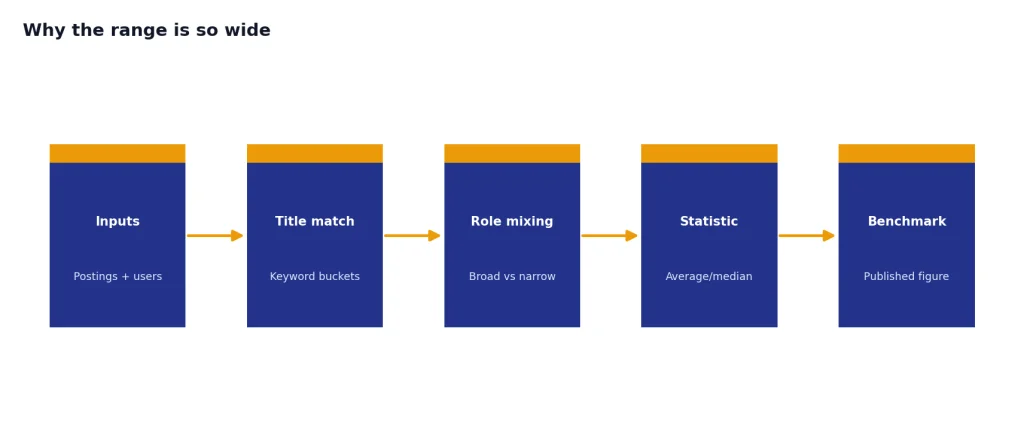
The title also covers several different jobs. A marketing prompt specialist may build reusable instructions for campaign drafts. A support automation specialist may tune prompts for a chatgpt customer service workflow. A technical AI engineer may write Python, build retrieval systems, design evaluations, monitor cost, and debug model failures. Those jobs should not have the same pay band.
The premium usually appears when prompt work affects production systems. Employers pay more when the work improves accuracy, reduces hallucinations, controls latency, lowers API cost, or makes an AI feature safe enough to ship. A person who only writes clever instructions is easier to replace than a person who can prove a prompt improves a measured business outcome.
There is also a sample-size problem. An arXiv study of LinkedIn postings analyzed 20,662 job postings and found only 72 prompt engineer positions, which means prompt engineering represented less than 0.5 percent of that sample.[6] The same study found that prompt engineer postings emphasized AI knowledge, prompt design, communication, and creative problem-solving, which supports the idea that the role is a hybrid rather than a single narrow task.[6]
That finding matches what job seekers see in the market. The clean title “Prompt Engineer” exists, but many serious jobs hide the same work inside product, AI engineering, data, support automation, or solutions roles. If you only search one title, you will miss part of the market. Our separate Prompt Engineering Jobs guide covers the hiring side in more detail.
How prompt engineering pay compares with related roles
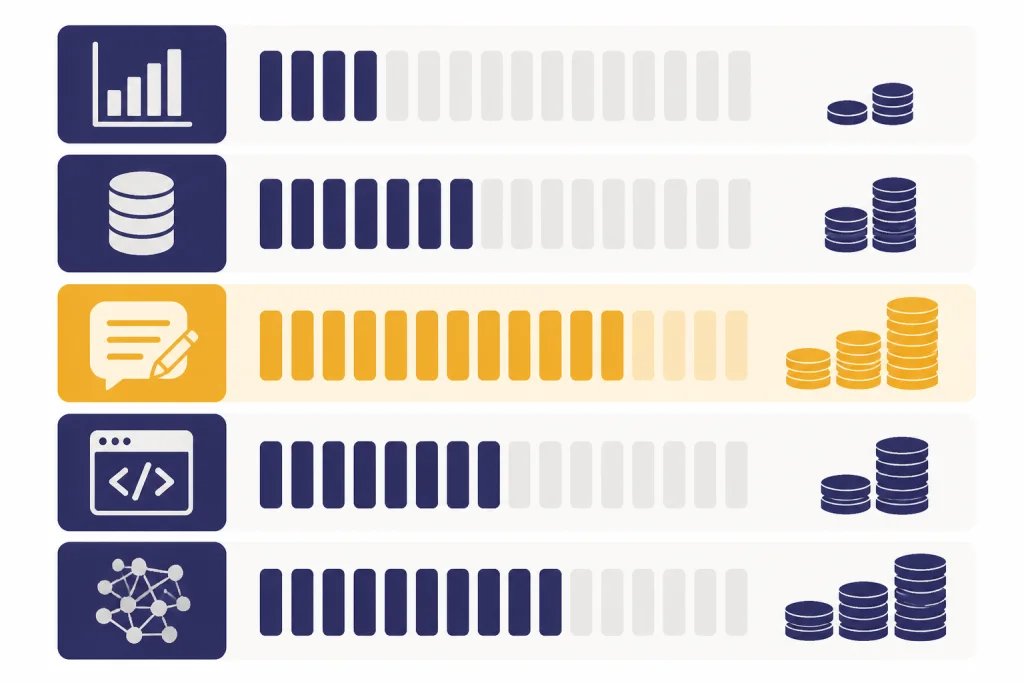
Prompt engineering pay makes more sense when compared with established technical roles. The BLS reported a $112,590 median annual wage for data scientists in May 2024 and projected 34 percent employment growth for data scientists from 2024 to 2034.[4] The BLS reported a $133,080 median annual wage for software developers in May 2024 and projected 16 percent growth for software developers from 2024 to 2034.[5]
Those benchmarks show the ceiling and the risk. A prompt engineer with strong coding, evaluation, and data skills can compete near software and data science compensation. A prompt-only role may sit below those benchmarks because it lacks the harder-to-substitute parts of the work.
| Role or category | Public pay benchmark | Interpretation for job seekers |
|---|---|---|
| Prompt Engineering, broad category | $62,977 average salary on ZipRecruiter as of March 11, 2026[2] | Likely includes broad, less technical prompting work |
| Prompt Engineer title | $97,940 average salary on ZipRecruiter as of March 11, 2026[1] | More relevant to direct prompt engineer postings |
| Prompt Engineer total pay | $126,000 median total pay cited by Coursera from Glassdoor data as of December 2025[3] | Useful for offers that include bonus or equity |
| Data scientist | $112,590 median annual wage in May 2024[4] | Good benchmark for analytical prompt roles |
| Software developer | $133,080 median annual wage in May 2024[5] | Good benchmark for production AI roles with code ownership |
The comparison favors candidates who frame prompt engineering as applied AI work. If your resume reads like “I use ChatGPT well,” you will be compared with general business users. If it reads like “I built and tested a production LLM workflow,” you are closer to the data and software labor markets.
What raises a prompt engineer salary
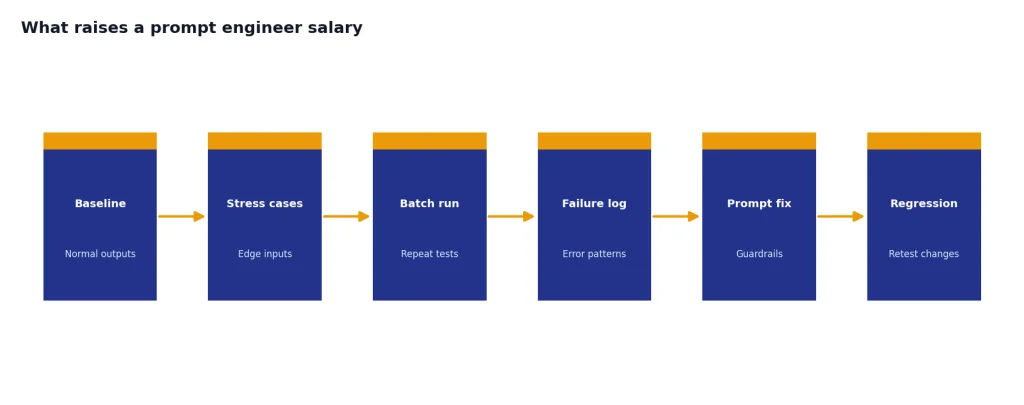
The highest salaries go to people who can make model behavior measurable. Employers want fewer vague claims and more evidence. A strong portfolio should show the problem, the baseline output, the prompt strategy, the evaluation method, the failure cases, and the final improvement.
Technical range matters. You do not need to become a research scientist for every role, but Python, APIs, structured outputs, retrieval-augmented generation, logging, and basic evaluation design all raise your value. If you build with OpenAI or other model APIs, understanding openai api pricing also helps because cost is part of production AI work.
Domain expertise also raises pay. Legal, health care, finance, customer support, and developer tooling all have different risk profiles. A candidate who understands a regulated workflow can often command more than a generalist prompt writer because the employer is buying judgment, not just syntax.
Reliability skills are another separator. Learn how to test prompts against adversarial inputs, edge cases, and bad source data. Learn how to handle model errors, rate limits, malformed JSON, and fallback behavior. Our OpenAI API Errors reference is useful if your target role touches production integrations.
Certifications can help, but they are not a substitute for evidence. A prompt engineering certification may help you organize study and signal interest. It will not carry an offer by itself if you cannot show working examples.

Job titles to search beyond prompt engineer
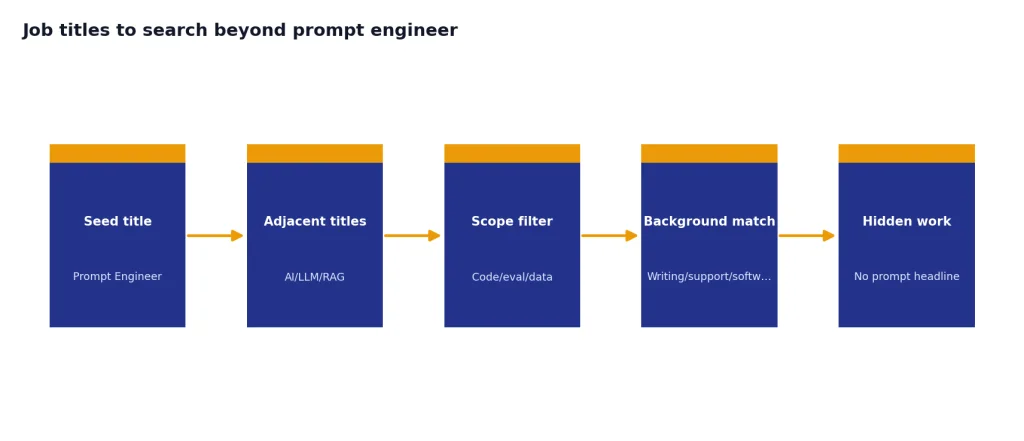
Search behavior affects salary research. If you only search “prompt engineer,” you may overfocus on a small number of listings and miss roles that pay better. The market increasingly embeds prompt work into broader titles.
- AI Engineer
- Generative AI Engineer
- LLM Engineer
- Applied AI Engineer
- AI Product Manager
- Conversational AI Designer
- AI Automation Specialist
- AI Solutions Engineer
- RAG Engineer
- AI Evaluation Engineer
These titles often require more than prompting. They may include code, model evaluation, workflow automation, data preparation, product discovery, or customer implementation. That extra scope is exactly why they can pay more.
For entry-level candidates, this means you should build toward a role family, not a single title. If you come from writing, start with content quality, documentation, and evaluation projects. If you come from support, build AI helpdesk workflows and study ChatGPT for Customer Service Teams. If you come from software, build small tools that call models, test outputs, and track cost.
If you are still exploring AI career paths, compare this market with broader ChatGPT Jobs. Many jobs that reward prompt skill will not put “prompt” in the headline.
How to use this data in a job search
Use salary data as a negotiation range, not as a promise. For a role titled “Prompt Engineer,” the ZipRecruiter average of $97,940 gives you a grounded midpoint for base salary conversations.[1] For a broader role that only mentions prompt engineering as one skill, the $62,977 ZipRecruiter “Prompt Engineering” figure is a warning that some employers may price the work as generalist business support.[2] For a technical role with bonus or equity, Coursera’s $126,000 total-pay figure can support a higher discussion, but only if the responsibilities match that level.[3]
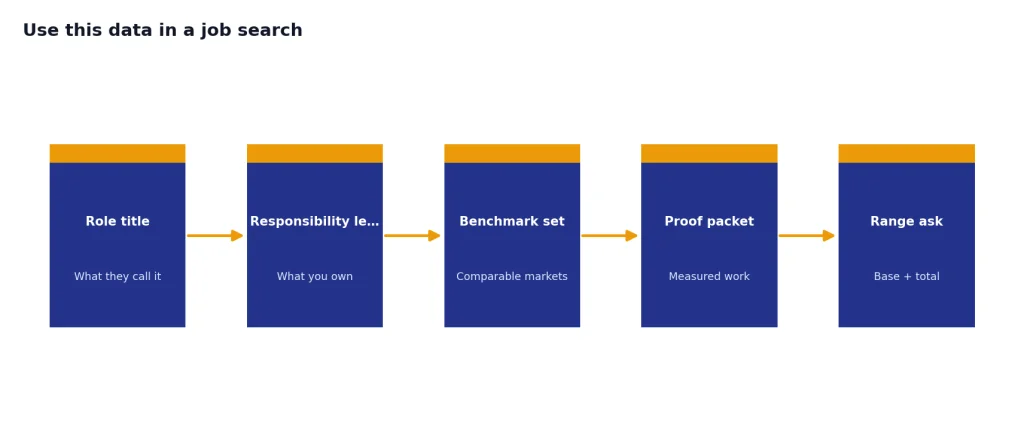
Ask recruiters which market they are pricing against. If they say the job is an AI engineering role, ask why the salary is below data scientist or software developer benchmarks. If they say it is a content or operations role, expect the range to be lower unless you own measurable automation outcomes.
Bring proof. A strong prompt engineering portfolio can include a customer support classifier, a structured extraction workflow, a safety evaluation set, a cost comparison between model choices, or a prompt library with test results. Use an AI resume builder tools compared guide to package the work clearly, but make sure the substance is yours.
Do not overclaim. Hiring teams know that many applicants list AI skills casually. Show specific systems, failure modes, and tradeoffs. If you use a ChatGPT prompt generator tool, present it as a helper, not as your core skill.
Bottom line for 2026
The prompt engineering salary market is real, but the title is unstable. The most defensible range for a U.S. prompt engineer in 2026 depends on the job definition. Broad prompt-related work may look closer to the $62,977 ZipRecruiter category average.[2] Direct prompt engineer roles look closer to ZipRecruiter’s $97,940 average.[1] More technical or total-compensation benchmarks can reach Coursera’s cited $126,000 median total pay figure.[3]
The outliers are real but rare. A public Anthropic “Prompt Engineer and Librarian” posting lists an expected salary range of $175,000 to $335,000, but that kind of listing reflects a highly selective AI lab role, not the typical market.[7] It is useful as evidence that the skill can be valuable at the frontier. It is not a normal starting salary.
The best career strategy is to treat prompt engineering as a valuable layer on top of another skill. Pair it with software, data science, product management, customer operations, research, compliance, or a specific industry. That is where the stronger salaries are.
Frequently asked questions
What is the average prompt engineering salary in 2026?
There is no single reliable average because salary sites categorize the role differently. ZipRecruiter reports $97,940 for “Prompt Engineer” as of March 11, 2026, while its broader “Prompt Engineering” category reports $62,977.[1][2] Coursera cites a $126,000 median total pay figure from Glassdoor as of December 2025.[3]
Can prompt engineers really make more than $200,000?
Yes, but that is not the median outcome. Public examples exist, including an Anthropic prompt engineer posting with a $175,000 to $335,000 salary range.[7] Those roles usually require strong AI judgment, technical fluency, evaluation skill, and the ability to work on high-stakes model behavior.
Is prompt engineering still a real job?
Yes, but it is a small and changing job category. One LinkedIn job-posting study found only 72 prompt engineer positions in a sample of 20,662 postings, or less than 0.5 percent of the sample.[6] The skill is often embedded inside AI engineer, product, support automation, and data roles.
Do I need coding skills to earn a high prompt engineering salary?
For the highest-paying roles, coding helps a lot. Employers pay more when you can connect prompts to APIs, build evaluations, measure outputs, and debug production behavior. Non-coding roles exist, but they are more likely to compete with content, operations, or training-data jobs.
Is a prompt engineering certificate worth it?
A certificate can help you learn the vocabulary and build a study path. It is not enough by itself. Employers care more about work samples, domain knowledge, and proof that your prompts improve measurable results.
What should I put in a prompt engineering portfolio?
Include projects that show inputs, outputs, test cases, and measurable improvement. Good examples include structured data extraction, support-ticket routing, RAG answer evaluation, safety testing, and cost comparisons across model choices. Explain the tradeoffs instead of only showing polished outputs.