
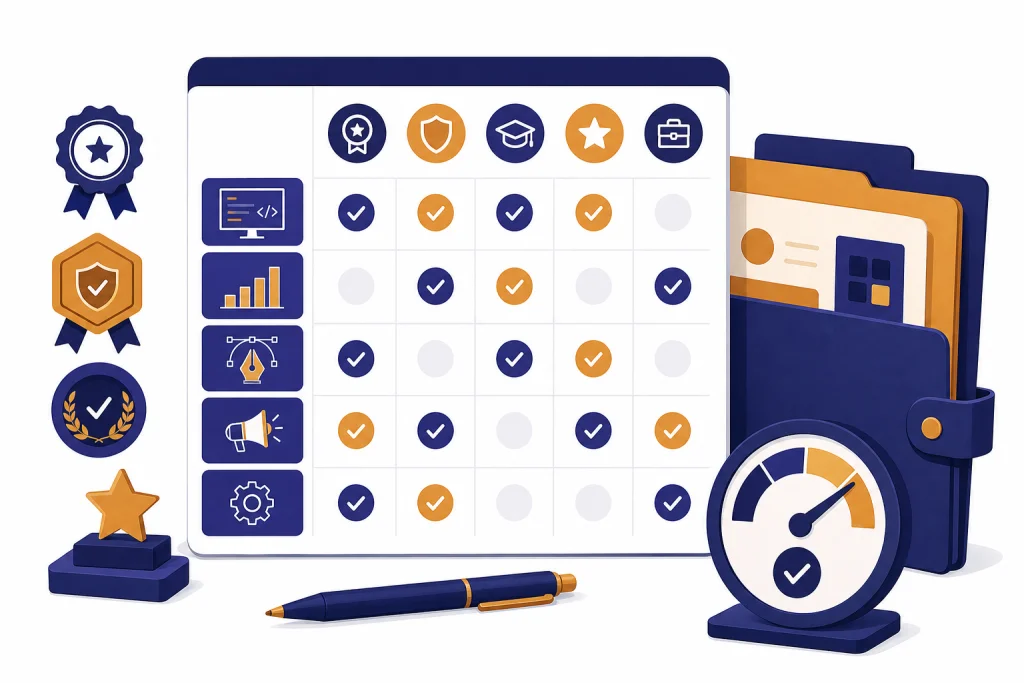
A prompt engineering certification can help you learn structured prompting, evaluate model output, and show employers that you have practiced with real AI workflows. It is not a substitute for a portfolio. The best choice depends on your goal. Vanderbilt’s Coursera specialization is the strongest broad option for nontechnical professionals. DeepLearning.AI’s ChatGPT Prompt Engineering for Developers is the best short developer course. Google Cloud and Microsoft credentials fit cloud and app-building roles. ASU’s AI Prompting Certificate is the more intensive university-branded option for business users. Avoid expensive certificates that promise a prompt engineer job by themselves.
Quick picks
If you want the safest all-around pick, choose the Vanderbilt University Prompt Engineering Specialization on Coursera. It is a beginner-level, three-course series with a shareable certificate, and Coursera lists it as taking about four weeks at ten hours per week.[3]
If you write code, start with DeepLearning.AI’s ChatGPT Prompt Engineering for Developers. DeepLearning.AI lists it as a beginner short course taught by Isa Fulford and Andrew Ng, with one hour and thirty minutes of material, nine video lessons, and seven code examples.[4]
If you work in Google Cloud, choose Prompt Design in Vertex AI. Google Cloud Skills Boost describes it as an introductory skill badge that covers prompt engineering, image analysis, and multimodal generative techniques in Vertex AI.[7]
If you want a workplace-focused university certificate and can justify the price, consider ASU’s AI Prompting Certificate Course. ASU lists it as a five-week online program with optional mentor-led sessions and a certificate of completion, priced at $1,850 at the time checked.[9]
If your real goal is a job, pair any certificate with projects. Hiring teams care more about proof that you can turn a messy task into a reliable AI workflow. Use this guide to prompt engineering jobs and our take on prompt engineering salary to understand the market before paying for a course.

What a prompt engineering certification actually means
A prompt engineering certification is usually a course certificate, skill badge, or assessment credential. It does not mean the provider has licensed you as a professional engineer. In this field, the word “certification” is loose. Some programs give a certificate of completion. Some require a graded assignment. Some use a lab-based assessment. Some are mostly video courses.
That distinction matters. A course certificate says you completed training. A skill badge says you completed a specific hands-on lab or challenge. A professional certification usually includes an exam and validity period. GSDC, for example, lists a multiple-choice exam with forty questions, a sixty-five percent passing score, a ninety-minute duration, and five-year validity for its Certified Prompt Engineering Certification.[10]
OpenAI’s own guidance is a useful benchmark for what good training should cover. OpenAI defines prompt engineering as writing effective instructions so a model can consistently generate content that meets requirements. OpenAI also recommends building evaluations to measure prompt behavior as you iterate, especially for more complex applications.[1]
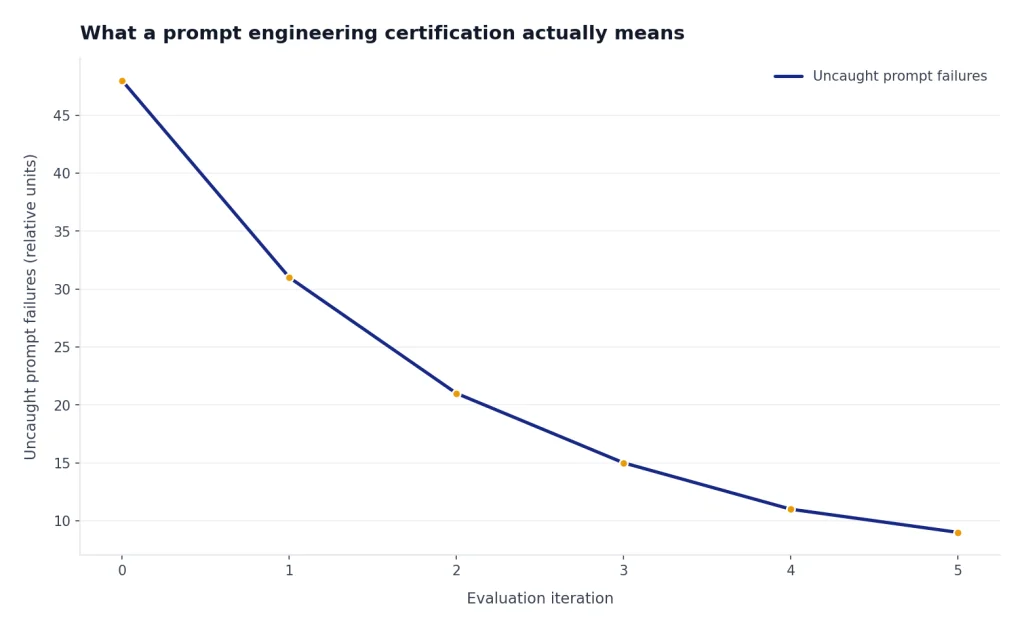
Good certification programs should teach more than clever prompt templates. They should cover task framing, examples, context, delimiters, model differences, output validation, safety, and evaluation. They should also teach when not to over-prompt. OpenAI notes that reasoning models often work best with straightforward prompts and that “think step by step” style prompting may be unnecessary or harmful for some reasoning models.[2]
If you are new to the underlying models, read what is GPT? before you start. If you plan to build software with prompts, review the OpenAI API pricing breakdown so your experiments do not turn into avoidable costs.
Best prompt engineering certification programs by goal
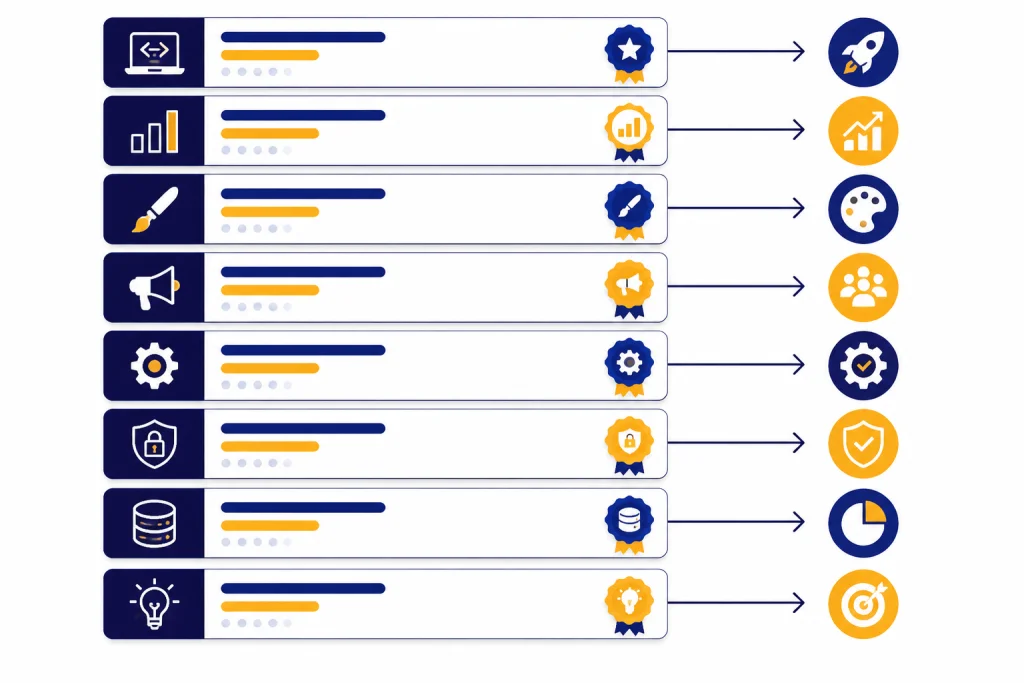
The best program depends on what you need the credential to prove. A marketer, software developer, cloud architect, customer support lead, and career switcher do not need the same training path.
| Program | Best for | Credential type | Why it stands out |
|---|---|---|---|
| Vanderbilt Prompt Engineering Specialization | Broad business and productivity use | Coursera shareable certificate | Three-course beginner series that starts with prompt patterns and expands into data analysis and trustworthy AI.[3] |
| DeepLearning.AI ChatGPT Prompt Engineering for Developers | Developers and API learners | Short course | Concise OpenAI API practice with lessons from Isa Fulford and Andrew Ng.[4] |
| IBM Generative AI: Prompt Engineering Basics | Beginners who want a recognized brand | Coursera shareable certificate | Covers prompt engineering concepts, best practices, tools, techniques, and a final project.[5] |
| AWS Essentials of Prompt Engineering | AWS learners and cloud beginners | Coursera course certificate option | One-module beginner course on prompt refinement, zero-shot, few-shot, chain-of-thought prompting, and risks.[6] |
| Google Cloud Prompt Design in Vertex AI | Google Cloud and Gemini users | Google Cloud skill badge | Hands-on badge for prompt engineering, image analysis, and multimodal techniques in Vertex AI.[7] |
| Microsoft Applied Skills: Build a generative AI chat app | Developers building with Microsoft Foundry | Lab-based Applied Skills credential | Validates building a generative AI chat app, including model deployment, chat history, and Foundry SDK work.[8] |
| ASU AI Prompting Certificate Course | Business professionals who want guided practice | University certificate of completion | Five-week online course with optional mentor-led sessions and hands-on ChatGPT work.[9] |
| GSDC Certified Prompt Engineering Certification | People who want an exam-style credential | Professional certification exam | Includes exam attempts, self-paced material, live sessions, practice exams, and a capstone project according to GSDC.[10] |
Best overall: Vanderbilt Prompt Engineering Specialization
Vanderbilt is the best overall pick for most readers because it teaches prompt engineering as a repeatable set of patterns. It is not only a list of prompts. Coursera’s program page says the specialization starts with fundamentals and moves to advanced prompt engineering skills, with hands-on exercises across the courses.[3]
This is a strong fit for analysts, managers, educators, writers, consultants, and operators who want to use ChatGPT and similar tools in daily work. It is less ideal if you want a developer-first path with API calls, testing harnesses, and production deployment.
Best for developers: DeepLearning.AI
DeepLearning.AI’s course is short, practical, and focused on application development. The course page says learners practice writing and iterating on prompts with the OpenAI API, and it covers use cases such as summarizing, inferring, transforming, expanding, and building a chatbot.[4]
Choose this if you can read basic Python and want to move beyond the ChatGPT interface. It is not a complete career credential. Treat it as your first lab, then build a small app. If you need prompt-writing support instead of a course, compare options in the best ChatGPT prompt generator tools.
Best beginner brand credential: IBM
IBM’s Generative AI: Prompt Engineering Basics is a good first certificate for learners who want a recognizable company name and a structured introduction. Coursera says the course teaches the relevance of prompt engineering, best practices, common tools, common techniques, and a final project.[5]
Pick IBM if you are starting from zero and want a resume-friendly entry point. If you already build automations, agents, or API workflows, it may feel too introductory.
Best cloud-specific badges: Google, Microsoft, and AWS
Cloud credentials are useful when your job already runs on that platform. Google Cloud’s Prompt Design in Vertex AI is the best fit for teams using Vertex AI and Gemini, because it includes hands-on labs and a challenge path tied to Google Cloud tooling.[7]
Microsoft’s Applied Skills credential is a better fit for developers who need to prove they can build a generative AI chat app in Microsoft Foundry. Microsoft describes the assessment as an interactive lab that evaluates tasks such as preparing and deploying a model, creating a chat app with the Foundry SDK, and implementing chat history.[8]
AWS Essentials of Prompt Engineering is the lightest of the three. It works as a quick foundation for AWS learners before deeper Bedrock or AI Practitioner study. Coursera lists it as a one-module course that covers prompt optimization, zero-shot, few-shot, chain-of-thought prompting, and risk awareness.[6]
How to judge a prompt engineering certificate
Use a stricter test than the course sales page. A good prompt engineering certification should help you do real work more reliably. It should not only teach prompts for social media posts or generic emails.
- It teaches evaluation. You should learn how to compare outputs, test edge cases, and document what changed.
- It covers model differences. A prompt that works well in one model may fail in another.
- It includes safety and misuse risks. Prompt injection, hallucinations, privacy, and sensitive data handling belong in the curriculum.
- It uses realistic artifacts. Good assignments produce prompts, test cases, workflows, support macros, app prototypes, or policy documents.
- It does not promise a job by itself. No short certificate can guarantee a prompt engineering role.
Also check the credential wording. “Certificate of completion” is not the same as a proctored certification exam. That does not make it useless. It just changes how you should present it. A completion certificate supports a skills story. A lab badge supports a tooling story. An exam certification supports a credential story.
For business teams, the best certificate is often the one attached to a real internal use case. A customer service manager, for example, can use training to build better triage prompts, escalation summaries, and knowledge-base drafts. See this guide to ChatGPT customer service for practical examples.
For founders and freelancers, the certificate should support an offer. A course is useful if it helps you sell a clearer deliverable, such as AI workflow audits, prompt libraries, support automation, or documentation systems. If you are exploring services, compare ideas in how to make money with ChatGPT in 2026 and how to use ChatGPT to make money online.
What to build while you study
A certificate becomes more credible when it points to a portfolio. Build small, specific artifacts while you study. Do not wait until the course is finished.
- Prompt library: five to ten prompts for one role, with notes on inputs, outputs, failure modes, and examples.
- Before-and-after case study: show the original task, weak prompt, improved prompt, and measurable output improvement.
- Evaluation sheet: define criteria such as accuracy, tone, completeness, compliance, and source use.
- Workflow demo: document a repeatable process, such as turning call notes into a support summary.
- Guardrail document: list what the model should refuse, what data it should not receive, and when a human must review output.
Keep your projects narrow. “I built an AI assistant” is vague. “I built a prompt workflow that turns refund requests into tagged support summaries with escalation checks” is stronger. That kind of project maps to real business value.
If you want to move toward paid work, connect your portfolio to a business problem. For example, use ChatGPT to draft a service page, build a simple workflow, or prepare a client proposal. Our ChatGPT business plan generator can help you structure a small AI service offer.
If you want a job, tailor the portfolio to the role. AI operations roles need process design. Developer roles need code and evaluations. Content roles need brand voice control and editorial QA. Support roles need accuracy, escalation, and privacy safeguards. Broader AI roles may overlap with ChatGPT jobs, but pure prompt engineering jobs remain narrower than the hype suggests.

How to list a prompt engineering certificate on your resume
List the certificate under a “Certifications” or “Professional Development” section. Use the exact provider name. Do not inflate a course certificate into a professional license.
Certifications
Prompt Engineering Specialization — Vanderbilt University, Coursera
Completed practical coursework in prompt patterns, AI-assisted data analysis, and trustworthy generative AI workflows.
Then prove it in your experience bullets. A certificate line is weak by itself. A project bullet is stronger.
Built a reusable prompt workflow for customer email triage, including tone rules, escalation criteria, and a manual QA checklist.On LinkedIn, add the certificate only if it supports your target role. Your headline should not become “Certified Prompt Engineer” unless you have real work examples. A better headline is specific: “Customer support operations manager building AI-assisted triage workflows” or “Content strategist using evaluated prompt systems for B2B editorial operations.”
In interviews, explain your process. Say how you define the task, choose context, write the first prompt, test output, revise the prompt, and decide when a human reviews the result. That is more convincing than naming a certificate.

When to skip paid certification
Skip paid certification if you do not yet know your goal. Start with free official documentation, a short course, and a small project. Paying for a certificate before choosing a use case often leads to credential collecting instead of skill building.
Skip it if the provider promises fast, high-paying prompt engineering jobs without evidence. Prompt engineering is useful, but many companies now treat it as part of product, marketing, support, data, engineering, and operations work rather than a standalone job title.
Skip it if the curriculum is only prompt lists. You can find lists anywhere. What you need is judgment: how to structure context, test outputs, prevent failure, document version changes, and know when the model should not answer.
Pay when the certificate gives you structure, feedback, labs, a recognizable brand, or a credential your employer values. Pay when it helps you finish a portfolio project faster. Pay when your company reimburses training and you can tie the course to a business result.
The practical bottom line is simple. Choose one course, build one real project, document your process, and apply the skill to a role you already understand. That combination beats a long list of certificates.
Frequently asked questions
Is a prompt engineering certification worth it?
It can be worth it if you need structure, accountability, or a recognizable credential. It is less useful if you expect the certificate alone to get you hired. The best return comes from pairing the course with a portfolio project.
What is the best prompt engineering certification for beginners?
Vanderbilt’s Prompt Engineering Specialization is the best broad beginner option for most people. IBM’s Generative AI: Prompt Engineering Basics is also a good entry point if you want a shorter brand-backed course. AWS Essentials of Prompt Engineering works well as a quick cloud-adjacent introduction.
What is the best prompt engineering course for developers?
DeepLearning.AI’s ChatGPT Prompt Engineering for Developers is the best first stop for developers. It focuses on API-based prompting and practical application patterns. After that, build a small app with evals, logs, and failure tests.
Does OpenAI offer an official prompt engineering certification?
OpenAI publishes official prompting and prompt engineering guidance, but OpenAI has not published an official prompt engineering certification in the sources checked for this article. Use OpenAI’s documentation as a technical reference, not as a credential. If a third-party program claims to be “OpenAI certified,” verify that claim carefully.
Can I get a prompt engineering job with only a certificate?
Usually no. A certificate can help you explain your training, but employers want evidence that you can solve real problems. Build examples that show prompt design, testing, revision, and business impact.
Should I choose a university certificate or a vendor badge?
Choose a university certificate if you want broad workplace credibility and structured learning. Choose a vendor badge if your work depends on that platform, such as Google Cloud, Microsoft Foundry, or AWS. Choose a developer short course if you need hands-on API practice more than a formal credential.