


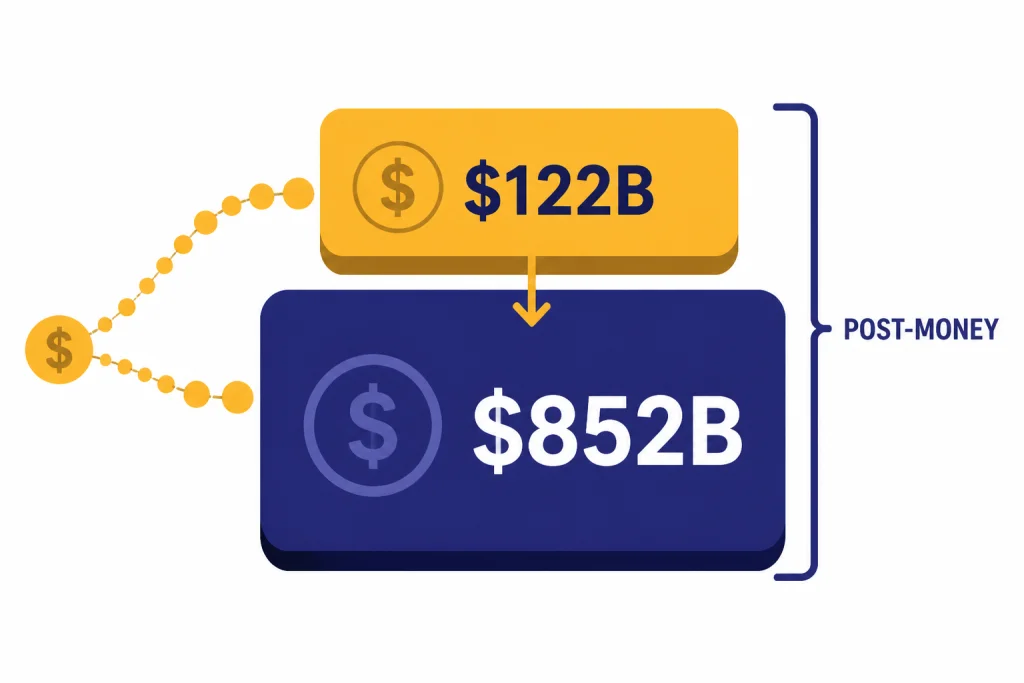
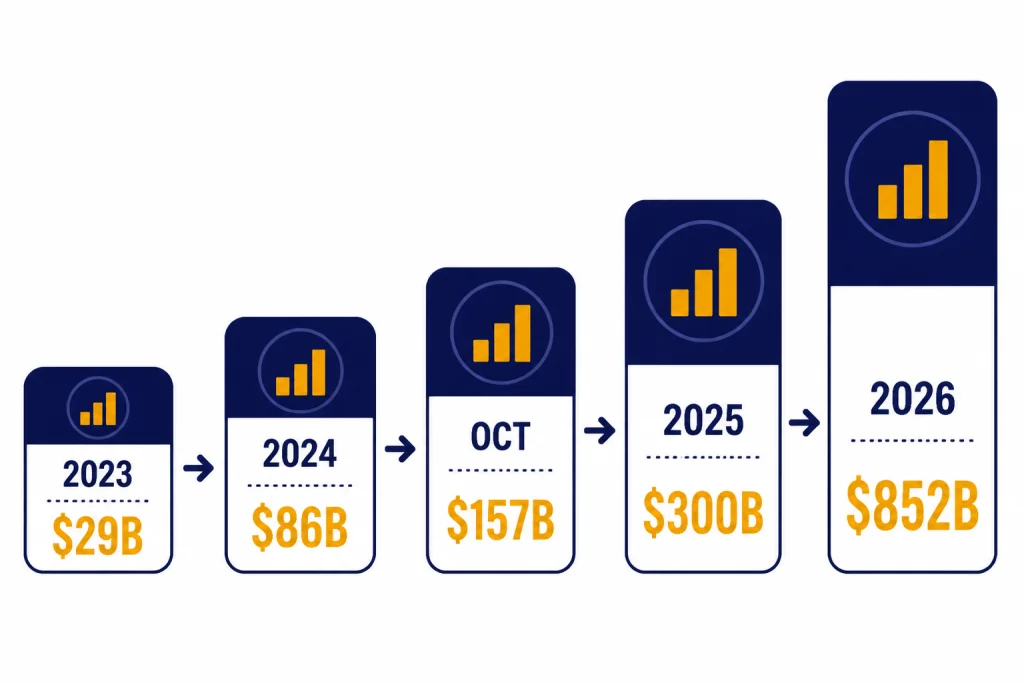
OpenAI valuation is $852 billion as of April 12, 2026, based on the company’s latest announced funding round of $122 billion in committed capital.[1] That makes OpenAI one of the most valuable private technology companies in the world, but it is not a public market capitalization. The number comes from private financing terms, not daily stock trading. OpenAI’s worth has moved from a reported $27 billion to $29 billion in 2023, to $157 billion in 2024, to $300 billion in 2025, and then to $852 billion in 2026.[4][3][2][1] The rise reflects ChatGPT adoption, enterprise revenue, compute demand, and investor expectations for AI infrastructure.
Current OpenAI valuation
OpenAI’s current valuation is $852 billion post-money, based on OpenAI’s March 31, 2026 announcement that it closed $122 billion in committed capital.[1] “Post-money” means the valuation includes the new capital in the round. If a company raises money at a post-money valuation, investors are valuing the company after the financing has been added.
That figure is the best public reference point for openai valuation as of this article’s publication date. It is more useful than rumors, secondary-market chatter, or speculative IPO estimates because OpenAI published it directly. For company background, see our OpenAI History guide.
The same OpenAI announcement gives the investor case in plain terms. OpenAI said it was generating $2 billion in revenue per month, had more than 900 million weekly active ChatGPT users, had more than 50 million subscribers, and processed more than 15 billion API tokens per minute.[1] Those are operating scale numbers, not profit numbers. OpenAI has not published an official net income figure for this.
OpenAI valuation history
OpenAI’s valuation history changed sharply after ChatGPT became a mainstream product. Before that, OpenAI was known mainly as a research lab and infrastructure-heavy AI company. After ChatGPT, investors began valuing it as a consumer platform, enterprise software supplier, API provider, and AI infrastructure company at the same time.
| Date | Valuation reference | Type of deal | What it showed |
|---|---|---|---|
| April 2023 | $27 billion to $29 billion[4] | Share sale | ChatGPT had turned OpenAI into a breakout private AI company. |
| February 2024 | $86 billion[5] | Employee share tender offer | Private buyers were willing to price OpenAI far above its 2023 level. |
| October 2024 | $157 billion post-money[3] | Primary funding round | OpenAI raised $6.6 billion and pointed to demand across users, businesses, and developers.[3] |
| March 2025 | $300 billion post-money[2] | Primary funding round | OpenAI raised $40 billion to expand research, compute, and products.[2] |
| March 2026 | $852 billion post-money[1] | Committed capital round | OpenAI raised $122 billion and framed compute as a strategic advantage.[1] |
The table mixes primary rounds and secondary transactions. That matters. A primary round adds capital to the company. A secondary or tender offer lets existing holders, such as employees, sell shares. Both can imply a valuation, but they do not mean the same thing for OpenAI’s balance sheet.
The fastest confirmed jump came between the 2025 and 2026 company announcements. OpenAI moved from a $300 billion post-money valuation in March 2025 to an $852 billion post-money valuation in March 2026.[2][1] That increase reflected a much larger capital plan, not only a change in sentiment.
Why the valuation is so high
OpenAI’s valuation rests on several overlapping bets. The first is that ChatGPT can remain a huge consumer product. OpenAI said ChatGPT had more than 900 million weekly active users and more than 50 million subscribers when it announced the 2026 round.[1] Subscription revenue is only one part of the picture, but it gives investors a visible consumer channel.
The second bet is enterprise adoption. OpenAI said enterprise made up more than 40% of revenue and was on track to reach parity with consumer revenue by the end of 2026.[9] That is why valuation discussions now overlap with openai revenue, business products, and corporate AI agents. Enterprise customers can make spending more predictable than consumer usage alone.
The third bet is developer infrastructure. OpenAI’s API gives outside companies a way to build AI features without training their own frontier models. That connects valuation to usage volume, model quality, and pricing. Developers comparing platform costs should also read our OpenAI API pricing breakdown.
The fourth bet is compute. OpenAI described durable access to compute as a strategic advantage in its 2026 funding announcement.[1] The company also announced the Stargate Project in January 2025, describing a new company intended to invest $500 billion over four years in AI infrastructure for OpenAI in the United States.[11] These projects explain why OpenAI needs unusually large financing rounds.
High valuation does not mean low risk. The same factors that support the valuation also raise the stakes. Compute commitments are expensive. Consumer usage can be costly to serve. Enterprise buyers may demand security, controls, custom deployment, and predictable pricing. OpenAI’s worth depends on turning scale into durable economics.

Private valuation versus market cap
OpenAI does not have a public stock ticker. Its valuation is a private financing number. A public company’s market cap changes every trading day as investors buy and sell shares. A private company valuation changes when financing terms, tender offers, or other share transactions establish a new price.
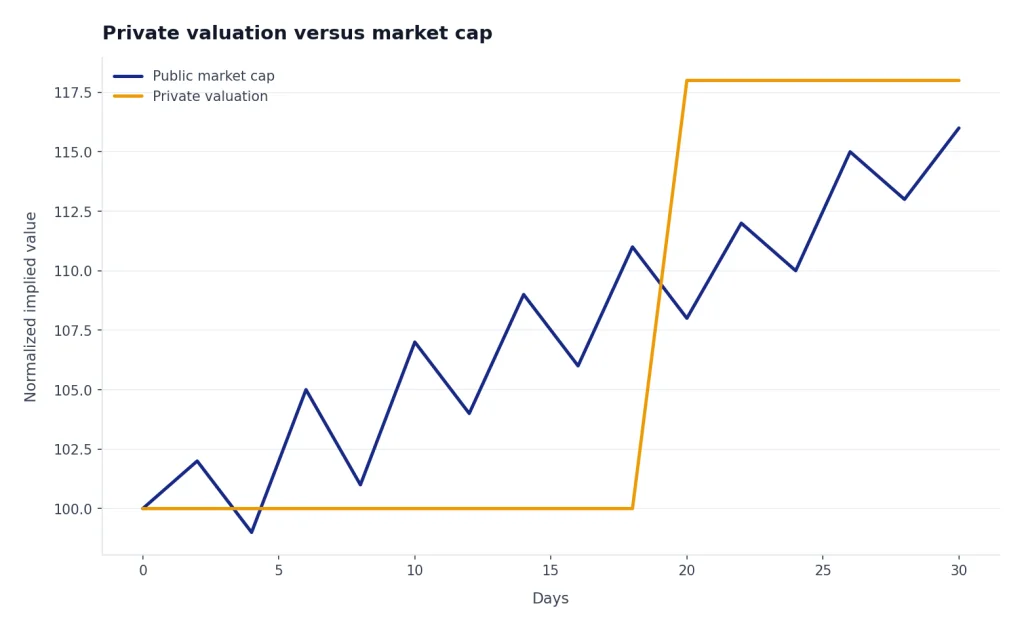
This distinction matters for readers who ask whether they can “buy OpenAI stock.” As of April 12, 2026, OpenAI had announced ETF-related access through ARK Invest as part of the 2026 financing, but it had not published an official IPO date.[10] For ongoing updates, follow our OpenAI News page rather than relying on social media cap tables.
Post-money valuation also differs from enterprise value, revenue multiple, and future IPO valuation. Post-money valuation is tied to a financing round. Enterprise value would normally adjust for debt and cash. Revenue multiples compare valuation with annualized revenue. A future IPO price would depend on audited financials, public-market demand, governance terms, lockups, and the broader AI market at that time.
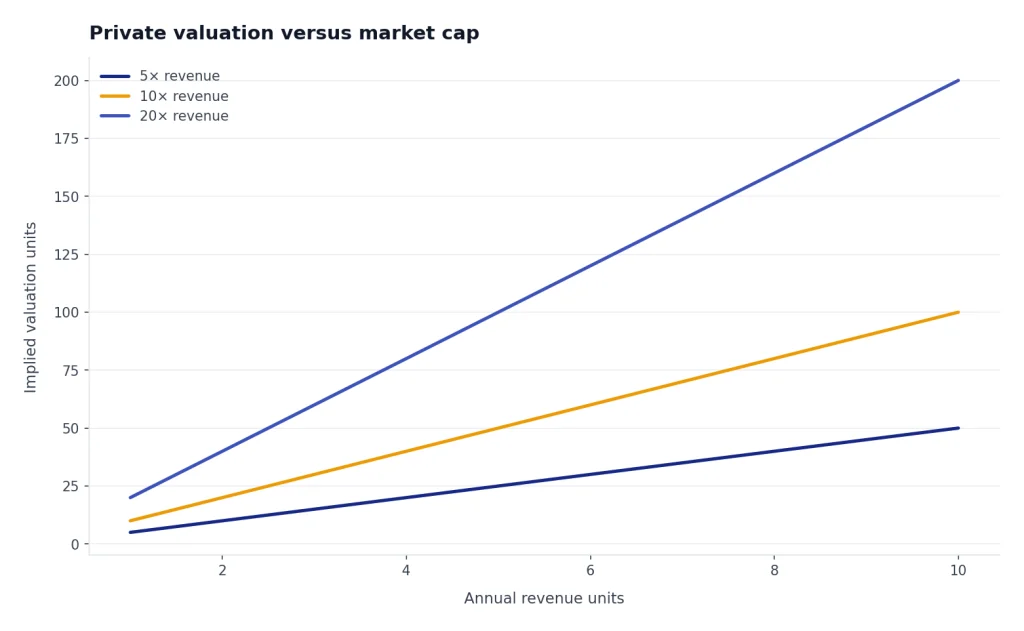
Private valuations can also include investor preferences that ordinary readers cannot see. Preferred stock can carry rights that common stock does not. Tender offers can price limited shares differently from a full-company sale. That is why OpenAI’s $852 billion valuation should be read as the latest financing valuation, not a guaranteed sale price for the whole company.[1]
Microsoft, ownership, and governance
OpenAI’s valuation cannot be separated from its structure. OpenAI says it was founded in 2015 as a nonprofit and created a for-profit subsidiary in 2019 to help scale research and deployment.[6] In October 2025, OpenAI said the nonprofit became the OpenAI Foundation and the for-profit became OpenAI Group PBC, a public benefit corporation.[6]
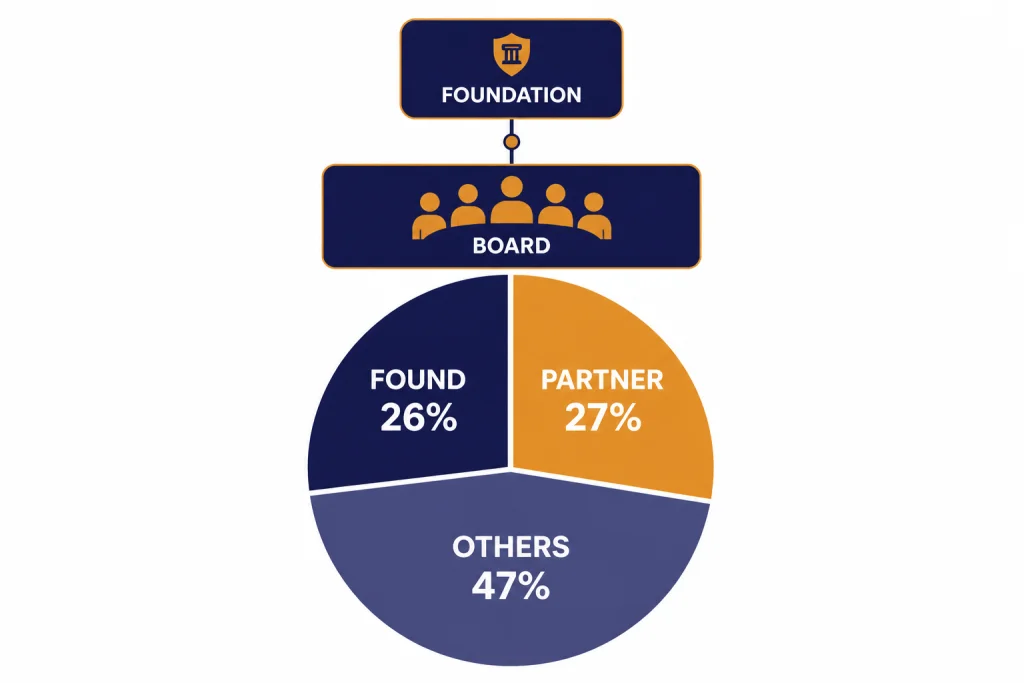
OpenAI’s structure page says the OpenAI Foundation holds a 26% equity stake in OpenAI Group, Microsoft holds roughly 27%, and the remaining 47% is held by current and former employees and investors.[6] For a deeper explanation of those mechanics, see who owns OpenAI?
Microsoft’s role is central. Microsoft announced a multiyear, multibillion-dollar investment in OpenAI in January 2023 and said it was the third phase of the partnership after earlier investments in 2019 and 2021.[7] OpenAI’s own partnership announcement said Azure would remain the exclusive cloud provider for OpenAI workloads across research, API, and products at that time.[7] Our OpenAI and Microsoft guide covers the relationship in more detail.
The governance structure also affects investor interpretation. OpenAI says the OpenAI Foundation appoints all members of the OpenAI Group board and can replace directors at any time.[6] That is different from a conventional public technology company where shareholder voting power usually sits at the center of control.
The 2025 restructuring was partly about making capital formation simpler. OpenAI said it was moving away from a complex capped-profit structure toward a normal capital structure where everyone has stock, while the nonprofit would continue to control the public benefit corporation.[8] Investors tend to prefer simpler equity. Mission-focused critics tend to focus on whether governance still protects the original nonprofit purpose.
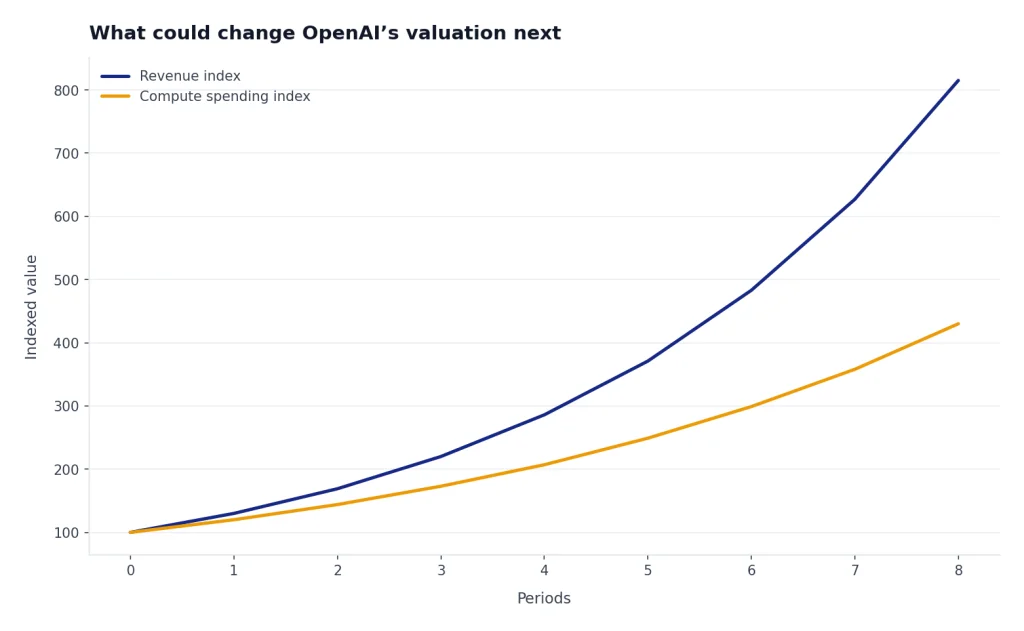
What could change OpenAI’s valuation next
The next major valuation change could come from a new financing, a secondary sale, or an IPO. OpenAI has not published an official IPO date. Axios reported in March 2026 that OpenAI shares would be included in several ARK Invest exchange-traded funds and that $3 billion was part of the new $122 billion round.[10] That is not the same as a public listing.
Revenue growth will be the clearest operating signal. CNBC reported that OpenAI reached $10 billion in annual recurring revenue in June 2025, citing a company spokesperson.[12] OpenAI’s later 2026 announcement said it was generating $2 billion in revenue per month.[1] Investors will watch whether that growth keeps outpacing compute spending.
Product depth will also matter. OpenAI’s valuation depends on more than ChatGPT subscriptions. It includes business products, APIs, agents, coding tools, and infrastructure partnerships. If you are evaluating OpenAI as a customer rather than an investor, compare Azure OpenAI Service vs OpenAI API, ChatGPT Plus price, and the OpenAI Playground.
Leadership and governance remain part of the valuation story. A company with this much capital, compute demand, and public attention depends heavily on board oversight and executive execution. For the people behind the company, see OpenAI’s CTO and leadership team and our Sam Altman biography.
The main downside factors are familiar: competition, regulation, safety controversy, infrastructure costs, and uncertainty around long-term AI demand. A high valuation means investors expect OpenAI to become a durable platform company, not only a popular chatbot company. The evidence is strong enough to attract enormous capital. It is not strong enough to remove risk.
Frequently asked questions
What is OpenAI worth right now?
OpenAI is valued at $852 billion as of April 12, 2026, based on its latest announced $122 billion committed capital round.[1] This is a private post-money valuation, not a public stock market capitalization.
Is OpenAI a public company?
No. OpenAI does not trade on a public stock exchange. OpenAI Group PBC is a private public benefit corporation controlled by the OpenAI Foundation under the structure OpenAI describes on its website.[6]
How much of OpenAI does Microsoft own?
OpenAI says Microsoft holds roughly 27% of OpenAI Group as of the recapitalization closing.[6] OpenAI also says the OpenAI Foundation holds 26%, while current and former employees and investors hold the remaining 47%.[6]
Why did OpenAI’s valuation rise so quickly?
The rise came from consumer scale, enterprise adoption, API usage, and the belief that compute access will be a durable advantage. OpenAI’s 2026 announcement cited more than 900 million weekly ChatGPT users, more than 50 million subscribers, and more than 15 billion API tokens processed per minute.[1]
Can retail investors buy OpenAI stock?
Not in the same way they can buy a listed stock. Axios reported that OpenAI shares would be included in several ARK Invest exchange-traded funds, but OpenAI has not published an official IPO date.[10] Most direct OpenAI equity remains private.
Is the $852 billion valuation guaranteed?
No. It is the valuation from a private financing round, not a guaranteed acquisition price or daily market quote. Private valuations can change when new capital is raised, shares trade privately, or public-market conditions shift.