

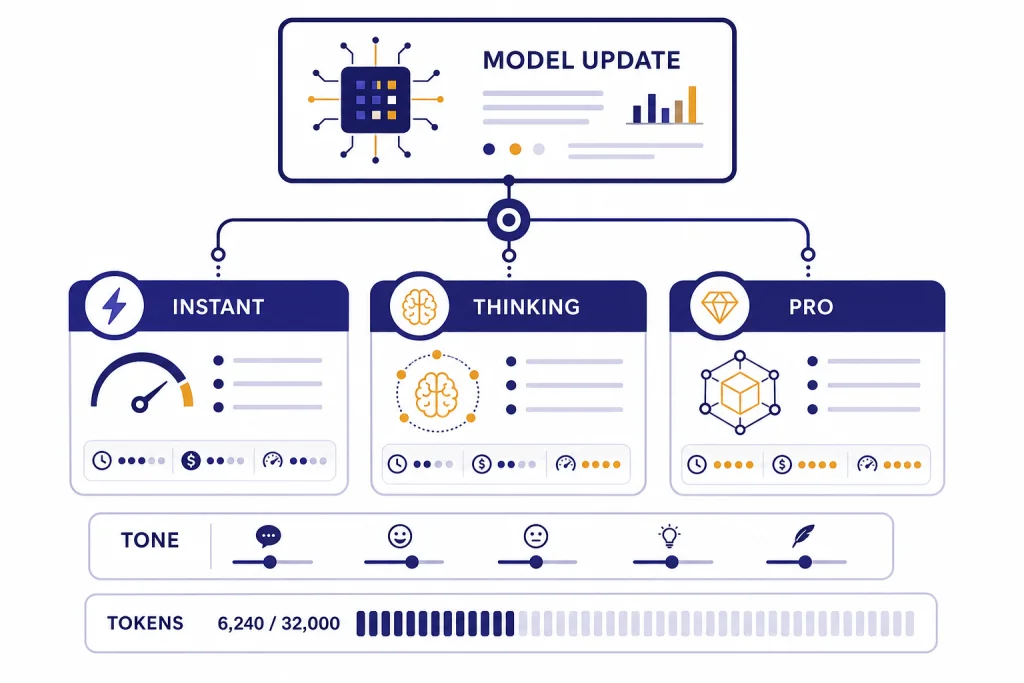
The GPT-5.1 update changed ChatGPT in three practical ways: it made everyday answers warmer and more conversational, gave the reasoning model a more flexible speed-versus-depth profile, and expanded personalization controls so users could shape tone without rewriting every prompt. OpenAI released GPT-5.1 Instant and GPT-5.1 Thinking on November 12, 2025, then updated GPT-5 Pro to GPT-5.1 Pro on November 19, 2025.[1][2] For developers, GPT-5.1 also brought adaptive reasoning, extended prompt caching, new code-editing tools, and API availability under GPT-5.1 and gpt-5.1-chat-latest.[3] As of March 8, 2026, GPT-5.1 is no longer OpenAI’s newest GPT-5-series update, but it remains the release that reset ChatGPT’s tone and model-routing direction.
What changed in GPT-5.1
GPT-5.1 was not a single switch. It was a coordinated update across ChatGPT’s fast model, reasoning model, Pro model, personalization system, and developer platform. OpenAI described the release as an upgrade to the GPT-5 series that made ChatGPT both smarter and more conversational.[1]
The most visible change was GPT-5.1 Instant. This model became warmer by default, more conversational, and better at following instructions, according to OpenAI’s launch post.[1] The less visible but more important architectural change was adaptive reasoning. GPT-5.1 Instant can use light reasoning for harder prompts while still behaving like a fast everyday model for routine requests.[2]
GPT-5.1 Thinking changed the other side of the experience. Instead of spending roughly similar effort across many prompts, it adapts its thinking time more sharply to the task. OpenAI said GPT-5.1 Thinking is faster on simple tasks and more persistent on complex ones than GPT-5 Thinking.[1] That matters for users who ask a mix of quick questions and hard planning, coding, math, or document-analysis requests.
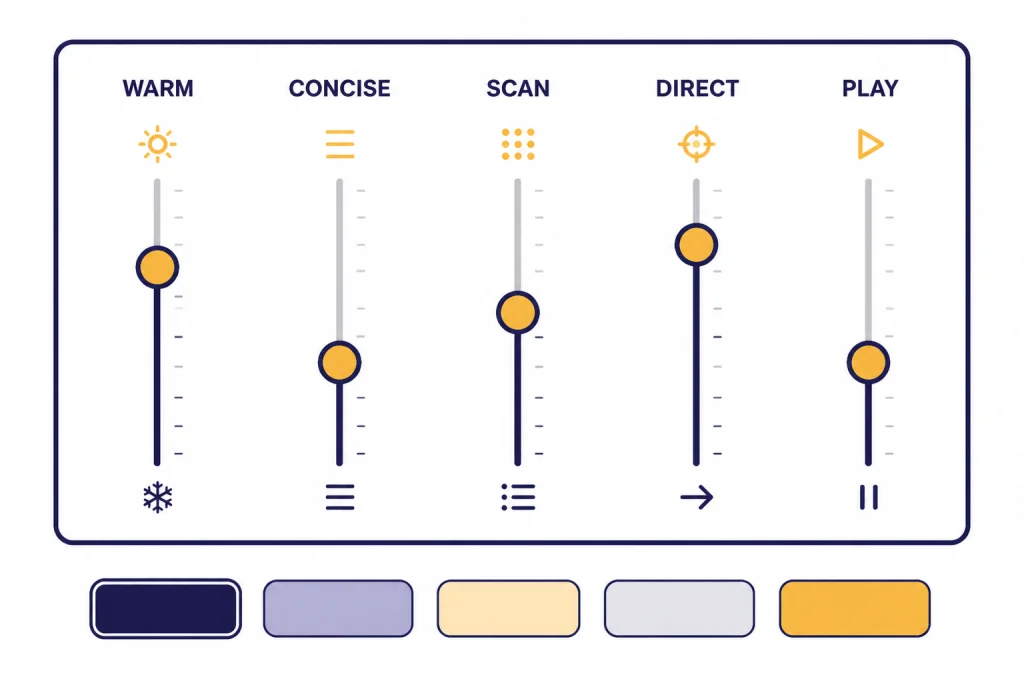
The update also changed how users steer ChatGPT. The new tone controls gave users presets such as Default, Friendly, Efficient, Professional, Candid, and Quirky, with additional experiments around conciseness, warmth, scannability, and emoji use.[2] If you track model behavior over time, this is the bridge between classic model selection and the more opinionated, personalized ChatGPT experience that later updates continued. For broader context, see our all GPT models compared side by side and context window sizes for every GPT model.
| Area | Before GPT-5.1 | After GPT-5.1 | Why it matters |
|---|---|---|---|
| Everyday chat | GPT-5 Instant handled most fast responses. | GPT-5.1 Instant became warmer, more conversational, and better at instruction following.[1] | Short answers felt less stiff and more aligned to user tone. |
| Reasoning | GPT-5 Thinking handled harder prompts with less dynamic timing. | GPT-5.1 Thinking varied thinking time more precisely by task difficulty.[1] | Simple tasks could finish faster while hard tasks could receive more effort. |
| Routing | GPT-5 Auto routed many requests behind the scenes. | GPT-5.1 Auto continued routing each query to the best-suited model.[1] | Most users did not need to manually choose between fast and reasoning models. |
| Personalization | Users had tone controls and custom instructions, but less direct style tuning. | OpenAI added updated presets and experimented with granular controls for warmth, conciseness, scannability, and emoji frequency.[2] | Users could make ChatGPT sound more professional, direct, friendly, or playful. |
| API | Developers used GPT-5 models and earlier reasoning controls. | OpenAI made GPT-5.1 and gpt-5.1-chat-latest available to paid API developers and added new developer tools.[3] | Apps could use the newer model behavior without depending on the ChatGPT interface. |
GPT-5.1 Instant, Thinking, and Pro
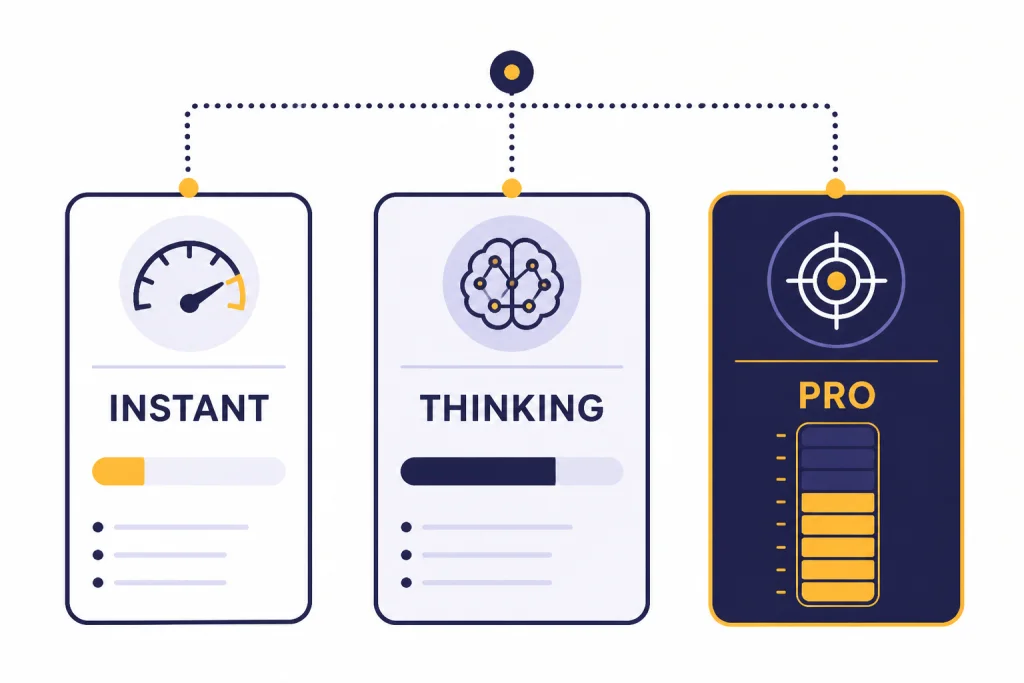
The GPT-5.1 update had three user-facing model tracks: GPT-5.1 Instant, GPT-5.1 Thinking, and GPT-5.1 Pro.[2] These names matter because they map to different jobs. Instant is the fast default experience. Thinking is the model for harder reasoning. Pro is the higher-compute option for ChatGPT Pro users.
GPT-5.1 Instant
GPT-5.1 Instant was the most noticeable part of the update for everyday ChatGPT users. OpenAI called it ChatGPT’s most-used model and said it became warmer, more intelligent, and better at following instructions.[1] In practical terms, users saw a model that was more likely to answer in the requested style, keep a useful tone, and handle moderately complex prompts without immediately pushing the interaction into a slower reasoning mode.
The important detail is that Instant did not simply become “friendlier.” OpenAI said GPT-5.1 Instant uses light adaptive reasoning for tougher questions while staying fast.[2] That makes it a better fit for prompts that are not deep research but still need structure, such as drafting a difficult email, turning messy notes into a plan, or comparing a few tradeoffs.
GPT-5.1 Thinking
GPT-5.1 Thinking targeted the opposite complaint: reasoning answers could be too slow or too heavy for simple tasks, yet not persistent enough for the hardest ones. OpenAI said the model adapts thinking time more precisely, spending less time on simpler requests and more time on complex problems.[1]
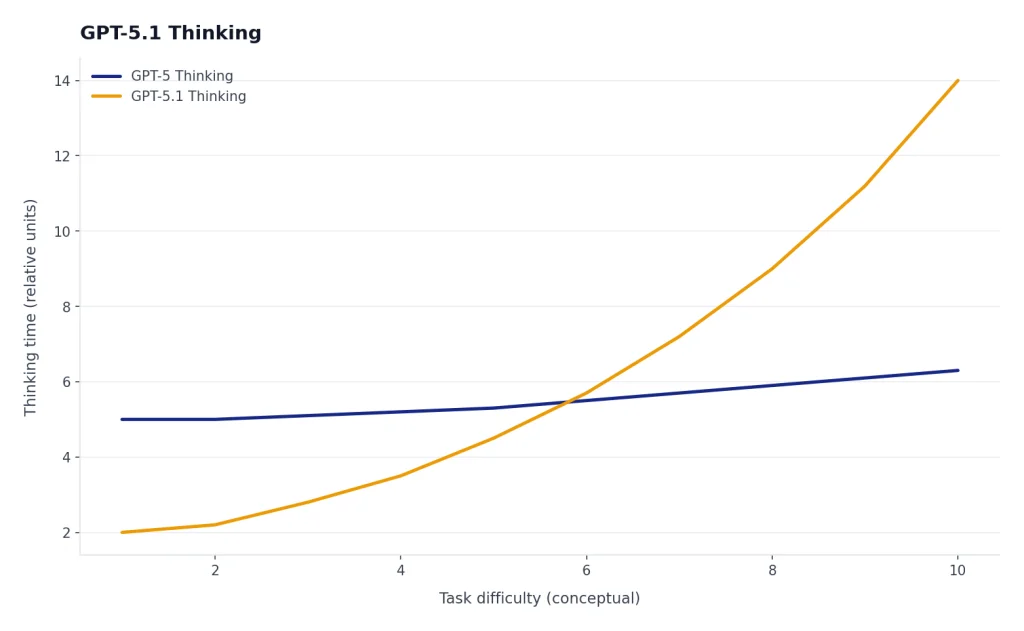
OpenAI gave a concrete comparison: on a representative distribution of ChatGPT tasks, GPT-5.1 Thinking was roughly twice as fast on the fastest tasks and twice as slow on the slowest tasks compared with GPT-5 Thinking, with thinking time set to Standard for both models.[1] That does not mean every answer is faster. It means the model spends effort less uniformly. For users, the gain is better matching between task difficulty and response time.
GPT-5.1 Pro
GPT-5.1 Pro followed one week after the main release. OpenAI’s ChatGPT release notes say GPT-5 Pro was updated to GPT-5.1 Pro on November 19, 2025, and that GPT-5.1 Pro rolled out that day for all ChatGPT Pro users in the model picker.[2] OpenAI said early testers preferred GPT-5.1 Pro over GPT-5 Pro, especially for writing help, data science, and business questions.[2]
If you use ChatGPT mainly for high-stakes analysis, long documents, business writing, or technical planning, GPT-5.1 Pro was the part of the update most likely to matter. If you mainly ask quick questions, summarize articles, or draft everyday text, GPT-5.1 Instant was the more important change. Our most powerful GPT model benchmark guide is the better place to compare Pro-style models across generations.
New tone and personalization controls
GPT-5.1 made personalization a first-class part of the ChatGPT update, not a side feature. OpenAI said it was refining tone presets and adding Professional, Candid, and Quirky, while keeping updated versions of Default, Friendly, and Efficient.[1] The ChatGPT release notes also listed Cynical and Nerdy as still available at launch.[2]
The broader shift was that style controls moved closer to the model layer. Users could still write custom instructions, but GPT-5.1 was designed to follow custom instructions and style preferences more reliably.[2] That matters because many ChatGPT complaints are not about factual capability. They are about tone: too verbose, too upbeat, too cautious, too casual, or too formal.
The practical workflow changed. Instead of telling ChatGPT “be concise and professional” in every prompt, a user could set a base style and then adjust when a conversation needed a different voice. OpenAI also said it was experimenting with more granular controls for conciseness, warmth, scannability, and emoji frequency.[1]
This was also an important product signal. ChatGPT was moving away from a single default personality toward a configurable assistant. That direction later showed up in other product updates around browsing, apps, voice, and multimodal interfaces. For examples outside text-only chat, see our ChatGPT Atlas launch and Sora 2 launch coverage.
| Preset | Best use | Possible downside |
|---|---|---|
| Professional | Client emails, executive summaries, policy drafts, formal analysis. | Can feel too polished for brainstorming. |
| Candid | Feedback, tradeoff analysis, decision support, direct editing. | May feel blunt if the user expects a softer tone. |
| Friendly | Learning, coaching, personal planning, low-pressure writing. | Can become too chatty for dense work. |
| Efficient | Checklists, commands, quick comparisons, technical answers. | May omit context a beginner needs. |
| Quirky | Creative prompts, ideation, playful examples, naming exercises. | Can distract from serious tasks. |
Developer and API changes
The developer version of the GPT-5.1 update focused on adaptive reasoning, lower-latency use cases, coding workflows, and tool use. OpenAI said GPT-5.1 and gpt-5.1-chat-latest were available to developers on all paid API tiers, with pricing and rate limits the same as GPT-5.[3]
OpenAI’s model documentation lists GPT-5.1 as a flagship model for coding and agentic tasks with configurable reasoning and non-reasoning effort.[4] The same documentation lists a 400,000-token context window, 128,000 max output tokens, and a September 30, 2024 knowledge cutoff for GPT-5.1.[4] Those limits are important for teams using GPT-5.1 in long-document review, coding agents, and multi-step tool workflows. For a model-by-model limit view, use our context window comparison.
Pricing also stayed in familiar GPT-5 territory. OpenAI’s GPT-5.1 model page lists GPT-5.1 text pricing at $1.25 per 1 million input tokens, $0.125 per 1 million cached input tokens, and $10.00 per 1 million output tokens.[4] OpenAI’s developer announcement separately says GPT-5.1 pricing and rate limits are the same as GPT-5.[3] For cost comparisons across models, see our OpenAI API pricing guide.
Reasoning effort and no-reasoning mode
For developers, the biggest control was reasoning effort. OpenAI said GPT-5.1 supports no reasoning by setting reasoning_effort to none, which makes the model behave more like a non-reasoning model for latency-sensitive use cases.[3] OpenAI’s model page lists supported reasoning efforts as none, low, medium, and high.[4]
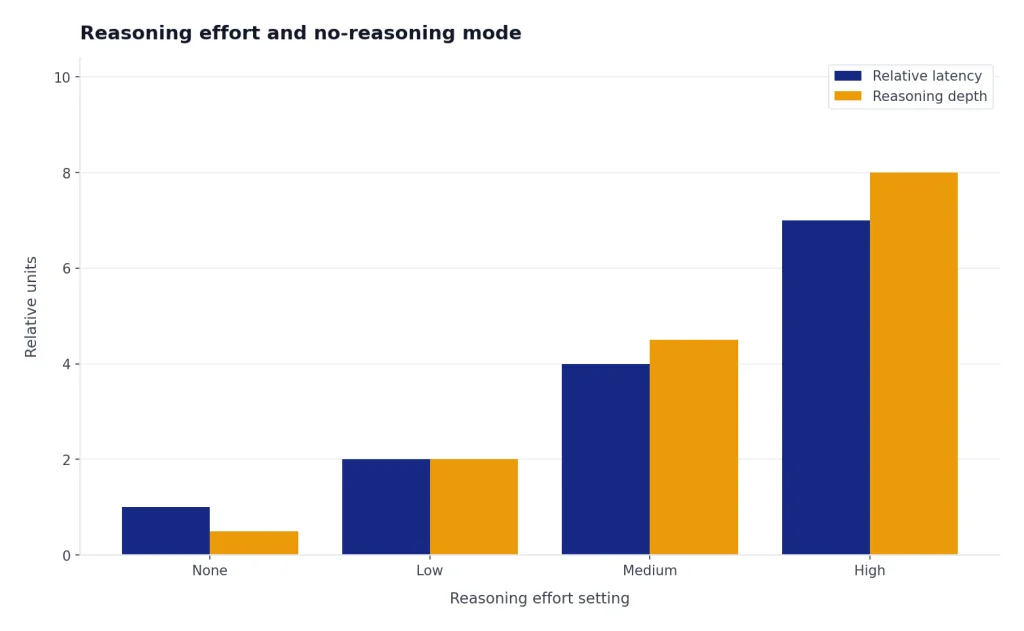
This gives app builders a cleaner routing strategy. A customer-support bot can use no reasoning for simple lookup or classification. A coding agent can use high reasoning for a difficult repository change. A writing assistant can use low or medium effort when the goal is quality without excessive delay.
Prompt caching
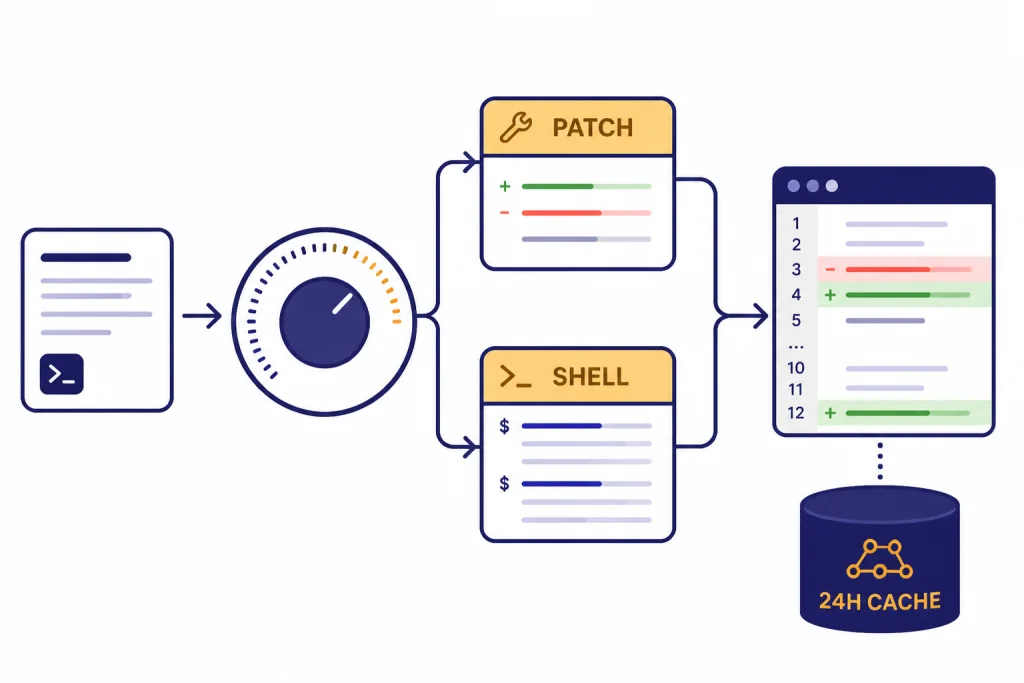
OpenAI also released extended prompt caching for GPT-5.1 with up to 24-hour cache retention.[3] The developer post says cached input tokens remain 90% cheaper than uncached tokens, with no extra charge for cache writes or storage.[3] This matters for products that repeatedly send the same policy, codebase summary, document set, or system context across a session.
New coding tools
GPT-5.1 also introduced two developer tools in the Responses API: a freeform apply_patch tool and a shell tool.[3] The apply_patch tool lets the model create, update, and delete files with structured diffs, while the shell tool lets a developer integration run model-proposed shell commands in a controlled local environment.[3]
These tools explain why GPT-5.1 was more than a chat-tone update. It was also part of OpenAI’s push toward agentic coding workflows, where a model can inspect files, make changes, run checks, read the results, and iterate. That line continues into later coding-focused releases, including the updates we cover in GPT-5.2 Release Notes and Features and the GPT-5.3 release.
Safety and evaluation notes
OpenAI published a GPT-5.1 Instant and GPT-5.1 Thinking system card addendum on November 12, 2025.[5] The addendum says the models use largely the same comprehensive safety mitigations described for GPT-5, while providing updated baseline safety metrics for the new versions.[5]
The addendum is useful because it shows where GPT-5.1 improved and where the picture was mixed. OpenAI said GPT-5.1 Instant outperformed GPT-5 Instant from August 15, 2025 on all listed production benchmark categories, but performed slightly worse than the October 3, 2025 GPT-5 Instant version on disallowed sexual content, violent content, mental health, and emotional reliance.[5]
For GPT-5.1 Thinking, OpenAI reported light regressions versus GPT-5 Thinking for harassment, hateful language, and disallowed sexual content, and said it was working on improvements in those categories.[5] That is a reminder that model updates are not uniformly better across every safety category. A release can improve the main user experience while still requiring follow-up work in specific evaluation areas.
The jailbreak results were more positive for Instant. OpenAI reported a jailbreak not_unsafe score of 0.976 for GPT-5.1 Instant, compared with 0.850 for the October 3, 2025 GPT-5 Instant version and 0.683 for the August 15, 2025 GPT-5 Instant version.[5] For GPT-5.1 Thinking, OpenAI said jailbreak robustness was on par with its predecessor.[5]
The safest reading is conservative. GPT-5.1 was a meaningful usability and capability update, but OpenAI’s own system card does not describe it as a clean safety win in every category. Users should still verify important answers, avoid treating ChatGPT as a professional substitute in medical, legal, or financial decisions, and choose the right model for the risk of the task.
Availability and current status
OpenAI began rolling out GPT-5.1 Instant and GPT-5.1 Thinking on November 12, 2025, starting with paid Pro, Plus, Go, and Business users, followed by free and logged-out users.[1] Enterprise and Edu plans received a seven-day early-access toggle that was off by default before GPT-5.1 became the sole default model.[1]
The original transition plan kept GPT-5 Instant and GPT-5 Thinking available under the legacy models dropdown for paid subscribers for three months.[1] GPT-5.1 Pro then rolled out for all ChatGPT Pro users on November 19, 2025, with GPT-5 Pro remaining available as a legacy model for 90 days before retirement.[2]
As of this article’s March 8, 2026 publication date, the GPT-5 series has already moved beyond GPT-5.1. OpenAI’s release notes list GPT-5.3 Instant updates on March 3, 2026 and GPT-5.4 Thinking in ChatGPT on March 5, 2026.[2] That means GPT-5.1 should be understood as a major step in the GPT-5 iteration cycle, not the newest endpoint.
For subscribers, the practical question is not whether GPT-5.1 is “the latest.” It is what changed in the ChatGPT experience after it. The warmer Instant tone, adaptive reasoning, and personalization system became part of the baseline that later GPT-5 updates built on. For pricing-plan context, see ChatGPT Plus price in 2026. For the business relationship behind OpenAI’s infrastructure and distribution, see our OpenAI and Microsoft explainer.
Who benefits from GPT-5.1
GPT-5.1 helped different users in different ways. The update was most valuable if you cared about response tone, instruction following, mixed fast-and-hard workloads, or developer control over reasoning effort.
- Everyday ChatGPT users benefited from GPT-5.1 Instant’s warmer default style and improved instruction following.[1]
- Students and researchers benefited from GPT-5.1 Thinking’s more dynamic use of reasoning time, especially when switching between simple explanations and difficult problems.[1]
- Professionals benefited from clearer tone presets, especially Professional, Candid, Friendly, Efficient, and Quirky.[2]
- Developers benefited from GPT-5.1 API access, configurable reasoning effort, extended prompt caching, apply_patch, and shell.[3]
- ChatGPT Pro users benefited from GPT-5.1 Pro, which OpenAI said early testers preferred for writing help, data science, and business questions.[2]
The update was less important if you only use ChatGPT for simple factual lookups, especially when web search is available, or if you already rewrite every answer into your own voice. It also did not remove the need to check citations, calculations, or domain-specific advice. GPT-5.1 improved the assistant’s feel and control surface, but it did not make model output automatically authoritative.
The best way to summarize the gpt-5 1 update is this: OpenAI used GPT-5.1 to make ChatGPT feel less like a rigid model picker and more like an adaptive assistant. Instant became more natural. Thinking became more elastic. Pro became clearer for complex work. Developers gained more knobs for latency, reasoning, coding, and cost. Later GPT-5 releases may be stronger, but GPT-5.1 was the update that made the GPT-5 generation easier to live with.
Frequently asked questions
What was the GPT-5.1 update?
The GPT-5.1 update was OpenAI’s November 12, 2025 upgrade to the GPT-5 series in ChatGPT, centered on GPT-5.1 Instant and GPT-5.1 Thinking.[1] It made the fast model more conversational and the reasoning model more adaptive. It also introduced stronger personalization controls and later added GPT-5.1 Pro for ChatGPT Pro users.[2]
Is GPT-5.1 the same as GPT-5.1 Thinking?
No. In ChatGPT, GPT-5.1 referred to a family experience that included GPT-5.1 Instant, GPT-5.1 Thinking, GPT-5.1 Auto, and later GPT-5.1 Pro.[1][2] GPT-5.1 Thinking was the reasoning-focused option for harder tasks. GPT-5.1 Instant was the faster everyday model.
What changed for developers in GPT-5.1?
Developers gained GPT-5.1 and gpt-5.1-chat-latest in the API, configurable reasoning effort, extended prompt caching, and two new tools: apply_patch and shell.[3] OpenAI’s model page lists GPT-5.1 with a 400,000-token context window and 128,000 max output tokens.[4]
Did GPT-5.1 cost more in the API?
OpenAI said GPT-5.1 pricing and rate limits were the same as GPT-5 for developers.[3] The GPT-5.1 model page lists $1.25 per 1 million input tokens, $0.125 per 1 million cached input tokens, and $10.00 per 1 million output tokens.[4] Costs can still rise if an app uses more output tokens, higher reasoning effort, or larger contexts.
Was GPT-5.1 safer than GPT-5?
OpenAI’s system card addendum described mixed results. GPT-5.1 Instant improved over an August 15, 2025 GPT-5 Instant baseline across listed production benchmark categories, but had some regressions versus an October 3, 2025 GPT-5 Instant version.[5] GPT-5.1 Thinking also showed light regressions in some content categories, according to OpenAI.[5]
Is GPT-5.1 still the newest ChatGPT model?
No. As of March 8, 2026, OpenAI’s release notes already list later GPT-5-series updates, including GPT-5.3 Instant updates on March 3, 2026 and GPT-5.4 Thinking in ChatGPT on March 5, 2026.[2] GPT-5.1 remains important because it introduced the warmer default tone, adaptive reasoning pattern, and personalization controls that shaped later releases.