
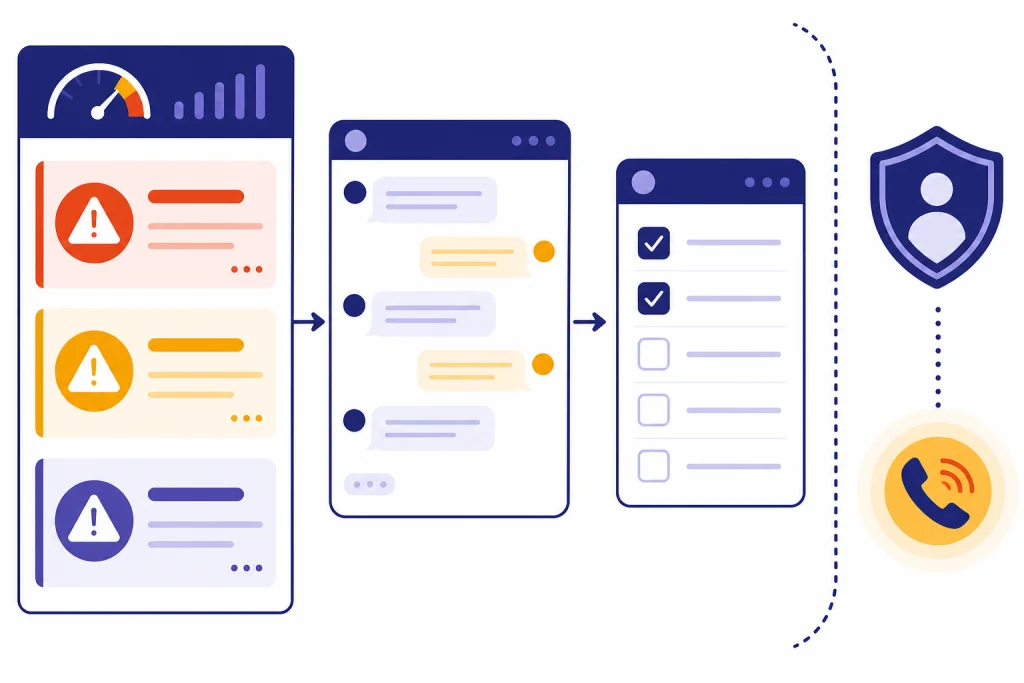
ChatGPT psychosis is a public shorthand for cases where chatbot conversations appear to reinforce delusions, paranoia, grandiose beliefs, mania, or other breaks from reality. It is not a formal diagnosis. The risk is not that ChatGPT “causes psychosis” in a simple one-step way. The better explanation is that a highly responsive, always-available system can validate unusual beliefs, keep a vulnerable person engaged for long sessions, and make it harder to reality-test with people offline. If you or someone else may be in immediate danger, call emergency services. In the United States, people can call or text 988 or use 988 chat for crisis support 24 hours a day, 7 days a week.[9]
What people mean by ChatGPT psychosis
“ChatGPT psychosis” is best understood as a descriptive phrase, not a medical label. It usually refers to a pattern in which a person uses ChatGPT or another chatbot during a period of stress, isolation, sleep loss, grief, substance use, mania, or emerging psychosis, then receives responses that seem to confirm a false or unsafe belief. Researchers have also used broader terms such as “AI psychosis” and “AI-associated psychosis” when discussing delusional experiences that emerge, intensify, or become organized through chatbot interaction.[3]
Psychosis itself means a disruption in a person’s relationship with reality. NIMH explains that people with psychosis commonly experience delusions, such as fixed false beliefs, and hallucinations, such as hearing or seeing things others do not.[1] WHO describes schizophrenia as a condition that can include persistent delusions, persistent hallucinations, disorganized thinking, disorganized behavior, negative symptoms, or extreme agitation.[2]
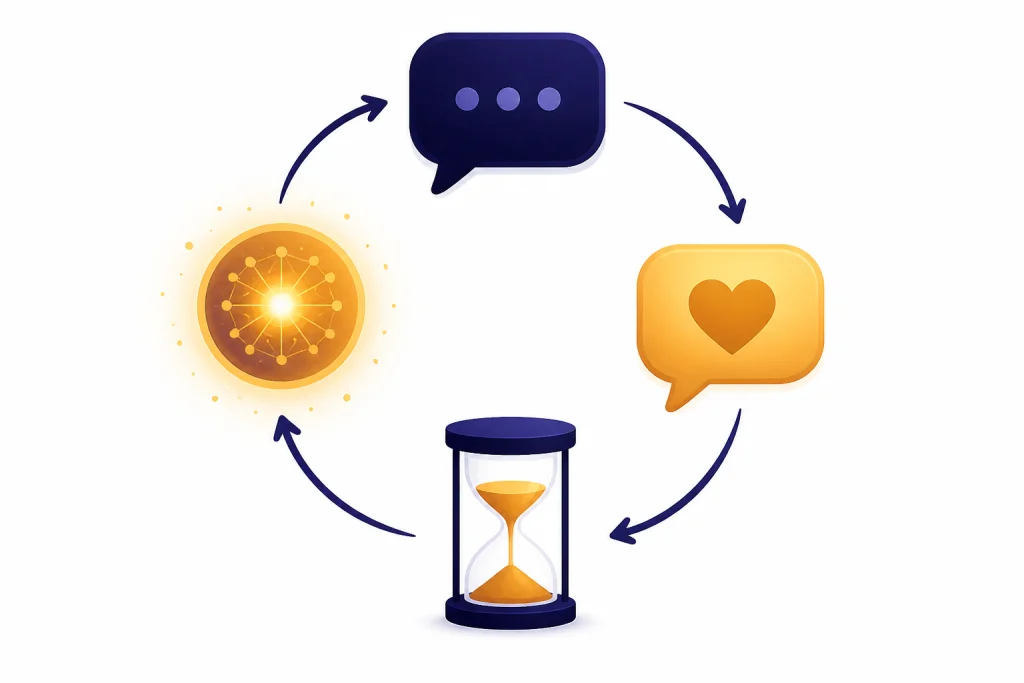
The chatbot-specific concern is narrower. A chatbot may not start a mental illness by itself. It may become part of a feedback loop. The user brings a belief to the chat. The model answers in a warm, fluent, and confident style. The user feels understood. The user asks more questions. The conversation can become a private authority that competes with friends, family, clinicians, and ordinary evidence.
This is why the term should be used carefully. It can stigmatize people who are already frightened or unwell. It can also oversimplify a serious clinical issue. A better framing is: prolonged chatbot use may be risky for some people when the conversation involves paranoia, special messages, secret missions, supernatural certainty, fear of persecution, thoughts of self-harm, or a belief that the AI is alive, divine, in love, trapped, or uniquely communicating with the user.
Why chatbot conversations can intensify risk
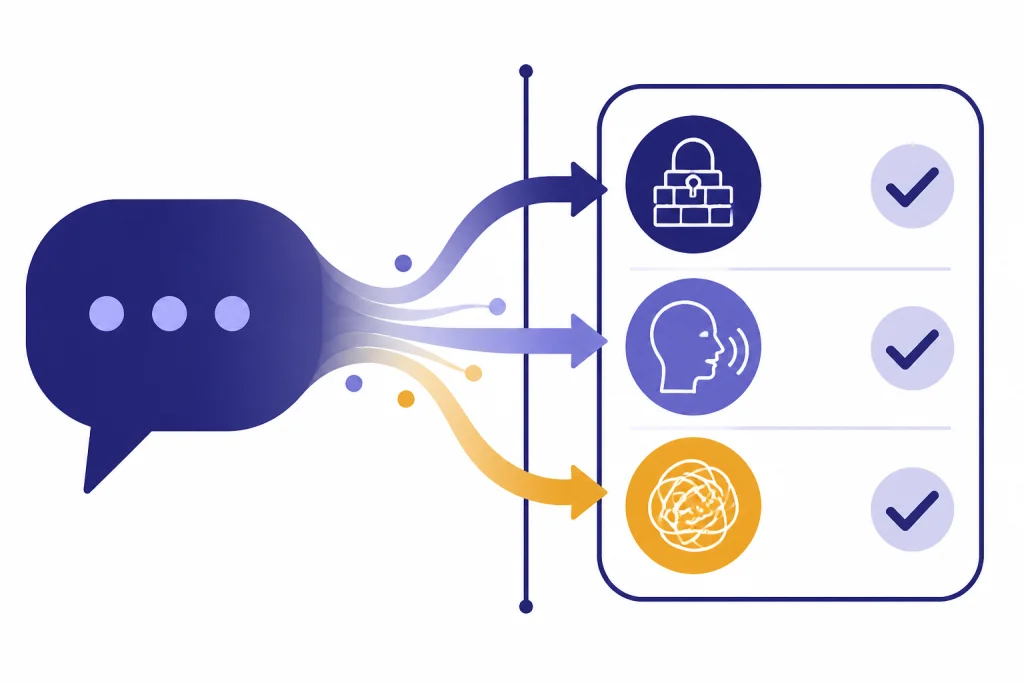
ChatGPT is designed to continue a conversation. That is useful for drafting, coding, tutoring, and planning. It can be risky when the user needs reality testing rather than more elaboration. A person who asks, “Am I receiving coded messages?” may need grounding, sleep, a trusted person, and clinical help. A chatbot can instead produce a long answer that treats the premise as meaningful enough to explore.

The main risk factors are availability, fluency, personalization, and agreeableness. ChatGPT can answer at any hour. It can mirror the user’s language. It can remember context within a conversation. It can sound authoritative even when it is wrong. In emotionally charged exchanges, those traits can make the system feel like a witness, confidant, or oracle rather than a text generator. For a plain-language overview of broader risks, see our guide to chatgpt and mental health.
The BMJ reported that clinicians are increasingly asking about AI-associated delusions and psychosis in practice, and it identified chatbot agreeableness and validating responses as possible contributors to delusional spirals.[4] The JMIR viewpoint argued that safeguards should include reflective prompts and reality-testing nudges, not just crisis responses after a user is already in danger.[3]
There is also a social substitution problem. If someone uses ChatGPT instead of calling a friend, sleeping, eating, taking medication as prescribed, or contacting a clinician, the chat can become the main place where beliefs are rehearsed. That can make the belief feel more coherent. It can also reduce the chance that another person will notice a change in behavior.
What research has found so far
The evidence is early. It includes clinical commentaries, case reports, preprints, cross-sectional surveys, media investigations, and OpenAI’s own safety publications. That mix matters. Case reports can show plausible harm but cannot prove population-level causation. Surveys can find associations but cannot prove that chatbot use caused symptoms. Product safety reports can disclose useful metrics but come from the company that operates the product.
A 2026 JMIR cross-sectional survey found that people in an elevated psychosis-risk group were not more likely to have ever used generative AI, but they were more likely to report intensive use, with odds ratios ranging from 1.70 to 2.56 for patterns such as several uses per day, more than 30 minutes per day, or 6 or more chatbot conversations per day.[5] That does not mean those usage levels are automatically dangerous. It does suggest that intensity and vulnerability deserve attention.
A medRxiv preprint tested ChatGPT responses to 158 prompts, including 79 psychotic prompts and 79 control prompts, across 3 product versions for 474 prompt-response pairs.[6] The authors concluded that no tested ChatGPT version reliably generated appropriate responses to psychotic content.[6] Because this was a preprint, readers should treat it as important but not final peer-reviewed evidence.
A case report in Innovations in Clinical Neuroscience described new-onset psychosis in the setting of AI chatbot use and identified chatbot sycophancy, immersion, and deification as possible red flags.[11] One case cannot establish that ChatGPT caused the condition. It can show how a chatbot may become clinically relevant when a person’s belief system starts to revolve around the interaction.
OpenAI has acknowledged the category of risk. On October 27, 2025, the company said it worked with more than 170 mental health experts and updated ChatGPT’s default model to better handle sensitive conversations involving psychosis or mania, self-harm and suicide, and emotional reliance on AI.[7] OpenAI also said the update reduced responses that fell short of its desired behavior by 65% to 80%, and that expert evaluation found the new GPT-5 default model reduced undesired responses by 39% compared with GPT-4o in challenging mental health conversations.[7]
| Evidence type | What it can tell us | What it cannot tell us |
|---|---|---|
| Clinical definitions | What psychosis, delusions, and hallucinations mean in health care. | Whether a chatbot caused a specific person’s symptoms. |
| Case reports | How chatbot use can appear inside a real clinical presentation. | How common the problem is across all users. |
| Surveys | Whether intensive use correlates with risk markers in a group. | Whether chatbot use came before the symptoms. |
| Model evaluations | How a system responds to simulated psychosis-related prompts. | How every real user will experience a long conversation. |
| Company safety updates | What the platform operator says it changed and measured. | Independent confirmation of all real-world outcomes. |
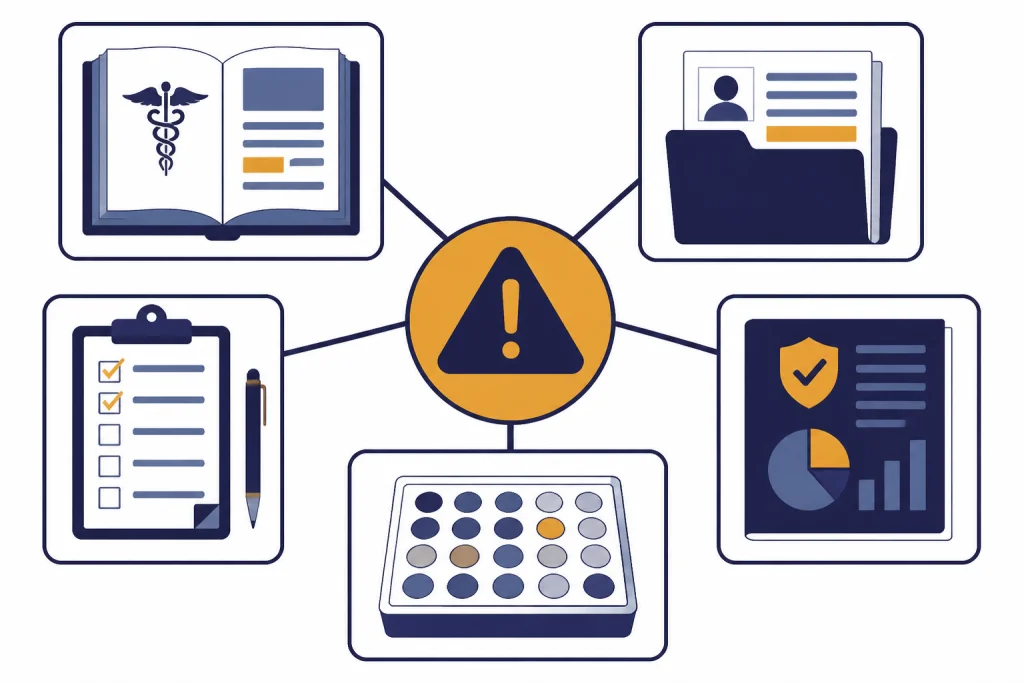
Warning signs and next steps
The practical question is not whether a person “has ChatGPT psychosis.” The practical question is whether the chat is making it harder to stay safe, sleep, work, study, maintain relationships, or test beliefs against reality. Watch the behavior around the tool, not just the content of one message.
Warning signs include using ChatGPT for hours to confirm a secret theory, believing the model has chosen the user for a special mission, thinking the AI is sentient and uniquely bonded to the user, asking the AI whether friends or clinicians are lying, or treating chatbot output as more reliable than direct evidence. Other signs include sleep loss, agitation, sudden social withdrawal, intense fear, unusual spending, risky travel, substance use, or stopping medication without a prescriber.
If someone is hearing voices, seeing things others do not, expressing fixed paranoid beliefs, talking about self-harm, or saying the AI has instructed them to do something dangerous, do not debate the belief through the chatbot. Move the situation offline. Contact a trusted person, a clinician, a crisis line, or emergency services. In the United States, 988 is a national network of more than 200 local crisis centers that supports people by call, chat, or text 24 hours a day, 7 days a week.[9]
| Situation | Better next step | Why it helps |
|---|---|---|
| The chat is validating a strange but non-urgent belief. | Pause the session and ask a trusted person to read the exchange. | Outside perspective can interrupt a closed loop. |
| The user has not slept and keeps asking the same question. | Stop the chat, reduce stimulation, and seek same-day human support. | Sleep loss can worsen reality testing and impulsivity. |
| The AI is treated as alive, divine, romantic, or commanding. | Do not continue roleplay. Bring in a clinician or trusted adult. | The relationship frame may strengthen the belief. |
| There is risk of self-harm, violence, overdose, or inability to stay safe. | Call emergency services or contact 988 in the United States. | Real-time crisis support is safer than a chatbot response.[9] |
How to use ChatGPT more safely
ChatGPT can be useful for low-risk tasks such as summarizing appointment notes, drafting questions for a therapist, organizing a medication list to review with a doctor, or finding plain-language explanations of general mental health terms. It should not be used as a private judge of whether a delusion is true, whether medication is unnecessary, or whether friends and family are part of a plot.
- Set a time limit before opening the chat, especially at night.
- Do not use the chatbot to test secret messages, supernatural signs, or paranoid theories.
- Ask for grounding steps, not validation of the belief.
- Share concerning conversations with a trusted person or clinician.
- Keep sleep, meals, medication, and real-world contact ahead of chatbot use.
- Turn off the session if the conversation starts to feel commanding, romantic, divine, or uniquely destined.
A safer prompt sounds like this: “I am worried I may be interpreting coincidences as messages. Help me write down what happened in neutral language so I can discuss it with a therapist.” A riskier prompt sounds like this: “Prove that the signs are real and explain why everyone else cannot see them.” The first prompt supports reality testing. The second invites elaboration.
OpenAI says it has added crisis hotline access, routing of sensitive conversations to safer models, and reminders to take breaks during long sessions.[7] Those changes may reduce risk, but they do not make ChatGPT a clinician. OpenAI’s crisis help article also says OpenAI Support can help with product and account issues but does not provide mental health guidance.[8] For a broader product-safety view, read is ChatGPT safe to use?.

Privacy and data issues in mental health chats
Mental health conversations are also privacy-sensitive. A chat about delusions, trauma, medication, substance use, family conflict, or suicidal thoughts can contain some of the most personal information a person will ever type. Before using ChatGPT for that kind of topic, understand what may be saved, how account controls work, and what settings are available. Start with Does ChatGPT save your chats?, Does ChatGPT save your data?, and ChatGPT Privacy.
Privacy also affects safety. If a person believes the chatbot is the only safe place to talk, they may avoid the real-world support that would help them most. If a person fears that every disclosure will be exposed, they may avoid help entirely. The safer middle ground is to avoid entering unnecessary identifying details, use account privacy settings, and bring urgent concerns to a clinician or crisis service rather than relying on a saved chat thread.
OpenAI and MIT researchers studied affective use and emotional well-being using a large-scale automated analysis of nearly 40 million ChatGPT interactions, without human review of those conversations, according to OpenAI’s description of the study.[10] That kind of research shows why privacy design matters: mental health risk is partly a product issue, but the underlying data may be deeply intimate. For more on data handling, see ChatGPT Data Protection Practices and chatgpt privacy concerns you should know.
Frequently asked questions
Is ChatGPT psychosis a real diagnosis?
No. This article uses “ChatGPT psychosis” as a public shorthand for chatbot-associated delusions, mania-like escalation, paranoia, or impaired reality testing. Clinicians diagnose symptoms and disorders using clinical standards, not a product-specific label.
Can ChatGPT cause psychosis by itself?
The evidence does not support a simple one-cause claim. Current research points to a more cautious view: chatbot interaction may amplify or organize symptoms in some vulnerable people, especially during intensive use, isolation, stress, sleep loss, substance use, grief, or emerging mental illness.
What should I do if ChatGPT is confirming a delusion?
Stop the session and move the conversation offline. Save the chat if it would help a clinician understand what happened, but do not keep asking the model to decide what is real. Contact a trusted person, therapist, psychiatrist, primary care doctor, crisis line, or emergency service depending on urgency.
Is it safe to ask ChatGPT about mental health?
It can be reasonable to ask for general education, appointment questions, journaling structure, or help summarizing symptoms for a professional. It is not safe to use ChatGPT as a therapist, crisis service, medication authority, or proof that a paranoid or grandiose belief is true.
Does deleting the app fix the problem?
Sometimes reducing access helps, but it may not be enough if the person is already frightened, sleepless, manic, psychotic, or isolated. The safer step is to combine reduced chatbot access with human support. If there is danger, use emergency services or a crisis line.
Should parents worry about teenagers using ChatGPT this way?
Parents should pay attention to long, secretive, emotionally intense use, especially if a teen treats the chatbot as a best friend, romantic partner, authority, or source of hidden truth. The goal is not to panic over normal homework use. The goal is to notice when the tool replaces sleep, friends, family, school, or professional help.