
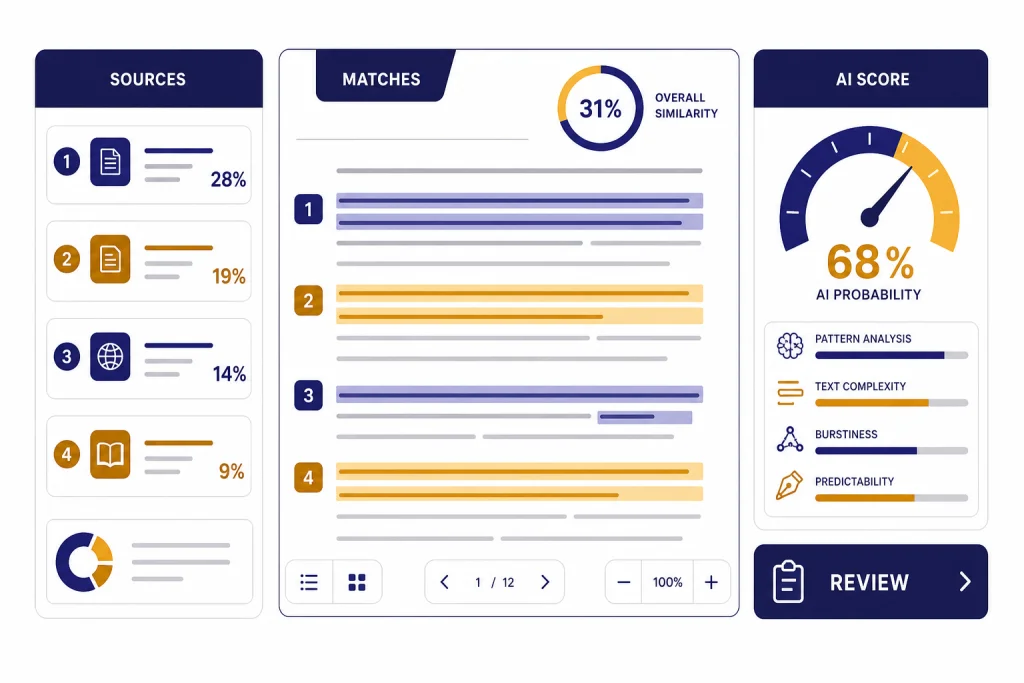
The best plagiarism checkers in 2026 depend on the job. Scribbr is the best one-off academic checker for students who need a Turnitin-like report before submission. Turnitin is the institutional standard for schools, but students usually cannot buy it directly. iThenticate fits journals, researchers, and publishers. Copyleaks is the strongest all-around option when you need plagiarism and AI detection in one report. Grammarly is best for everyday writing, while Originality.ai and Copyscape are better for web publishers. This guide compares AI-aware and traditional plagiarism checkers by use case, database fit, privacy, price model, and when not to trust the score.
Quick picks
If you only want the short answer, start here. Use Scribbr for a student paper, Turnitin if your school already licenses it, iThenticate for manuscripts and research publishing, Copyleaks for combined AI and plagiarism review, Grammarly for everyday business writing, Originality.ai for web content teams, Quetext for a lower-cost individual workflow, and Copyscape for finding copied web pages.
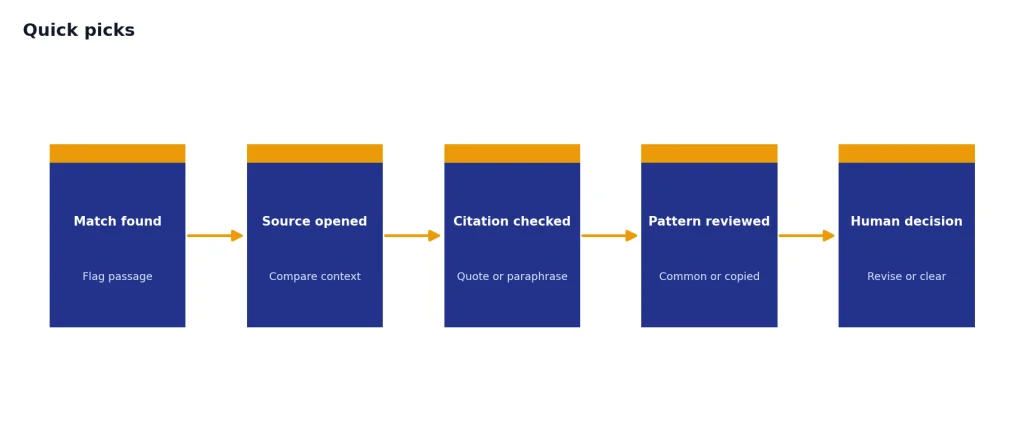
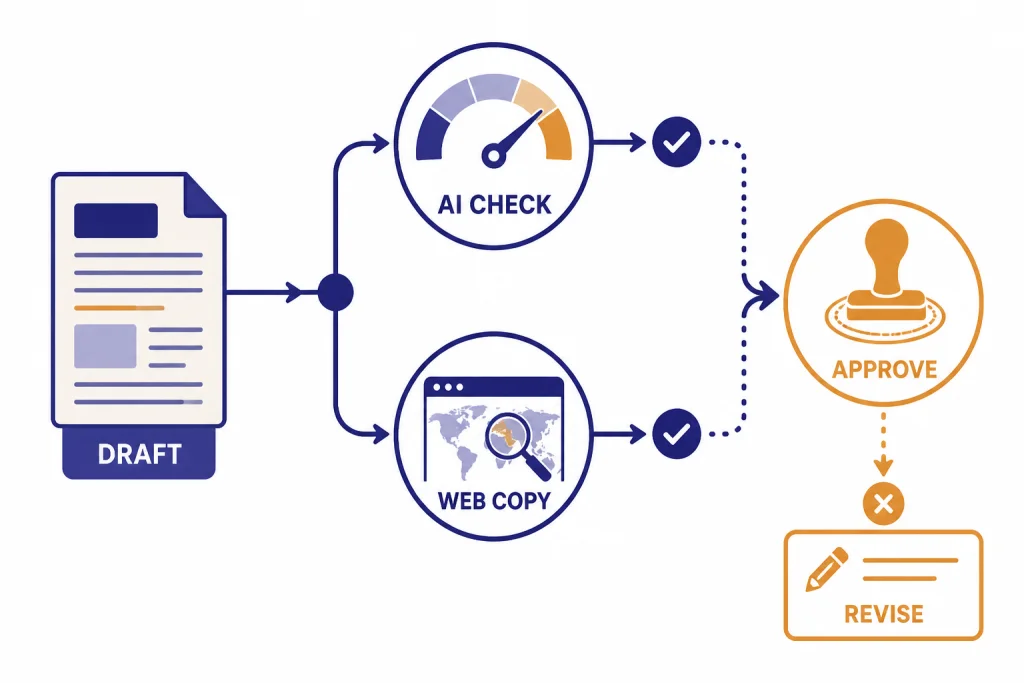
Do not treat any checker as a final plagiarism verdict. A similarity score means text matched something. It does not prove intent, misconduct, or poor citation practice by itself. The best tools show the source, the matching passage, and enough context to decide whether the match is a quote, a common phrase, a reference list item, self-plagiarism, or a real attribution problem.
AI detection adds another layer of uncertainty. Turnitin’s own guide says its AI writing model may misidentify human-written, AI-generated, and AI-paraphrased text, and it should not be the sole basis for adverse action against a student.[3] If AI authorship matters in your workflow, pair the detector with process evidence such as drafts, revision history, notes, source logs, and assignment instructions. Teachers should also read our Best AI Detectors for Teachers and Schools before relying on a single score.
How we judged plagiarism checkers
A good plagiarism checker needs more than a percentage. It needs useful source matching, clear highlighting, reasonable privacy controls, report export, and a database that fits the document type. A college essay, a journal article, a blog post, and a product description should not always be checked with the same tool.
We weighted five practical criteria. First, the checker must show matches in a way a human can review. Second, it must fit the user’s source universe: academic databases for papers, web indexes for online content, and private comparison sets for self-plagiarism. Third, it must explain what happens to uploaded documents. Fourth, it should have a price model that makes sense for the expected volume. Fifth, AI detection should be treated as a supporting signal, not a replacement for plagiarism matching.
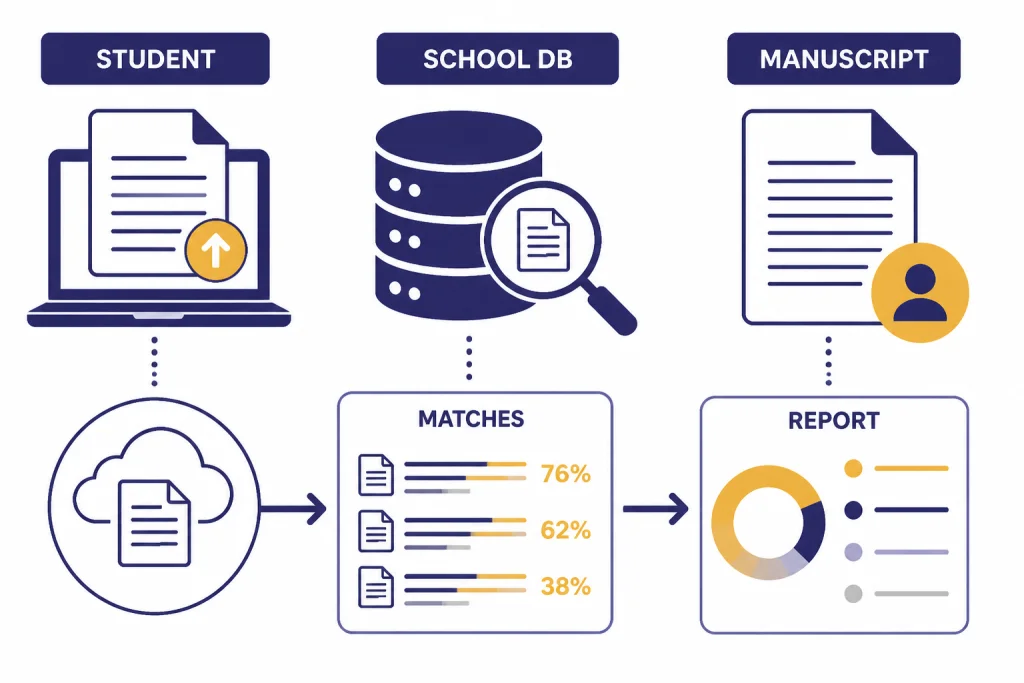
Database fit is the biggest divider. Scribbr says its plagiarism check compares against academic papers, websites, publications, and similar databases used by many universities and publishers, but it does not access a school’s private database of previously submitted student work.[2] That distinction matters. A public checker can find copied journal text or web text. It may miss a classmate’s paper that only exists inside a university repository.
Price also changes the recommendation. iThenticate sells individual credits for manuscripts, with a single manuscript option listed at $125 and a multiple-manuscript option listed at $300; it also says AI writing detection is not available to individual users.[5] That is reasonable for a journal submission. It is not reasonable for a student who wants to check short weekly assignments. By contrast, Copyscape charges 3 cents per search up to 200 words plus 1 cent per additional 100 words or part of 100 words, which is efficient for web duplicate checks but not a full academic review.[10]
Best plagiarism checkers compared
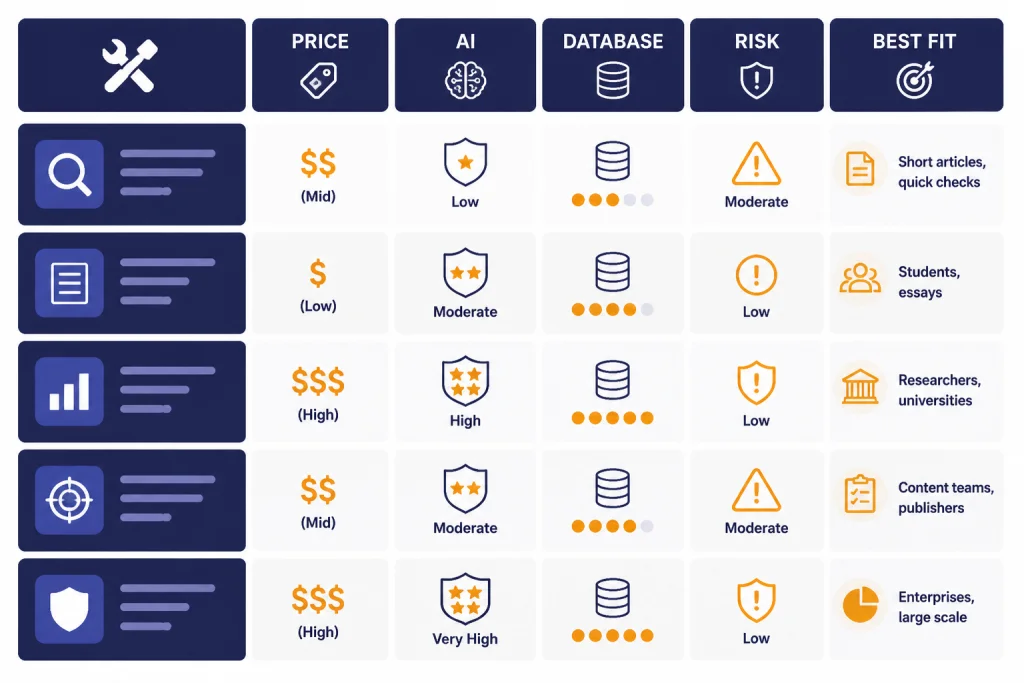
The table below compares the strongest options by practical use case. Pricing and limits can change. We cite the official pages where available and avoid unsupported claims when a vendor does not publish a clear figure.
| Tool | Best for | AI detection | Published price model | Main drawback |
|---|---|---|---|---|
| Scribbr | Student papers and one-off academic checks | Included in the premium report | Plagiarism Checker from $19.95; self-plagiarism check $9.95[1] | No access to your university’s private student-paper database[2] |
| Turnitin | Schools, colleges, and academic integrity offices | Yes, if licensed and enabled | Institutional licensing; OpenAI has not published an official figure for this because Turnitin is not an OpenAI product | Not usually available for direct student purchase |
| iThenticate | Researchers, journals, and publishers | Organization feature; not for individual users | $125 single manuscript credit; $300 for up to 3 manuscripts or 1 manuscript up to 75,000 words[5] | Expensive for routine student use |
| Copyleaks | Teams that want AI and plagiarism in one report | Yes | Personal $16.99/month or $13.99/month billed annually; Pro $99.99/month or $74.99/month billed annually[6] | Credit model requires volume planning |
| Grammarly | Everyday writing and business documents | Yes on paid tiers | Plagiarism and AI-generated text detection are listed in paid plan features; the page also lists 2,000 AI prompts per member per month for Pro[7] | Less specialized for academic misconduct review |
| Originality.ai | Publishers, agencies, and SEO content teams | Yes | $30 pay-as-you-go for 3,000 credits; Pro $14.95/month monthly or $12.95/month yearly; 1 credit equals 100 words[8] | Built more for publishing workflows than schools |
| Quetext | Individuals who want plagiarism plus writing tools | Yes | Free plan up to 1,000 words; Essential starts from $19.99/month; plagiarism-only plan listed at $24.99 per month for 100,000 words per month[9] | Plan page can be confusing because bundles and word sliders overlap |
| Copyscape | Duplicate web content and content theft checks | Mentions human or AI-generated content originality checks | 3 cents per search up to 200 words, plus 1 cent per extra 100 words[10] | Not built for full academic citation review |
Best academic plagiarism checkers
Scribbr: best one-off academic checker for students
Scribbr is the best pick for students who want an academic-style plagiarism report before submitting a paper. It is not the same as submitting to your school’s Turnitin account, but it is closer to an academic workflow than most consumer writing apps. Scribbr says the premium report identifies similarities, links them to sources, and includes Grammar Checker, AI Detector, and Self-Plagiarism Checker access.[2]
Scribbr is strongest when you need to inspect citations. It is less useful if your risk is a private student paper that your university stores internally. Scribbr says public plagiarism checkers do not access a university’s private database of previously submitted work.[2] If you reused your own older essay, upload it into Scribbr’s self-plagiarism workflow instead of hoping a public database catches it.
Turnitin: best institutional academic integrity system
Turnitin remains the most important name in school plagiarism checking because it is embedded in learning management systems and institutional review processes. It is not the best recommendation for an individual buyer, because most students cannot simply subscribe to the same institutional product their school uses.
Turnitin’s AI writing report is separate from the similarity score. Turnitin says the AI percentage is different from and independent of the similarity score, and AI highlights are not visible inside the Similarity Report.[3] That separation is useful. A paper can have a low similarity score and a high AI indicator, or a high similarity score and no meaningful AI concern.
Turnitin also publishes release notes for its AI writing detection model. On February 12, 2026, it said it updated the model to improve recall while maintaining a low false positive rate, and that older reports would not be retroactively updated.[4] That means historical AI scores may not match scores generated after a model update.
iThenticate: best for research publishing
iThenticate is the best fit for journal articles, grant documents, theses, dissertations, and professional research publishing. It is part of the same academic integrity ecosystem as Turnitin, but it targets publication screening rather than classroom grading.
The price model makes its intended audience clear. iThenticate lists a $125 single manuscript option for one document credit up to 25,000 words and a $300 multiple option for up to 3 manuscripts or one manuscript up to 75,000 words.[5] It also states that AI writing detection is not available to individual users.[5] Use it when the cost of missing a problem is higher than the check itself.
Best AI and web publishing checkers
Copyleaks: best combined AI and plagiarism report
Copyleaks is the best all-around choice when one report needs to cover both traditional plagiarism and AI-generated text. Its pricing page says users can scan for AI-generated content and potential plagiarism in a single report, and that Personal and Pro plans include access to both detection features.[6]
The credit model is simple enough once you plan volume. Copyleaks says one credit covers 250 words or less, and gives the example that 100 credits equals up to 25,000 words.[6] That works well for departments, agencies, and teams that can estimate monthly text volume. It is less convenient for occasional users who only check one paper a semester.
Originality.ai: best for publishers and content teams
Originality.ai is designed for teams that publish online. It combines AI checking, plagiarism checking, readability, grammar, fact-checking support, team seats, scan history, and API access in one publishing-oriented platform.[8] If you manage freelance articles, affiliate content, or SEO pages, this workflow is more relevant than a student-facing academic checker.
The pay-as-you-go plan is listed at $30 for 3,000 credits, with 1 credit equal to 100 words.[8] The Pro plan is listed at $14.95 per month when paid monthly or $12.95 per month when paid yearly.[8] This is easier to justify for repeated content operations than for a single assignment.
Copyscape: best for duplicate web content
Copyscape is still useful because it does one job well: find copies of web content. It supports copy-and-paste checks, PDF and Word uploads, batch site search, an API, team workflows, exclusions, and a private index.[10] It is a practical tool for editors who need to know whether a draft, page, or product description appears elsewhere online.
Do not use Copyscape as your only academic checker. It is not designed to interpret citation style, reference-list matches, unpublished student work, or institutional repositories. Use it when the concrete question is, “Does this text already exist on the open web?”
If your plagiarism workflow sits inside a larger AI writing stack, compare related tools too. Our guides to best AI writing tools compared in 2026, Best AI Research Tools for Academics, and Best AI Summarizer Tools for Long Documents cover adjacent products that often sit before or after the plagiarism check.
Free and low-cost checkers
Free plagiarism checkers are useful for a first pass, but they are risky for high-stakes work. The common tradeoff is simple. You get convenience, but you may lose database depth, report quality, privacy clarity, or document-length flexibility.
Quetext is the strongest low-cost option in this group because it has a clear paid path and a real report workflow. Its free plan lists DeepSearch plagiarism checking up to 1,000 words and AI Content Detector use up to 1,000 words.[9] Its paid plans add higher word limits, downloadable reports, source exclusion, grammar and spell check, and bulk uploads.[9]
Grammarly is not a dedicated academic plagiarism checker, but it is a practical choice for people who already write inside Grammarly. Its plan page lists plagiarism and AI-generated text detection as paid-plan features, with the free plan showing those features as unavailable.[7] For workplace writing, that convenience often matters more than having the deepest academic database.
GPTZero is an AI-first platform, not our main traditional plagiarism pick. Its pricing page lists a free plan at $0 per month with 1 AI detection scan per month, a Pro plan at $19.90 per month with unlimited AI detection scans, and a lifetime plan at $299 one time.[11] Choose it when AI-authorship review is the main concern, then pair it with a stronger plagiarism checker if source copying is also a concern.
SmallSEOTools and DupliChecker can help with quick, low-stakes web checks. SmallSEOTools lists a plagiarism checker plan at $9.99 per month with 40,000 words plus 8,000 extra words.[12] DupliChecker’s page shows a 1,000-word limit per free plagiarism search.[13] Use tools like these for rough screening, not for accusations, grading, publication decisions, or confidential drafts.
AI detection limits
AI detection and plagiarism detection answer different questions. Plagiarism detection asks whether text matches existing sources. AI detection estimates whether text has statistical patterns associated with machine-generated writing. Those are not the same problem.
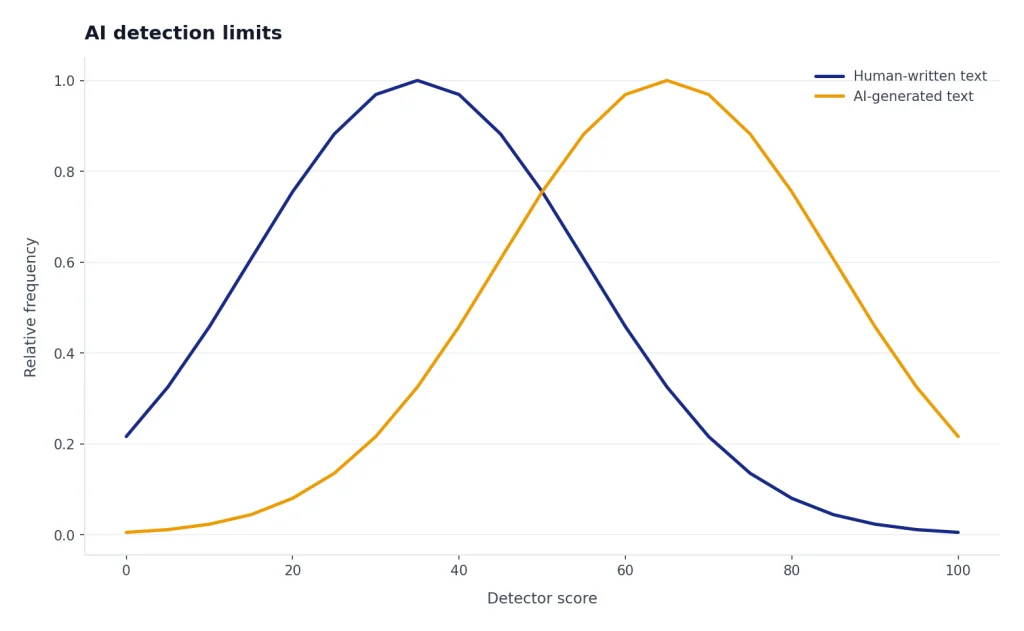
A student can plagiarize without using AI. A writer can use AI without plagiarizing. A human can write polished text that looks machine-like to a detector. An AI model can produce text that does not match any existing source. That is why similarity reports and AI reports must be reviewed separately.
Turnitin’s guidance is unusually clear on this point. It says the AI writing model may not always be accurate and may misidentify human-written, AI-generated, and AI-paraphrased text.[3] It also says the score requires further scrutiny and human judgment alongside institutional policy.[3] Any tool that claims certainty should make you more cautious, not less.
For schools, the better process is evidence-based. Ask for drafts, outlines, notes, source trails, document history, and a short conversation about the writing choices. For publishers, compare the draft against the assignment brief, source links, factual claims, and editorial history. If you need a broader view of detection tools, read our AI detector for teachers guide and our Best ChatGPT Prompt Generator Tools guide to understand how prompts affect output style.
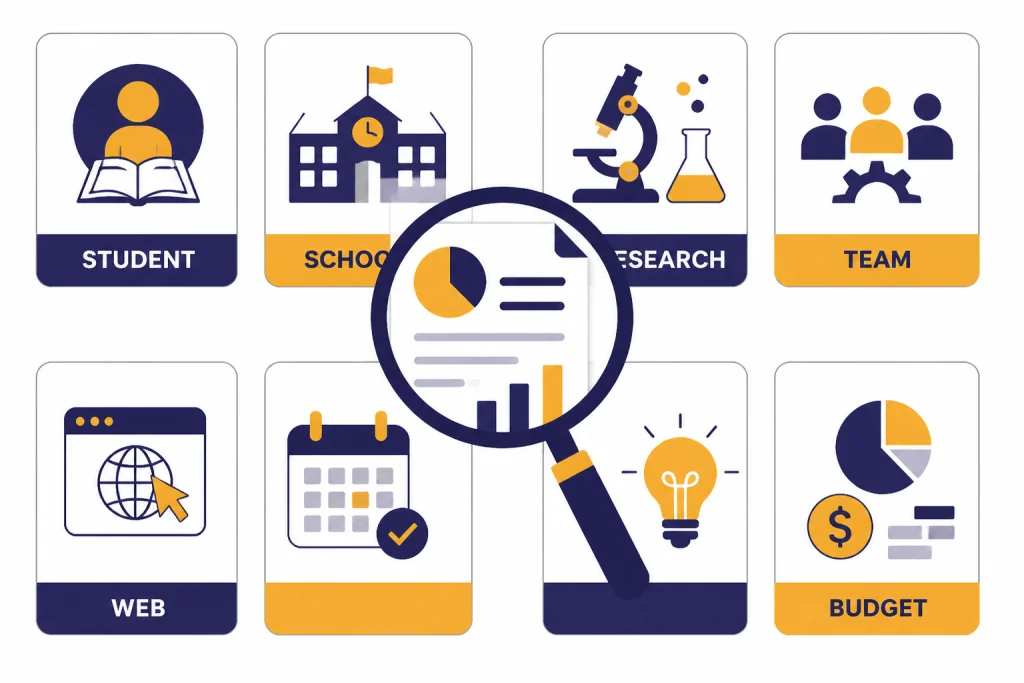
How to choose by use case
For students: choose Scribbr when the document is important and you need a readable report before submission. If your institution uses Turnitin, remember that your school’s result may differ because of private repository access. Keep your drafts and notes so you can explain your process if a tool flags something incorrectly.
For teachers: use the checker your institution supports, but do not outsource judgment to the score. Similarity may come from common phrasing, templates, bibliographies, quoted text, or allowed collaboration. AI indicators should start a review, not end it.
For researchers: use iThenticate when publication risk matters. Its manuscript-based pricing is expensive, but it fits the stakes of journal submission, grant work, and institutional research screening.
For marketers and publishers: use Originality.ai or Copyscape depending on the job. Originality.ai is stronger when you need AI detection, team workflows, and scan history. Copyscape is stronger when the main risk is duplicate web content. If your workflow also uses image, video, translation, or coding tools, our related guides to Best AI Image Tools, best AI video tools of 2026, best AI translation tools tested, and best AI coding assistants of 2026 can help you build a broader review process.
For everyday writers: use Grammarly if you already rely on it for grammar, tone, and rewrites. It is convenient for business documents, emails, reports, and drafts. It is not the tool I would choose for a formal academic misconduct review.
For budget users: start with Quetext if you want a real report and clear paid upgrades. Use free SEO-style checkers only for rough screening. Do not upload confidential, unpublished, or high-stakes work to a tool unless you understand its storage and privacy policy.
Frequently asked questions
What is the best plagiarism checker overall?
Scribbr is the best overall choice for most students because it is built around academic reports and source review. Copyleaks is better if you need plagiarism and AI detection in one team workflow. iThenticate is better for research publishing, and Copyscape is better for copied web content.
Is Turnitin better than public plagiarism checkers?
Turnitin is stronger inside schools because it can be tied to institutional systems and private student-paper repositories. Public checkers can still be useful, but they may not compare your work against a university’s private database. Scribbr states that public plagiarism checkers do not have access to those private student-paper databases.[2]
Can plagiarism checkers detect ChatGPT?
Traditional plagiarism checkers detect matching text, not ChatGPT use by itself. Some tools now include AI detection, but AI detection is probabilistic and can be wrong. Turnitin says its AI model may misidentify human, AI-generated, and AI-paraphrased text.[3]
Are free plagiarism checkers safe?
Some are fine for rough checks, but free tools vary widely in privacy, database quality, and report usefulness. Avoid uploading unpublished research, confidential business documents, admissions essays, or sensitive student work unless the tool clearly explains storage and deletion. For high-stakes documents, use a reputable paid checker with a clear privacy policy.
What plagiarism score is acceptable?
There is no universal acceptable score. A score can rise because of quotations, references, templates, common phrases, or correctly cited material. Review the matched passages and sources instead of treating the percentage as a pass-fail grade.
Should I use more than one plagiarism checker?
Use more than one checker only when the document is important and the tools serve different purposes. For example, a researcher might use iThenticate for manuscript similarity and Copyscape for web copies. Running the same low-stakes draft through many weak tools usually adds confusion rather than confidence.