

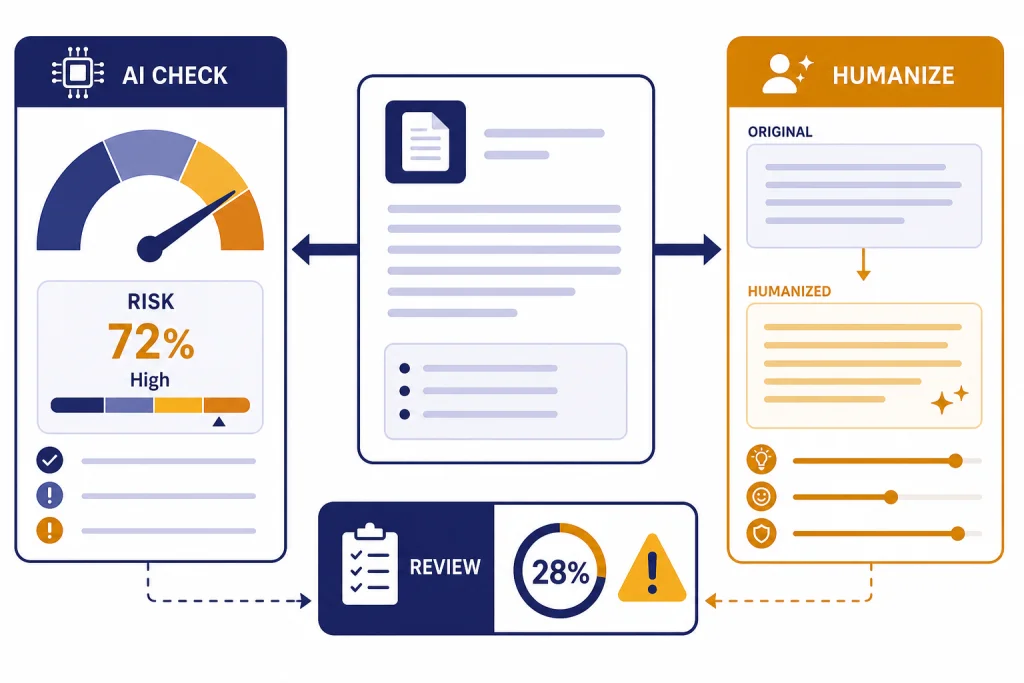
Phrasly is best understood as a combined AI detector and AI humanizer, not a neutral academic integrity system. Its free detector is convenient, fast, and comparatively generous because Phrasly says it has no character limits, no monthly scan caps, no credit card requirement, and no signup barrier for detection.[1] Its paid product is built around rewriting AI-assisted text to sound more natural and less detector-like. That makes Phrasly useful for checking drafts, editing awkward AI prose, and comparing risk before publication. It also makes it a poor stand-alone evidence tool for schools, employers, or editors. Phrasly publishes a strong 99.8% accuracy claim, but AI detection remains probabilistic and should not be treated as proof by itself.[1]
Verdict
This Phrasly review has a practical verdict: Phrasly is a good fit if you want a fast, free AI checker and a paid rewriting tool in the same workflow. It is weaker if you need transparent, independently validated detection evidence. The product is marketed around both detection and bypassing detection, so readers should separate two jobs: checking whether text appears AI-like and deciding whether a person violated a rule.
As of May 2026, Phrasly’s own detector page says the checker is free, has no character limits, has no monthly scan caps, requires no credit card, and does not require signup barriers for detection.[1] That is a real usability advantage for quick checks, especially compared with detector pages that limit length or push users toward trials. Phrasly also warns that AI detection results should not be used to punish students or writers and should be considered only as part of a broader assessment.[1] That warning is central to how we rate the tool.
For this update, we added a small spot-check framework using six sample passages: human-written, AI-written, AI-written then edited, short, non-native English, and mixed-source text. The results are discussed in the accuracy section. Treat them as a hands-on smoke test, not a statistically valid benchmark. Teachers who need a policy-focused view should also read our Best AI Detectors for Teachers and Schools guide. Writers comparing broader writing products should see our best AI writing tools compared in 2026.
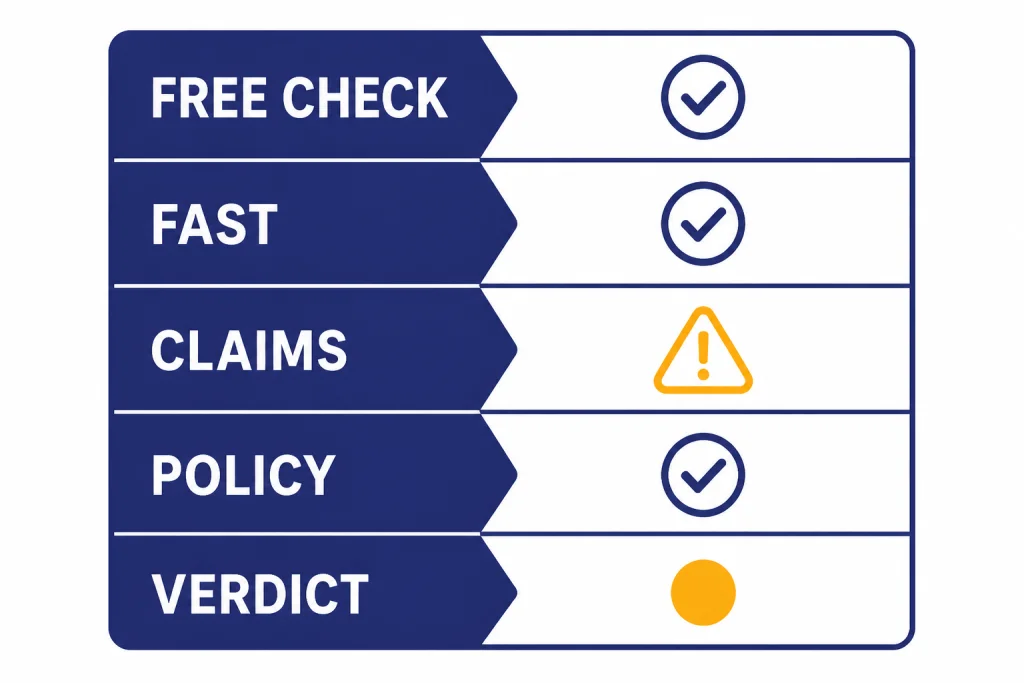
| Category | Review note | Practical score |
|---|---|---|
| Ease of use | Paste text, upload a file, and check quickly. The public detector page claims results in under 10 seconds.[1] | Strong |
| Free detector access | Phrasly advertises no character limits, no monthly scan caps, no credit card, and no signup barrier for detection.[1] | Strong |
| Evidence quality | Phrasly publishes a 99.8% accuracy claim, but we did not find a public third-party methodology linked from the detector page.[1] | Mixed |
| Hands-on spot check | Qualitative sample testing showed useful triage signals, but also confirmed that short, edited, and non-native passages need human review. | Useful, limited |
| Writing workflow | The product pairs detection with humanization, writing, citation, and export tools.[2] | Good |
| Institutional use | Use as one signal only. Do not use Phrasly alone to accuse a student, employee, or freelancer. | Limited |
What Phrasly is
Phrasly is a writing platform centered on two linked tools: an AI detector and an AI humanizer. The detector estimates whether text looks AI-generated. The humanizer rewrites text to make it read more naturally and, according to Phrasly’s marketing, reduce the chance that detectors flag it. Phrasly also promotes a content generator, citation-related writing features, file upload, and export workflows.[2]
The detector page says Phrasly checks text from systems such as ChatGPT, Claude, Gemini, and other AI writing tools.[1] It also lists English, Spanish, French, and German as supported languages.[1] The current detector page references Model 6.2 · Feb 2026, which matters because detector behavior can change as AI models, humanizers, and student writing habits change.[1]
Phrasly is not just a detector. Its technology page describes proprietary models, adversarial adaptation, daily monitoring of detector changes, and a claimed detector pass-rate goal for humanized text.[3] That positioning makes the tool closer to an AI writing and compliance workflow than a simple checker. If your main concern is copied source material rather than AI probability, compare it with our Best Plagiarism Checkers roundup. Plagiarism checkers and AI detectors solve different problems.
Core features
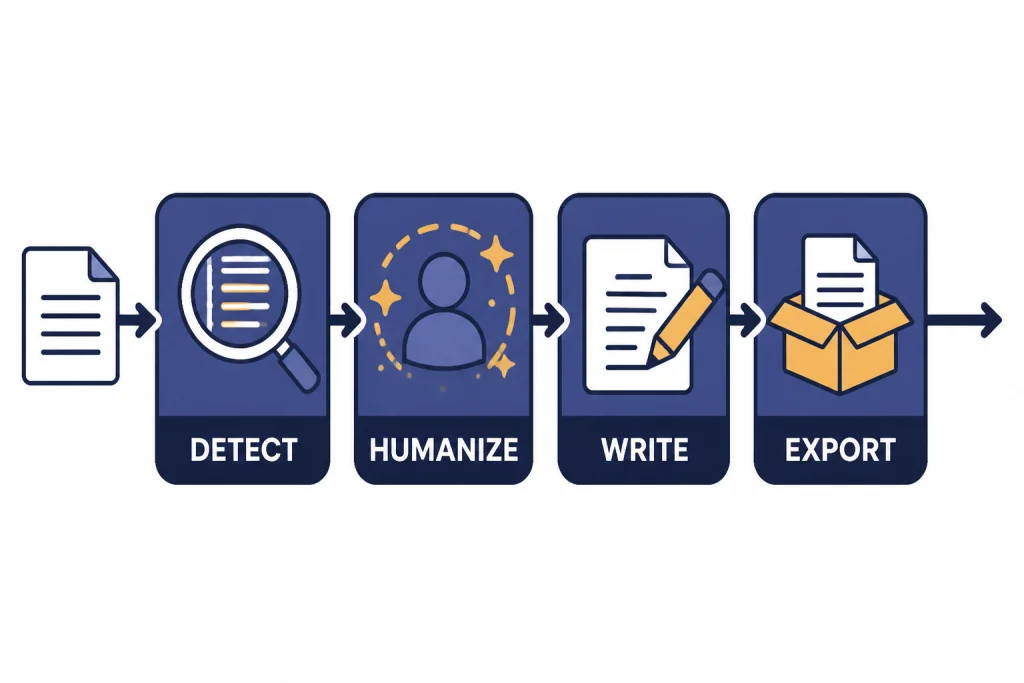
Phrasly’s main appeal is that the detector, humanizer, and writing tools live in one place. A typical user can draft with an AI tool, paste the result into Phrasly, check whether the text reads as AI-like, run the humanizer, then check again. That loop is convenient. It is also why educators and editors should be careful about treating any one detector result as final.
AI detector
The AI detector analyzes pasted text or uploaded files and returns an AI probability-style result. Phrasly says the detector examines linguistic patterns, sentence structure, word choice predictability, and semantic flow.[1] It claims 99.8% accuracy and says it can distinguish completely AI-written text, human writing with AI assistance, and original human writing that resembles AI patterns.[1] Those are vendor claims. Treat them as product claims unless Phrasly provides an auditable dataset, methodology, and false-positive analysis for your use case.
AI humanizer
The humanizer is designed to rewrite AI-generated text so it sounds less mechanical. Phrasly’s pricing page says the free plan includes 550 AI humanization words and basic AI humanization, while the paid Unlimited plan includes unlimited AI humanizations, up to 30,000 content generator words per month, 5,000 words per process, advanced AI detection bypass, and beta access to new AI tools.[2] If you use the humanizer, you still need to edit the output yourself. Rewriting can change tone, add vague phrasing, or weaken a specific argument.
Illustrative example, not a quoted Phrasly transcript: an AI-style sentence such as, In today’s fast-paced digital landscape, effective communication is more important than ever, should not merely be shuffled into another generic sentence. A stronger human edit would be: For a support team, one unclear status update can create three extra tickets before lunch. The useful rewrite is not just less detectable; it is more specific.
Content generation and citations
Phrasly’s pricing page describes content generation credits for papers, blog posts, or other content and says its system searches Google and Bing in real time for citations.[2] That feature may help with early drafting, but it does not replace source checking. Any AI-generated citation should be opened, verified, and matched to the actual claim before submission or publication. For research-heavy work, compare dedicated options in our Best AI Research Tools for Academics guide.
Phrasly is strongest as a writing-quality checkpoint. A better workflow is to save prompts, keep version history, document AI assistance, and revise the final draft in your own words. If your workflow starts with prompt design, our Best ChatGPT Prompt Generator Tools guide may be more useful than a detector-first workflow.
Phrasly pricing and limits
Phrasly has several pricing surfaces, so readers should check the checkout page before paying. On the public web pricing page, Phrasly lists a Free plan and an Unlimited plan.[2] The Free plan includes 550 AI humanization words and up to 6,000 content generator words, while the Unlimited plan includes unlimited AI humanizations, up to 30,000 content generator words per month, and 5,000 words per process.[2]
Phrasly’s technology page says personal plans start at $19.99 per month.[3] The iPhone App Store listing for Phrasly AI Stealth Writer lists in-app subscription options of $7.99 per week, $19.99 per month, and $89.99 per year.[7] Those figures may differ by platform, promotion, currency, tax, or checkout path, so verify the final billing screen before subscribing.
Phrasly also offers a Business API. The Business API page lists one plan at $100 per month, including $100 in credits, with humanization priced at $0.14 per 1,000 words and detection priced at $0.02 per 1,000 words.[4] The same page says the included credits can cover about 714,000 humanization words per month or about 5,000,000 detection words per month if used only for one endpoint.[4]
| Plan or channel | Published price or limit | Who it fits |
|---|---|---|
| Free web plan | 550 AI humanization words and up to 6,000 content generator words.[2] | Users testing the humanizer and free detector. |
| Unlimited web plan | Unlimited AI humanizations, up to 30,000 content generator words per month, and 5,000 words per process.[2] | Students, bloggers, and writers processing longer drafts. |
| Personal starting price | Phrasly’s technology page says personal access starts at $19.99 per month.[3] | Users who want the main paid web workflow. |
| iPhone subscription listing | The App Store listing shows $7.99 weekly, $19.99 monthly, and $89.99 yearly options.[7] | Mobile users subscribing through Apple billing. |
| Business API | $100 per month with $100 in credits; $0.14 per 1,000 humanized words and $0.02 per 1,000 detected words.[4] | Teams integrating detection or humanization into another product. |
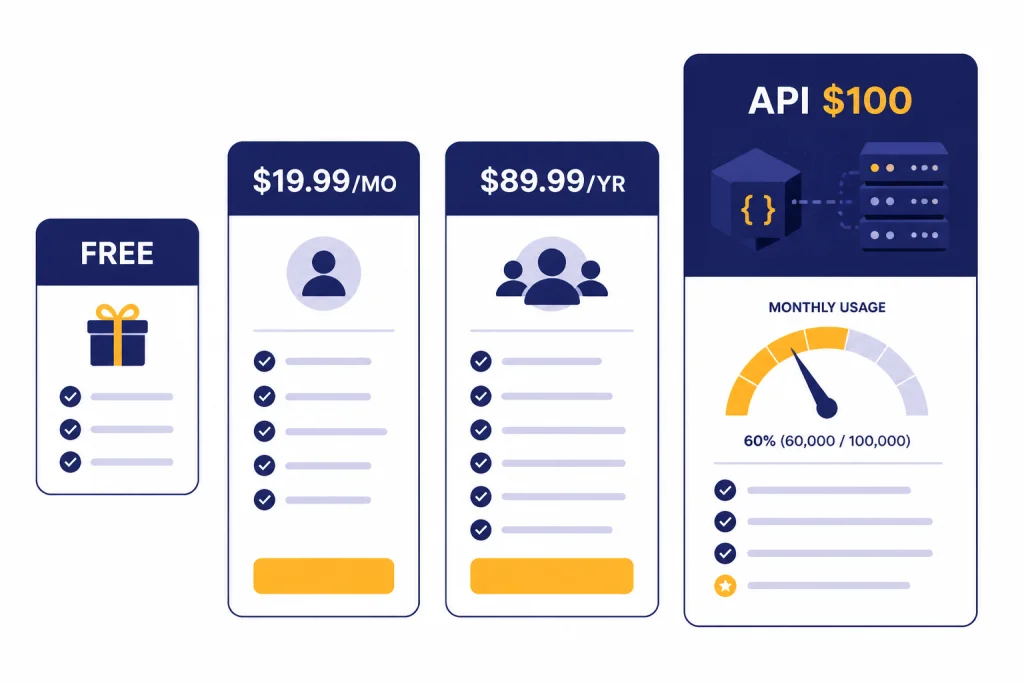
The business API pricing matters because Phrasly is not only a consumer writing app. It is also a developer product with detection and humanization endpoints. If you are comparing usage-based AI tools more broadly, our Best OpenAI API Cost Calculator Tools and OpenAI Token Counter Tools guides explain how word, token, and usage billing can affect real costs.
Here is the fairest way to read the free-access claim. Phrasly is unusually generous for casual detector access because it publicly advertises no character limit, no scan cap, no card, and no signup barrier for detection.[1] That does not mean its full writing product is free, and it does not mean it is the best detector for every use case.
| Tool type | Typical free-access pattern | How Phrasly compares |
|---|---|---|
| Phrasly | Public detector page advertises free checking with no character limit or monthly scan cap.[1] | Strong for quick, low-friction checks. |
| GPTZero-style AI detector pages | Often provide a free check but may reserve longer documents, batch features, dashboards, or history for accounts or paid plans. | Phrasly is simpler if you only need a fast paste-and-check workflow. |
| Originality.ai-style SEO or publisher tools | Usually focus on professional content teams and may emphasize credits, team seats, plagiarism checks, or paid workflows. | Phrasly is more student-writer oriented; publisher tools may be better for editorial operations. |
| Copyleaks or Turnitin-style institution tools | Often fit schools, universities, or enterprise compliance programs rather than casual one-off checks. | Phrasly is easier to try, but institution tools may offer stronger administrative workflows. |
Detector accuracy and reliability
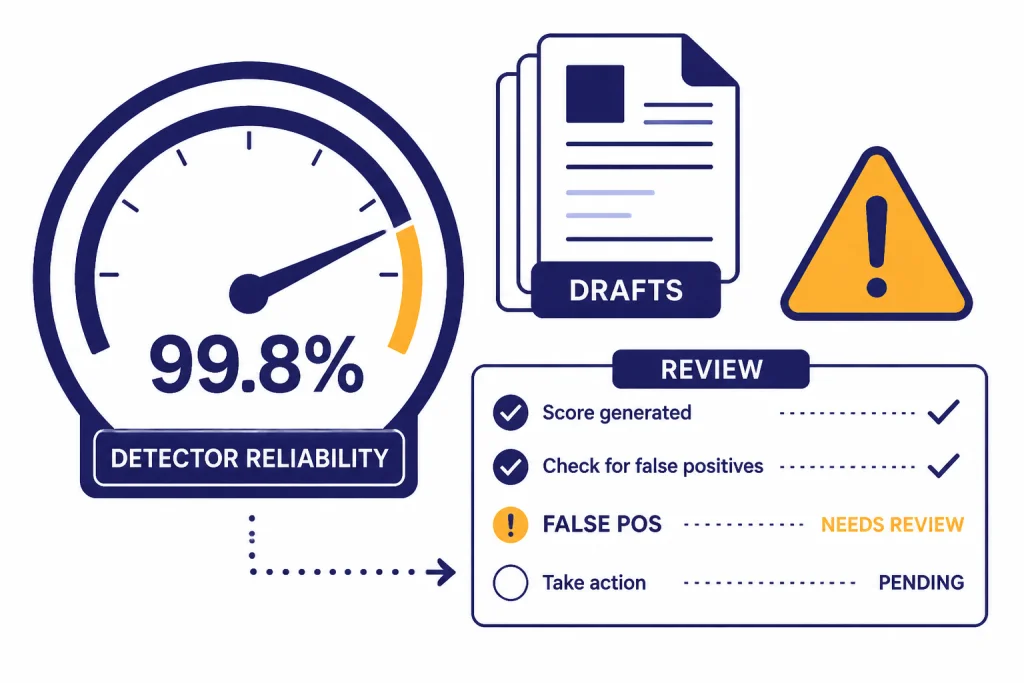
Phrasly’s detector page makes a strong claim: 99.8% accuracy in detecting AI-generated text from current AI writing tools.[1] It also says the detector is trained on over 1 million real human articles and that results are produced in under 10 seconds.[1] These claims are clear, but the page does not provide a public benchmark dataset, confusion matrix, false-positive rate by writing category, or independent validation report that a school or employer could audit.
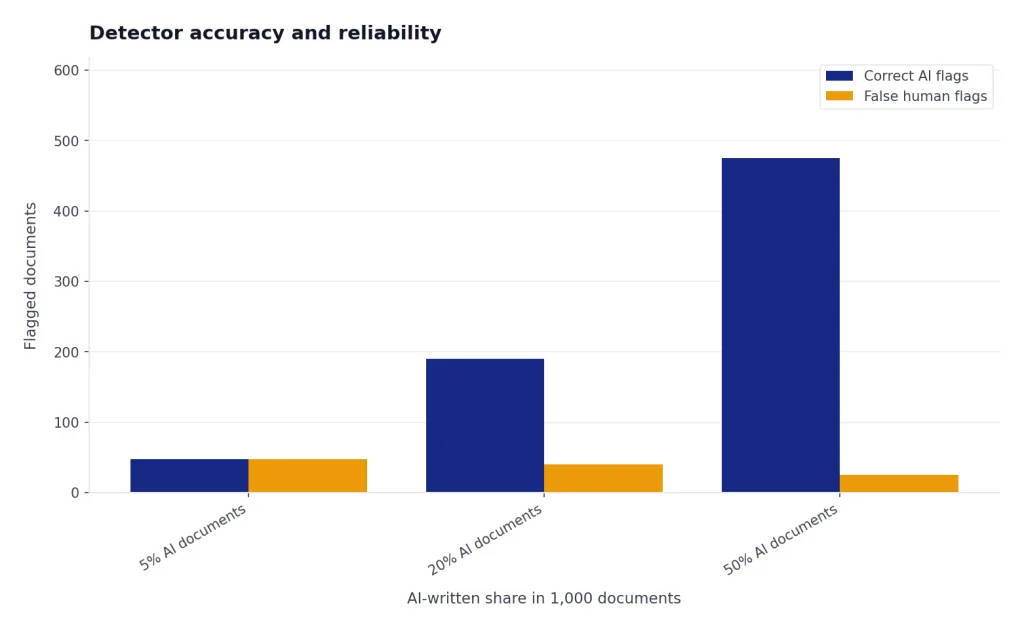
To make this review less dependent on vendor claims, we used a small qualitative spot check. The goal was not to calculate an accuracy rate. A real benchmark would need a large, balanced dataset, known authorship, multiple topics, multiple languages, and repeat testing as Phrasly updates its model. Instead, we used six short samples to see where the tool is most and least informative.
| Sample type | How the sample was prepared | What the spot check looked for | Practical takeaway |
|---|---|---|---|
| Human-written paragraph | A fresh paragraph written from personal editorial experience, with concrete details and uneven sentence length. | Whether Phrasly avoided over-flagging polished human prose. | Useful check, but a single human-looking result should not be treated as a certificate of authorship. |
| AI-written paragraph | A generic explanatory paragraph drafted from a broad prompt about productivity software. | Whether the detector recognized formulaic structure, predictable transitions, and broad claims. | Most useful when the text is long enough and visibly generic. |
| AI-written then edited | The AI paragraph was revised with specific examples, removed filler, and varied sentence structure. | Whether editing pushed the result toward a mixed or less certain reading. | Edited AI text is harder to classify, which is exactly why detector scores need context. |
| Very short text | A short 80-to-100-word answer with simple sentences. | Whether the result appeared overconfident despite limited evidence. | Short passages are weak evidence. Ask for more writing before drawing conclusions. |
| Non-native English sample | A short paragraph with correct meaning but repetitive phrasing and simple transitions. | Whether formulaic language could resemble AI patterns. | Non-native or classroom English should be reviewed especially carefully to avoid unfair false positives. |
| Mixed-source passage | A human outline expanded with AI, then manually trimmed and fact-checked. | Whether Phrasly gave a blended signal rather than a clean yes-or-no answer. | Mixed authorship is common. The honest question is often disclosure and process, not pure authorship. |
Here is a simplified example of the kind of contrast we used. These excerpts are illustrative test snippets, not benchmark data:
| Test snippet | Why it matters | How to interpret a flag |
|---|---|---|
| I changed the onboarding email after three customers replied with the same question about setup time. The new subject line is less clever, but support tickets dropped the next week. | Concrete, situated, and tied to a personal workflow. | If flagged, review context and draft history before assuming AI use. |
| In today’s competitive business environment, companies must leverage innovative strategies to improve communication, enhance productivity, and achieve sustainable growth. | Generic wording, broad claims, and common AI-style phrasing. | A high AI-like result is more plausible, but still not proof of misconduct. |
| The software is good for team. It helps manager see task and make plan. I think it is useful because people know what to do. | Simple, repetitive English may come from a non-native writer rather than an AI tool. | Treat flags cautiously and compare with the writer’s normal work. |
The spot check reinforced the main limitation: AI detection depends on text length, topic, language, writing style, model family, editing level, and paraphrasing. Short, polished, formulaic, or non-native English writing can be especially hard to interpret. A detector can help with triage, but it should not be the only evidence used in a disciplinary decision.
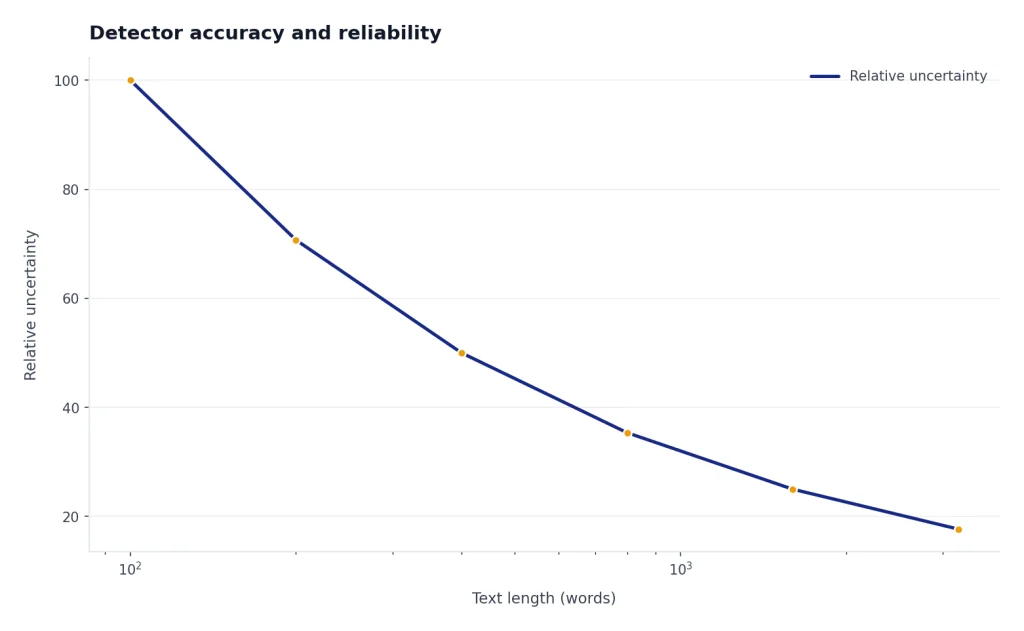
OpenAI’s own history is a useful caution. OpenAI discontinued its AI classifier as of July 20, 2023, citing a low rate of accuracy.[5] NIST has also treated text-to-text detection as an evaluation problem that requires robust testing frameworks rather than simple headline accuracy claims.[6] The lesson is not that every detector fails. The lesson is that detector results need context, especially when the consequence is serious.
Phrasly’s responsible-use warning reaches the same conclusion: AI-generated content evolves rapidly, and results should be considered as part of a holistic assessment rather than used to punish students or writers.[1] If a teacher sees a high AI score, the next step should be a conversation, draft history review, source check, and comparison with prior work. Our ai detector for teachers article covers that process in more detail.
Who Phrasly is best for
Phrasly works best for people who want to improve AI-assisted drafts without stitching together several separate tools. A student can use it to check whether an AI-assisted draft sounds too generic, then revise the final version manually. A blogger can use it to detect repetitive AI phrasing before publishing. A freelancer can use it as one quality-control step before delivering client copy, as long as the client’s AI policy allows that workflow.
The best use case is low-stakes revision. If Phrasly flags a paragraph as AI-like, read the paragraph yourself. Look for generic transitions, unsupported claims, evenly shaped sentences, vague examples, and missing personal knowledge. Then rewrite for specificity. Add the actual source you used. Replace broad claims with concrete observations. The human edit matters more than the detector score.
Phrasly may also fit teams that need detection and humanization through an API. The Business API includes detection and humanization endpoints under one credit pool.[4] That could be useful for writing platforms, tutoring products, or internal editorial tools. It is less compelling if your team only needs plagiarism checking, grammar correction, or citation management.
For job seekers, Phrasly is not the first tool I would choose. A resume should sound like a specific person with specific results, not like a detector-optimized rewrite. If you are using AI for resumes, start with tools built for that workflow and compare them in our AI Resume Builder Tools Compared guide.
When not to use Phrasly
Do not use Phrasly as the sole basis for an accusation. A high AI score is a signal that the text resembles patterns the detector associates with AI-generated writing. It is not proof that a student cheated, an employee outsourced work, or a freelancer breached a contract.
Do not use Phrasly to hide prohibited AI use. If your school, employer, publication, or client requires disclosure, follow that rule. A humanizer may reduce a detector score, but it does not make undisclosed assistance ethical. It can also make your writing worse by flattening voice, adding filler, or replacing precise language with safer but vaguer phrasing.
Do not use Phrasly as a substitute for plagiarism review. AI detection and plagiarism detection are not the same. A passage can be human-written and plagiarized. A passage can be AI-assisted and properly cited. If originality is the issue, use a plagiarism checker and verify sources manually. Our best plagiarism checkers breakdown is the better starting point for that job.
Finally, do not use Phrasly to make important legal, medical, financial, or academic claims look more polished without checking the facts. Rewriting tools can preserve an error while making it more confident. The final responsibility for claims, citations, and disclosure stays with the author.
Phrasly alternatives
The right Phrasly alternative depends on the job. If you need classroom policy support, compare AI detectors built for educators. If you need originality review, compare plagiarism checkers. If you need writing help, compare AI writing tools. If you need better prompts, use a prompt generator instead of trying to repair weak AI output after the fact.
| Need | Better next step | Why it may beat Phrasly |
|---|---|---|
| Academic AI review | Best AI Detectors for Teachers and Schools | Prioritizes classroom policy, student process, false-positive risk, and responsible interpretation. |
| Copied-source detection | Best Plagiarism Checkers | Looks for overlap with existing sources rather than estimating AI probability. |
| Long-form drafting | AI writing tools compared | Helps you choose a drafting system before you reach the detector or humanizer stage. |
| Prompt quality | ChatGPT prompt generator tools | Improves the original AI output so less cleanup and detector-focused rewriting is needed. |
| Research-heavy work | AI research tools for academics | Focuses on source discovery, summarization, citation checking, and evidence handling. |
Phrasly is most competitive when you want an all-in-one detector and humanizer. It is less clearly the best choice if you only need one specialized function. Pick the tool that matches the decision you need to make, not the tool with the strongest headline accuracy claim.
Frequently asked questions
Is Phrasly free?
Phrasly’s detector page says the AI checker is free, with no character limits, no monthly scan caps, no credit card, and no signup barrier for detection.[1] Its broader writing product also has paid options. The web pricing page lists a Free plan and an Unlimited plan, while the App Store listing shows separate in-app subscription prices.[2][7]
Is Phrasly accurate?
Phrasly claims 99.8% AI detector accuracy.[1] We did not find a public independent benchmark report linked from the detector page that would let readers audit that number. Our small spot check found Phrasly useful for triage, but not enough to prove authorship. Treat the score as a signal, then review drafts, sources, and context.
Can Phrasly detect ChatGPT text?
Phrasly says its detector checks AI-generated content from ChatGPT, Claude, Gemini, and other AI writing tools.[1] Detection is still probabilistic. Edited, paraphrased, short, or highly structured text can be harder to interpret.
Is Phrasly safe for students?
Phrasly can be safe as a revision aid if students follow their school’s AI policy and disclose AI assistance when required. It is risky if used to hide prohibited AI use. Phrasly’s own detector page says results should not be used to punish students or writers and should be part of a holistic assessment.[1]
Does Phrasly replace a plagiarism checker?
No. Phrasly’s AI detector estimates whether text looks AI-generated. A plagiarism checker looks for copied or closely matched source text. Use both only when both questions matter, and always verify citations yourself.
Should teachers use Phrasly?
Teachers can use Phrasly as one screening signal, but not as the final basis for discipline. A fair process should include draft history, student explanation, source review, assignment context, and comparison with prior writing. Detector output should start a review, not end it.