
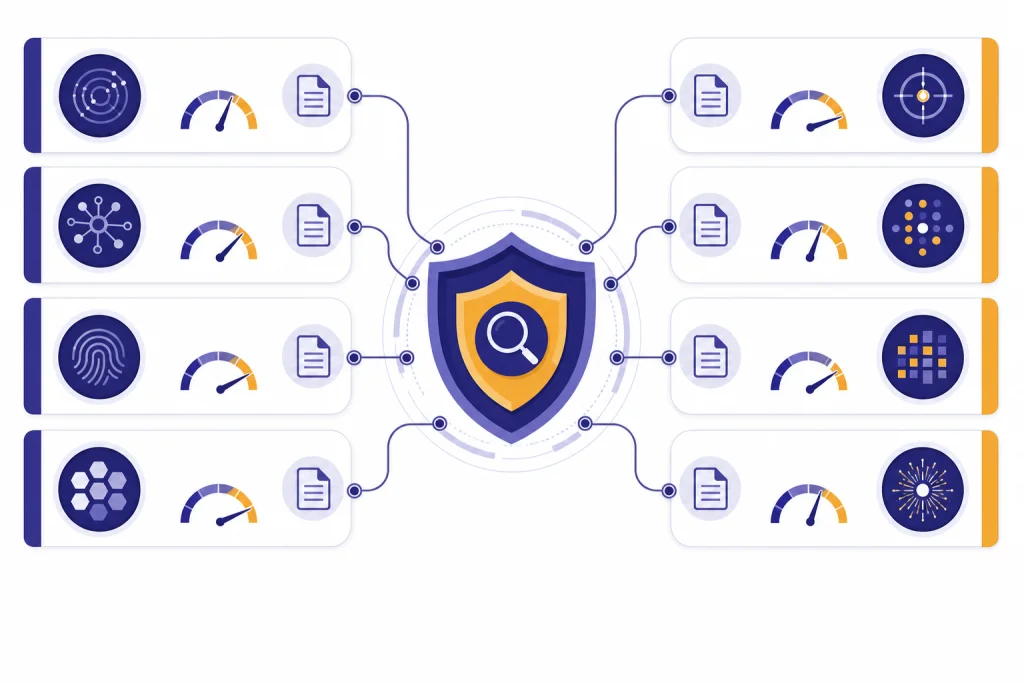
The best AI detectors in 2026 are useful screening tools, not proof machines. After hands-on checks across common classroom, publishing, and business-review scenarios, Pangram is our best overall pick, Originality.ai is the strongest fit for publishers, Turnitin remains the best institutional option for schools that already license it, GPTZero is the easiest recommendation for educators who need reports and student-facing workflows, and Copyleaks is the best fit when AI detection must sit beside plagiarism detection. Use any detector as one signal. Do not use a detector score by itself to accuse a student, reject a writer, or make an employment decision.
Quick ranking
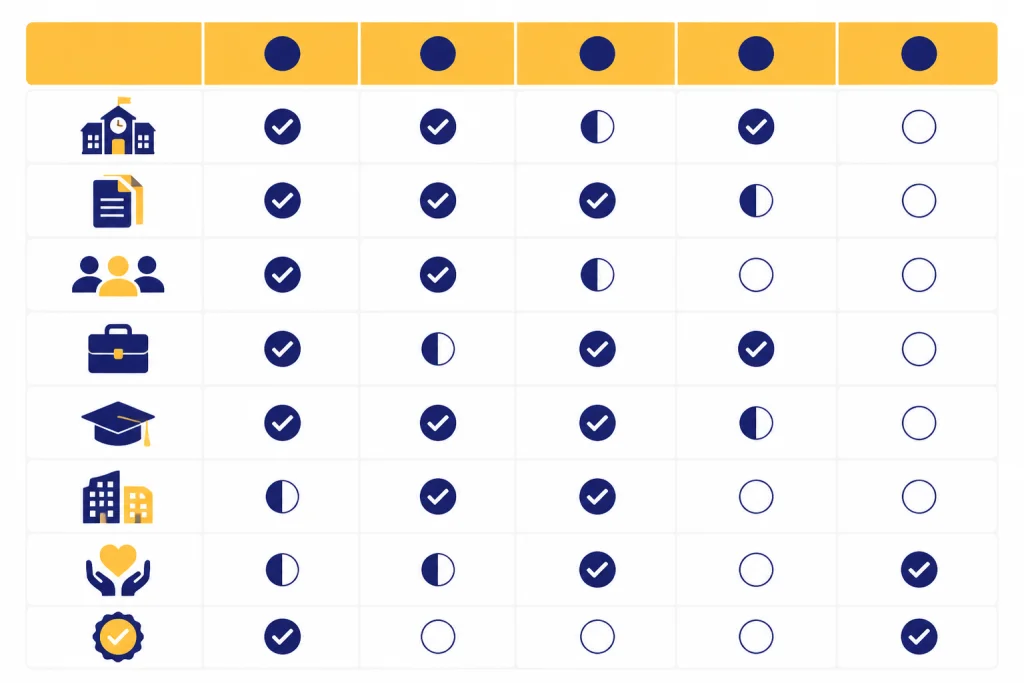
The best AI detector depends on the decision you need to make. A teacher needs a workflow that supports review and student conversation. A publisher needs batch checks, clear highlights, and plagiarism context. A compliance team needs audit trails and access controls. A student usually needs a low-cost way to understand risk, not a tool that promises certainty.
Our ranking gives more weight to practical reliability, reporting clarity, responsible-use guidance, and fit for real workflows than to self-reported accuracy claims. OpenAI’s own retired classifier is a useful warning: OpenAI said the tool was no longer available as of July 20, 2023 because of a low rate of accuracy, and its published evaluation identified only 26% of AI-written text as likely AI-written while incorrectly labeling 9% of human-written text as AI-written.[1]
| Rank | AI detector | Best for | Why it ranks here |
|---|---|---|---|
| Best overall | Pangram | High-stakes review teams | Strong independent research signal, clear interpretability, multilingual support, and useful organization plans.[3][4] |
| Best for publishers | Originality.ai | Content teams and SEO publishers | Combines AI detection, plagiarism checks, readability, grammar, and team workflows in one product.[5] |
| Best for institutions | Turnitin | Schools already using Turnitin | Integrated with academic-integrity workflows, but access depends on an institutional license.[7] |
| Best educator workflow | GPTZero | Teachers and student conferences | Strong reporting orientation and explicit guidance that no detector is perfect.[13] |
| Best AI plus plagiarism bundle | Copyleaks | Enterprises, schools, and multilingual review | AI and plagiarism scans sit in one report, with AI detection in more than 30 languages and plagiarism detection in more than 100 languages.[8] |
| Best free quick check | QuillBot AI Detector | Fast no-cost checks | The detector is free for all users; Premium mainly adds bulk file-upload convenience.[9] |
| Best academic add-on | Scribbr | Students who also need plagiarism review | Scribbr’s own comparison ranked its premium detector highly and highlighted that false positives still occur across the category.[10] |
| Best interface for small teams | Winston AI | Marketing and editorial teams | Clean reports, document scans, OCR, image detection, and team-oriented plans.[11] |
How we tested the AI detectors
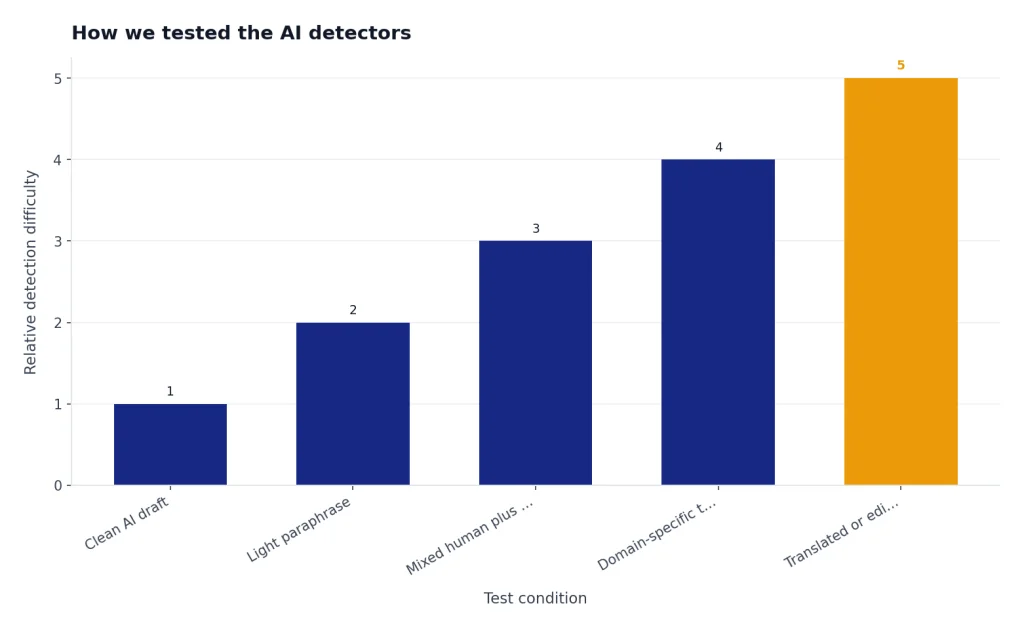
We treated detection as a workflow problem, not a magic-authorship problem. Each tool was checked against realistic tasks: unedited AI drafts, polished human writing, mixed human-plus-AI drafts, short passages, long passages, paraphrased passages, and documents where a reviewer would need to explain the result to another person.
We also checked whether a tool gives useful evidence. A bare percentage is weak. Sentence-level highlights, document history, writing-process reports, exportable PDFs, and a clear explanation of uncertainty are more useful. If you work in education, pair this roundup with Best AI Detectors for Teachers and Schools. If you mainly need overlap checking, read Best Plagiarism Checkers before buying a detector-only tool.
We did not accept vendor accuracy claims at face value. The RAID benchmark paper explains the problem well: many detectors claim accuracy of 99% or more, but RAID introduced a much harder benchmark with over 6 million generations across 11 models, 8 domains, 11 adversarial attacks, and 4 decoding strategies.[2] In practical terms, a detector that works on a clean ChatGPT paragraph may fail on edited, translated, domain-specific, or lightly paraphrased text.
- Detection quality: Did the tool handle obvious AI text without over-flagging polished human writing?
- False-positive control: Did the tool support cautious interpretation?
- Evidence quality: Did the report show why a passage was flagged?
- Workflow fit: Did it support schools, publishers, teams, or individual users well?
- Cost clarity: Could a buyer understand what a scan costs before committing?
Ranked reviews
Pangram: best overall AI detector
Pangram is the strongest overall pick because it combines good usability with unusually strong independent research support. A University of Chicago working paper evaluated Pangram, OriginalityAI, GPTZero, and RoBERTa on false positives and false negatives, and found that Pangram was the only detector in that study to meet a stringent policy cap of FPR ≤ 0.005 without giving up the ability to detect AI text.[3]
Pangram also has a practical pricing structure. Its free plan lists 4 credits per day, its Individual monthly plan lists 600 credits per month at $20 per month, and its Professional monthly plan lists 3,000 credits per month at $65 per month.[4] The product also lists support for detecting AI-generated and human-written content in over 20 languages.[4]
Choose Pangram when false positives matter and you need a detector that explains its result. Avoid it if you only need an occasional free check and do not want to learn a new workflow.
Originality.ai: best for publishers and content teams
Originality.ai is the best fit for publishers, agencies, and site owners because it is built around content operations rather than classroom review. Its pricing page lists AI checking, plagiarism checking, readability, grammar and spelling, fact-checking aid, team seats, and API access in the same product family.[5]
Originality.ai’s public pricing page lists a $30 pay-as-you-go option with 3,000 one-time credits, a Pro plan at $14.95 per month, and an Enterprise plan at $179 per month on monthly billing.[5] That makes it easier to budget than tools that hide most pricing behind sales calls. For teams that also use AI drafting tools, compare this with best AI writing tools compared in 2026.
The trade-off is that Originality.ai can feel too content-marketing oriented for classrooms. It is a strong screening layer for editorial QA. It should not become an automatic rejection machine for freelancers.
Turnitin: best for institutions that already license it
Turnitin is not the best detector for individual buyers because most individuals cannot simply buy it. Turnitin says administrators interested in AI Writing Detection should speak to their Turnitin or iThenticate account manager, and instructors or users should contact their institution’s administrator.[7]
For schools that already use Turnitin, the value is workflow. The AI writing report sits inside a broader academic-integrity environment. Turnitin’s release notes show continuing updates to AI writing detection, including a February 12, 2026 model update intended to improve recall while maintaining a low false-positive rate.[6] Turnitin also states that an AI writing score should not be used as the sole basis for adverse action against a student.[6]
Use Turnitin when your institution has policy, training, appeal procedures, and human review. Do not use screenshots of a Turnitin score as courtroom-level evidence.
GPTZero: best educator-facing workflow
GPTZero is widely used because it is easy to understand and built around education. Its own support guidance tells educators that no AI detector is perfect and points them toward Writing Reports that can replay a student’s writing process and show authenticity signals.[13] That is the right direction. Process evidence is more useful than a single probability score.
GPTZero is a good choice when the goal is a conversation: ask a student about drafts, sources, edits, and process. It is weaker when a school wants a binary yes-or-no answer. No text-only detector can provide that across every writing style, assignment type, and language background.
Copyleaks: best AI plus plagiarism detector
Copyleaks is a strong option when AI detection and plagiarism detection need to live together. Its pricing page says the Personal plan includes AI and plagiarism scans in a single report, AI detection in more than 30 languages, plagiarism detection in more than 100 languages, Google Docs access, and a Chrome extension.[8]
Copyleaks lists the Personal plan at $16.99 per month, or $13.99 per month when billed annually, and the Pro plan at $99.99 per month, or $74.99 per month when billed annually.[8] It is a better buy for teams that need both originality checks and AI review than for a casual user who only wants to paste a paragraph.
QuillBot AI Detector: best free quick check
QuillBot is the easiest free recommendation for quick checks. QuillBot says its AI Detector is free for all users, and that Premium changes file-upload convenience rather than the detection itself: free users can upload 1 file at a time, while Premium users can upload up to 20 files at once for batch detection.[9]
Use QuillBot for low-stakes self-checks and fast second opinions. Do not use it as the only tool for disciplinary, editorial, or hiring decisions.
Scribbr: best academic add-on
Scribbr is most useful when AI detection is part of a student-facing academic review flow. Scribbr’s own comparison says false positives happen and that AI texts combined with human text or paraphrased text are hard to detect.[10] That candor matters. A detector that explains its limits is more trustworthy than one that only advertises a headline accuracy number.
If you are a student, use Scribbr or QuillBot to understand risk, then preserve drafts, notes, outlines, and version history. If your work is research-heavy, you may also want Best AI Research Tools for Academics or Best AI Summarizer Tools for Long Documents.
Winston AI: best interface for small teams
Winston AI is a polished option for small editorial and marketing teams that want shareable reports, document scanning, OCR, plagiarism options, and image detection in one interface. Its pricing page lists a free trial with 2,000 credits for 14 days, paid tiers with monthly credits, and AI image detection priced by credits per image.[11]
Winston AI is a good fit when reports need to be understandable to nontechnical reviewers. It is not our top pick for schools because education workflows need more than a clean dashboard; they need appeals, policy language, and careful human review.
Pricing and use-case comparison
AI detector pricing changes often, and credit systems are not always comparable. A “credit” can mean a word, a document, a scan, or a block of words depending on the vendor. Before you buy, calculate the number of documents you expect to check, the average length, and whether you need plagiarism review in the same workflow. If you are comparing AI writing, summarizing, and detection tools in one budget, OpenAI Token Counter Tools can also help you think in usage terms.
| Tool | Public starting point | Best buyer | Watch out for |
|---|---|---|---|
| Pangram | Free plan with 4 credits per day; Individual plan at $20 per month.[4] | Schools, publishers, and review teams that care about false positives. | Credit accounting requires attention for long documents. |
| Originality.ai | $30 pay-as-you-go option; Pro at $14.95 per month.[5] | Publishers, agencies, and site owners. | Less ideal for student-facing due process. |
| Turnitin | Institutional access through account administrators.[7] | Schools already in the Turnitin ecosystem. | Not a normal individual subscription. |
| Copyleaks | Personal at $16.99 per month or $13.99 per month annually.[8] | Teams that need AI and plagiarism detection together. | Credit limits and scan volume matter. |
| QuillBot | Free AI detector; Premium adds bulk file upload convenience.[9] | Individuals who need quick checks. | Not enough evidence for high-stakes decisions. |
| Winston AI | Free trial with 2,000 credits for 14 days.[11] | Small teams that want polished reports. | Credit use varies by content type. |
Limits, false positives, and when not to use detectors
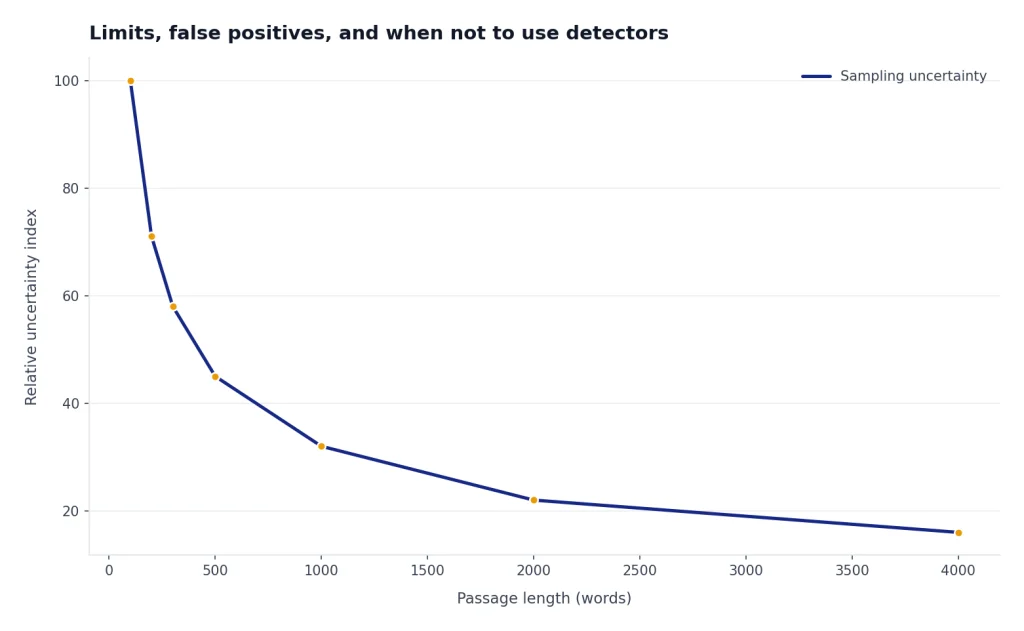
AI detectors estimate probability. They do not identify authorship. They usually infer patterns such as predictability, sentence structure, repetition, and similarity to known AI-like text. That creates predictable failure cases.
Short passages are risky. OpenAI warned that its classifier was very unreliable on text below 1,000 characters, and that even longer texts could be incorrectly labeled.[1] Turnitin’s release notes also state that results are likely less accurate when submissions contain less than 300 words.[6]
Language background matters. A Stanford-linked study found that GPT detectors frequently misclassified non-native English writing as AI-generated, raising fairness concerns for students who write formal, predictable, or constrained English.[12] This is one reason schools should never rely on a detector score alone.
- Do not use a detector score as the only evidence of misconduct.
- Do not screen job applicants with an AI detector unless you have a legally reviewed policy.
- Do not assume “0% AI” means no AI was used.
- Do not assume “100% AI” means a human did not write or heavily edit the text.
- Do not punish non-native, neurodivergent, or highly formal writers for a statistical style match.
A responsible process looks different. Ask for drafts, outlines, notes, citation trails, document history, interview answers, and revision explanations. For resumes and job materials, combine detector results with normal hiring judgment; if you use AI resume tools, read AI Resume Builder Tools Compared to understand how common assisted writing has become.
How to choose the right AI detector
Choose the detector that matches the consequence of the decision. The higher the stakes, the more you need transparency, policy, and human review.
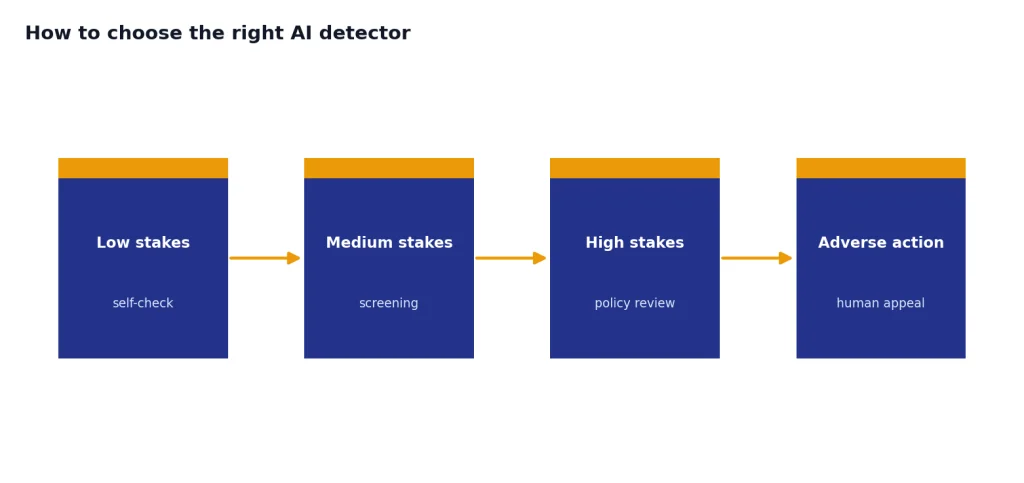
- Teachers: Start with GPTZero, Turnitin, or Pangram depending on your school’s tools. Require draft evidence before making a judgment.
- Universities: Prefer tools with admin controls, reporting, and documented appeal procedures. Turnitin and Pangram are the strongest fits.
- Publishers: Choose Originality.ai or Copyleaks if plagiarism checks, readability, and team workflows matter.
- Students: Use QuillBot or Scribbr for low-stakes self-checks, but keep version history instead of trying to “game” detectors.
- Developers and platforms: Look for API access, rate limits, data retention terms, and audit logs before comparing accuracy claims.
If your real goal is better writing, a detector may be the wrong category. A writing tool, prompt tool, or research assistant may solve the underlying problem more cleanly. See Best ChatGPT Prompt Generator Tools, Best AI Writing Tools Compared in 2026, and Best AI Research Tools for Academics for adjacent options.
The safest rule is simple. Use AI detectors to decide what deserves review, not to decide what is true.
Frequently asked questions
What is the best AI detector in 2026?
Pangram is our best overall pick because it combines strong research support, useful explanations, multilingual coverage, and plans for individuals and organizations. Originality.ai is better for publishers, Turnitin is better for schools that already license it, and QuillBot is better for free quick checks.
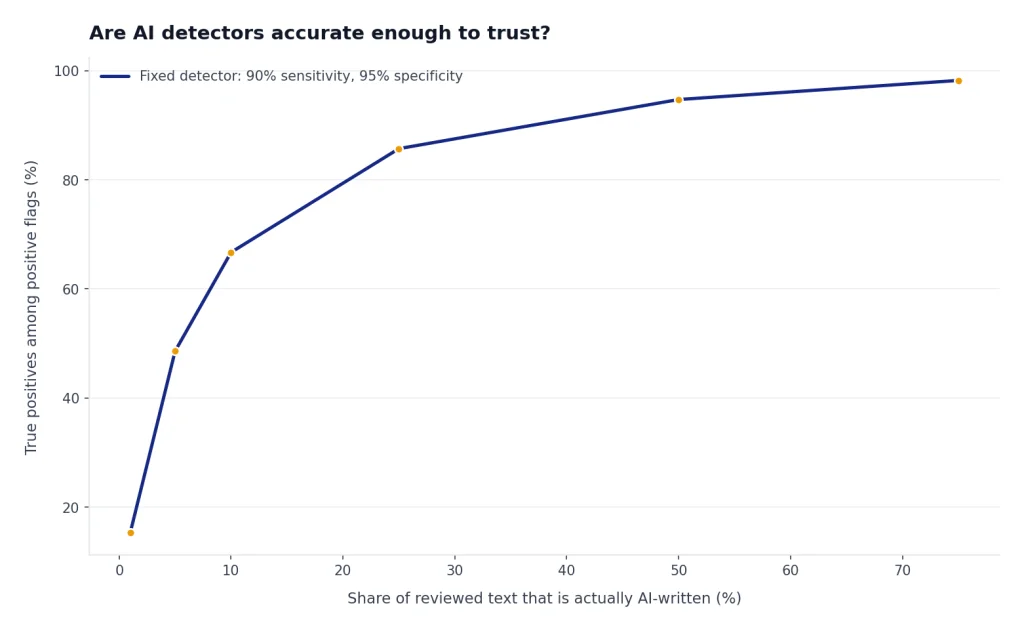
Are AI detectors accurate enough to trust?
They are accurate enough to support review in some cases, but not accurate enough to prove authorship by themselves. Treat every result as a probability signal. Ask for process evidence before making a serious decision.
Can AI detectors falsely accuse human writers?
Yes. False positives are a known problem, especially with short text, formal writing, non-native English writing, and highly edited prose. A detector flag should trigger a human review, not an automatic penalty.
Which AI detector is best for teachers?
Turnitin is the best fit for institutions that already use it. GPTZero is a strong teacher-facing option because it emphasizes reports and writing-process evidence. Pangram is a strong choice when a school wants careful false-positive control and interpretable results.
Which free AI detector should I use?
QuillBot is the easiest free quick-check option. Scribbr also has student-friendly AI detection tools. Free detectors are fine for rough screening, but they should not be used as the only basis for academic or professional decisions.
Do AI detectors work on paraphrased AI text?
Sometimes, but performance drops when AI text is edited, paraphrased, translated, or mixed with human writing. That is why a detector score should be paired with drafts, version history, sources, and a reviewer’s judgment.