
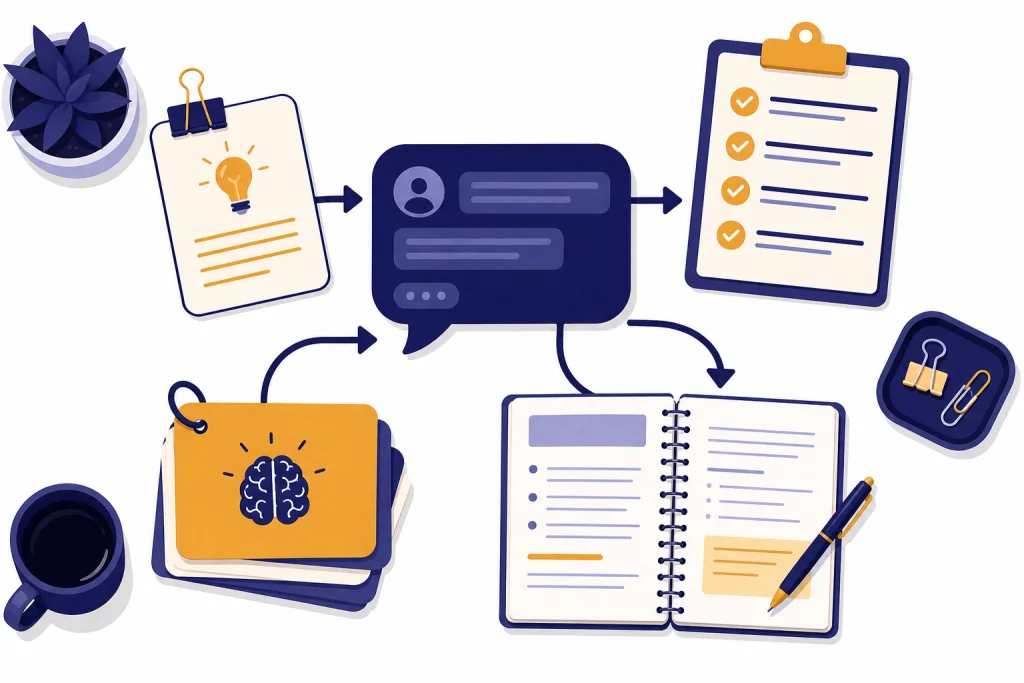
The best ChatGPT student prompts help you study more actively, find weak spots, organize assignments, and improve drafts without asking AI to do the work for you. Use ChatGPT like a tutor, coach, quiz partner, rubric checker, and study planner. Do not use it as a ghostwriter unless your instructor explicitly allows that. This guide gives you copy-paste prompts for lectures, reading, essays, math, lab reports, language learning, exams, presentations, and time management. Each prompt is designed to make ChatGPT ask questions, explain reasoning, and push you toward stronger work you can defend in class.
Use ChatGPT as a tutor, not a ghostwriter
ChatGPT can help you learn faster when you make it explain, question, compare, quiz, and critique. It can hurt you when you ask it to replace your thinking. The safest student prompts usually say: do not write the final answer for me, ask me questions first, show the reasoning, and point out what I still need to verify.
OpenAI’s Study mode is built around this same idea. OpenAI says Study mode asks interactive questions, guides users step by step, checks understanding with open-ended prompts, and can work with uploaded course materials such as images or PDFs.[1] OpenAI introduced Study mode on July 29, 2025, describing it as a way to learn with step-by-step guidance instead of quick answers.[2]
That does not mean every assignment allows AI. Course policies vary. If the syllabus is unclear, ask your instructor what is allowed before you use ChatGPT for anything that affects a grade. For teachers’ perspective on classroom uses, see our ChatGPT Teacher Prompts guide.
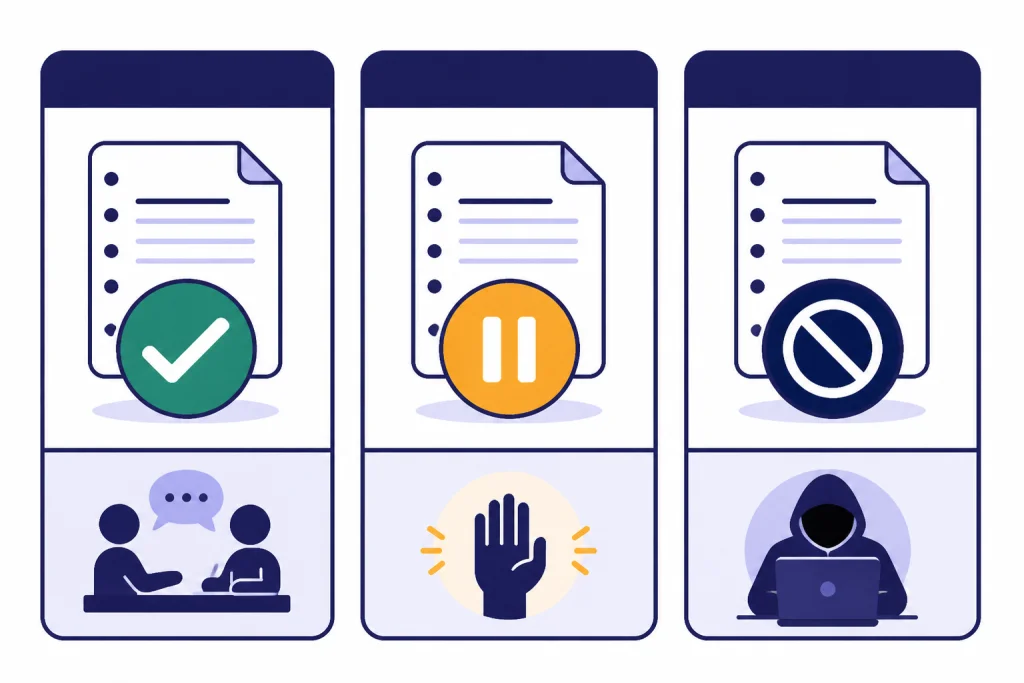
| Student goal | Good ChatGPT use | Risky ChatGPT use |
|---|---|---|
| Understand a reading | Ask for a concept map, key claims, and questions to answer while rereading. | Ask for a replacement summary and skip the assigned text. |
| Write an essay | Ask for outline feedback, thesis pressure testing, and revision suggestions. | Ask ChatGPT to write the essay and submit it as your own. |
| Solve homework | Ask for hints, similar examples, and checks after you attempt the problem. | Ask for the final answer with no reasoning. |
| Prepare for an exam | Ask for a quiz, error log, and spaced review plan. | Ask for leaked answers or shortcuts around learning. |
The student prompt formula that gets better answers
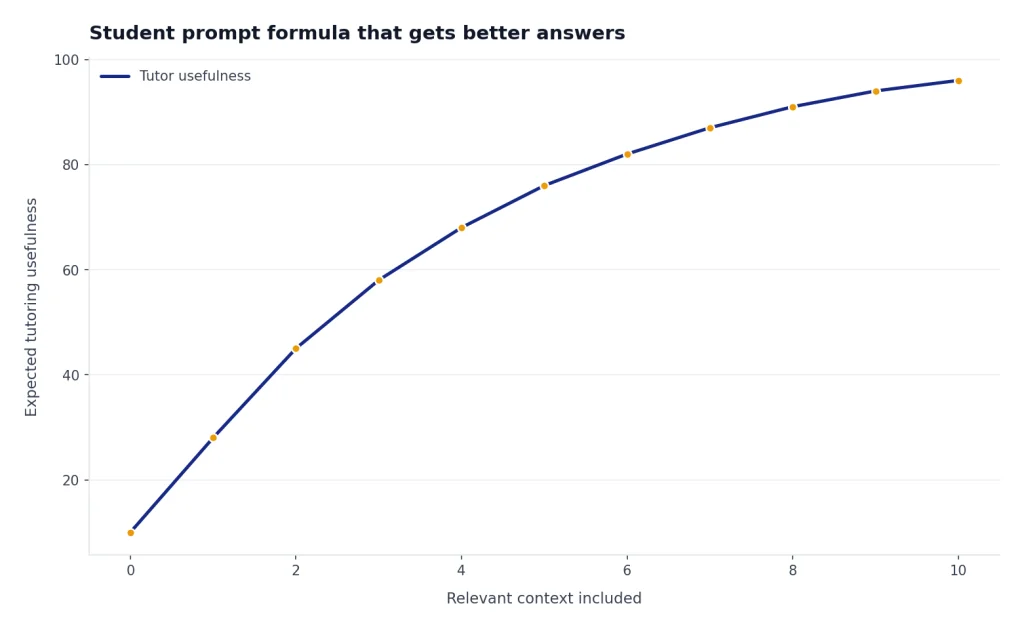
A strong student prompt gives ChatGPT a role, your class context, the task, the rules, and the output format. The formula is simple: role plus context plus goal plus constraints plus format.
Use this base prompt when you do not know where to start:
Act as a patient tutor for [course and level]. I am working on [assignment or topic]. My current understanding is [what I know]. Do not complete the assignment for me. Ask me questions, give hints, explain concepts in plain English, and check my understanding. Format the help as [steps, table, quiz, checklist, or feedback].Add your rubric, notes, or draft when you can. More context usually produces better tutoring. If you are building a repeatable set of study prompts, our chatgpt prompt generator can help you turn one good prompt into a reusable template.
- Role: tutor, editor, lab partner, study coach, debate opponent, or rubric reviewer.
- Context: course level, topic, textbook chapter, lecture notes, assignment prompt, and rubric.
- Goal: understand, practice, revise, memorize, compare, calculate, or plan.
- Constraints: do not write the final answer, cite uncertainty, ask before assuming, use only my notes.
- Format: checklist, quiz, Socratic dialogue, table, flashcards, timeline, or revision plan.
Copy-paste ChatGPT student prompts
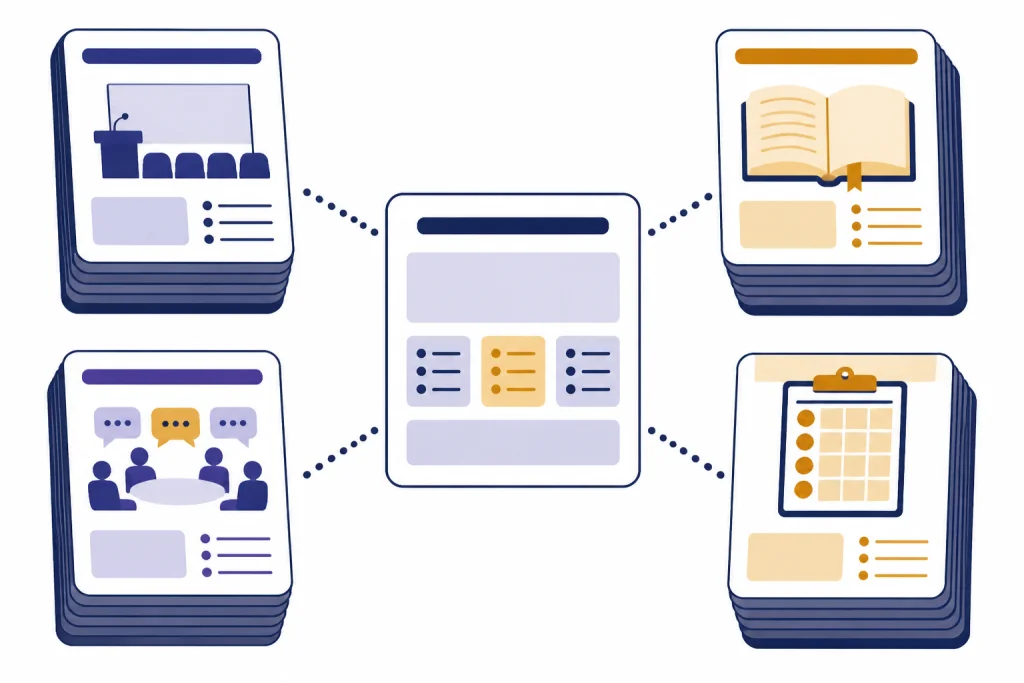
These prompts work best when you replace the bracketed text with your real course details. Paste your class notes or assignment instructions only if your school policy allows it and the material does not contain private information.
Lecture notes prompt
I am a student in [course]. Turn these lecture notes into a study guide. Separate core concepts, definitions, examples, likely exam questions, and confusing points. Do not add facts from outside the notes unless you mark them as extra context. End with questions I should ask my instructor.Reading comprehension prompt
Help me understand this assigned reading: [paste excerpt or notes]. Identify the main claim, supporting evidence, assumptions, key terms, and counterarguments. Then ask me short-answer questions that test whether I understood it.Class discussion prompt
I need to contribute to class discussion on [topic]. Give me five thoughtful discussion points based on my notes. For each point, include a question I can ask classmates and a possible follow-up if someone disagrees.Rubric checker prompt
Act as a strict but fair rubric reviewer. Here is the assignment rubric: [paste rubric]. Here is my draft: [paste draft]. Do not rewrite it. Give me a table with rubric category, current evidence, missing evidence, and the next revision I should make.For broader self-study templates beyond school assignments, use our ChatGPT Learning Prompts for Self-Study collection.
Prompts for studying and exam prep
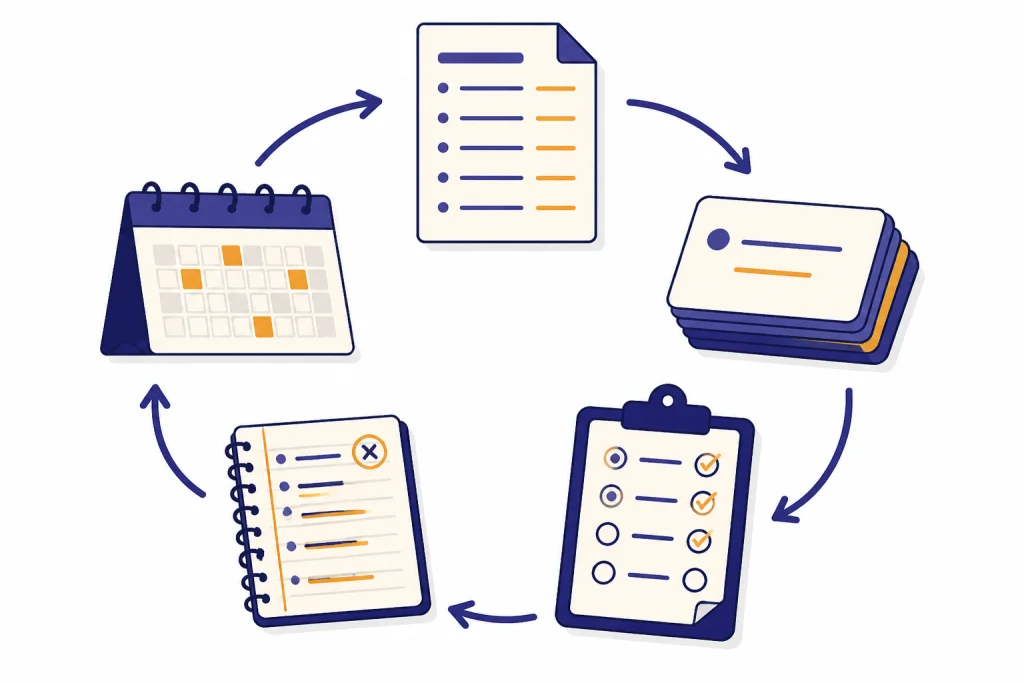
Exam prep prompts should expose what you do not know. Ask ChatGPT to test you before it teaches you. Then ask it to build a review plan from your mistakes.
Socratic tutor prompt
Teach me [topic] using Socratic questions. Start with easy questions and increase difficulty only when I answer correctly. If I am wrong, give a hint instead of the answer. After I answer, explain the reasoning and ask the next question.Practice test prompt
Create a practice test for [course topic] based only on these notes: [paste notes]. Include multiple-choice, short-answer, and explain-your-reasoning questions. Do not show the answer key until I submit my answers.Error log prompt
Here are the questions I missed: [paste missed questions and my answers]. Find the pattern in my mistakes. Sort them into concept gaps, careless errors, vocabulary confusion, and weak reasoning. Give me a focused review plan.Memory check prompt
Quiz me on [topic] using active recall. Ask one question at a time. After I answer, grade my response as strong, partial, or incorrect. Keep a running list of concepts I need to review again.If you want a daily routine around these prompts, pair them with our chatgpt productivity prompts for daily workflow guide.
Prompts for essays, research, and citations
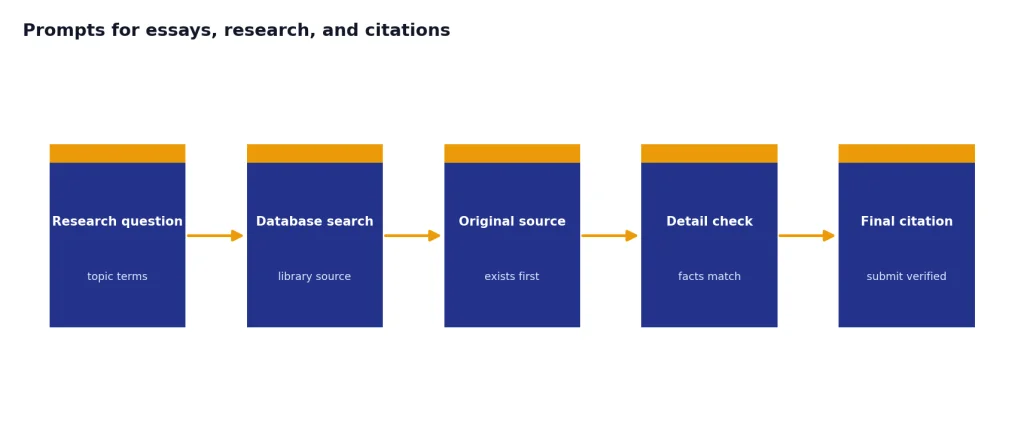
For writing, ChatGPT is most useful before and after drafting. Use it to clarify your thesis, test your structure, find weak transitions, and compare your draft against the rubric. Do not ask it to invent sources. AI-generated citations can be wrong, and you are responsible for every source you submit.
Thesis pressure test prompt
Here is my working thesis: [paste thesis]. Act as a skeptical professor. Tell me whether it is specific, arguable, and supportable. Give me stronger versions, but explain why each version is stronger so I can write my own.Outline improvement prompt
Here is my essay outline: [paste outline]. Check whether each section supports the thesis. Identify gaps, repeated ideas, weak evidence, and places where I need a counterargument. Do not write the essay.Draft feedback prompt
Give feedback on my draft like a writing center tutor. Focus on argument, organization, evidence, clarity, and citation needs. Do not rewrite paragraphs. For each issue, quote a short phrase from my draft and explain the revision I should make.Research question prompt
I need a research question for [topic] in [course]. Ask me about scope, time period, population, and available sources. Then suggest research questions ranked from broad to narrow, with keywords I can use in library databases.For multilingual coursework, translation, or source comprehension across languages, see our ChatGPT translation prompts for quality output. If you write in Canvas or need to revise long assignments in stages, our ChatGPT Tutorial: Build Documents in Canvas is a useful companion.
Prompts for STEM, data, and problem solving
STEM prompts should make ChatGPT slow down. Ask for hints, units, assumptions, and similar examples before final calculations. When you use it for code or data, verify outputs against your course method and your own calculations.
Math hint prompt
I am solving this problem: [paste problem]. Do not solve it yet. Ask me what method I think applies. Then give me one hint at a time. After I attempt a step, check it and explain any mistake.Science concept prompt
Explain [concept] for a [course level] student. Use one everyday analogy, one formal definition, one diagram described in words, and one misconception to avoid. Then quiz me with short-answer questions.Lab report prompt
Help me review my lab report for [experiment]. Here is the rubric and my draft: [paste]. Check whether my hypothesis, method, results, uncertainty, and conclusion match. Flag unsupported claims and missing controls. Do not invent data.Spreadsheet analysis prompt
I have a dataset for [assignment]. Ask me what each column means before analyzing it. Then suggest formulas, charts, and checks for errors. Explain each step so I can reproduce it in my spreadsheet.For spreadsheet-heavy classes, use the templates in ChatGPT Excel Prompts for Power Users. For advanced data analysis workflows, see our chatgpt tutorial.
Academic integrity and citation rules
Academic integrity rules are not the same at every school. Some instructors allow AI for brainstorming but not drafting. Some allow grammar feedback but require disclosure. Some ban it for take-home exams. Vanderbilt’s generative AI guidance tells instructors to decide how students should disclose or cite AI use, which is a reminder that course-level rules matter.[8]
If you use AI-generated wording, ideas, or analysis in submitted work, check the required citation style. MLA says that when AI content is quoted, paraphrased, or otherwise incorporated into your work, you should cite the tool and prefers a stable shareable URL to the conversation when available.[6] Penn State’s APA guide points students to APA’s guidance for citing generative AI and gives examples for ChatGPT-generated text.[7]
Privacy also matters. OpenAI’s Data Controls FAQ says users can choose whether their conversations help improve OpenAI’s models, and that turning off model training applies across the user’s account.[5] Do not paste private records, grades, another student’s work, confidential research data, or unpublished instructor materials unless you have permission.
Disclosure statement template: I used ChatGPT to [brainstorm questions / review my outline / create practice quiz questions / check grammar]. I did not use it to write the final submitted answer. I verified all facts and sources myself.AI detectors can be part of school conversations, but they are not a substitute for clear policy and good documentation. If you are trying to understand how educators evaluate AI use, read our Best AI Detectors for Teachers and Schools overview.
A practical study workflow
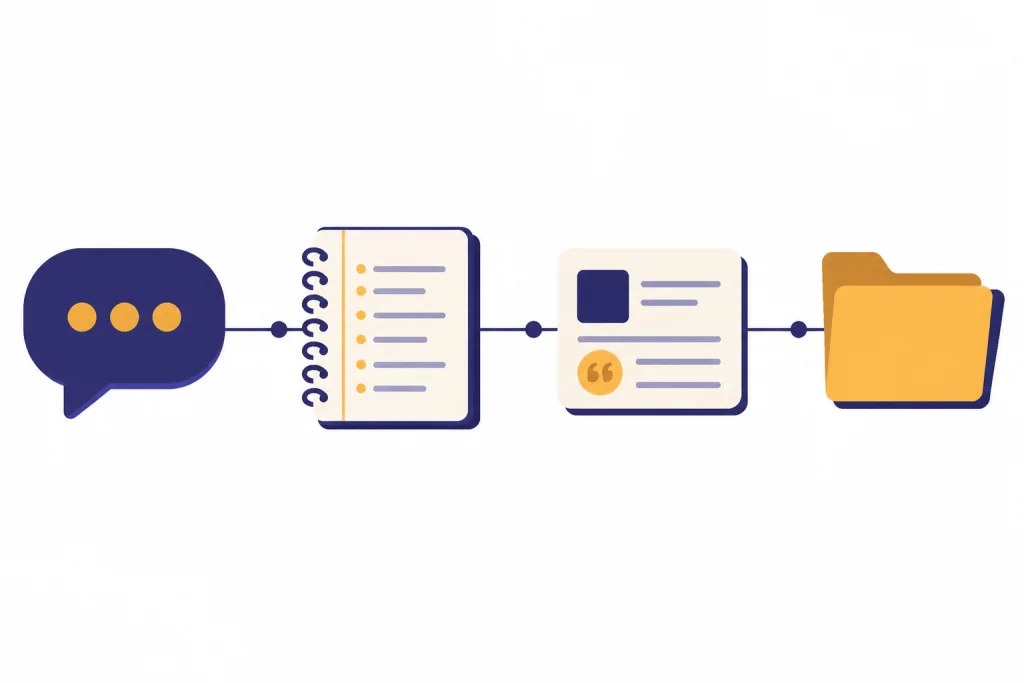
Use these prompts in a repeatable loop. The goal is not to make every assignment depend on ChatGPT. The goal is to build a habit of preparation, practice, feedback, and revision.
| Stage | What you do first | What you ask ChatGPT | What you verify |
|---|---|---|---|
| Before class | Preview the reading and write questions. | Turn headings into a pre-reading checklist. | Whether the questions match the assigned material. |
| After class | Clean up notes in your own words. | Find gaps and create recall questions. | Any added explanation against your textbook or lecture. |
| Before homework | Attempt the problem or outline. | Give hints and check your reasoning. | Final methods, units, citations, and instructor requirements. |
| Before submission | Revise your own draft. | Compare the draft with the rubric. | That all claims, sources, and wording are yours or properly credited. |
Save the prompts that work. Rename them by class and task. Over time, you will build a personal library for quizzes, essays, labs, reading, and review sessions. If you want a lighter creative break after serious studying, try our ChatGPT Creative Prompts for Storytellers, but keep school submissions separate from creative experimentation.
Frequently asked questions
Can ChatGPT help me get better grades?
ChatGPT can support better grades when you use it to study, practice, revise, and identify weak spots. It cannot guarantee a grade. Your results still depend on your understanding, effort, instructor expectations, and course policy.
Is it cheating to use ChatGPT for homework?
It depends on the assignment and your school’s policy. Asking for hints, explanations, or feedback may be allowed in one class and banned in another. If the rules are unclear, ask your instructor before using ChatGPT on graded work.
What is the safest ChatGPT prompt for students?
The safest prompt tells ChatGPT not to complete the assignment for you. Ask it to act as a tutor, ask questions, give hints, and check your reasoning. This keeps the work centered on your learning.
Should I cite ChatGPT in my paper?
Cite or disclose ChatGPT use when your instructor, school, or citation style requires it. You should also disclose it when AI-generated wording, ideas, or analysis materially influenced the submitted work. Keep a record of your prompt, output, date, and how you used it.
Can ChatGPT make up sources?
Yes. Treat AI-generated references as unverified until you confirm them in your library database, journal site, textbook, or another reliable source. Never submit a citation just because ChatGPT formatted it convincingly.
What should I avoid pasting into ChatGPT?
Avoid private student records, personal data, unpublished research, exam materials, confidential school documents, and another student’s work. Also avoid pasting copyrighted course materials if your instructor or platform rules do not permit it. When in doubt, summarize the context instead of uploading the full material.