

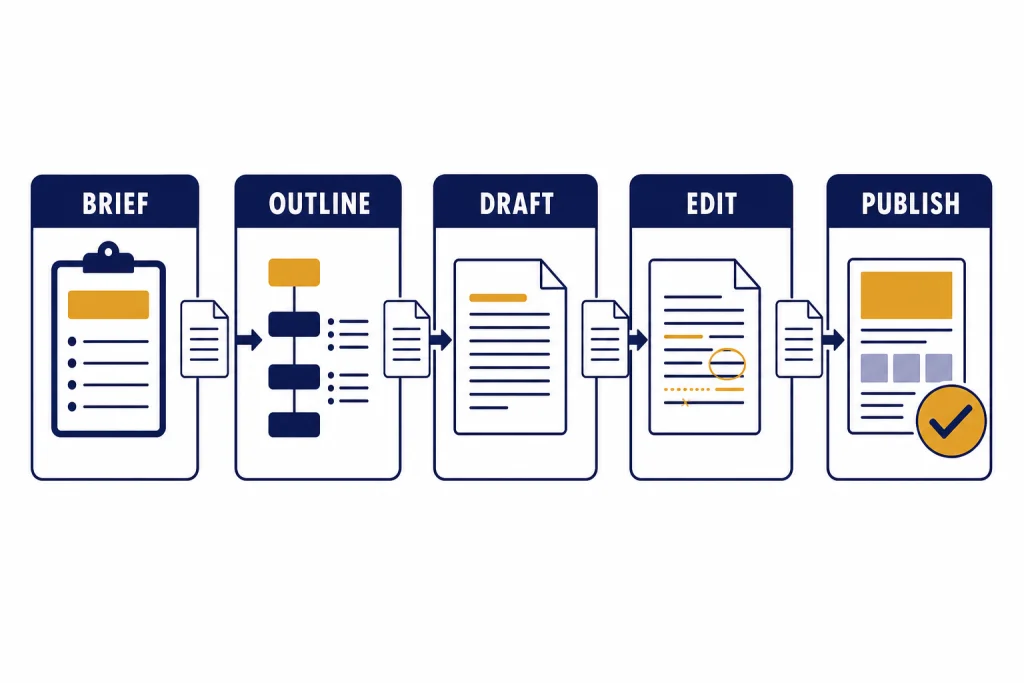
ChatGPT can help bloggers and authors write faster, but it works best as an editorial partner, not as a replacement for judgment. Use it to plan outlines, test angles, expand rough notes, revise weak passages, check structure, and adapt finished work for different formats. Keep your own reporting, lived experience, voice, and final edits in the center of the process. For bloggers, the biggest gains come from repeatable workflows for briefs, drafts, SEO notes, and updates. For authors, ChatGPT is more useful for structure, scene diagnosis, continuity checks, and revision than for producing a finished manuscript on its own.
Where ChatGPT fits in the writing process
ChatGPT is strongest when you give it a role inside a clear writing system. It can be a brainstorming partner, outline critic, developmental editor, line editor, headline tester, synopsis helper, or repurposing assistant. It is weaker when you ask it to create a complete article, essay, chapter, or book from a vague prompt and publish the result with little human review.
OpenAI describes canvas as a separate workspace for writing and coding projects that go beyond simple chat, designed for creating and refining ideas side by side with ChatGPT.[1] That matters for longer work. A chat thread is useful for quick exchanges. A document-style workspace is better when you need to revise sections, keep context visible, and make targeted edits without losing the whole draft.
For bloggers, ChatGPT can reduce blank-page time. Ask it to turn raw notes into an outline, identify missing subtopics, generate title options, or rewrite a section for clarity. If your work overlaps with search visibility, pair this guide with chatgpt for SEO and chatgpt for blog writing to separate writing quality from optimization work.
For authors, ChatGPT is better as a manuscript assistant than a ghostwriter. It can summarize a chapter, find continuity problems, create a character timeline, compare two scene versions, or suggest ways to increase tension. It should not replace your taste, experience, or responsibility for the final work.
Bloggers and authors need different workflows
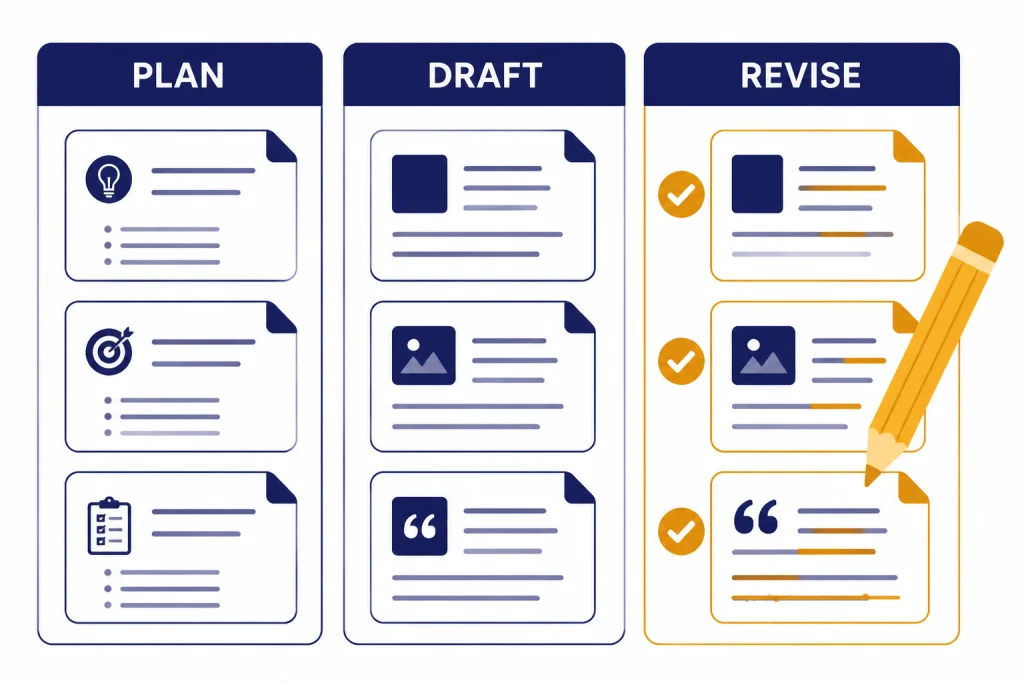
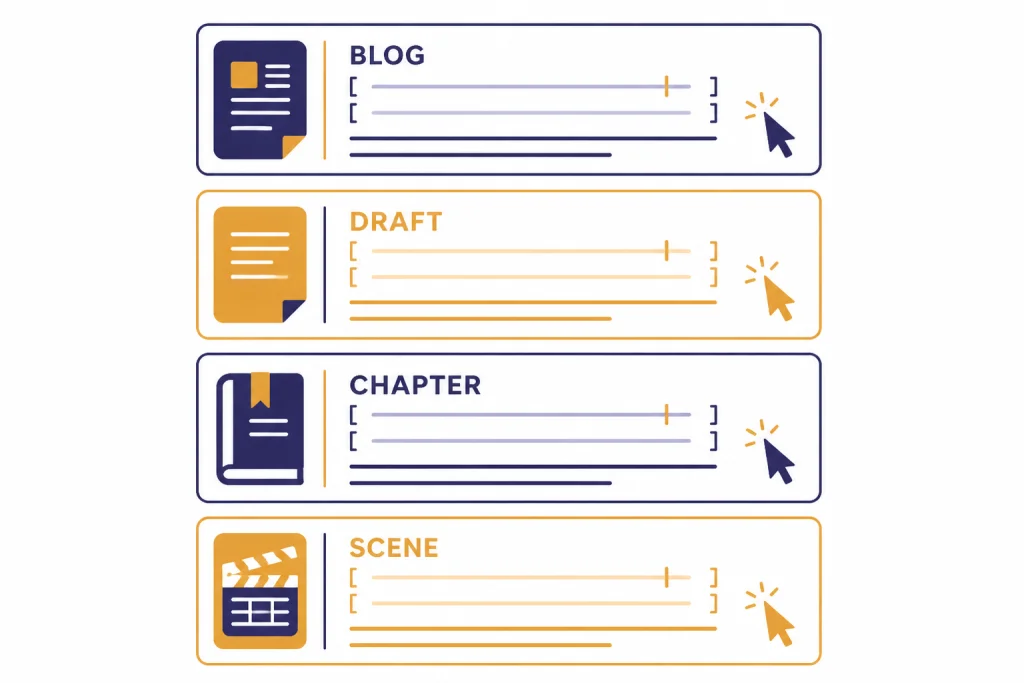
Bloggers and authors both write, but they work under different constraints. Blog posts usually have a defined searcher, a narrow promise, and a short publishing cycle. Books and long-form projects need continuity, pacing, theme, voice, and structure across a much larger span. The same prompt will not serve both jobs equally well.
| Writing situation | Best use of ChatGPT | Human responsibility |
|---|---|---|
| Blog post outline | Turn a keyword, audience, and angle into a complete section plan. | Choose the promise, verify search intent, and add firsthand expertise. |
| Blog draft | Expand approved bullet points into a rough section draft. | Cut generic phrasing, add examples, and confirm factual claims. |
| Newsletter | Create subject-line variants, preview text, and shorter versions. | Protect trust, tone, and the relationship with readers. |
| Nonfiction book | Test chapter order, diagnose repetition, and summarize arguments. | Own the thesis, evidence, case studies, and final prose. |
| Fiction manuscript | Track character details, scene goals, and unresolved threads. | Decide voice, plot, emotional truth, and style. |
| Marketing copy for a book or blog | Generate back-cover copy, blurbs, ad angles, and landing page variants. | Make sure claims are accurate and not inflated. |
A blogger should think in terms of repeatable production. Create a reusable brief for every post. Include the reader, topic, angle, outline, source list, internal links, and examples. If you also publish video or social content, adapt finished posts with ChatGPT for YouTubers or chatgpt for social media content creation.
An author should think in terms of memory and continuity. Keep a separate project for each book. Store character notes, chapter summaries, chronology, research notes, and style rules. Ask ChatGPT to work against those materials, not against a blank prompt.
Build a writing brief before you draft
A strong brief is the difference between useful assistance and generic output. Before asking ChatGPT to write, give it the constraints a human editor would need. That includes the audience, the job of the piece, the reader’s starting knowledge, the desired level of depth, the format, the tone, and the facts that must not change.
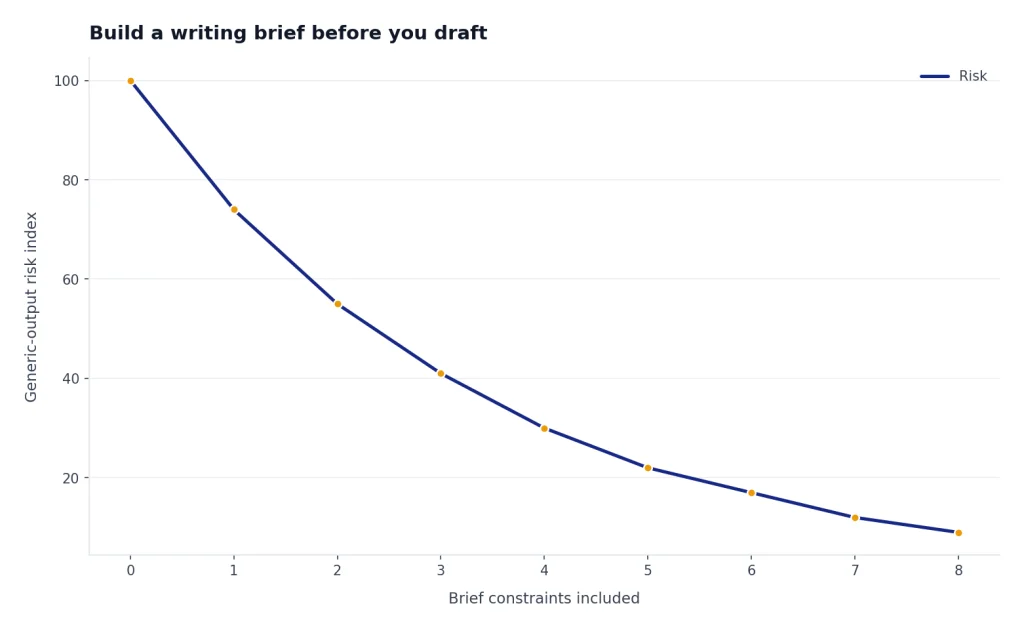
For a blog post, the brief should include the target keyword, search intent, unique angle, required sections, internal links, source notes, and examples from your own experience. For a nonfiction chapter, include the chapter goal, main claim, supporting evidence, reader takeaway, and material that belongs in later chapters. For fiction, include point of view, scene goal, conflict, emotional turn, continuity notes, and words or tropes to avoid.
Projects in ChatGPT are designed to keep related chats, files, and instructions together, which makes them useful for recurring writing work and long-running drafts.[3] Use project instructions to store your baseline rules: preferred spelling, reading level, audience, banned phrases, citation expectations, formatting style, and how direct you want feedback to be.
A good brief also tells ChatGPT what not to do. Do not invent quotes. Do not add statistics without sources. Do not change character names. Do not introduce new claims. Do not imitate a living author’s style. Do not make legal, medical, or financial claims without a source and human review. These negative instructions save time because they reduce cleanup later.
A practical drafting and revision workflow
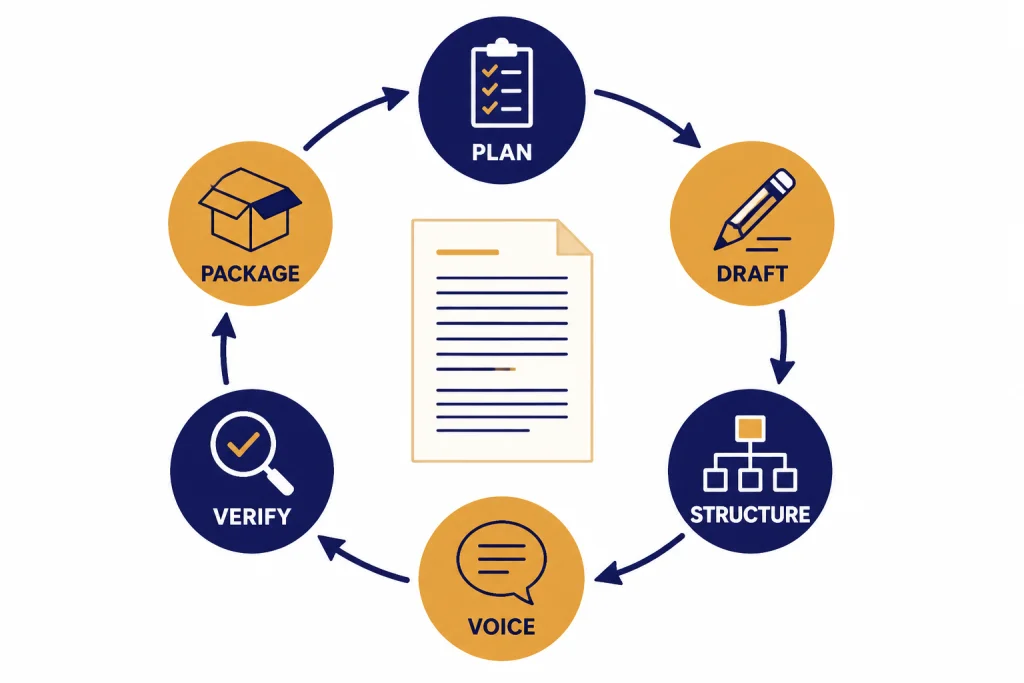
Use ChatGPT in passes. Do not ask for everything at once. A single prompt that requests research, outline, drafting, editing, SEO, and fact-checking will usually produce a shallow answer. A staged workflow gives you more control and makes mistakes easier to catch.
- Plan. Ask for possible angles, reader objections, and a section outline. Choose the best structure yourself.
- Draft small sections. Give ChatGPT one section at a time with bullets, notes, or source excerpts. Review before moving on.
- Revise for structure. Ask what feels repetitive, missing, out of order, or unsupported.
- Edit for voice. Provide a sample of your own writing and ask for changes that preserve cadence and vocabulary.
- Verify. Check names, dates, claims, examples, quotes, links, and any claim that could affect a reader’s decision.
- Package. Create titles, subtitles, summaries, excerpts, social posts, email blurbs, and metadata from the final draft.
Writers often get the best results by asking ChatGPT to critique before asking it to rewrite. For example: “Read this section as a skeptical editor. Identify the three weakest claims, the point where attention drops, and any sentence that sounds generic. Do not rewrite yet.” That prompt forces diagnosis before production.
Once you agree with the diagnosis, ask for a revision with limits: “Revise only the second and fourth paragraphs. Keep the examples. Make the transitions sharper. Do not add new facts.” This prevents the common problem where a helpful rewrite also removes the parts that made the draft yours.
Prompts for bloggers and authors
The best prompts sound like an editor’s assignment. They define the role, the source material, the audience, and the output. They also constrain the level of invention. Use the following prompts as starting points, then adapt them to your genre and process.
Blog outline prompt
“Act as a senior editor for a practical blog. I am writing about [topic] for [reader]. The reader wants [outcome] and is worried about [objection]. Create an outline with clear H2 sections, a short note on what each section must prove, and places where firsthand examples would strengthen the piece. Do not draft the article yet.”
Draft improvement prompt
“Review this draft section for clarity, specificity, and reader value. Mark sentences that sound generic. Suggest stronger examples. Then provide a revised version that keeps my meaning, removes filler, and avoids adding unsupported claims.”
Nonfiction chapter prompt
“Here is my chapter summary and rough draft. Identify the central promise of the chapter, the strongest supporting idea, the weakest supporting idea, and any section that belongs in another chapter. Then propose a revised chapter order with a short reason for each move.”
Fiction scene prompt
“Read this scene for goal, conflict, stakes, and emotional turn. Do not rewrite in another author’s style. Tell me where the scene loses tension, where the point of view slips, and what the reader learns by the end that they did not know at the start.”
If you build a repeatable prompt library, keep it organized by task rather than by mood. Separate prompts for outlines, draft critique, line edits, title testing, character continuity, synopsis writing, and repurposing. A tool like a ChatGPT prompt generator can help you standardize the pieces without rewriting instructions every time.
Research, fact-checking, and sources
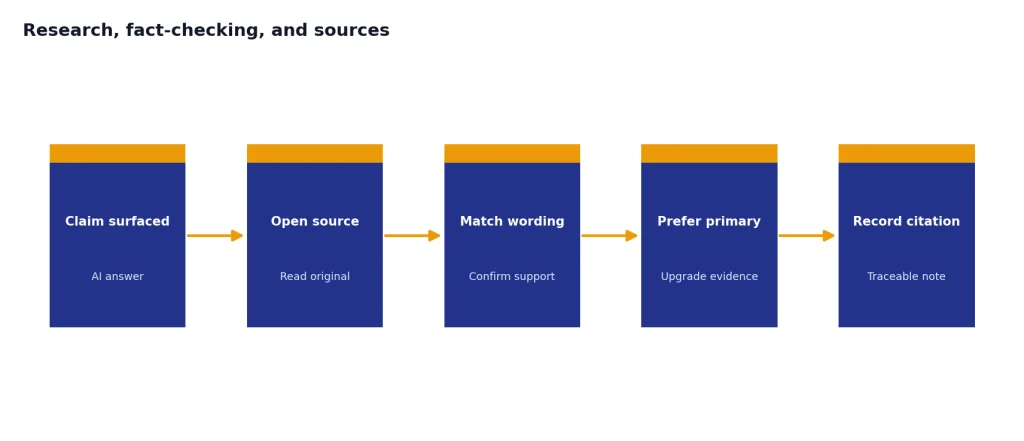
ChatGPT can assist with research, but it should not be your only source of truth. Use it to generate research questions, compare themes across sources, summarize uploaded notes, and identify gaps. Then verify the claims yourself against primary sources, interviews, documents, books, or trusted publications.
ChatGPT search can provide timely answers with links to relevant web sources, and OpenAI says it can search automatically when a question benefits from web information.[5] This is useful for bloggers who update posts, track current products, or write about changing rules. Still, citations are not decoration. Open the links, confirm the claim, and make sure the source actually says what the summary says.
Deep research is better for more complex questions. OpenAI describes it as a tool that can work with uploaded files, the public web, specific sites, and connected apps, then produce a documented report with citations or source links.[6] Use it when you need a literature scan, competitor review, market overview, or background memo before writing. Do not use it as a substitute for original reporting when your article or book depends on firsthand evidence.
A simple rule helps: use ChatGPT to make your research process more organized, not to lower your evidence standard. For academic or source-heavy work, see chatgpt for research. For audience and survey work, ChatGPT for Market Research and Surveys covers a more structured research workflow.
Voice, originality, and ethics
The central risk of ChatGPT for writing is sameness. If you accept complete drafts without intervention, the work may become smooth but forgettable. Readers do not return because every sentence is grammatically correct. They return because the writer has judgment, taste, perspective, and useful experience.
Protect your voice by giving ChatGPT your own draft first. Ask it to preserve your sentence rhythm, keep unusual details, and flag only the parts that need attention. Do not ask it to write “like” a living author. Ask instead for specific qualities: tighter paragraphs, more concrete nouns, less throat-clearing, sharper transitions, or a warmer explanation.
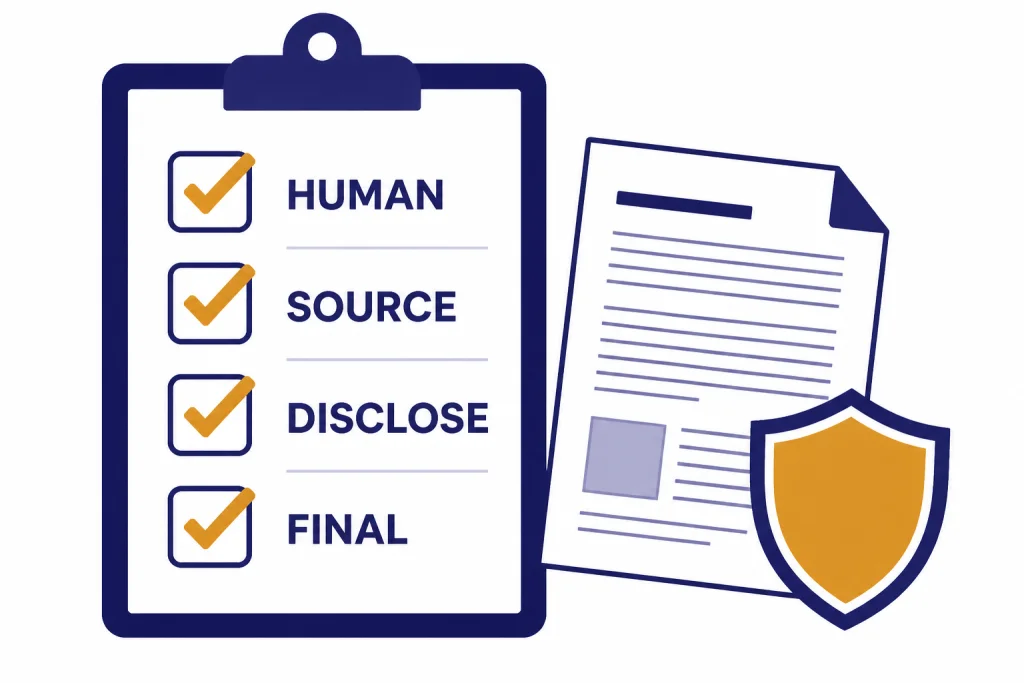
U.S. Copyright Office guidance says works containing AI-generated material may be registrable only when they include sufficient human authorship, and applicants must disclose AI-generated content in registration applications when required.[7] That is not a reason to avoid AI assistance altogether. It is a reason to keep meaningful human creative control over selection, arrangement, expression, revision, and final form.
Ethics also depend on reader expectations. A recipe blog, a personal essay, a reported article, a novel, and a corporate white paper do not carry the same disclosure norms. When AI materially shaped the final work, consider whether your readers, publisher, client, or platform expects disclosure. If you write for clients, put AI use in the contract or editorial policy before the project starts.
Privacy and project setup
Writers often paste sensitive material into writing tools: unpublished chapters, client briefs, interview transcripts, business plans, legal drafts, personal stories, and source notes. Treat ChatGPT like any other cloud-based tool. Decide what can be uploaded, what must be anonymized, and what should stay offline.
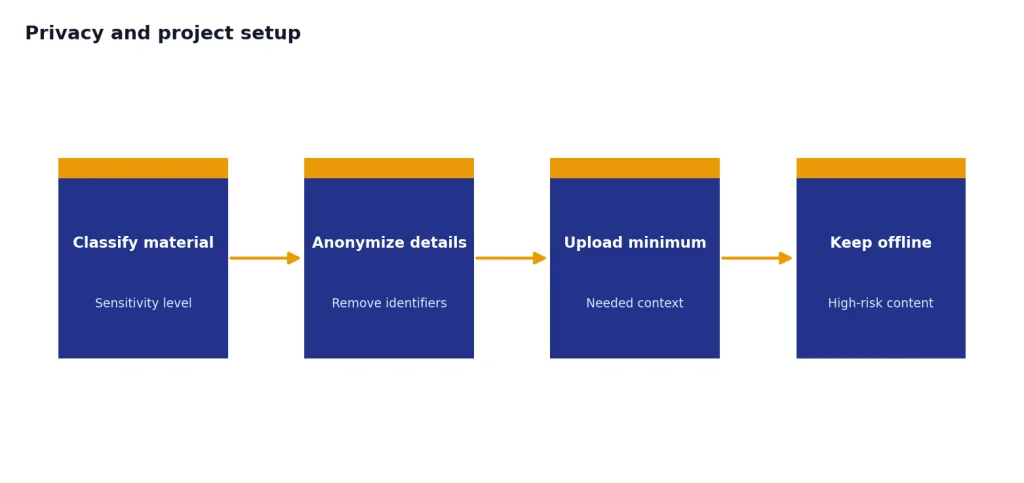
OpenAI says ChatGPT can use memory to recall helpful details and preferences across conversations, and users can reset, delete, or turn memory off in settings.[4] For writers, memory can be useful for style preferences, recurring audience notes, and formatting rules. It is less appropriate for storing confidential details, full manuscript text, private client facts, or source identities.
Business and enterprise users have different data controls from personal accounts. OpenAI states that it does not train its models on ChatGPT Business, Enterprise, Edu, healthcare, teacher, or API customer data by default.[10] If you write under a publisher, agency, employer, or client contract, confirm which account type you are using and follow the stricter policy.
Set up one project per major writing effort. For a blog, create projects by site or content cluster. For a book, create one project for the manuscript, another for research notes if the source material is heavy, and a separate space for marketing copy. If you work with clients, keep each client in a separate project and do not mix files.
ChatGPT is one part of a broader publishing workflow. You may still need a notes app, document editor, citation manager, spreadsheet, project board, or version-control habit. For document-heavy work, the ChatGPT Tutorial: Build Documents in Canvas is a useful next step. If you want ChatGPT to remember your preferences more reliably, read ChatGPT Tutorial: Memory Power-User Tips.
Frequently asked questions
Can ChatGPT write a full blog post for me?
It can produce a full draft, but you should treat that draft as raw material. Add firsthand examples, verify factual claims, cut generic phrasing, and make sure the article matches your reader’s real problem. The best results come from drafting in sections rather than asking for a complete post in one prompt.
Can authors use ChatGPT without losing their voice?
Yes, if they use it for critique, structure, continuity, and targeted edits. Give ChatGPT your own writing first and ask it to preserve your rhythm and choices. Avoid prompts that ask for a whole chapter in a generic style.
Should I disclose that I used ChatGPT for writing?
It depends on the context. Client work, journalism, academic work, and publisher submissions may have explicit disclosure rules. Even when disclosure is not required, be honest if AI materially shaped the finished work or if your readers reasonably expect human-only authorship.
Is ChatGPT good for editing a manuscript?
It is useful for early and middle-stage editing. Ask it to find repetition, unclear motivation, weak transitions, continuity issues, and places where a chapter loses focus. A human editor is still better for deep literary judgment, market positioning, and final publication decisions.
Can ChatGPT replace a research assistant?
It can help organize research, summarize notes, generate questions, and compare sources. It cannot replace verification. Open the sources, confirm claims, and use primary documents whenever accuracy matters.
What is the best first prompt for a writer?
Start with a brief, not a command to write. Tell ChatGPT the audience, goal, format, constraints, source material, and what kind of help you want. A strong first prompt asks for a plan or critique before it asks for prose.