
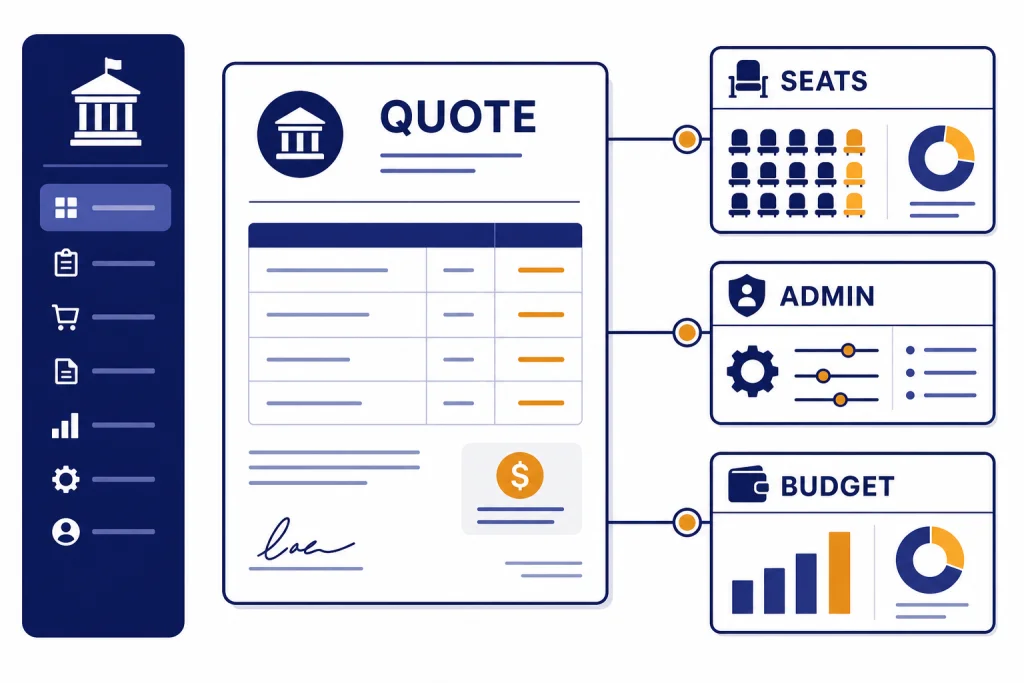
ChatGPT Edu pricing is not published as a fixed public rate by OpenAI. Universities must contact OpenAI for a contract quote, and the final cost can depend on campus size, scope, support needs, procurement terms, and how the institution allocates licenses. OpenAI describes ChatGPT Edu as an affordable university plan for students, faculty, researchers, and campus operations, but it does not list a universal per-seat price on the public Edu page.[1] Public campus examples show why buyers should treat any single number as a local chargeback, not OpenAI’s official list price: Carnegie Mellon lists $240 for a 12-month ChatGPT Edu subscription, while the University of Iowa lists $156 per user annually.[5][7]
Quick answer
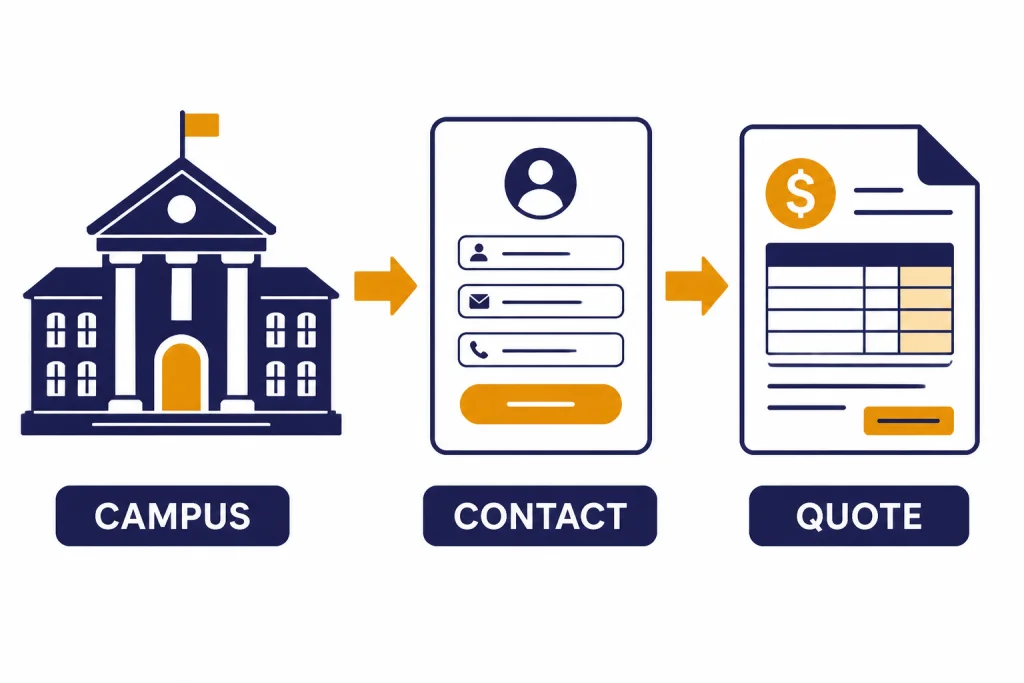
OpenAI has not published an official public price for ChatGPT Edu. Treat ChatGPT Edu as a quote-based institutional plan, not a student self-serve subscription. A university should ask OpenAI for a written quote and then decide whether to fund access centrally, charge departments, restrict licenses to employees, or include students.
The most practical estimate is a local one. Some universities publish internal recharge prices. Carnegie Mellon lists $240 for a 12-month subscription, and Boise State says ChatGPT Edu licenses cost $240 per year.[5][6] The University of Iowa lists a lower cost of $156 per user annually for faculty and staff.[7] Those numbers help with benchmarking, but they do not prove a universal OpenAI rate.
If you are an individual student, ChatGPT Edu is usually not something you can buy directly. Start with your campus IT service catalog. If your school does not offer it, compare individual options in ChatGPT Plus for Students, ChatGPT Student Discount, and ChatGPT Subscription Plans.
What OpenAI publishes about ChatGPT Edu pricing
OpenAI’s public education page positions ChatGPT Edu as a campus-scale plan and directs universities to contact sales rather than self-check out.[1] OpenAI’s Help Center also says ChatGPT Edu is made for schools that want to deploy AI broadly to students and campus communities, and tells institutions to reach out to the OpenAI team to learn more.[2]
That means the official answer to chatgpt edu pricing is simple: OpenAI has not published an official figure for this. Any quote you receive should be read from the order form, not inferred from another university’s public recharge page.
OpenAI announced ChatGPT Edu on May 30, 2024 as a version of ChatGPT built for universities, including students, faculty, researchers, and campus operations.[3] The launch announcement described it as affordable for educational institutions, but did not publish a universal seat price.[3]
That lack of a posted list price matters. It gives procurement teams room to negotiate, but it also makes early budget planning harder. A finance office should assume there may be contract terms beyond a simple license fee, including renewal dates, minimum commitments, support level, data terms, and payment method.
Public university price examples
Public campus pages provide useful reference points, but they are not the same thing as OpenAI’s published price. They may include local cost recovery, central subsidies, procurement fees, or department chargeback rules. Use them as benchmarks, not as a promise.
| Institution | Published campus price | Who the page appears to target | How to interpret it |
|---|---|---|---|
| Carnegie Mellon University | $240 for a 12-month subscription[5] | Faculty, staff, and students with sponsorship[5] | A local annual license charge |
| Boise State University | $240 per year[6] | Department or college purchasers[6] | A department-funded campus license price |
| University of Iowa CLAS | $156 per user annually[7] | Faculty and staff[7] | A local faculty and staff access charge |
The spread between $156 and $240 is the key lesson.[7][5] Universities should not copy another school’s price into a board memo as if it were the official rate. Instead, use the examples to test whether a quote is in the expected range for your scope.
For individual comparison, ChatGPT Plus and other self-serve plans are a different category. If your decision is personal rather than institutional, read how much ChatGPT Plus costs or whether ChatGPT Plus is worth it instead of using campus Edu numbers.

What universities get with ChatGPT Edu
ChatGPT Edu is not just a bulk version of an individual account. OpenAI describes it as a campus deployment product with expanded access to GPT-5, higher message limits than the free version, tools for analysis and research, and custom GPTs that can be shared inside university workspaces.[1]
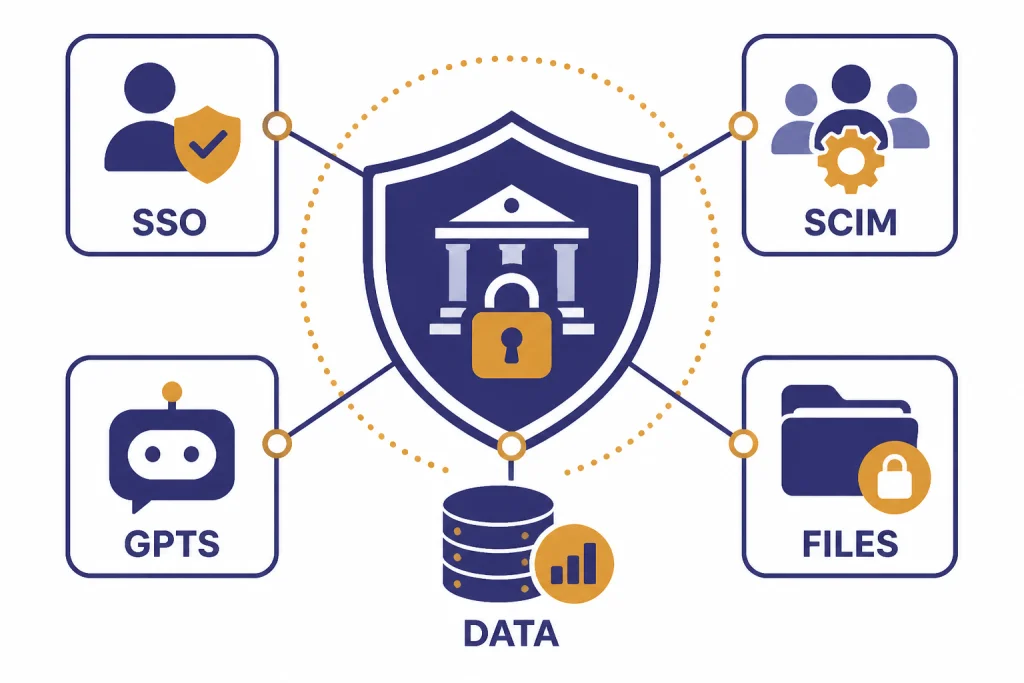
The Help Center lists access to OpenAI’s latest flagship model, advanced tools such as data analysis, web browsing, and file uploads, custom GPT creation and sharing, substantially higher message limits than ChatGPT Free, improved language capabilities with more than 50 languages supported, and administrative controls such as group permissions, SSO, SCIM, and GPT management.[2]
Security and data controls are the strongest reason to consider Edu instead of unmanaged individual subscriptions. OpenAI says organization data from ChatGPT Edu is not used by default to train or improve OpenAI models, including inputs and outputs.[4] OpenAI also says business data is encrypted at rest with AES-256 and in transit with TLS 1.2 or higher.[4]
For a university, those controls can be more important than the model access itself. A campus may need SAML SSO, domain verification, SCIM provisioning, group permissions, usage analytics, and central administration before it can approve any AI tool for restricted workflows. That is why the relevant comparison is often ChatGPT Enterprise pricing or ChatGPT business pricing, not just Free versus Plus.
How to build a campus budget
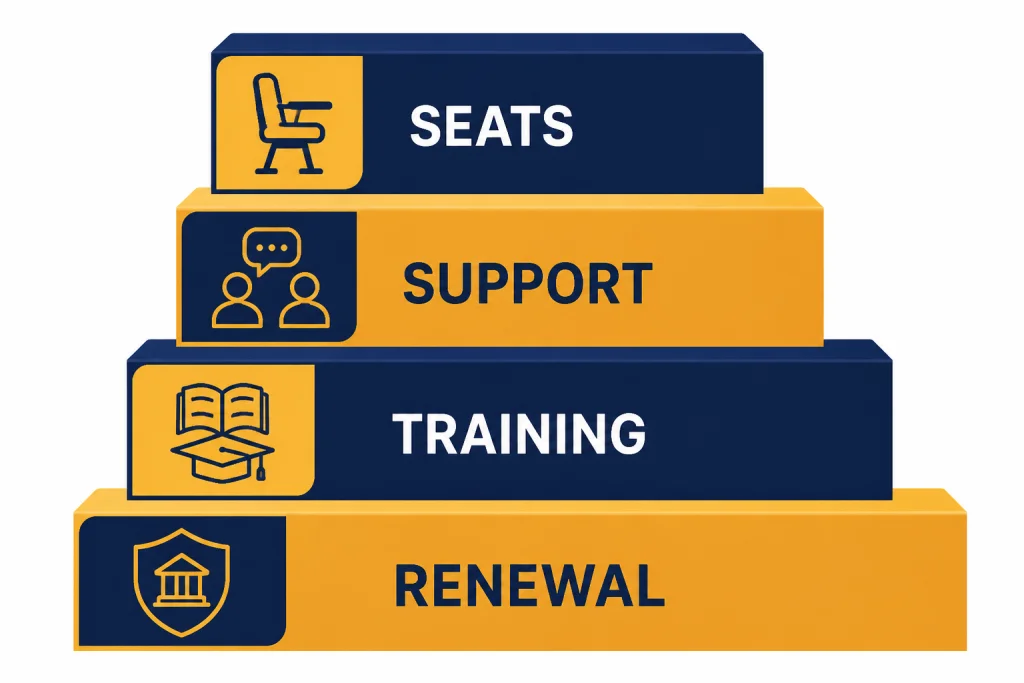
A useful ChatGPT Edu budget has more than one line item. Start with seats, then add deployment costs, support costs, training time, and a renewal reserve. The license is only one part of the total cost.
- Define the population. Decide whether the first phase covers faculty, staff, researchers, teaching assistants, selected courses, all enrolled students, or the full campus.
- Choose the funding model. Central funding improves equity. Department recharge limits waste. A hybrid model can give core access to priority groups while allowing optional expansion.
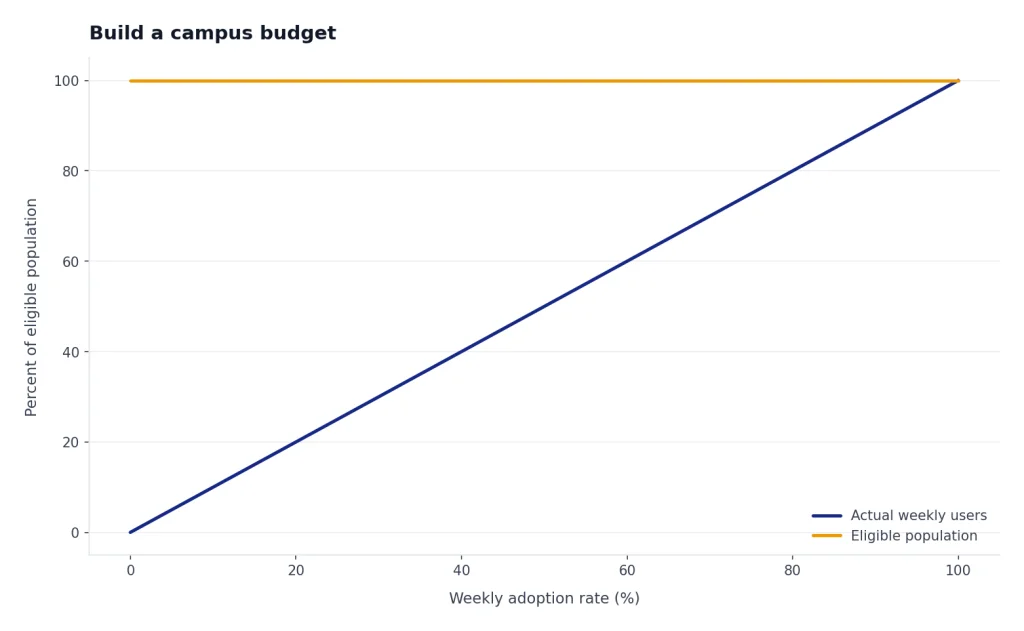
- Estimate adoption. Do not assume every eligible person will use the tool every week. Pilot data is more reliable than headcount.
- Plan support. Add time for help desk documentation, account merge questions, SSO troubleshooting, accessibility review, and academic integrity guidance.
- Review renewal risk. If the first year is subsidized, decide what happens when the contract renews.
A practical pilot starts with the departments that already have high demand: writing programs, data science, engineering, medicine, library services, and administrative analytics. Those groups can produce real usage data before a campus-wide commitment.
Students who only need individual access should not wait for a university contract if a personal plan solves the problem. Compare ChatGPT Free vs Plus, ChatGPT Plus benefits, and ChatGPT Plus vs Pro before paying out of pocket.
ChatGPT Edu versus Plus, Business, and Enterprise
The right comparison depends on who owns the relationship. ChatGPT Plus is for an individual. ChatGPT Business is for a team workspace. ChatGPT Enterprise is for large organizations with negotiated terms. ChatGPT Edu is for universities that want campus deployment with education-focused administration.
| Plan | Best fit | Pricing style | Main reason to choose it |
|---|---|---|---|
| ChatGPT Plus | One student, instructor, or staff member | Self-serve individual subscription | Personal productivity without campus administration |
| ChatGPT Business | Departments, labs, and small offices | Published or self-serve business pricing, depending on plan availability | Team workspace and business controls |
| ChatGPT Enterprise | Large organizations | Custom quote | Enterprise security, support, and contract terms |
| ChatGPT Edu | Universities and campus communities | Custom quote | Campus-scale deployment for students, faculty, researchers, and operations |
If your use case is a single research group, Business or Enterprise may be easier to evaluate. If the goal is equitable access across a university, Edu is the more natural starting point. If the goal is application development rather than ChatGPT seats, compare the separate OpenAI API pricing model.
Do not treat Edu as a student discount code. OpenAI’s Edu product is an institutional plan. Students looking for personal savings should check ChatGPT promo code, ChatGPT Plus discount code, or ChatGPT free trial, but they should expect official student-specific discounts to vary by time and eligibility.
Procurement checklist for universities
Before signing a ChatGPT Edu order, ask for answers in writing. The contract should be clear enough that IT, procurement, the general counsel, accessibility staff, teaching and learning leaders, and the finance office can all read it the same way.
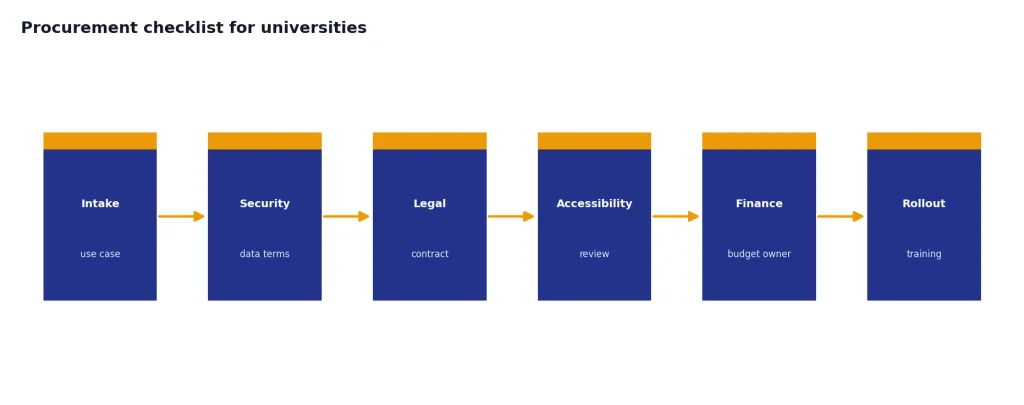
- Price basis: Is the quote per seat, per eligible user, per active user, or a campus-wide allocation?
- Minimum commitment: Is there a required minimum number of seats or a minimum annual spend?
- Included access: Which models, tools, file features, analysis tools, and custom GPT features are included?
- Usage limits: Which limits apply to messages, files, advanced tools, image generation, research tools, or future capabilities?
- Student eligibility: Are all enrolled students eligible, or only students in approved courses or sponsored roles?
- Data terms: Confirm training, retention, encryption, data residency, audit, and deletion terms.
- Administration: Confirm SSO, SCIM, domain verification, group permissions, analytics, and offboarding.
- Support: Identify the support channel, escalation path, response targets, and training resources.
- Renewal: Document price protection, renewal notice windows, cancellation terms, and budget owner.
Also ask how existing personal accounts will move into the university workspace. Account migration can become a support burden if faculty or students already use ChatGPT with a campus email address. The policy should say what happens to personal history, custom GPTs, and data that should not be moved.
Who should choose ChatGPT Edu
Choose ChatGPT Edu if the university wants managed, privacy-conscious access for a defined campus population. It is strongest when the institution needs administrative control, procurement oversight, SSO, data protections, and a common AI environment for teaching, research, and operations.
Do not choose ChatGPT Edu just because a few individuals want better model access. In that case, department-funded individual plans or a smaller workspace may be simpler. Edu makes sense when the institution has a governance problem to solve, not just a subscription problem.
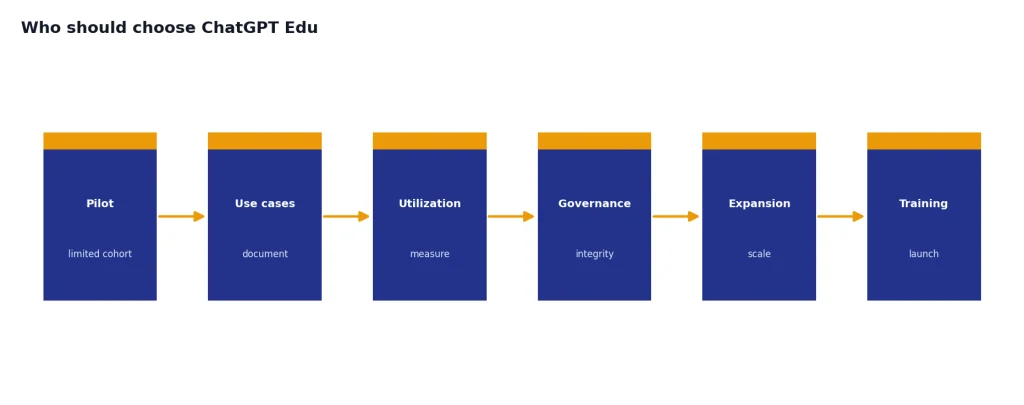
The best approach is usually phased. Start with a pilot, document use cases, measure utilization, collect academic integrity concerns, and then expand. A campus-wide launch should include training for students and instructors, not just licenses.
Frequently asked questions
How much does ChatGPT Edu cost?
OpenAI has not published an official figure for this. Universities must contact OpenAI for a quote.[1] Public campus examples include $240 per year at Boise State and $156 per user annually at the University of Iowa, but those are local published prices, not a universal list price.[6][7]
Can students buy ChatGPT Edu directly?
Usually no. ChatGPT Edu is an institutional plan for schools and universities. A student should check the campus IT portal, library technology page, or teaching and learning office to see whether the university has purchased access.
Is ChatGPT Edu cheaper than ChatGPT Plus?
Not necessarily on a simple per-user basis. Edu pricing is quote-based and may include institutional controls, support, privacy terms, and campus administration. Plus is an individual subscription, so it is easier to buy but does not solve the same governance problem.
What features are included in ChatGPT Edu?
OpenAI lists advanced tools such as data analysis, web browsing, and file uploads, custom GPT creation and workspace sharing, higher limits than ChatGPT Free, more than 50 supported languages, and administrative controls such as SSO, SCIM, group permissions, and GPT management.[2] Availability and limits should still be confirmed in the university’s order form.
Does OpenAI train on ChatGPT Edu data?
OpenAI says it does not use data from ChatGPT Edu by default to train or improve its models, including inputs and outputs.[4] Universities should still review the contract, retention settings, connected apps, and any optional sharing or feedback features before rollout.
What is the best first step for a university?
Ask OpenAI for a quote and run a controlled pilot with a clear user population. Include IT security, procurement, academic affairs, accessibility, and faculty representatives before a broad launch. The pilot should measure usage and support load, not just satisfaction.