

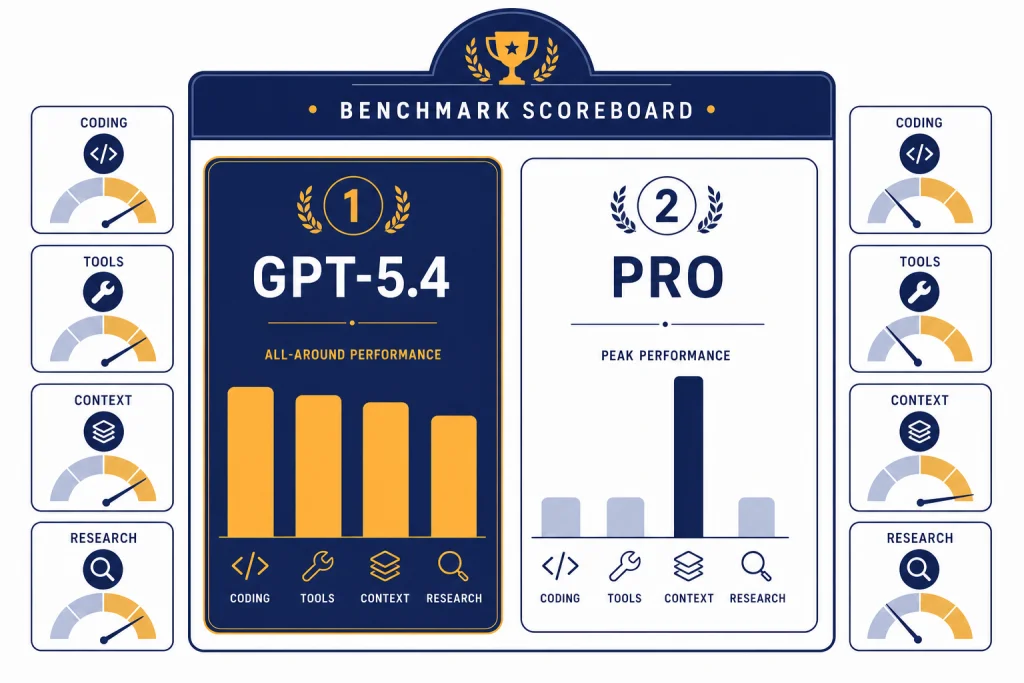
The most powerful GPT model as of May 2026 is best described in two layers. If you are choosing from the current OpenAI lineup, GPT-5.5 Pro is the top choice for maximum-quality chat, hard reasoning, and research-style work, while GPT-5.5 is the current frontier default for most high-end tasks. If you need a fully cited, apples-to-apples public benchmark table, the most complete evidence in the sources for this article is still the GPT-5.4 and GPT-5.4 Pro release data: GPT-5.4 Pro leads several difficult reasoning and tool-assisted categories, while GPT-5.4 has the broadest published all-around record across professional work, coding, computer use, tool use, academic reasoning, and long-context tests.[1]
That distinction is important. This is a benchmark showdown of the published comparable evidence, not a claim that every older benchmark score predicts production performance or that GPT-5.4 beats the newer GPT-5.5 family. Vendor benchmarks can be useful, but they are optimized measurements in specific harnesses. Treat them as a starting map, then validate GPT-5.5, GPT-5.5 Pro, GPT-5.4, and any cheaper fallback model on your own prompts, tools, files, latency targets, and review standards.
The short answer
If you want the most powerful GPT model in the plain-English, current-product sense, start with GPT-5.5 Pro. It is the current top-tier GPT choice for maximum answer quality when cost and latency matter less than getting the strongest possible first draft, analysis, plan, or research synthesis. For most premium work where you still care about responsiveness and throughput, start with GPT-5.5.
If you want the strongest fully published benchmark sheet available in this article’s cited sources, the answer is more nuanced. OpenAI described GPT-5.4 Pro as the option for maximum performance on complex tasks, and reported the best GPT-family scores in several difficult academic and tool-assisted reasoning categories, including GPQA Diamond, FrontierMath Tier 4, BrowseComp, and Humanity’s Last Exam with tools.[1] GPT-5.4, meanwhile, has reported scores for more categories than GPT-5.4 Pro and leads earlier GPT models on GDPval, SWE-Bench Pro, OSWorld-Verified, Toolathlon, BrowseComp, and several vision and professional-work evaluations.[1]
The practical answer is therefore: use GPT-5.5 Pro for peak current capability, GPT-5.5 as the current high-end default, and the GPT-5.4 benchmark table below as a well-documented baseline for what the previous frontier generation proved in public. GPT-5.3-Codex remains historically important because it set strong coding and terminal-agent results when it launched, but GPT-5.4 later incorporated many of those coding advances into a broader model.[4][1] For a wider model map, use our all GPT models compared side by side guide.
Benchmark scoreboard
The clearest way to judge model power is to separate benchmark categories. Professional deliverables, coding patches, terminal-agent work, desktop computer use, browser research, science reasoning, and long-context retrieval do not measure the same skill. The table below keeps the published numbers, but it also adds the missing context that benchmark leaderboards often hide: score type, tool use, and comparability.
| Benchmark | What it tests | Best published GPT result in cited sources | Closest GPT comparison | Score type and harness caveat | Reader takeaway |
|---|---|---|---|---|---|
| GDPval | Professional deliverables across 44 occupations | GPT-5.4 at 83.0% | GPT-5.4 Pro at 82.0%; GPT-5.2 at 70.9% | Reported as a wins-or-ties style professional-work comparison, not a simple pass/fail exam.[1][7] | GPT-5.4 had the strongest cited GPT score for broad professional work, but you should still test on your own deliverables. |
| SWE-Bench Pro | Real-world software engineering tasks | GPT-5.4 at 57.7% | GPT-5.3-Codex at 56.8%; GPT-5.2 at 55.6% | Agentic coding benchmark; results depend on repository setup, tools, patch validation, and inference configuration.[1] | GPT-5.4 narrowly edged the coding-specialized GPT-5.3-Codex in this cited table, but repo-specific testing matters more than the 0.9-point gap. |
| Terminal-Bench 2.0 | Terminal-based coding-agent work | GPT-5.3-Codex at 77.3% | GPT-5.4 at 75.1% | Terminal-agent harness; not directly comparable to chat-only coding prompts.[1] | GPT-5.3-Codex still had a narrow cited lead on this terminal-specific test. |
| OSWorld-Verified | Desktop computer-use tasks | GPT-5.4 at 75.0% | GPT-5.3-Codex at 74.0%; GPT-5.2 at 47.3% | Success rate in a computer-use environment; production desktop agents may face different UI states, permissions, and failures.[1] | GPT-5.4 was the strongest cited GPT model for general computer-use agents. |
| BrowseComp | Hard web research and tool-assisted search | GPT-5.4 Pro at 89.3% | GPT-5.4 at 82.7%; GPT-5.2 Pro at 77.9% | Tool-assisted browsing/research benchmark; outcomes depend heavily on retrieval, browsing, and citation behavior.[1] | GPT-5.4 Pro was the stronger cited pick for demanding research prompts. |
| GPQA Diamond | Graduate-level science reasoning | GPT-5.4 Pro at 94.4% | GPT-5.4 at 92.8%; GPT-5.2 Pro at 93.2% | Academic reasoning accuracy; high scores do not guarantee domain-safe answers in medicine, law, finance, or engineering.[1] | GPT-5.4 Pro led the cited GPT family on this science benchmark. |
| Humanity’s Last Exam with tools | Very hard multimodal and tool-assisted reasoning | GPT-5.4 Pro at 58.7% | GPT-5.4 at 52.1%; GPT-5.2 Pro at 50.0% | Tool-enabled evaluation; compare only against runs with similar tool access and inference settings.[1] | GPT-5.4 Pro was the peak cited GPT option for the hardest evaluated reasoning tasks. |
| OpenAI MRCR v2, 64K–128K | Long-context multi-needle retrieval | GPT-5.4 at 86.0% | GPT-5.2 at 85.6% | Long-context retrieval score at a specified range; it does not prove perfect recall across a full million-token prompt.[1] | GPT-5.4 improved slightly at this range, but long-context accuracy can still fall under extreme or noisy inputs. |
This table is useful, but it is not a clean league table. It mixes wins-or-ties comparisons, success rates, tool-assisted evaluations, agent harnesses, and long-context retrieval tests. Some scores are close enough that variance, prompt setup, tool permissions, or a different evaluation harness could change the practical winner. Also, no source in this article’s citation set provides the same fully comparable table for GPT-5.5 or GPT-5.5 Pro, so do not treat the GPT-5.4 numbers as a current top-model ranking by themselves.
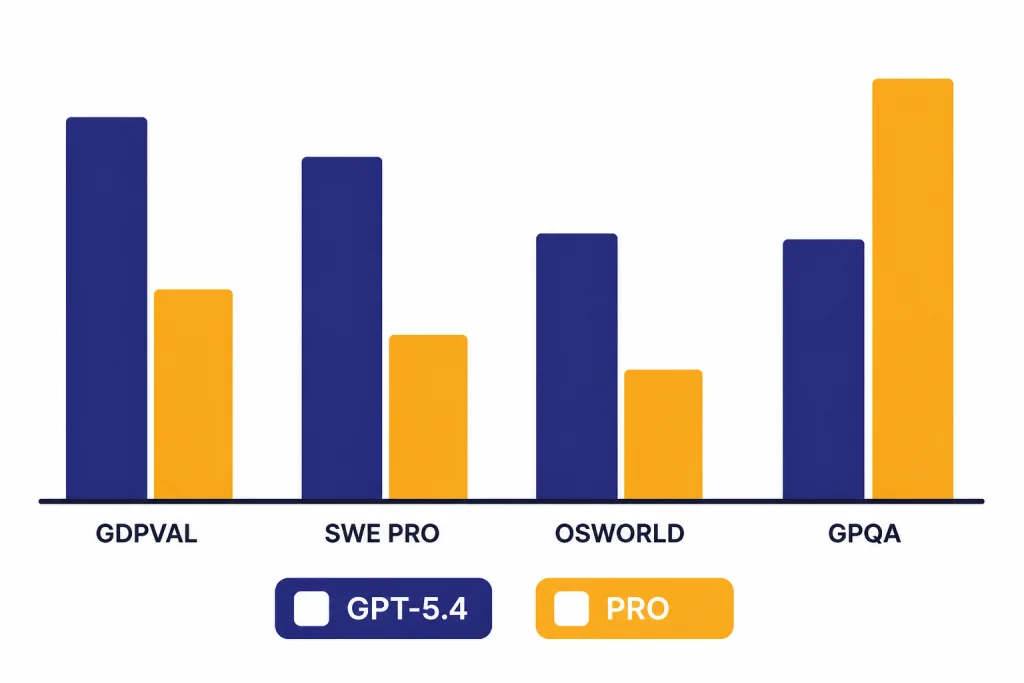
Why GPT-5.4 still matters in the published benchmarks
GPT-5.4 matters because it is the last model in this citation set with a broad, detailed public benchmark sheet across many task families. OpenAI says GPT-5.4 brought together reasoning, coding, and agentic workflows, and incorporated the coding strengths of GPT-5.3-Codex while improving professional work across spreadsheets, presentations, documents, tools, software environments, and computer-use tasks.[1]
The biggest shift was not a single headline score. It was breadth. GPT-5.4 was built for long-running work where the model must plan, use tools, inspect files, write or edit code, operate software, and maintain context across many steps. OpenAI reported that GPT-5.4 supports up to 1M tokens of context in Codex and the API, giving agents more room to plan, execute, and verify work over long horizons.[1] For a deeper size-by-size breakdown, see our guide to context window sizes for every GPT model.
Computer use is another reason GPT-5.4 remains a meaningful baseline. OpenAI called it the first general-purpose OpenAI model with native computer-use capabilities, and reported a 75.0% success rate on OSWorld-Verified compared with 47.3% for GPT-5.2.[1] That matters for agents that need to operate web apps, desktop interfaces, forms, spreadsheets, dashboards, and other software surfaces. It does not mean every production UI agent will achieve the same success rate; real apps contain pop-ups, permission prompts, stale sessions, missing files, and ambiguous visual states.
The model also improved on tool use. GPT-5.4 scored 54.6% on Toolathlon, compared with 51.9% for GPT-5.3-Codex and 45.7% for GPT-5.2 in OpenAI’s detailed table.[1] For workflows that depend on function calls, file search, code execution, browser use, and external APIs, this can matter more than a pure chat benchmark. In production, however, tool reliability also depends on schema design, retry behavior, rate limits, sandbox permissions, and how you verify the model’s actions.
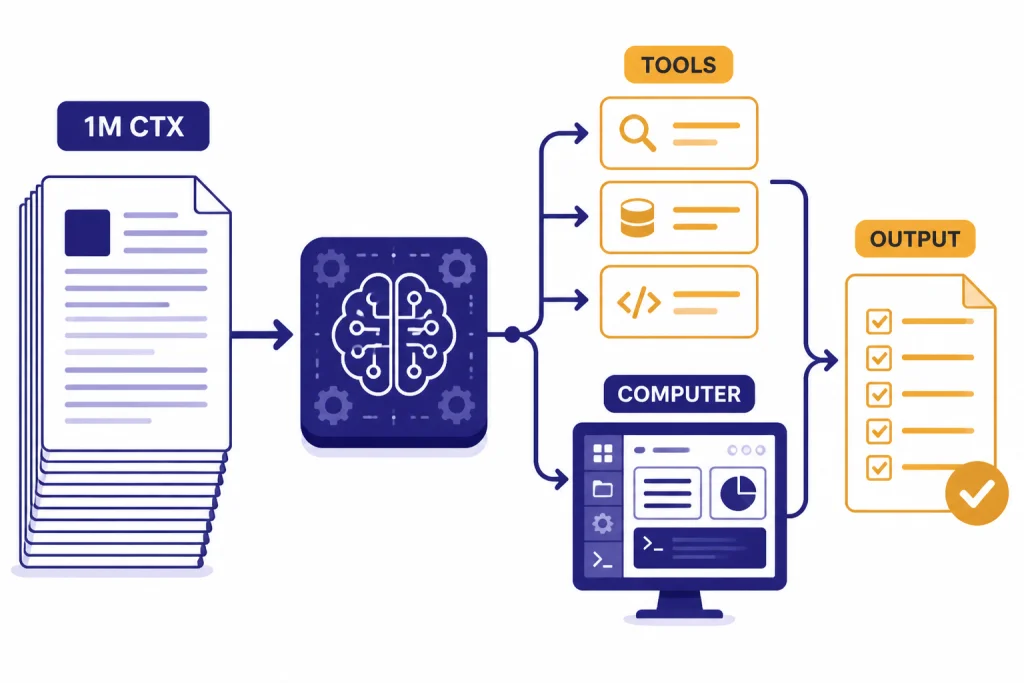
Where GPT-5.5 Pro and GPT-5.4 Pro fit
Use the Pro tier when the job is hard enough to justify slower, more expensive, or more constrained inference. In May 2026, that usually means trying GPT-5.5 Pro first for the hardest current-model work: deep research synthesis, complex planning, difficult debugging, high-stakes analytical drafts, and prompts where a better first answer can save significant human review time. If your deployment is pinned to GPT-5.4-era models or you need the cited public benchmark trail, GPT-5.4 Pro is the comparable Pro reference point.
OpenAI’s API documentation listed GPT-5.4 Pro with a 1,050,000-token context window, a 128,000-token max output, and reasoning effort support at medium, high, and xhigh.[3] OpenAI also noted that some GPT-5.4 Pro requests may take several minutes to finish.[3] That makes the Pro pattern clear: it is not the first model to use for every request. It is an escalation route for prompts where ordinary frontier quality is not enough.
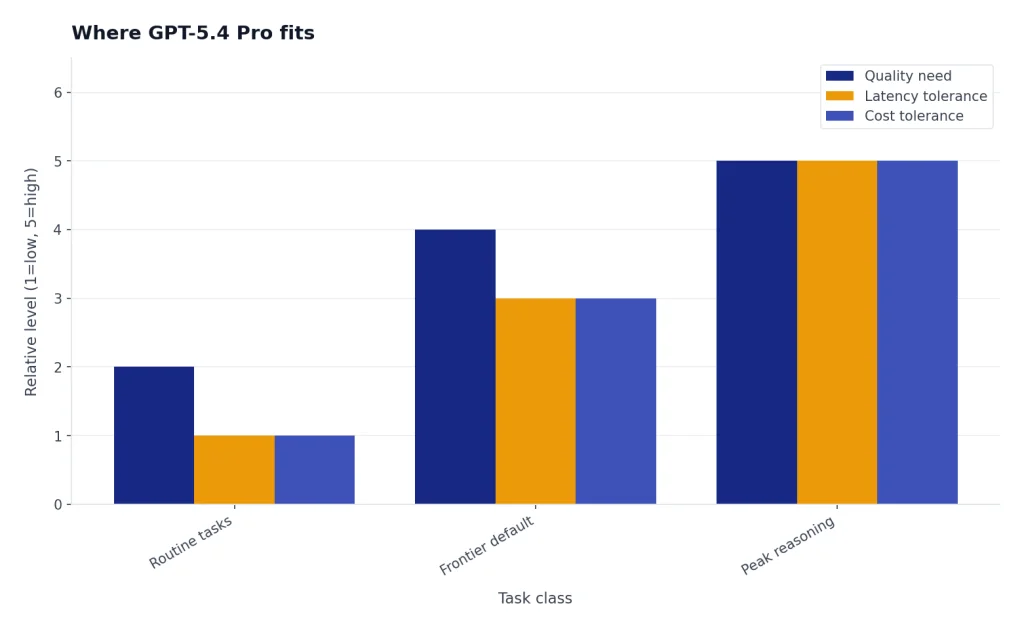
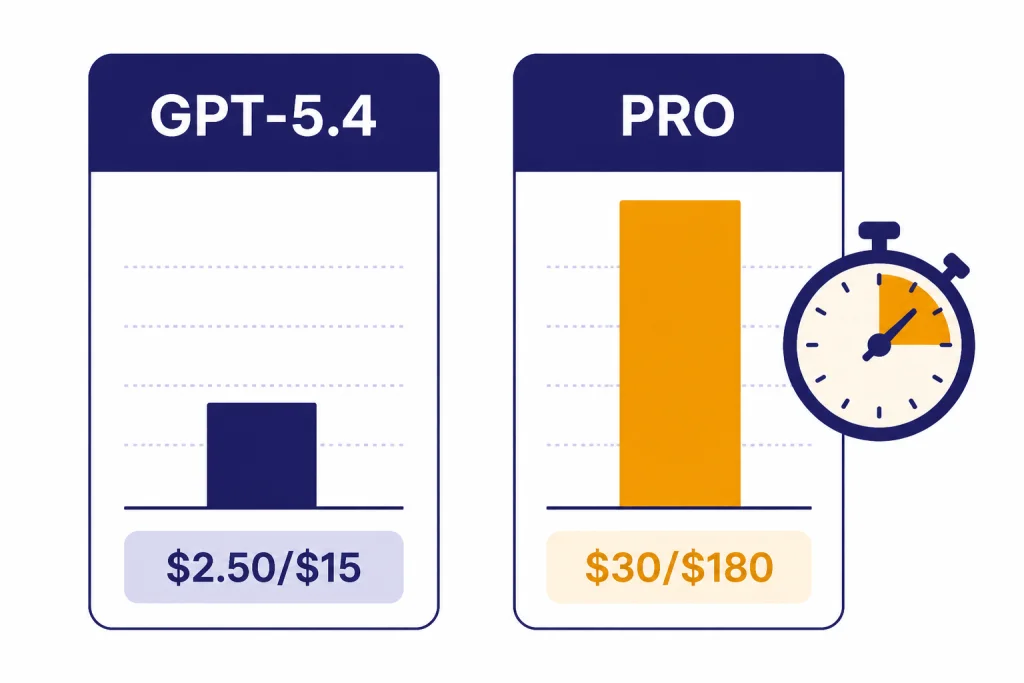
The GPT-5.4-era price difference was large. GPT-5.4 was listed at $2.50 per 1M input tokens and $15.00 per 1M output tokens.[2] GPT-5.4 Pro was listed at $30.00 per 1M input tokens and $180.00 per 1M output tokens.[3] Do not automatically project those exact numbers onto newer models without checking the current API page, but the decision logic remains the same: route most traffic to the strongest affordable default, then escalate only the requests that need peak reasoning. If cost is the main constraint, start with our cheapest GPT model comparison before deploying at scale.
| Model | Best use | Context window in cited API docs | Max output in cited API docs | API input price in cited docs | API output price in cited docs |
|---|---|---|---|---|---|
| GPT-5.4 | Frontier work at scale on the cited benchmark generation | 1,050,000 tokens | 128,000 tokens | $2.50 / 1M tokens | $15.00 / 1M tokens[2] |
| GPT-5.4 Pro | Maximum GPT-5.4-era performance on complex tasks | 1,050,000 tokens | 128,000 tokens | $30.00 / 1M tokens | $180.00 / 1M tokens[3] |
| GPT-5.5 | Current high-end default for many May 2026 workflows | Check current model docs | Check current model docs | Check current pricing | Check current pricing |
| GPT-5.5 Pro | Current peak choice for the hardest reasoning and research-style prompts | Check current model docs | Check current model docs | Check current pricing | Check current pricing |
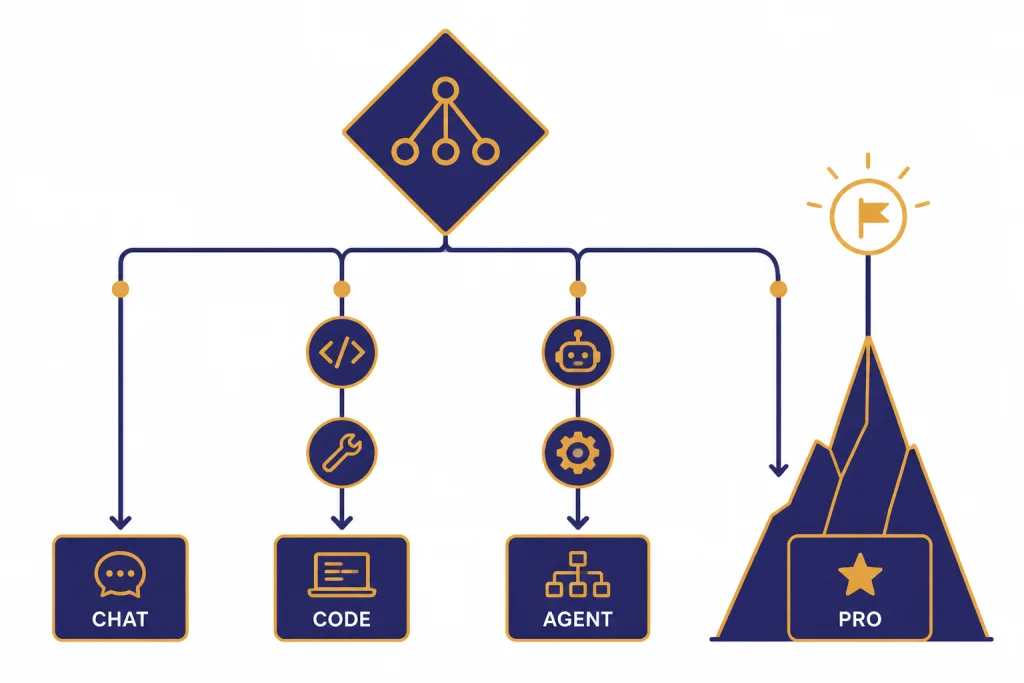
A useful production pattern is a three-step router. First, send routine extraction, classification, formatting, and short summaries to a fast or inexpensive model. Second, send normal high-value work to GPT-5.5 or another current frontier default. Third, escalate only the hardest prompts, failed validations, or ambiguous outputs to GPT-5.5 Pro. That routing pattern usually beats a one-model strategy because it balances quality, cost, latency, and review effort.
Model picks by task
The most powerful model is not always the best model to use. A model can be strongest on paper and still be the wrong choice for a fast chat reply, a low-cost extraction job, or a production endpoint that needs predictable latency. Use these recommendations as a starting point, then validate them with your own prompts.
- Hard reasoning and research: Try GPT-5.5 Pro first if it is available in your product or API environment. If you are comparing against the cited GPT-5.4 generation, GPT-5.4 Pro led GPT-5.4 on BrowseComp, GPQA Diamond, FrontierMath Tier 4, and Humanity’s Last Exam with tools in OpenAI’s published table.[1]
- General professional work: Try GPT-5.5 as the current default, but use GPT-5.4 as the cited baseline. GPT-5.4 had the strongest GDPval result shown by OpenAI, scoring 83.0% on the wins-or-ties comparison across 44 occupations.[1]
- Coding agents: Start with GPT-5.5 or GPT-5.5 Pro for current testing, then compare GPT-5.4 and GPT-5.3-Codex on your own repository. GPT-5.4 led SWE-Bench Pro at 57.7%, while GPT-5.3-Codex led Terminal-Bench 2.0 at 77.3% in the cited table.[1] For coding-specific tradeoffs, use our best GPT model for coding guide after you have identified your repo-level failure cases.
- Desktop and browser agents: Test GPT-5.5 first for current deployments, but use GPT-5.4 as the documented benchmark baseline. It led the published GPT comparison on OSWorld-Verified, WebArena-Verified, and Online-Mind2Web.[1]
- Everyday conversation: Do not spend Pro-tier budget on every casual answer. GPT-5.3 Instant remained relevant in the cited lineup because OpenAI released it to improve everyday conversational flow, search answers, refusals, and tone.[5] In the current lineup, a fast GPT-5.5 chat surface or Instant-style product label may be the better everyday choice than a slow reasoning setting.
- Writing and editing: Use GPT-5.5 for most complex drafts and GPT-5.5 Pro for difficult rewrites that require strategy, structure, or source reconciliation. The model still needs a clear brief, audience, voice, constraints, and revision loop. Our best GPT model for writing guide expands on drafting, editing, and rewriting workflows.
- Speed-sensitive work: Do not automatically pick the most powerful model. Create a latency budget, test median and tail response times, and compare quality against the fastest acceptable model. Our fastest GPT model benchmark guide is the better starting point when response time is the main requirement.
- Image-heavy work: GPT-5.5-class chat models can help with visual reasoning and prompt planning, but image generation is a separate model choice. As of May 2026, the current image-generation top tier includes GPT-image-2. Use our best GPT model for image generation article when the output itself is an image.
- Video generation: A text GPT model is not the right answer if the deliverable is video. In the current OpenAI lineup, Sora-2 Pro is the relevant peak video-generation option, while GPT models are better used for scripts, shot lists, prompts, review notes, and editorial planning.
For most teams, the practical routing pattern is simple: send normal high-value work to GPT-5.5, escalate the hardest prompts to GPT-5.5 Pro, and keep a faster or cheaper model available for classification, extraction, and routine transformations. If your stack is still standardized on GPT-5.4, use GPT-5.4 as the default and GPT-5.4 Pro as the escalation model. Either way, measure final accepted output per dollar, not just benchmark rank.
How to read benchmark claims
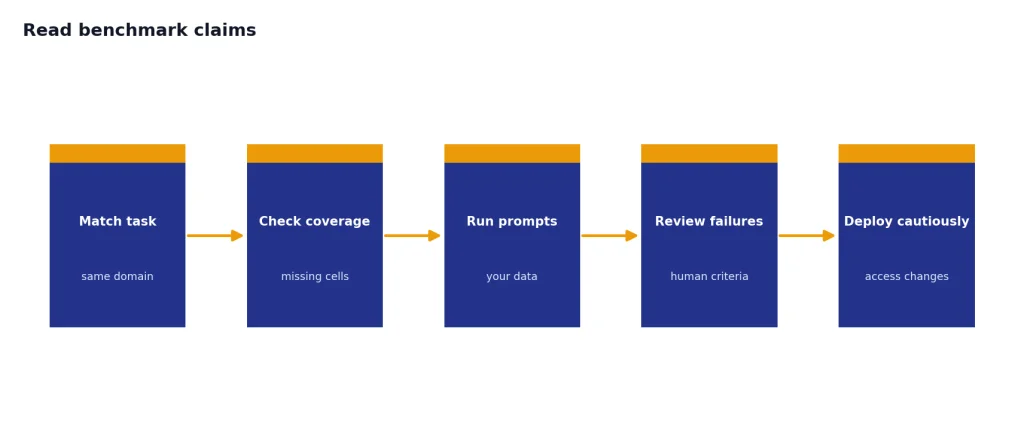
Benchmarks are useful, but they are not a substitute for testing your own work. GDPval says more about professional deliverables than chat tone. SWE-Bench Pro says more about repository patching than data extraction. OSWorld-Verified says more about desktop action sequences than legal drafting. GPQA Diamond says more about graduate-level science questions than sales copy.
OpenAI’s GDPval methodology is designed around economically valuable work tasks across 44 occupations, and the initial GDPval publication describes it as an early step rather than a complete measure of workplace performance.[7] That caveat matters. A model can win a benchmark and still need human supervision, domain review, tool permissions, and prompt design.
You should also separate vendor benchmarks from independent and hands-on evidence. Vendor numbers are usually run by teams that understand the model, tooling, and evaluation harness extremely well. They can be accurate and still fail to predict your production results. Before committing, compare the vendor table with third-party or community evaluations where available, then run a small internal test set that reflects your real workload.
| What to test yourself | Example prompt or task | What counts as failure | Why it matters |
|---|---|---|---|
| Domain accuracy | Ask the model to summarize a policy, contract clause, research note, or technical spec your team already understands. | Confident but unsupported claims, missed exceptions, wrong citations, or vague hedging. | Public benchmarks rarely match your house style, terminology, or risk tolerance. |
| Tool reliability | Give the model a multi-step task that requires file lookup, function calls, spreadsheet edits, or browser actions. | Wrong tool arguments, skipped verification, partial completion, or failure to recover after an error. | Tool-using agents fail differently from chat-only models. |
| Cost-normalized quality | Run the same task through a fast model, GPT-5.5, and GPT-5.5 Pro, then have reviewers mark outputs as accepted, edited, or rejected. | A more expensive model produces only a small review-time saving, or a cheaper model needs too many retries. | The best model is often the one with the lowest cost per accepted answer, not the highest leaderboard score. |
| Latency and variance | Measure normal prompts and worst-case long prompts during realistic traffic windows. | Tail latency breaks your product experience even when average quality is strong. | Pro-tier reasoning may be excellent but unsuitable for synchronous user flows. |
Here is an illustrative hands-on testing pattern. Take 30 to 100 real tasks from your backlog, remove sensitive data, and define what an acceptable answer must include before you run any model. Then test candidates blind, record whether each answer was accepted without edits, accepted after edits, rejected, or escalated to a human. Finally, review the failures by category: factual error, missing constraint, tool error, formatting miss, unsafe advice, weak reasoning, or excessive latency. Those categories are often more useful than a single average score.
Also watch for missing cells. GPT-5.4 Pro does not have a published score in every GPT-5.4 table category. That does not mean it is weak in those categories. It means OpenAI did not publish a comparable number in that table. The same caution applies to GPT-5.5 and GPT-5.5 Pro in this article: their current-model status does not automatically give you a comparable public score for every older benchmark.
Finally, separate model intelligence from product access. ChatGPT model picker availability, API access, enterprise settings, usage limits, tools, and regional controls can change. For API deployment details and prices, compare the current OpenAI model pages with our OpenAI API pricing reference before you build. If you are choosing between ChatGPT plans, our ChatGPT Plus price in 2026 guide covers subscription-level value.
Frequently asked questions
What is the most powerful GPT model right now?
As of May 2026, GPT-5.5 Pro is the current peak GPT choice for maximum-quality reasoning, research-style work, and difficult prompts. GPT-5.5 is the more practical current high-end default for many workflows. The strongest fully cited public benchmark table in this article is still the GPT-5.4-era comparison, where GPT-5.4 Pro led several difficult reasoning categories and GPT-5.4 had broader published coverage.[1]
Is GPT-5.4 better than GPT-5.3-Codex?
Usually, yes for broad work. GPT-5.4 leads GPT-5.3-Codex on several published benchmarks, including GDPval, SWE-Bench Pro, OSWorld-Verified, Toolathlon, and BrowseComp.[1] GPT-5.3-Codex still has a published lead on Terminal-Bench 2.0, so coding-agent teams should test both on their own repositories before standardizing.
Is GPT-5.4 Pro always worth the cost?
No. GPT-5.4 Pro was much more expensive than GPT-5.4 in the cited API docs, with listed prices of $30.00 per 1M input tokens and $180.00 per 1M output tokens.[3] The same principle applies to newer Pro-tier models: use them when the task is difficult enough that higher answer quality matters more than latency or cost.
Which GPT model should I use for coding?
For current testing, start with GPT-5.5 and escalate the hardest debugging or architecture tasks to GPT-5.5 Pro. If you are comparing against the cited GPT-5.4 generation, GPT-5.4 is the strongest broad starting point: it leads GPT-5.3-Codex on SWE-Bench Pro, while GPT-5.3-Codex leads GPT-5.4 on Terminal-Bench 2.0 in OpenAI’s published table.[1] For production coding agents, run a small benchmark using your own issue types, language stack, tests, and review standards.
Which GPT model has the biggest context window?
OpenAI’s cited API documentation lists both GPT-5.4 and GPT-5.4 Pro with a 1,050,000-token context window and a 128,000-token max output.[2][3] Check the current API documentation for GPT-5.5 and GPT-5.5 Pro before deployment. Large context is useful, but it does not guarantee perfect recall across the whole prompt.
Are benchmarks enough to choose a model?
No. Benchmarks help narrow the list, but your best model depends on task type, cost, latency, tool access, context length, failure tolerance, and review workflow. Treat published benchmarks as a starting point, compare independent evaluations where available, and then test candidate models against your own acceptance criteria.