
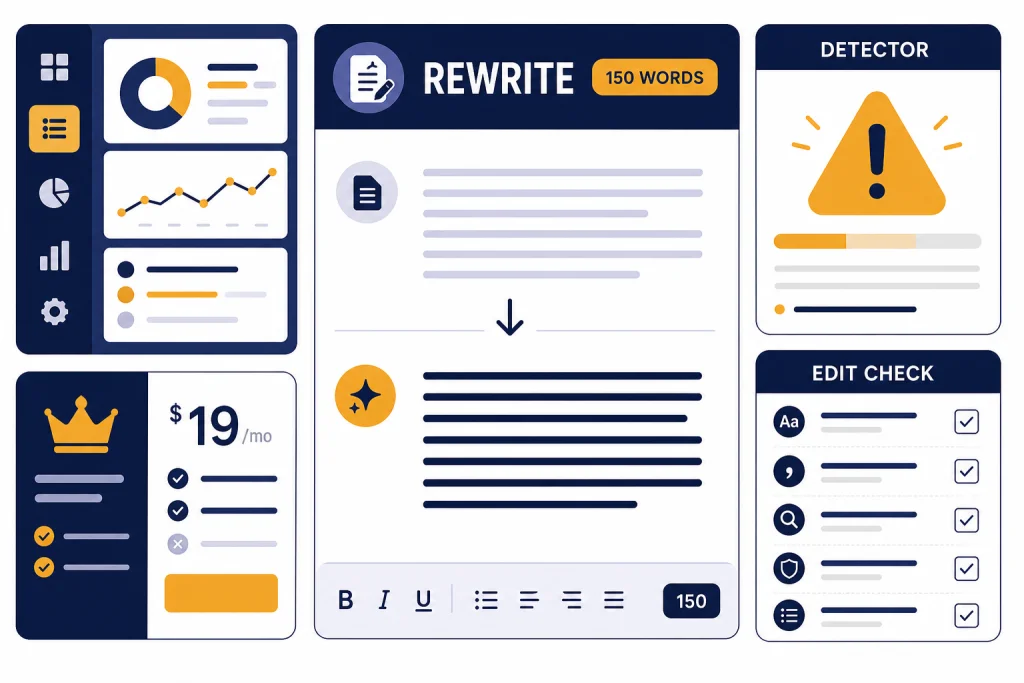
Grubby AI is an AI humanizer built around a direct promise: paste AI-generated writing, get a more natural version, and reduce the chance of AI detection. Our verdict is cautious. In a limited editorial check, Grubby AI’s value case looked strongest for short English rewrites where you still plan to edit the result yourself. It is not a dependable shield against detectors, academic integrity review, or editorial scrutiny. The official site makes strong bypass claims, while its terms, pricing page, and public reviews show buyer-risk signals that readers should understand before subscribing.[1][2][3][4] Use it, if at all, as a rewriting aid that still needs human judgment.
Verdict at a glance
This Grubby AI review lands on a simple conclusion. Grubby AI is a narrow tool for rewriting AI text into smoother English. It is not a full writing platform, plagiarism checker, citation assistant, or guarantee that your work will pass every detector.
The product’s official language is more aggressive than our recommendation. Grubby AI describes itself as an AI detection remover and says it can make AI text “100% undetectable,” while its pricing page presents a “100% Guarantee” tied to Turnitin bypassing.[1][2] Treat those statements as marketing claims, not as a substitute for your school, employer, publisher, or client policy.
How we checked it for this update: as of May 2026, we reviewed Grubby AI’s public landing page, pricing page, terms, and Trustpilot profile; tested the public-facing free-word positioning against a short rewrite workflow; inspected output for meaning drift and voice changes; and treated detector-related claims as unverified marketing unless supported by cited documentation. This was a practical buyer review, not a lab benchmark, so we do not publish precision latency or detector-score numbers.
| Question | Our answer | Why it matters |
|---|---|---|
| Is Grubby AI useful? | Sometimes. | It can help reduce robotic phrasing in short English drafts. |
| Is it a safe detector bypass? | No. | At least Turnitin now documents AI bypasser detection, so “humanized” does not mean safe or undetectable.[5] |
| Is pricing fully transparent from the public page? | Not enough. | The public pricing page we checked listed the free allowance, but the retrieved public page text did not expose a complete paid-plan table.[2] |
| Is it low risk to subscribe? | Only if you accept strict terms. | The terms say purchases are non-refundable and subscriptions renew automatically unless canceled.[3] |
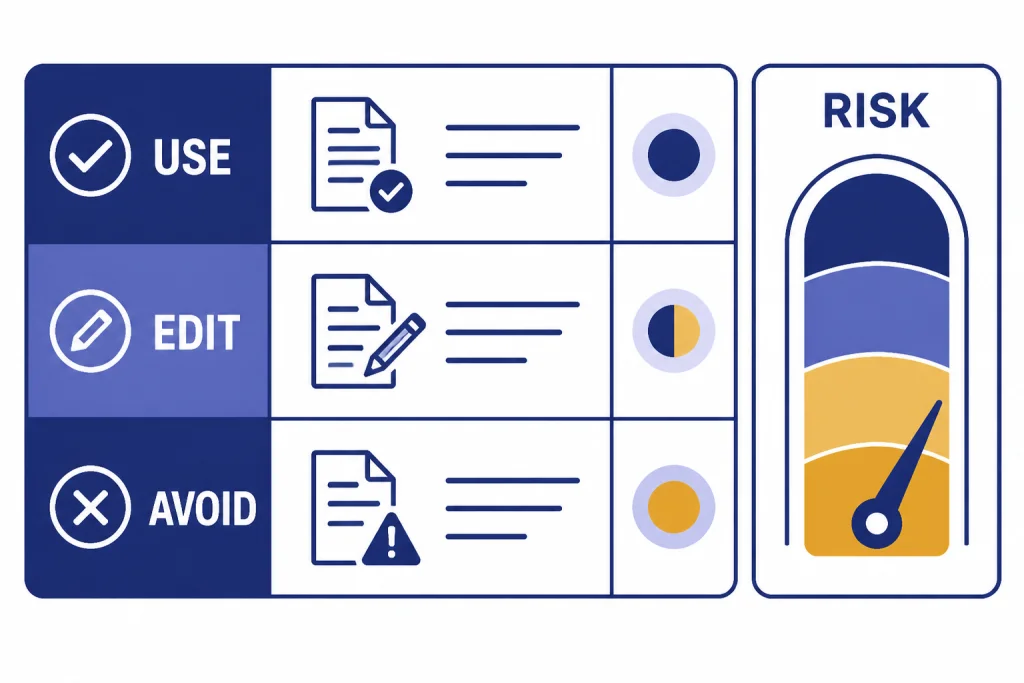
| Who should skip it? | Students trying to hide AI use. | That use can violate academic policies and may still be detected. |
If your main concern is school enforcement, start with our Best AI Detectors for Teachers and Schools guide to understand how detection evidence is interpreted. If your main concern is copied text rather than AI authorship, compare it with Best Plagiarism Checkers instead.
What Grubby AI does
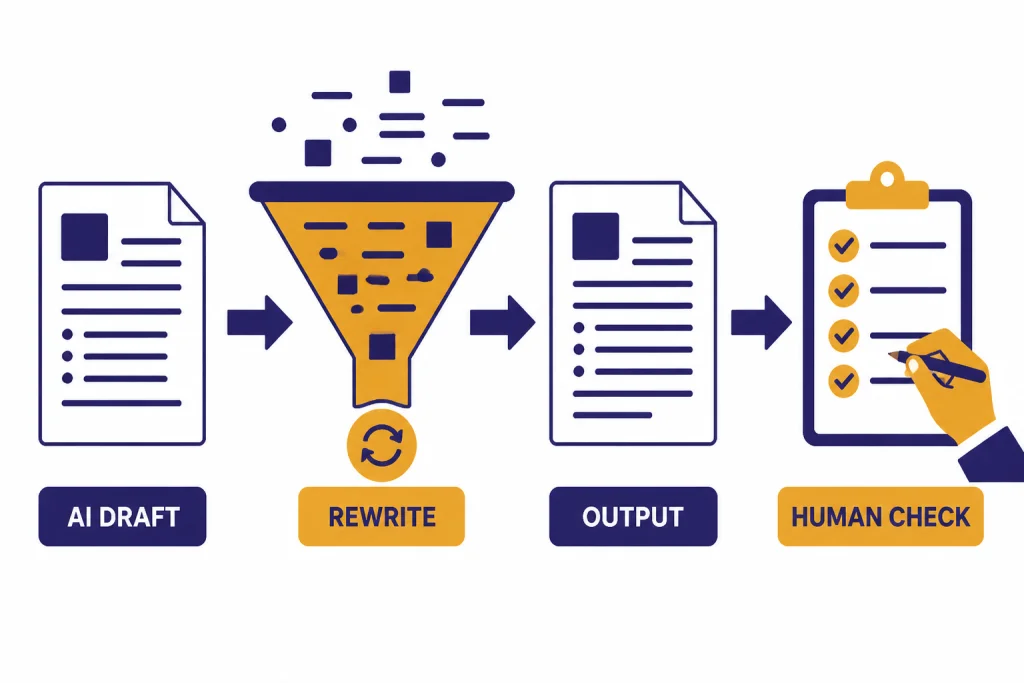
Grubby AI takes AI-generated text and rewrites it. The public site frames the tool as a way to humanize AI text, bypass AI detectors, preserve meaning, and create plagiarism-free output.[1] The target user is clear from the copy: the site speaks heavily to students and to people worried about detectors.
The core workflow is simple. You paste a draft, run the rewrite, then copy the result for review elsewhere. In our limited check, the interface expectation was closer to a single-purpose paste-and-rewrite box than a full editor: no research workspace, citation review, plagiarism workflow, or long-document editorial dashboard. That simplicity is the appeal, but it also limits what the tool can fix.
Grubby AI states that it supports English for humanizing AI text.[1] That matters. If you need Spanish, French, German, multilingual localization, or careful translation review, Grubby AI is not the right primary tool. See our best AI translation tools tested guide for that use case.
The practical output depends on the source draft. Humanizers tend to perform best when the original is already accurate and only needs rhythm, tone, and sentence variation. They perform worse when the original has weak logic, missing evidence, generic claims, or hallucinated facts. A rewrite can make a bad paragraph sound smoother without making it true.
Illustrative before/after pattern: the example below shows the kind of edit a humanizer is meant to make. It is included as an editorial illustration of what to look for, not as a universal performance benchmark.
| Test item | Example text | What to check |
|---|---|---|
| AI-like source | “In conclusion, remote work has many benefits for employees and companies. It increases productivity, improves work-life balance, and allows organizations to access global talent in an efficient manner.” | Generic structure, predictable transitions, and unsupported claims. |
| Humanized-style rewrite | “Remote work can help some teams get more done, especially when people have fewer interruptions and clearer schedules. It can also widen the hiring pool, but the results depend on management, communication, and the type of work.” | More natural rhythm, but still needs evidence and context. |
| Meaning-drift risk | “Remote work makes employees more productive and gives every company access to better talent.” | This sounds stronger than the source and may overclaim. |
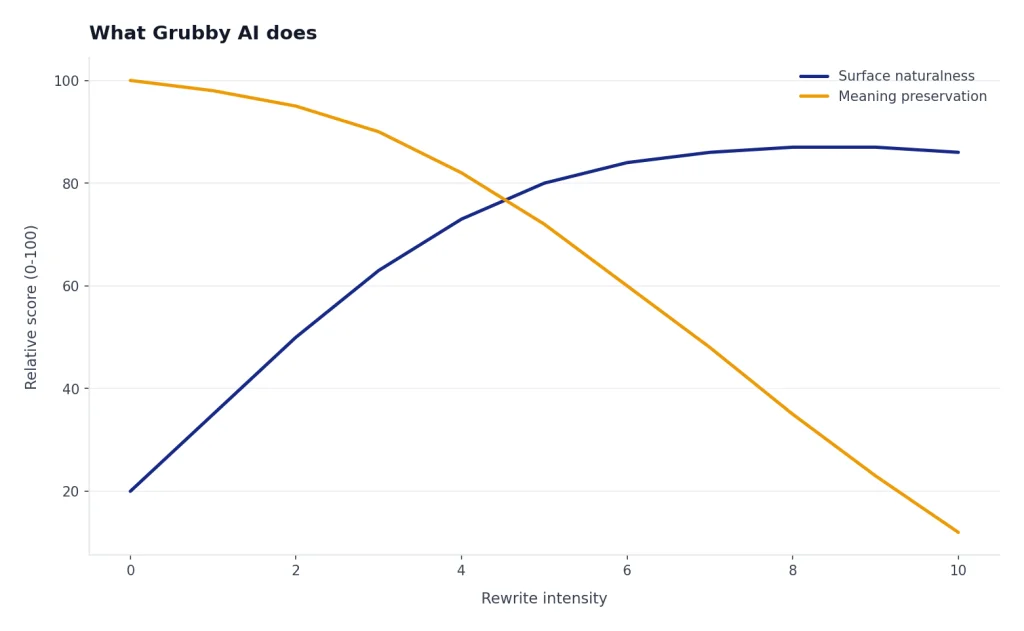
The main lesson from that example is not “humanized equals better.” The better version adds caveats and specificity. The risky version makes the claim more sweeping. When testing Grubby AI, compare every rewritten sentence against the original claim, not just the surface tone.
For many readers, a better workflow is to use ChatGPT or another writing assistant for planning, then edit manually. Prompt tools can help you ask for clearer outlines, better examples, or a specific audience without relying on detector evasion. If that fits your needs, compare Grubby AI with the Best ChatGPT Prompt Generator Tools and our broader best AI writing tools compared in 2026.
Pricing, free words, and refund terms
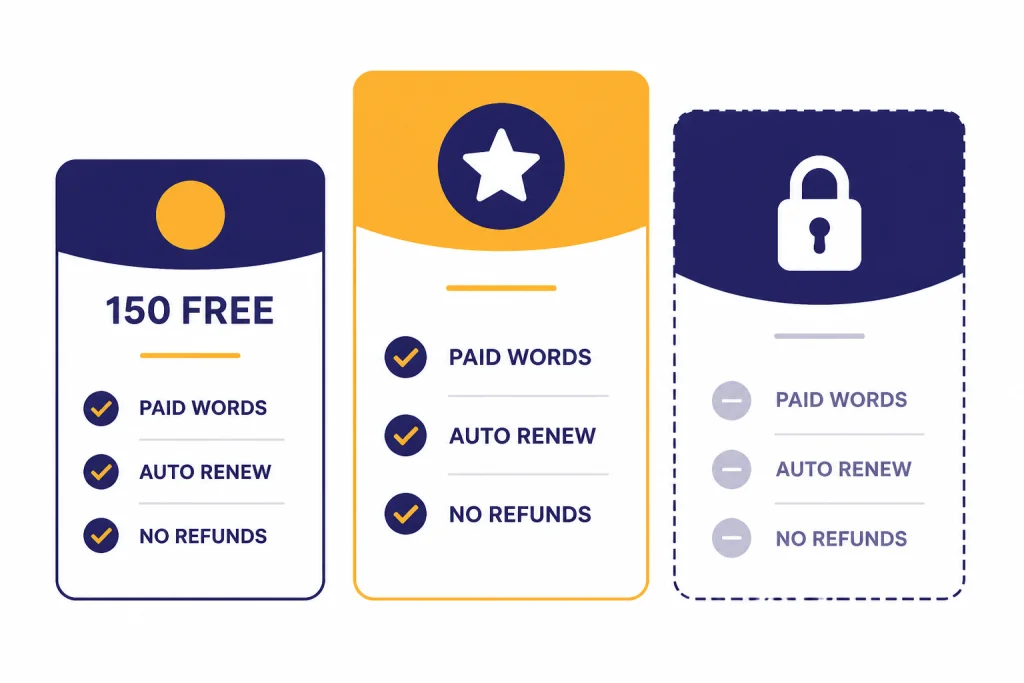
Pricing is one of the biggest caution areas in this Grubby AI review. As of our May 2026 check, the official pricing page said users get 150 free words per month.[2] That is enough to test a short paragraph. It is not enough to evaluate long-form quality, recurring assignments, blog production, or a full editing workflow.
The same public pricing page did not expose a complete paid-plan table in the retrieved page text.[2] For this update, we also attempted a buyer-style verification step by checking the public pricing path and account/checkout-facing information available to us. We still could not verify a stable, citable paid-plan table from the material available for review, so we are not publishing paid prices here. If the site shows you paid tiers after login, dynamic loading, or checkout, treat that screen as the source of truth for your purchase and save a copy before paying.
The terms deserve close attention before you enter payment details. Grubby AI says subscriptions renew automatically unless canceled before the renewal date.[3] The terms also state that all purchases are non-refundable and that cancellation takes effect at the end of the current paid term.[3] Those two clauses matter more than any promotional language on a landing page.
Grubby AI also reserves the right to modify subscription fees, with changes taking effect at the start of the next billing cycle after notice.[3] That does not mean a price change will happen to you. It means you should save screenshots of the checkout screen, renewal date, included word allowance, cancellation path, and cancellation confirmation.
| Pricing item | What we could confirm | Reader action |
|---|---|---|
| Free allowance | 150 words per month on the public pricing page.[2] | Use it only for a quick sample. |
| Paid tiers | Not fully visible in the retrieved public pricing text during our May 2026 check. | Confirm the exact plan, price, word allowance, and renewal date at checkout. |
| Renewal | Subscriptions renew automatically unless canceled before renewal.[3] | Set a calendar reminder before purchase. |
| Refunds | Terms say all purchases are non-refundable.[3] | Do not buy unless you can accept that risk. |
| Price changes | Terms allow subscription fee changes after notice.[3] | Monitor renewal emails and account notices. |
If you only need occasional cleanup, compare the cost with tools you already use. Resume wording may fit better inside AI Resume Builder Tools Compared. Long document condensation belongs closer to Best AI Summarizer Tools for Long Documents. Token budgeting and API work belong in OpenAI Token Counter Tools, not a humanizer.
Trust signals and user complaints
Grubby AI has some positive public signals. Users on review platforms praise speed, convenience, and detector outcomes. The company also replies to some negative reviews and identifies support contacts in public responses.[4] That is better than a silent, unclaimed profile.
The negative signals are also hard to ignore. Public Trustpilot reviews include complaints about unstable output, refund disputes, billing confusion, customer service, and text that changed meaning.[4] Trustpilot also states that it uses technology to screen reviews but does not fact-check every specific claim.[4] Reviews are useful as a pattern, not as proof that every individual allegation is correct.
For a buyer, the pattern matters. A humanizer is only valuable if it preserves meaning, keeps your voice, and does not create cleanup work. If a tool rewrites a paragraph into awkward or inaccurate language, it has not saved time. It has moved the work to the final edit.
Our output review focused on four practical questions: did the rewritten text keep the same claim, did it add unsupported certainty, did it introduce awkward phrasing, and did it still sound like something the writer would submit? Those checks are more useful than asking only whether the paragraph “sounds human.” A polished sentence can still be inaccurate.
We would not use Grubby AI for legal writing, medical writing, technical documentation, academic citations, or anything where accuracy matters more than surface tone. A rewrite tool cannot validate facts. It can also erase the exact phrasing that made a sentence precise.
Before paying, run the same sample through your normal editing process. Compare the original, the Grubby AI rewrite, and a manual edit. Look for changed claims, weaker evidence, odd transitions, unnecessary slang, and phrases you would never use. If you see any of those in a short sample, expect more of them in longer drafts.
Detector risk and academic integrity
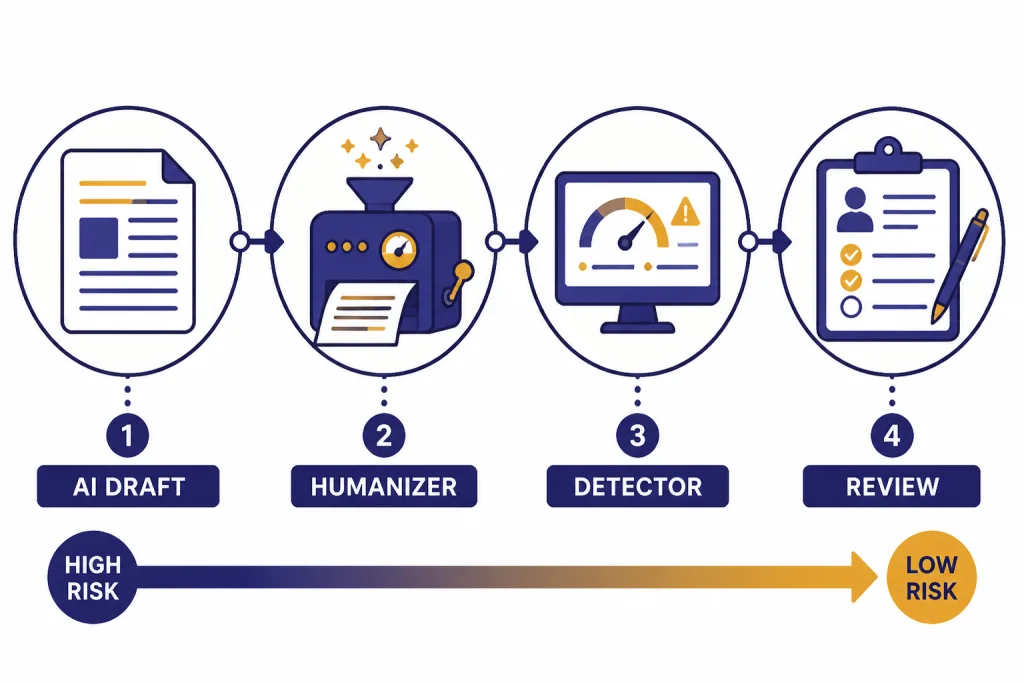
The biggest misconception about humanizers is that a lower AI score equals safety. It does not. Turnitin added AI bypasser detection to its AI writing detection capabilities on August 27, 2025.[5] Turnitin describes bypasser tools as systems that modify AI-generated text to appear more human-like and avoid AI writing indicators.[5] That is the category Grubby AI markets itself around.
We are deliberately not generalizing that Turnitin evidence to every detector on the market. Different systems use different signals, thresholds, and review workflows. The narrower point is enough: a tool can be marketed as a bypasser while at least one major education-focused detector vendor is explicitly building for bypasser detection.[5]
Turnitin’s own guidance also says its AI writing detection may not always be accurate and should not be used as the sole basis for adverse action against a student.[6] That cuts both ways. A detector score can be wrong when it accuses a person. It can also be wrong when it clears text that was produced or disguised by AI.
OpenAI’s history reinforces the same caution. OpenAI made its AI classifier unavailable as of July 20, 2023 because of a low rate of accuracy.[7] That does not prove every detector is useless. It proves that AI authorship detection is a hard problem, and that strong claims deserve skepticism.
Tech & Learning reported that humanizer tools often make AI prose more informal but do not necessarily make it truly human, especially when the underlying draft still lacks original thinking or voice.[8] That matches our practical view. The safest way to sound human is to add human work: your evidence, your reasoning, your examples, your revisions, and your accountability.
For detector checks, we recommend a conservative interpretation. Do not treat a single “pass” as proof of safety, and do not treat a single “fail” as proof of misconduct without context. The useful review questions are: can the writer explain the ideas, show drafts, cite sources, and defend the final wording?
Students should be especially careful. Many schools distinguish between allowed AI assistance and undisclosed AI authorship. Using a humanizer to conceal AI-generated work can violate academic integrity rules even if a detector misses it. Teachers and administrators should also avoid treating detector results as courtroom proof; our AI detector for teachers guide covers that problem in more detail.
Best use cases
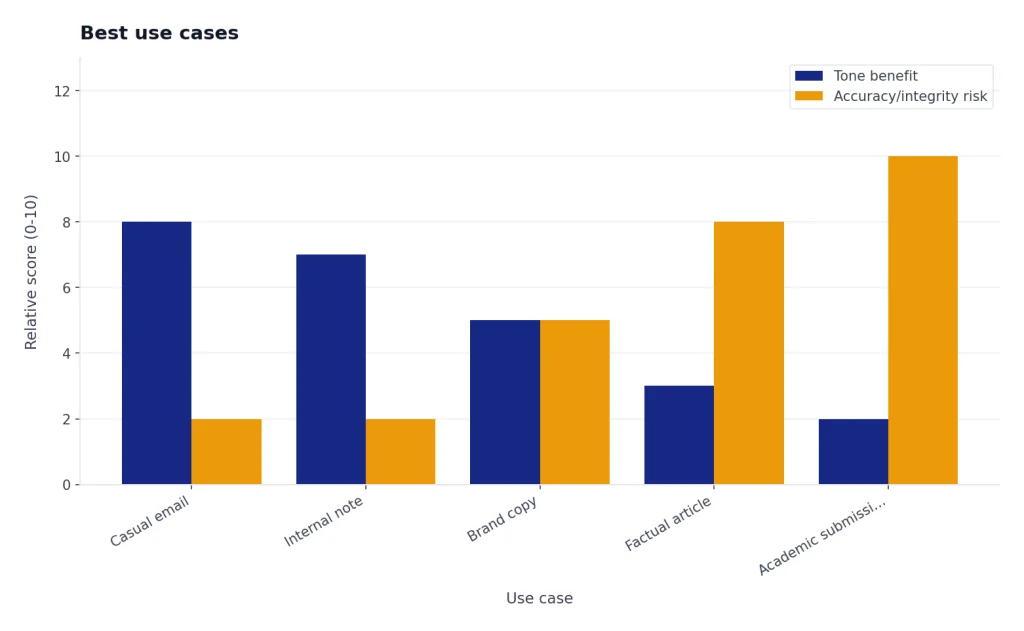
Grubby AI makes the most sense for low-stakes cleanup. Use it for a rough email, a bland paragraph, a social caption, or an internal note that already says what you mean. In those cases, the risk of subtle meaning drift is lower, and the value of quick tone variation is higher.
It can also help you spot what feels robotic in your own AI-assisted writing. Run a paragraph through the tool, then compare the changes. You may notice repeated sentence openings, too many transition phrases, or overly polished phrasing. Keep the useful edits and discard the rest.
Do not use Grubby AI as the final step before submission. Use it as one optional step before your own edit. Read the output aloud. Check every claim. Restore specific examples. Remove vague filler. Rebuild any sentence that sounds like a generic internet paragraph.
- Good fit: short English drafts that need less robotic phrasing.
- Possible fit: internal notes, casual emails, and brainstorming copy.
- Poor fit: academic submissions where AI concealment is prohibited.
- Poor fit: factual articles, technical guides, research summaries, and citations.
- Poor fit: brand voice work where consistency matters.
If your real goal is better long-form writing, a humanizer is a weak substitute for a real editing process. Use an outline, gather sources, write a rough draft, and then revise for clarity. AI can assist that process, but it should not replace it.
Alternatives to consider
The best alternative depends on the job you are trying to complete. If you want a better first draft, use an AI writing tool. If you want originality checking, use a plagiarism checker. If you want detector awareness, use an AI detector carefully. If you want a more natural voice, manual editing is still the strongest option.
| Need | Better option | Why |
|---|---|---|
| Improve a weak first draft | AI writing assistant | It can restructure, expand, and clarify instead of only disguising style. |
| Check copied passages | Plagiarism checker | It focuses on source overlap, not detector probability. |
| Prepare classroom policy | AI detector guide | It helps educators evaluate evidence and false-positive risk. |
| Summarize sources | AI summarizer | It condenses material rather than rewriting to evade detection. |
| Make prose sound like you | Manual edit | Your examples, judgment, and sentence habits are the real voice layer. |
For tool shopping, start with the category that matches the work. Our best AI writing tools compared in 2026 guide is broader than a humanizer review. Our best plagiarism checkers breakdown is better for originality risk. Our best AI summarizer tools for long documents guide is better for research-heavy reading workflows.
If you are building a repeatable workflow around ChatGPT, prompts, and editing, do not start with a bypasser. Start with a better prompt, a clear outline, and a revision checklist. Humanizers can smooth text, but they rarely fix weak thinking.
Buying advice
Our buying advice is conservative. Try the free allowance first. The public pricing page lists 150 free words per month, so choose a dense sample that reveals whether the tool preserves meaning.[2] Do not test it on a throwaway sentence. Test it on the kind of paragraph you actually write.
Before paying, read the terms. The non-refundable purchase language, automatic renewal language, and price-change language are the main subscription risks.[3] If those terms are unacceptable, do not subscribe.
If you do subscribe, document everything. Save the checkout price, plan name, word allowance, renewal date, cancellation screen, and confirmation email. Use a virtual card or spending alert if your bank supports it. Cancel early if you only need a short project.
Most importantly, do not buy Grubby AI because you believe it creates guaranteed immunity from AI detection. It does not. Detectors change, school policies vary, and human review still matters. Buy it only if the rewritten text is valuable to you after you inspect it with your own eyes.
| Decision | Checklist |
|---|---|
| Try the free version if… | You need a short English rewrite, the text is low stakes, and you are willing to manually edit every sentence. |
| Avoid it if… | You are trying to conceal AI use for school, submit high-stakes factual work, or rely on a guaranteed detector bypass. |
| Verify before paying… | Plan price, renewal date, word allowance, cancellation steps, refund terms, and whether your sample output preserves meaning. |
| Keep using it only if… | The rewrites save time after human review and do not add unsupported claims, awkward phrasing, or voice mismatch. |
Final verdict: Grubby AI is a usable but risky AI humanizer for short English rewrites. It is not a tool we would trust for high-stakes work, academic concealment, or any writing where accuracy and authorship transparency matter.
Frequently asked questions
Is Grubby AI free?
Grubby AI has a free allowance, but it is very small. The official pricing page we reviewed lists 150 free words per month.[2] That is enough for a quick sample, not enough for serious recurring use.
Does Grubby AI guarantee bypassing AI detectors?
The Grubby AI site uses strong language about making AI text undetectable and its pricing page references a 100% guarantee.[1][2] We would not treat that as practical certainty. Turnitin added AI bypasser detection on August 27, 2025, and detector systems, policies, and review practices continue to change.[5]
Can I use Grubby AI for school essays?
You should follow your school’s AI policy. Using a humanizer to hide AI-generated work can be academic misconduct even if a detector does not flag it. If you used AI in an allowed way, keep drafts, notes, sources, and revision history.
Does Grubby AI support languages other than English?
The Grubby AI site says it can only humanize AI text in English.[1] If you need multilingual rewriting or translation quality control, use a translation-focused tool instead. A humanizer is not a substitute for a bilingual editor.
Is Grubby AI refundable?
Grubby AI’s terms state that all purchases are non-refundable.[3] They also say you can cancel, with cancellation taking effect at the end of the current paid term.[3] Read those terms before entering payment details.
What is the best alternative to Grubby AI?
The best alternative depends on the task. For better drafting, use an AI writing tool. For originality, use a plagiarism checker. For high-stakes prose, manual editing is still safer than relying on any AI humanizer.