
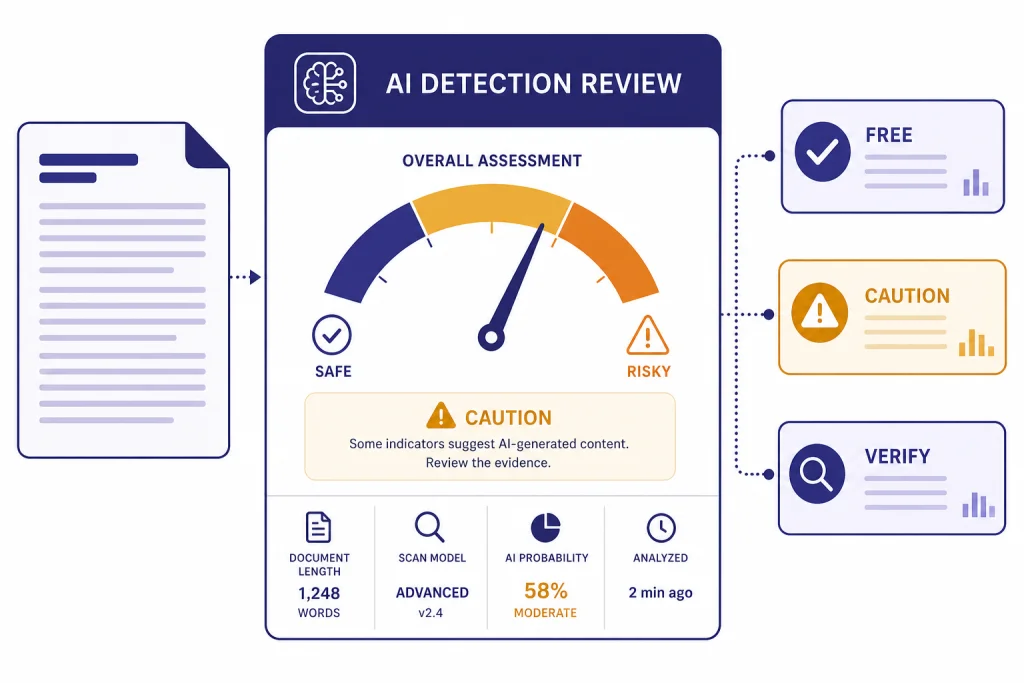
ZeroGPT is a fast, accessible AI detector for quick text checks, but it should not be treated as proof that a person used ChatGPT or another AI system. In this ZeroGPT review, our verdict is simple: use it as a screening tool, not as an accusation tool. The free detector is useful when you need a quick probability score, sentence-level clues, and a second opinion before editing or reviewing a document. It is weaker when the stakes are high, the writing is short, polished, technical, translated, or written by a non-native English speaker. Teachers, editors, and managers should pair ZeroGPT with writing history, drafts, interviews, and plagiarism checks before making decisions.
Verdict: who should use ZeroGPT
ZeroGPT is best for low-stakes, first-pass AI detection. It is useful when you want a quick check before editing an article, reviewing a student draft, screening an applicant writing sample, or comparing a suspicious passage against other evidence. It is not strong enough to be the only basis for an academic integrity case, a hiring rejection, or a publisher enforcement decision.
The official ZeroGPT site presents the detector as a free AI text checker that predicts whether text is AI-generated or human-written, and it advertises support for text from ChatGPT, Claude, Gemini, DeepSeek, and other large language models.[1] That scope is broad, but broad support does not equal courtroom-grade certainty.
Our recommendation is to use ZeroGPT as a signal. If it flags a document, ask for drafts, notes, version history, citations, or an oral explanation. If it clears a document, do not assume it proves human authorship. AI detectors can miss edited AI writing, and they can flag real human writing when the prose is predictable, formal, or heavily revised.
| Use case | ZeroGPT fit | Best next step |
|---|---|---|
| Student essay review | Helpful as a warning signal | Compare with drafts, assignment notes, and class writing samples |
| Blog or SEO editing | Useful for a quick polish check | Review originality, expertise, and factual accuracy separately |
| Hiring writing sample | Too weak as a rejection reason | Use a live writing task or follow-up interview |
| Academic misconduct investigation | Not enough by itself | Follow institutional policy and preserve evidence |
| Personal writing check | Good for curiosity and editing | Do not rewrite solely to satisfy a detector score |
What ZeroGPT is
ZeroGPT is an online AI content detector. You paste text into a web form, run detection, and receive an AI-likelihood result with supporting analysis. The current public ZeroGPT pages describe a suite that includes an AI detector, AI humanizer, plagiarism checker, and AI image detector.[1]
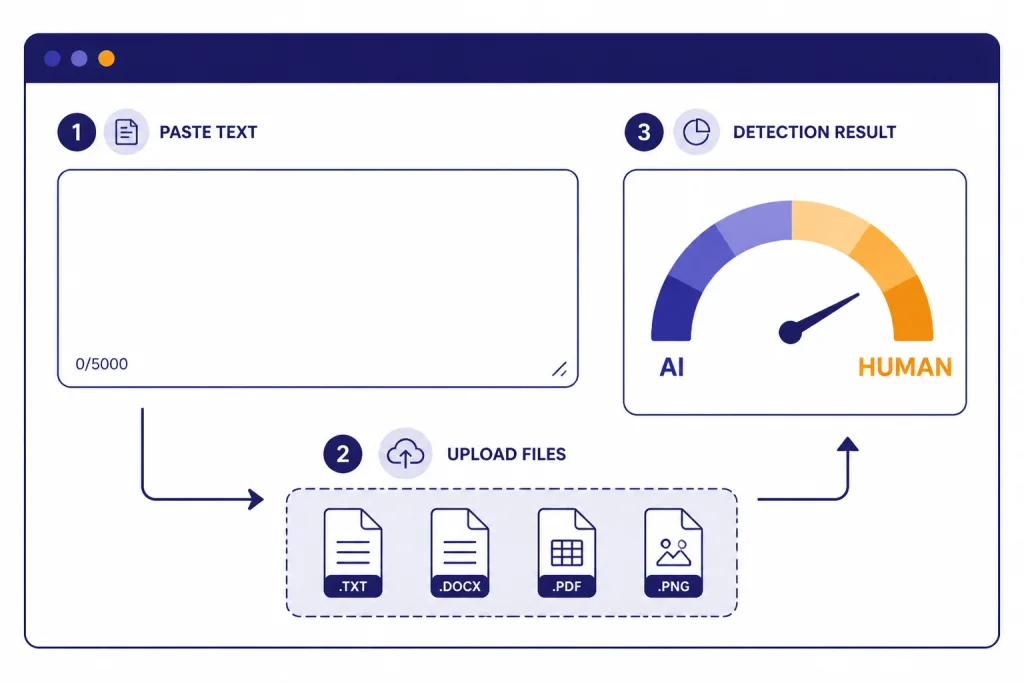
The detector page says users can paste text or upload documents, then view a detailed breakdown with percentage scores. It lists support for direct text input plus .txt, .docx, .pdf, and .odt files.[2] This matters because many free detectors are paste-only. Document upload makes ZeroGPT more practical for teachers, editors, and students who work in Word or PDF files.
The product is part of a crowded category. If you are comparing tools for school use, start with our broader guide to AI detectors for teachers. If your real concern is copied text rather than AI-written text, compare ZeroGPT with dedicated options in our guide to the best plagiarism checkers.
One important naming note: several websites use names similar to ZeroGPT. This review focuses on the public ZeroGPT pages we could verify from ZeroGPT.org and its related product pages. Before entering private documents, confirm that you are using the site your school, company, or client actually requires.
How we tested ZeroGPT
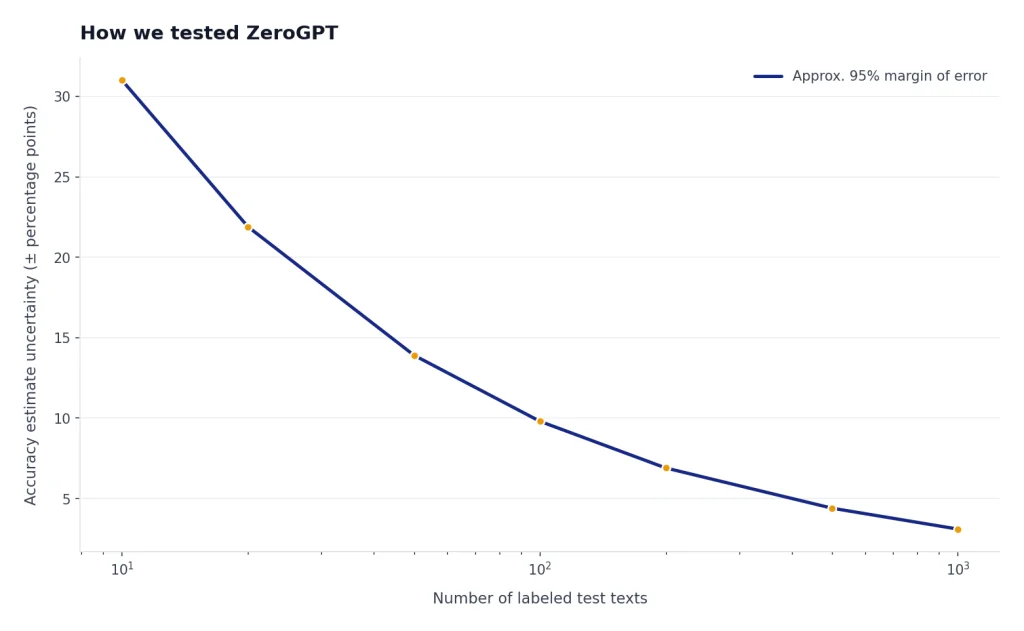
We tested ZeroGPT as a practical user would, not as a formal lab benchmark. That means we looked at the public workflow, stated limits, input options, result style, privacy claims, and risk of misusing the output. We did not publish a single accuracy percentage from our own small sample set because small detector tests can be misleading.
Our review used a simple decision framework. A good free AI detector should be easy to access, transparent about limits, clear about what the score means, cautious about privacy, and honest about uncertainty. ZeroGPT performs well on access and speed. It is weaker on explaining uncertainty in a way that prevents overconfidence.
For comparison, we also checked how ZeroGPT fits beside GPTZero, Copyleaks, and Originality.ai. GPTZero’s pricing page lists a free plan with limited AI detection and paid subscription options.[7] Copyleaks lists AI and plagiarism detection together in paid plans, including personal and pro options.[8] Originality.ai positions its plan around AI detection, plagiarism checks, readability, and API access.[9] Those tools are not automatically better for every reader, but they clarify the market: ZeroGPT’s appeal is frictionless checking, while paid competitors often focus on reporting, team workflows, or combined plagiarism detection.
Independent tests also vary. A March 21, 2026 Coda One comparison reported different detector scores across human text, ChatGPT output, Claude output, and humanized AI text, which reinforces the main point: detector results shift by text type and tool.[10] We treat those results as supporting context, not as a universal ranking.
Key features and limits
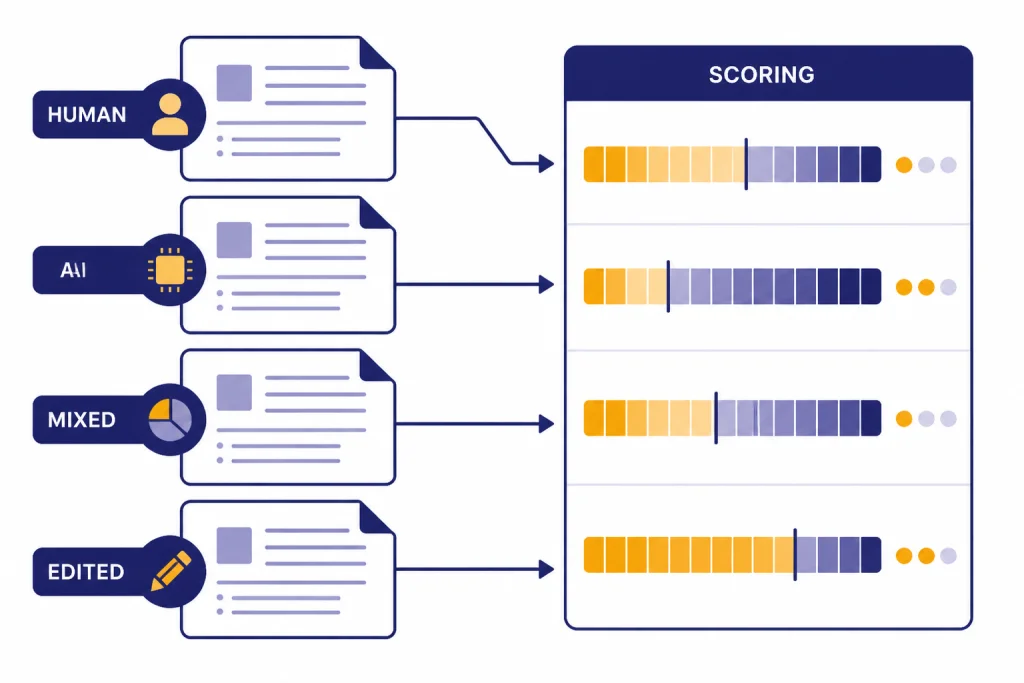
ZeroGPT’s strongest feature is convenience. You can paste text, run a check, and get a readable AI-likelihood result without building a workflow around it. The official homepage also advertises sentence-level analysis, detailed reports, and a free daily credit allocation for registered users.[1]
The free detector limit is the first practical constraint. ZeroGPT’s detector page says free users can check up to 5,000 characters per detection, while premium users can analyze files up to 50,000 characters and use batch file processing.[2] A separate BytePlus explainer also described ZeroGPT’s free plan around a 5,000-character submission limit, which broadly corroborates the constraint but may not reflect the latest daily-credit wording.[11]
That character limit is enough for a short answer, cover letter, email, or excerpt. It is not enough for a full research paper or long chapter. If you split a long document into chunks, you may change the context that the detector uses. A paragraph can look more AI-like when isolated from the surrounding draft.
| Feature | What ZeroGPT offers | Reader note |
|---|---|---|
| Text detection | AI-likelihood analysis for pasted text | Good for quick screening |
| File support | .txt, .docx, .pdf, and .odt listed on the detector page | Helpful for school and editorial files[2] |
| Free limit | Up to 5,000 characters per free detection | Long documents need chunking[2] |
| Premium file limit | Up to 50,000 characters per uploaded file | Useful only if the paid workflow fits your needs[2] |
| Adjacent tools | Humanizer, plagiarism checker, and image detector listed in the suite | Do not confuse AI detection with plagiarism detection[1] |
| API option | Developer API with sentence-level analysis and real-time results | Best for platforms, not casual users[3] |
ZeroGPT also promotes a humanizer. That creates a tension. A company can offer detection and rewriting tools in the same suite, but teachers and editors should understand what that means: some users will use detectors to audit writing, while others will use humanizers to lower detector scores. If you evaluate writing professionally, pair detector checks with authorship evidence rather than chasing a single score.
If your workflow involves AI writing tools rather than detection, see our comparison of AI writing tools. If you are checking resumes or cover letters, our guide to AI resume builder tools may be more relevant than an AI detector.
Accuracy limits and false positives
ZeroGPT advertises high accuracy on its own pages. The homepage lists 98.5% accuracy, 200K+ users, and 10M+ detections.[1] Treat those as vendor claims. ZeroGPT has not published an official, independently audited evaluation that proves those numbers across every text type, model, language, and editing style.
The broader AI detection field has a known reliability problem. OpenAI withdrew its own AI classifier on July 20, 2023 because of a low rate of accuracy.[5] That does not prove every detector is useless, but it is a strong warning against treating any detector result as final proof.
False positives are the main risk for students and workers. A peer-reviewed Patterns study found that GPT detectors could misclassify non-native English writing as AI-generated and warned against using such detectors in evaluative or educational settings without care.[6] The ethical issue is simple: a clean, formulaic, or second-language writing style can look statistically predictable even when a person wrote it.
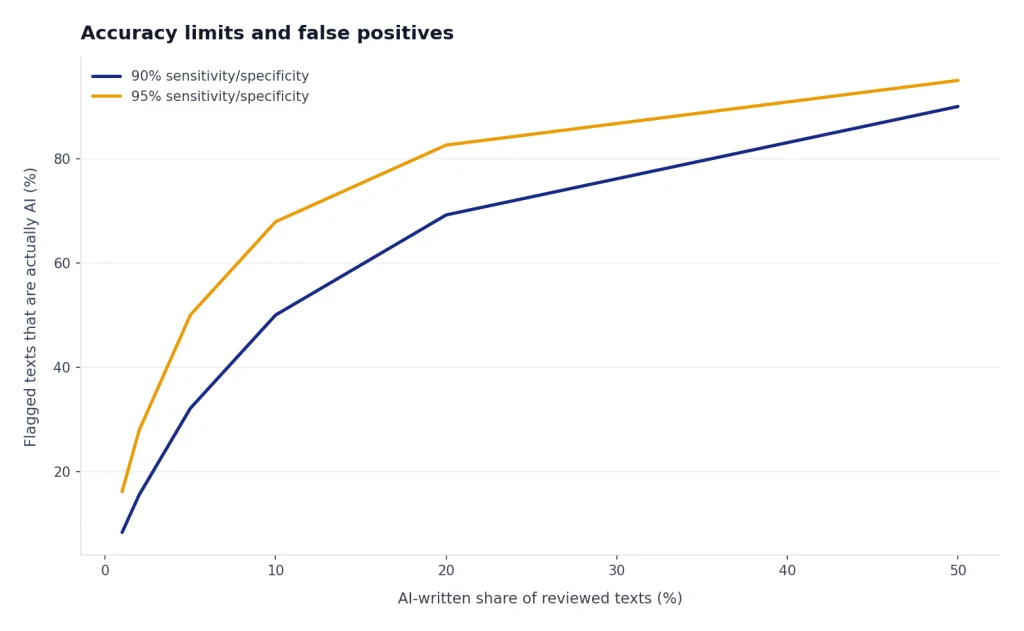
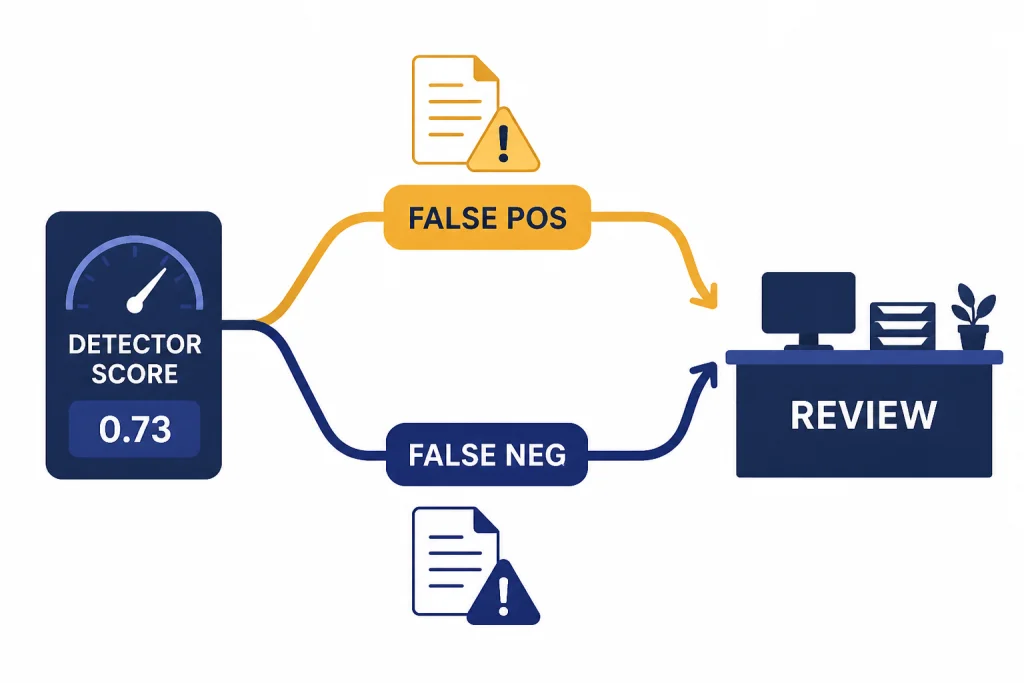
False negatives matter too. AI text can be edited, translated, paraphrased, or mixed with human writing. A detector may miss that kind of work, especially when the text is short or heavily revised. That means ZeroGPT can create both false confidence and false suspicion.
Use sentence highlights carefully. A highlighted sentence can show where the model sees AI-like patterns. It does not show intent, misconduct, or authorship. If you are reviewing student work, use the highlight as a prompt for discussion. Ask the student how they drafted the passage, what sources they used, and why they made specific wording choices.
ZeroGPT pricing and free access
For most readers, the free version is the main reason to try ZeroGPT. The homepage says registered users get 20,000 free characters daily, split as 10K for AI detection and 10K for the AI humanizer.[1] The detector page separately says free users can check up to 5,000 characters per detection.[2] Those two limits can both matter: one governs a single submission, while the other describes a daily allocation across tools.
The public pricing page we could access did not render plan details in the retrieved page content. Because of that, this review does not quote ZeroGPT paid prices. OpenAI has not published an official figure for ZeroGPT pricing, and ZeroGPT’s own retrievable pricing page did not expose the plan table in our source capture.
If you only need occasional checks, start free. If you need records, team permissions, audit trails, LMS integration, or consistent reporting, compare paid platforms before subscribing. A free detector can be convenient, but a school or business workflow often needs policy controls more than another percentage score.
Developers should look separately at the API. ZeroGPT’s API page lists AI text detection, sentence-level analysis, multi-language support, and real-time results.[3] It also shows a sample response with fields such as an AI percentage, confidence value, and sentence analysis.[3] If you are building internal tooling, also compare cost and usage with our guide to OpenAI API cost calculator tools and our overview of token counter tools.
ZeroGPT alternatives
ZeroGPT is not the only AI detector worth considering. The right alternative depends on why you are checking the text. A teacher needs different evidence than a blog editor. A publisher may need plagiarism and originality checks. A researcher may need citation review, not just AI scoring.
GPTZero is a common comparison point because it focuses on AI detection and writing analysis. Its pricing page lists a free plan with limited AI detection and paid subscription options.[7] Copyleaks is more relevant when you want AI detection and plagiarism detection in one report; its pricing page lists plans that include AI detection and plagiarism detection together.[8] Originality.ai is aimed more at publishers and teams, with AI detection, plagiarism checks, readability, and API access presented together.[9]
| Tool type | Best fit | Why you might choose it over ZeroGPT |
|---|---|---|
| ZeroGPT | Fast free checks | Low friction and simple results |
| GPTZero | Education-focused AI review | More structured detection workflow |
| Copyleaks | AI plus plagiarism review | Combines originality and AI checks |
| Originality.ai | Publishing and team review | Built around editorial quality workflows |
| Manual review | High-stakes decisions | Uses drafts, sources, interviews, and writing history |
If you work with academic sources, also compare AI detection with research-specific tools in our guide to AI research tools for academics. If the issue is summarizing long files, not proving authorship, use a purpose-built tool from our AI summarizer tools guide instead.
A safer workflow for using AI detectors
The safest way to use ZeroGPT is to separate detection from judgment. The detector can help you decide where to look. It should not decide what happened.
- Run the text through ZeroGPT only after you know your policy allows it.
- Save the full report, not just the percentage.
- Check whether the flagged passages are boilerplate, citations, definitions, or formulaic transitions.
- Ask for drafts, outlines, notes, version history, or source lists.
- Use a plagiarism checker if copied text is part of the concern.
- Give the writer a chance to explain the process.
- Make the final decision based on evidence, not a detector score.
Privacy also matters. ZeroGPT’s terms say data submitted for analysis is processed for that purpose and not stored on its servers.[4] That is a useful claim, but institutions should still avoid submitting sensitive student records, confidential business documents, medical text, legal files, or unpublished manuscripts unless their policies permit it.
For classroom use, the better long-term approach is to design assignments around process. Ask for topic proposals, annotated bibliographies, outlines, draft checkpoints, and short reflections. That creates a record of authorship that is more reliable than a detector percentage.
For business use, set a clear AI writing policy. Define when AI assistance is allowed, what must be disclosed, and which work must remain human-authored. If you do not define the rule first, an AI detector will become a vague substitute for policy.
Frequently asked questions
Is ZeroGPT accurate?
ZeroGPT advertises 98.5% accuracy, but that is a vendor claim, not a universal guarantee.[1] AI detector accuracy depends on text length, genre, language background, editing, and which model produced the text. Use the score as a clue, not proof.
Is ZeroGPT free?
Yes, ZeroGPT offers free AI detection. Its detector page says free users can check up to 5,000 characters per detection.[2] The homepage also describes 20,000 daily free characters for registered users across AI detection and humanizer use.[1]
Can teachers use ZeroGPT to accuse a student?
They should not use ZeroGPT alone for an accusation. AI detectors can produce false positives, especially with predictable prose or non-native English writing. A responsible process includes drafts, version history, assignment-specific questioning, and school policy.
Does ZeroGPT detect plagiarism?
AI detection and plagiarism detection are different tasks. ZeroGPT’s broader suite lists a plagiarism checker, but the AI detector itself estimates whether text looks AI-generated.[1] If copied sources are your concern, use a plagiarism checker in addition to any AI detector.
Does ZeroGPT store my text?
ZeroGPT’s terms say submitted analysis data is processed for that purpose and is not stored on its servers.[4] Even so, avoid submitting confidential or regulated material unless your organization has approved the tool. Privacy claims do not replace your own compliance obligations.
What is the best ZeroGPT alternative?
GPTZero is a common education-focused alternative, while Copyleaks and Originality.ai are stronger fits when you need broader originality or team workflows.[7][8][9] The best alternative depends on whether you need a quick free scan, a plagiarism report, classroom review, or an editorial audit trail.