

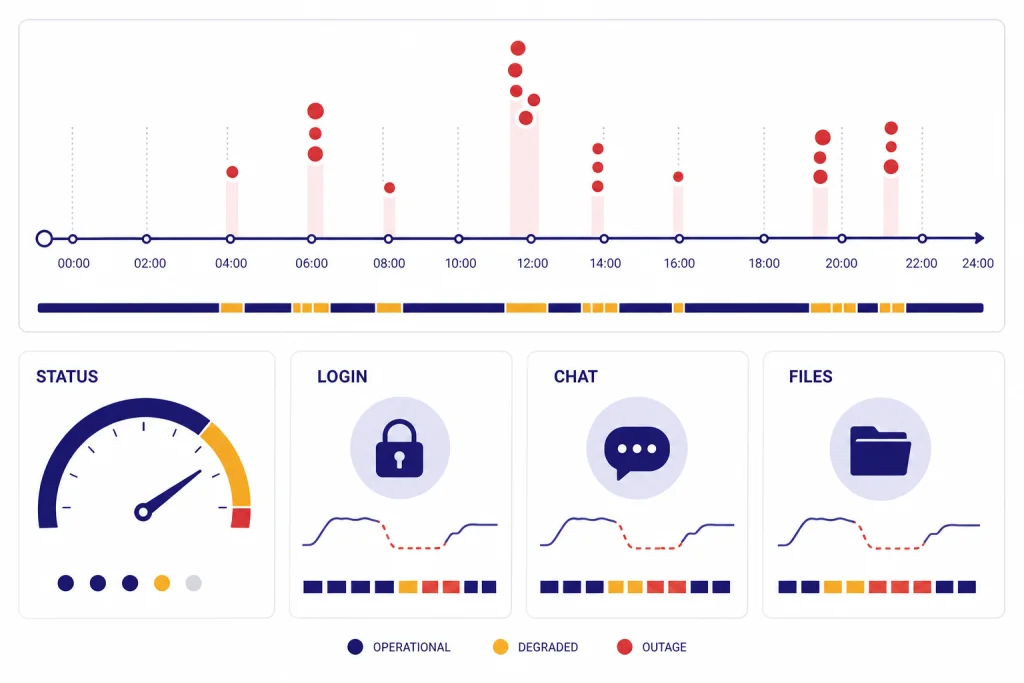
ChatGPT outage history is useful because the same failure patterns keep returning: database dependency failures, capacity shortages, deployment mistakes, authentication problems, and feature-specific breakdowns such as file uploads or image generation. This guide tracks the major ChatGPT downtime events documented by OpenAI through March 18, 2026. It focuses on incidents that affected availability, conversation generation, login, or major ChatGPT features, rather than every minor degraded-performance notice. Use it to understand whether a current problem looks like a platform outage, a local browser or app issue, a rate-limit problem, or a feature-specific failure that needs a different fix.
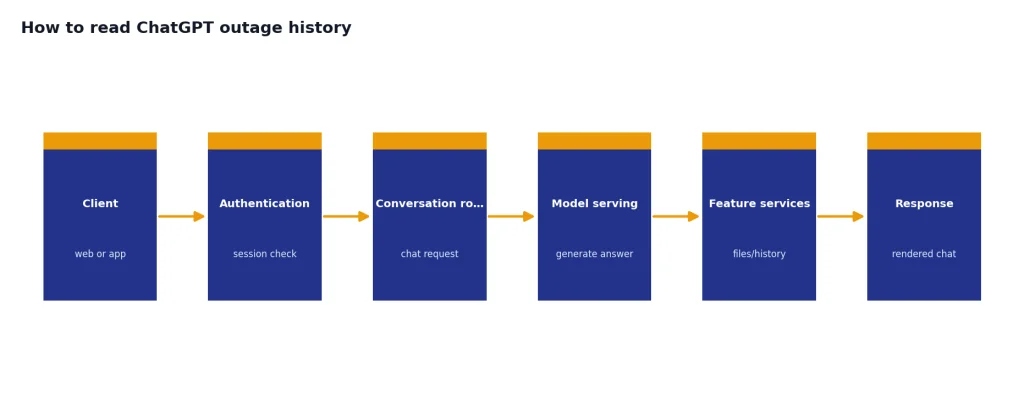
How to read ChatGPT outage history
OpenAI’s status page is the primary source for ChatGPT outage history. It reports incidents across ChatGPT, APIs, Sora, Codex, and related services. OpenAI also warns that availability metrics are reported at an aggregate level across tiers, models, and error types, so an individual user may see a different result depending on their plan, model, or feature path.[1]
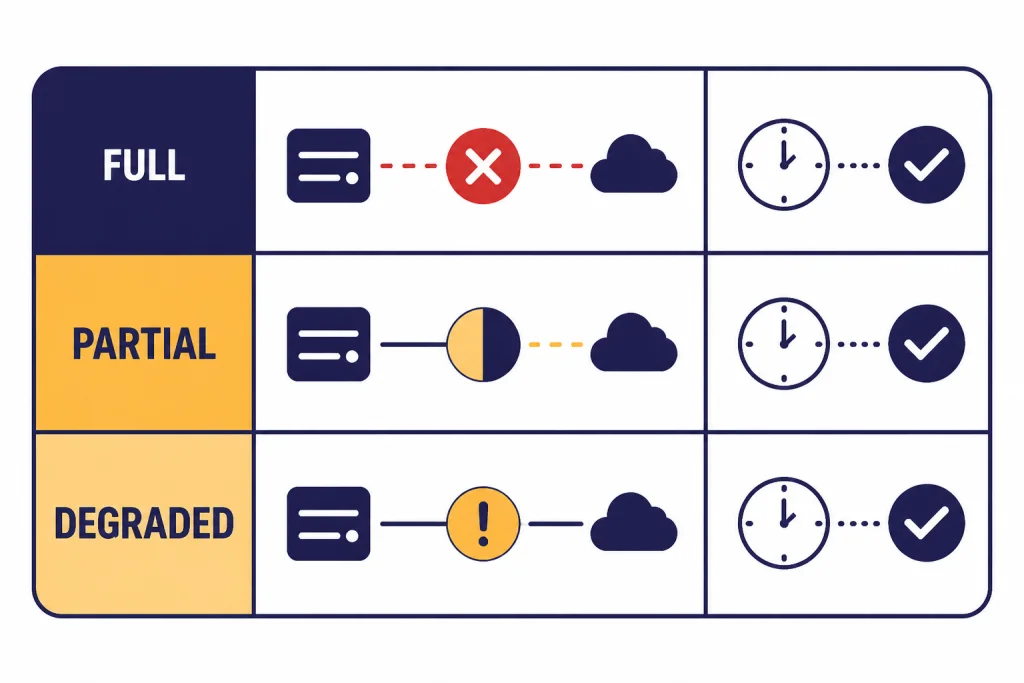
That matters. A full outage can make ChatGPT unavailable to most users. A partial outage can break one route, such as login, file uploads, voice, or a model family. Degraded performance may look like slow answers, blank completions, 500-class errors, 403 access failures, or repeated “something went wrong” messages. If you are troubleshooting live, start with the official status page, then compare your symptom with a targeted guide such as chatgpt login failed, chatgpt error 503 service unavailable, or chatgpt network error.
This article includes major incidents that OpenAI marked as full outages, partial outages, or substantial degraded performance affecting ChatGPT availability, conversations, login, or major product features. It does not include every short-lived API-only incident or every small feature bug. For a year-specific running log, see our chatgpt outages 2026 tracker.
Major ChatGPT outage timeline
The table below summarizes the major downtime events documented by OpenAI through the publication date of this article, March 18, 2026. Times appear as OpenAI reported them, usually in Pacific time. Some incidents have a separate postmortem; others only have a status-page update.
| Date | Incident | Impact | Cause or status note |
|---|---|---|---|
| March 20, 2023 | ChatGPT web interface incident | ChatGPT service was restored first, while conversation history took longer to restore. | OpenAI later said it took ChatGPT offline because of a Redis library bug that allowed some users to see titles from another active user’s chat history.[2][3] |
| November 8, 2023 | Major outage across ChatGPT and API | A large portion of OpenAI requests failed between 5:42 AM and 7:16 AM PT. | OpenAI attributed the incident to routing-layer nodes hitting memory limits and failing readiness checks during unusually high completions traffic.[4] |
| November 21, 2023 | Elevated errors on API and ChatGPT | The failure rate peaked at 75% on paid and free ChatGPT. | OpenAI said PostgresDB maintenance caused both read replicas for a load-bearing database path to fail at the same time.[5] |
| December 14, 2023 | Major outage on ChatGPT on web | ChatGPT on web was intermittently unavailable between 5:32 PM and 6:10 PM PST. | OpenAI said it identified and addressed the source of the problem, but did not publish a detailed root cause in the incident page.[6] |
| June 4, 2024 | ChatGPT unavailable for all user tiers | OpenAI reported a major outage affecting all user tiers, including paid, enterprise, free, and anonymous users. | The incident involved a ChatGPT-dependent database becoming unavailable after traffic surges tied to a connection pooling service.[7] |
| June 17, 2024 | Elevated errors on ChatGPT | ChatGPT experienced elevated error rates from 11:39 AM to 2:02 PM PT, with the majority of requests failing at one point. | OpenAI cited an inference-engine issue, cascading event-bus issues, IO-blocking, and a bug that returned empty completion responses.[8] |
| November 8, 2024 | ChatGPT currently unavailable | A large portion of ChatGPT traffic failed with 503 response codes from 4:06 PM to 4:41 PM PT. | OpenAI said a downstream load-balancing configuration change activated a latent bug and caused server workers to crash.[9] |
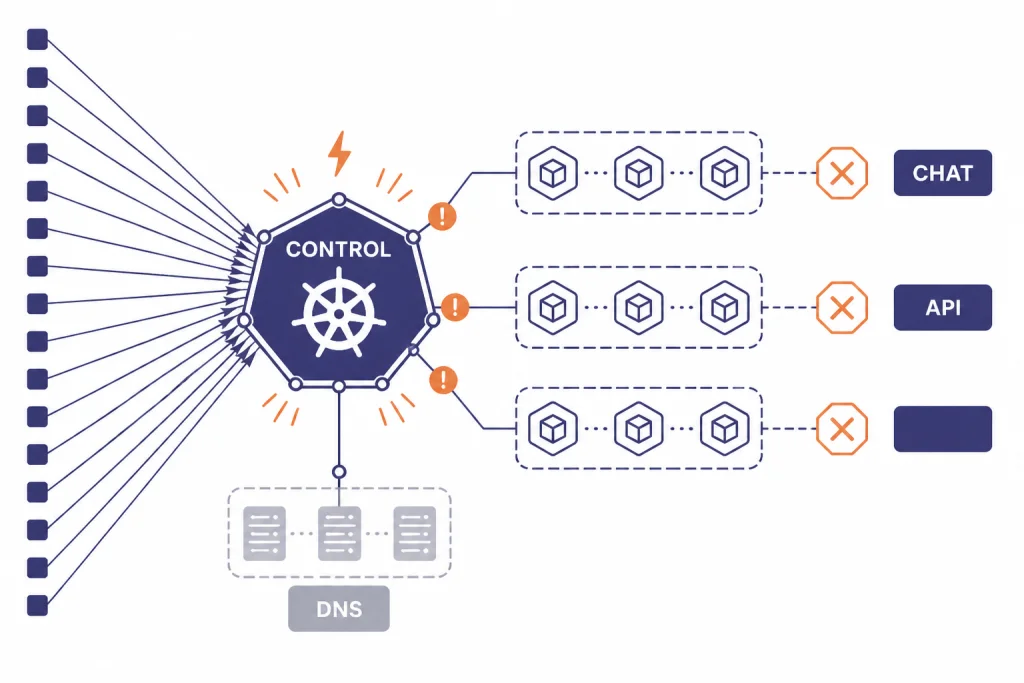
| December 11, 2024 | API, ChatGPT, and Sora facing issues | All OpenAI services experienced significant degradation or complete unavailability between 3:16 PM and 7:38 PM PST. | A new telemetry service overwhelmed the Kubernetes control plane and disrupted DNS-based service discovery.[10] |
| December 26, 2024 | High error rates for ChatGPT, APIs, and Sora | ChatGPT, Sora, and many APIs saw more than 90% error rates during the incident. | OpenAI said the root cause was a power failure in a cloud provider data center that affected critical services such as databases.[11] |
| February 6, 2025 | Increased errors for ChatGPT, Sora, and API | OpenAI marked the incident as a full outage affecting APIs, ChatGPT, and Sora. | The status page listed the incident as resolved, but did not publish a detailed root cause on the incident page.[12] |
| June 10, 2025 | Elevated error rates | ChatGPT error rates peaked at about 35%, and full recovery completed at 3:00 PM PDT on June 10. | A routine host operating-system update on cloud-hosted GPU servers caused many GPU nodes to lose network connectivity.[13] |
| November 14–15, 2025 | ChatGPT file uploads failing | File uploads to ChatGPT conversations failed for some users, including errors indicating that the file had expired. | OpenAI identified the cause and rolled out a fix; the incident page did not publish a separate postmortem.[14] |
| February 3, 2026 | Elevated error rates for ChatGPT and Platform users | The incident affected login functionality, account creation, and ChatGPT conversation availability across plan types. | A configuration change introduced an unexpected data type in a critical execution path; retry traffic amplified the load.[15] |
| February 4, 2026 | ChatGPT availability impacted | Some users experienced 403 errors when accessing ChatGPT between 9:06 AM and 9:59 AM PT. | A cloud maintenance event reduced database capacity, shifted load to remaining replicas, and amplified retries in internal services.[16] |
| February 10, 2026 | GPT-5.2 elevated error rates | Paid ChatGPT plans experienced elevated conversation errors for about 105 minutes. | OpenAI cited a temporary serving-capacity shortfall in one GPT-5.2 model fleet.[17] |
| February 12, 2026 | ChatGPT conversation issues | Successful conversation request rates dropped by about 35% during the peak impact window. | A routine deployment unintentionally removed a routing configuration resource needed by affected service instances.[18] |
| March 2, 2026 | File uploads and file processing failing | Some users saw failures or delays when uploading files or when newly uploaded content was processed. | OpenAI resolved the degraded-performance incident, which affected ChatGPT file-related components and Codex.[19] |
The biggest outages and what caused them
The most consequential ChatGPT outages were not all the same kind of failure. Some were classic availability incidents. Others were privacy, database, identity, or capacity events that surfaced to users as the same simple experience: ChatGPT would not answer.
March 2023: the outage that also exposed account data
The March 20, 2023 outage stands apart because it combined downtime with a data-exposure issue. OpenAI said a bug in the Redis client library allowed some users to see titles from another active user’s chat history, and that payment-related information of 1.2% of active ChatGPT Plus subscribers during a specific nine-hour window may have been visible.[2] Full credit card numbers were not exposed, according to OpenAI.[2]
For users, the visible symptom was a broken ChatGPT web experience and missing history. The official status incident said service was fully restored while OpenAI continued working to restore past conversation history.[3] That pattern still matters. A live chat window can work while history, pinned chats, uploads, or account features remain broken.
June 2024: all user tiers were affected
The June 4, 2024 incident was one of the clearest broad ChatGPT outages. OpenAI said the outage affected all user tiers, including paid, enterprise, free, and anonymous users, and that the impact did not include platform.openai.com or the API.[7] The root cause was a database dependency that became unavailable after traffic surges connected to a pooling service configuration.[7]
This is why “ChatGPT is down” does not always mean “OpenAI is fully down.” The ChatGPT web and app experience can fail while API traffic, the developer platform, or certain model endpoints continue to work. The reverse can also happen.
December 2024: infrastructure failures hit multiple products
OpenAI’s December 11, 2024 postmortem described a broad infrastructure failure across API, ChatGPT, and Sora. A new telemetry service created unexpectedly heavy Kubernetes API load, overwhelmed the control plane, and broke DNS-based service discovery.[10] OpenAI said all services experienced significant degradation or complete unavailability between 3:16 PM and 7:38 PM PST.[10]
Two weeks later, the December 26, 2024 incident produced more than 90% error rates for ChatGPT, Sora video creation, and many APIs.[11] This time, OpenAI said the root cause was a power failure in a cloud provider data center that affected critical services, including databases.[11] These two incidents show that ChatGPT availability depends on more than model inference. Control planes, DNS, databases, cloud regions, identity systems, and failover procedures all matter.
June 2025: GPU network connectivity caused a long degradation
The June 10, 2025 outage was a capacity and infrastructure incident. OpenAI said a routine host operating-system update on cloud-hosted GPU servers caused many GPU nodes to lose network connectivity, which reduced available capacity.[13] ChatGPT error rates peaked at about 35%, while API error rates peaked at about 25%, and full recovery completed at 3:00 PM PDT.[13]
For users, this kind of failure often looks inconsistent. One prompt may work. The next may fail. Mobile may behave differently from desktop. Paid and free users may see different model availability. If you are seeing slow answers rather than a hard outage, use our guide to why ChatGPT is so slow before assuming your device is broken.
What the outage history shows
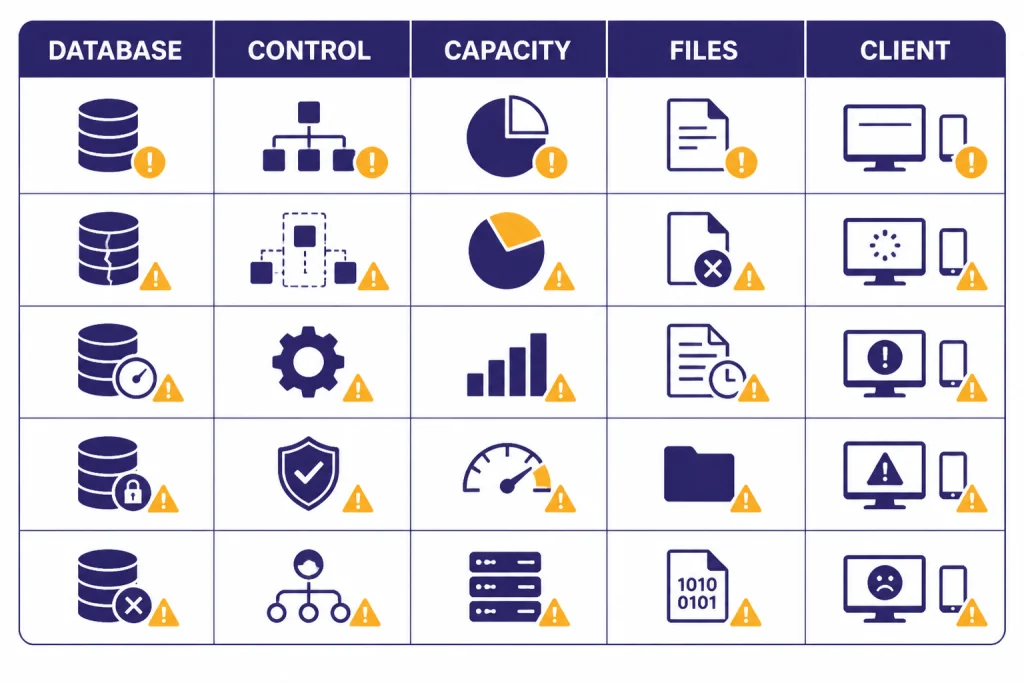
ChatGPT outages tend to cluster around a few recurring failure types. The labels below are editorial categories based on OpenAI’s incident write-ups and status updates, not OpenAI’s own taxonomy.
| Pattern | How it appears to users | Examples | Best first check |
|---|---|---|---|
| Database and identity dependencies | Login failures, 403 errors, missing history, stalled sessions. | November 21, 2023; June 4, 2024; February 4, 2026.[5][7][16] | Try a private window, then check status before resetting your account. |
| Deployment or configuration changes | Sudden conversation failures after a release, often resolved by rollback or config change. | November 8, 2024; February 3, 2026; February 12, 2026.[9][15][18] | Wait for mitigation if the issue is visible on OpenAI Status. |
| Capacity and model-serving pressure | Slow replies, intermittent errors, model-specific failures, or plan-specific impact. | June 10, 2025; February 10, 2026.[13][17] | Switch models if available, reduce prompt size, and retry later. |
| Feature-specific failures | Chat works, but files, images, voice, or a client feature fails. | November 2025 and March 2026 file-upload incidents.[14][19] | Use a feature guide such as chatgpt file upload not working or chatgpt app not working. |
| External cloud or provider problems | Broad degradation across several OpenAI products, sometimes with slow failover. | December 26, 2024 cloud provider data-center power failure.[11] | Do not spend time reinstalling apps if multiple products are affected. |
The practical lesson is simple. If many users are affected, local fixes rarely solve the root cause. Your job is to reduce wasted time: confirm whether the platform is impaired, preserve your work, and choose a workaround. If only you are affected, local causes such as VPN routing, browser cache, device app state, or account authentication become more likely. For those cases, use the ChatGPT VPN issues guide, the ChatGPT app troubleshooting guide, or the ChatGPT error 502 bad gateway guide.
What to do when ChatGPT is down
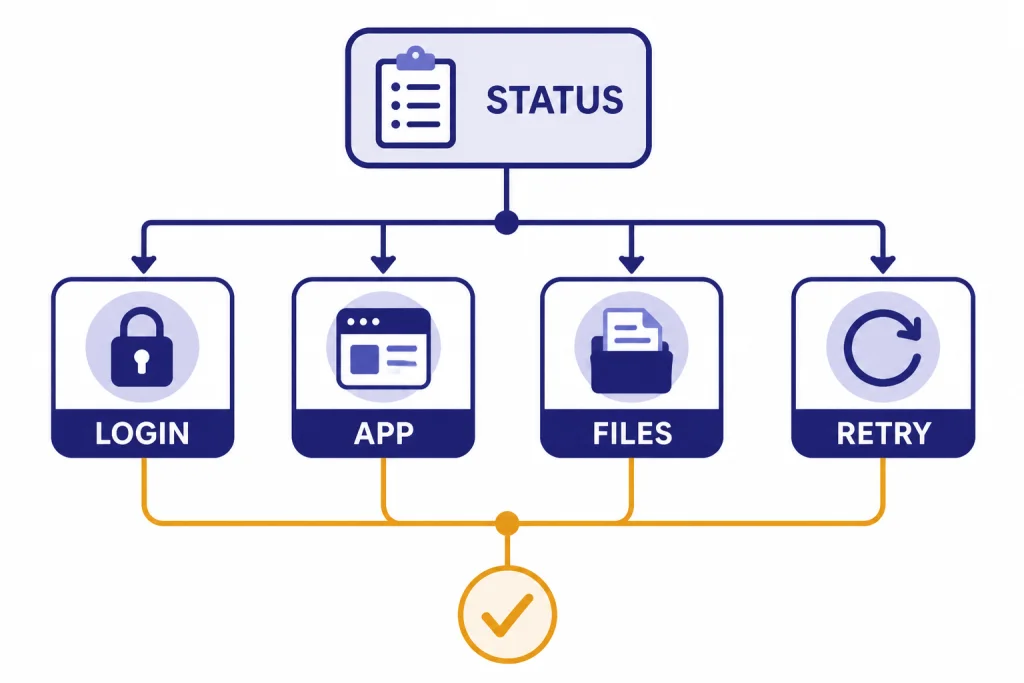
When ChatGPT fails, do not start by changing every setting. Work from broadest cause to narrowest cause.
- Check OpenAI Status first. If ChatGPT, login, conversations, files, or a specific model is listed as degraded, wait for mitigation before changing your setup.
- Preserve your prompt. Copy long prompts into a note before refreshing. During outages, a failed retry can lose form state.
- Compare clients. Try web, mobile, and desktop if you have them. A feature can fail in one client while another still works.
- Separate outage errors from rate limits. If you see “too many requests,” use the ChatGPT error 429 guide or the too many requests in 1 hour guide. Rate limits are not the same as a platform outage.
- Match the error code. A 500 error, 502 error, and 503 error point to different layers. Use chatgpt error 500 internal server, ChatGPT Error 502 Bad Gateway, or chatgpt internal server error depending on what you see.
- Try a clean session. Sign out and back in, use a private window, disable extensions, and test without a VPN only after checking the status page.
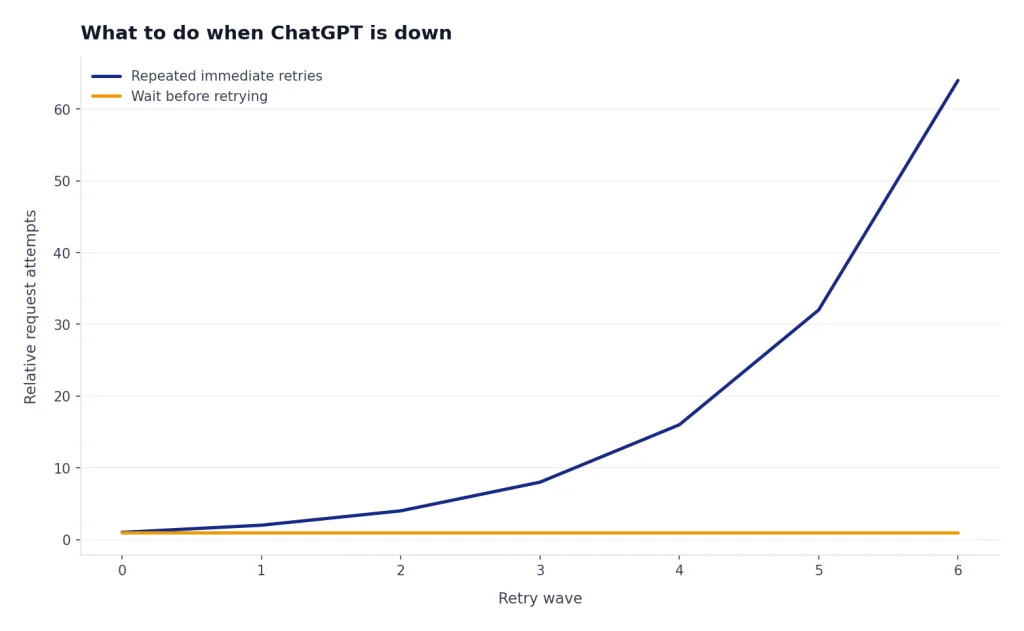
- Do not repeatedly submit the same request during an active incident. Retry storms can make user-facing failures worse, and OpenAI’s postmortems have repeatedly mentioned retry amplification or load pressure during incidents.[15][16]
If ChatGPT is partly working, choose a workaround based on the broken feature. For uploads, use smaller files or wait for the file pipeline to recover. For login, avoid repeated password resets unless the status page is clear. For a missing conversation, do not assume deletion; history features can lag behind the main chat service, as the March 2023 incident showed.[3] If you need access without a normal session, see how to use ChatGPT without logging in, but remember that no-login access may not include the same tools or saved history.
Frequently asked questions
What was the worst ChatGPT outage?
There is no single official ranking. The December 11, 2024 incident was one of the broadest because OpenAI said all services experienced significant degradation or complete unavailability between 3:16 PM and 7:38 PM PST.[10] The December 26, 2024 incident was also severe because ChatGPT, Sora, and many APIs saw more than 90% error rates.[11]
Does a ChatGPT outage always affect the API?
No. Some incidents affect ChatGPT only, while others affect APIs, Sora, Codex, or the developer platform. The June 4, 2024 ChatGPT outage affected all ChatGPT user tiers, but OpenAI said it did not include platform.openai.com or the API.[7]
Why does ChatGPT work for some people during an outage?
OpenAI reports availability at an aggregate level, and individual availability can vary by subscription tier, model, and feature path.[1] A partial outage can hit one region, model fleet, login route, client, or feature while other paths still work. That is why one user may be blocked while another can still chat.
Are file upload outages the same as ChatGPT being down?
Not usually. A file-upload incident can leave normal text chat working while uploads or processing fail. OpenAI documented file-upload failures in November 2025 and file-upload and processing failures in March 2026.[14][19]
Should I reinstall the ChatGPT app during an outage?
Only after you check OpenAI Status and test another client. Reinstalling the app will not fix a platform outage, database problem, or model-serving capacity issue. It can help if the status page is clear and only your device or app session is failing.
How often does ChatGPT go down?
ChatGPT has had several major incidents since 2023, plus many smaller degraded-performance events. The frequency varies by year and by feature. The best way to judge a current problem is to check the status page and compare your symptom with the historical patterns in this guide.