


The GPT-5 launch was OpenAI’s August 7, 2025 release of a new default ChatGPT system and API model family.[1] It replaced model-picking with automatic routing between fast replies and deeper reasoning, opened GPT-5 to Free, Plus, Pro, and Team users, and gave developers `gpt-5`, `gpt-5-mini`, `gpt-5-nano`, and `gpt-5-chat-latest`.[1] The launch mattered because it turned GPT into a routed product experience, not just a single model upgrade. It also drew criticism when older ChatGPT models disappeared too abruptly.[10] As of May 1, 2026, original GPT-5 is no longer selectable in ChatGPT, but GPT-5 remains important background for the newer GPT-5.3, GPT-5.4, and GPT-5.5 family.[4]
What happened at the GPT-5 launch
OpenAI launched GPT-5 on August 7, 2025.[1] In ChatGPT, it became the new default for signed-in users and replaced GPT-4o, OpenAI o3, OpenAI o4-mini, GPT-4.1, and GPT-4.5.[1] That made the GPT-5 launch a product migration as much as a model release.
OpenAI described GPT-5 as a unified system.[1] The system used a fast model for ordinary prompts, a deeper reasoning model for harder prompts, and a router that decided which path to use.[1] Users could still steer the system by asking it to think harder, and paid users could manually choose GPT-5 Thinking at launch.[1]
The launch followed months of speculation and prelaunch GPT-5 feature rumors. The official result was less about a single chatbot personality and more about an operating layer for ChatGPT, Codex, and the API. OpenAI also said GPT-5 was trained on Microsoft Azure AI supercomputers, tying the release to the broader OpenAI-Microsoft infrastructure relationship.[1]
There was immediate disagreement about how large the leap felt. OpenAI called GPT-5 a significant advance across coding, math, writing, health, visual perception, and more.[1] Reuters reported that two early reviewers were impressed by coding, science, and math performance, but did not see a jump as large as the move from GPT-3 to GPT-4.[12] Both readings can be true. GPT-5 was a major integration launch, but it did not land for every user as a simple step-change in day-to-day chat quality.
| Launch fact | What OpenAI announced | Why it mattered |
|---|---|---|
| Date | August 7, 2025 | GPT-5 became the next flagship ChatGPT system.[1] |
| ChatGPT access | Free, Plus, Pro, and Team rollout began at launch; Enterprise and Edu followed after.[1] | GPT-5 was not limited to paid subscribers, although paid plans received higher usage.[1] |
| Default behavior | GPT-5 replaced several older ChatGPT models for signed-in users.[1] | The model picker became less central, and automatic routing became the default experience.[1] |
| API family | OpenAI introduced gpt-5, gpt-5-mini, gpt-5-nano, and gpt-5-chat-latest.[2] | Developers could trade off capability, cost, latency, and chat-style behavior.[2] |
| Current note | Original GPT-5 was retired from ChatGPT on February 13, 2026.[11] | The launch still explains the GPT-5 family, but ChatGPT now uses newer GPT-5.x models. |

What GPT-5 changed in ChatGPT
The main ChatGPT change was automatic routing.[1] Before GPT-5, advanced users often chose between general models, reasoning models, and faster mini models. GPT-5 collapsed that choice into a default system that could answer quickly or reason longer depending on the request.[1]
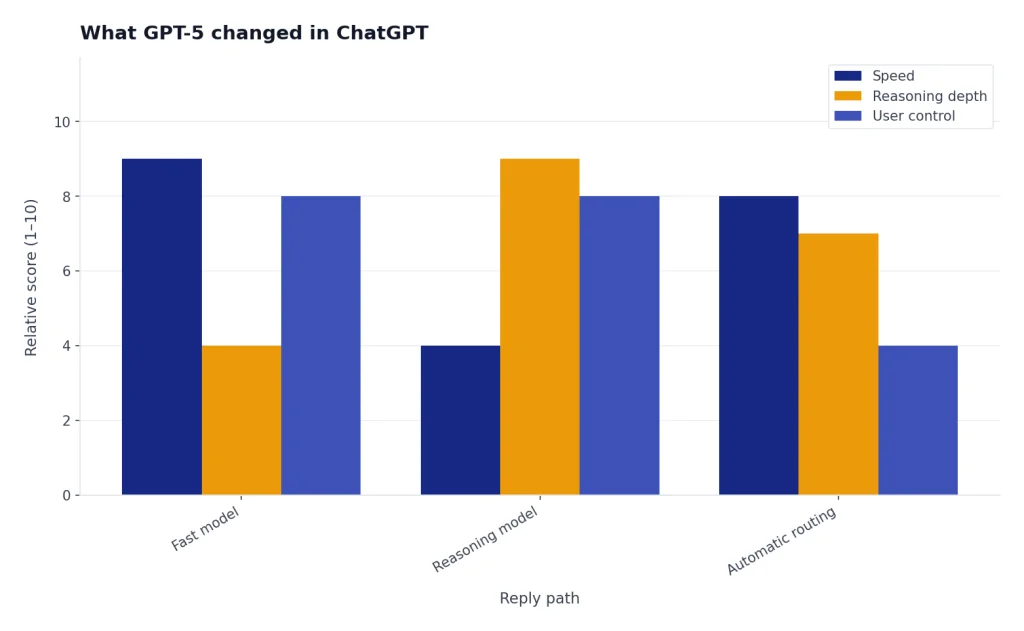
This simplified the interface for casual users. It also removed a layer of control that many power users had built into their habits. The same prompt could feel different because the system might route it differently, and the loss of older models changed the tone and workflow for users who had standardized around GPT-4o or o3.
OpenAI’s GPT-5 system card mapped the old model world to the new system.[3] GPT-4o corresponded to a fast GPT-5 main model.[3] OpenAI o3 corresponded to a GPT-5 thinking model.[3] Smaller prior models had GPT-5 mini and nano successors.[3] That mapping is useful when comparing GPT-5 against later models in our GPT model comparison and when checking the context window guide.
GPT-5 Pro was the high-compute version for harder questions.[1] OpenAI said external experts preferred GPT-5 Pro over GPT-5 Thinking in real-world reasoning prompts, and that GPT-5 Pro made fewer major errors in those evaluations.[1] In practice, Pro was meant for questions where accuracy, depth, and completeness mattered more than speed.

Performance claims that mattered
OpenAI’s launch materials emphasized benchmarks, lower hallucination rates, better coding, and stronger instruction following.[1] The most useful way to read those claims is by task type, not as one universal score.
- Coding: OpenAI reported 74.9% on SWE-bench Verified and 88% on Aider Polyglot. It also said GPT-5 was preferred over o3 in internal front-end web development comparisons 70% of the time.
- Math and science: OpenAI reported 94.6% on AIME 2025 without tools and 88.4% on GPQA for GPT-5 Pro without tools.
- Multimodal and health: OpenAI reported 84.2% on MMMU and 46.2% on HealthBench Hard.
- Factuality: With web search enabled on anonymized ChatGPT traffic prompts, OpenAI said GPT-5 responses were about 45% less likely to contain a factual error than GPT-4o. When thinking, OpenAI said GPT-5 responses were about 80% less likely to contain a factual error than OpenAI o3.
- Efficiency: OpenAI said GPT-5 Thinking performed better than o3 with 50-80% fewer output tokens across several capability areas.
The safety claims also mattered. OpenAI said GPT-5 reduced sycophantic replies in targeted evaluations from 14.5% to less than 6%.[3] It also introduced safe completions, a training approach designed to provide partial or high-level help when a full answer could cross a safety boundary.[3] For biological and chemical risk, OpenAI treated GPT-5 Thinking as High capability and said it completed 5,000 hours of red-teaming with external partners.[3]
Benchmarks do not guarantee a better answer for every prompt. They do show the areas OpenAI optimized: coding, tool use, long-context retrieval, factuality, and safer responses. The launch was strongest for work that benefits from reasoning and structured tool use. It was weaker for users who mainly judged ChatGPT by warmth, familiarity, or creative voice.
Availability, model names, and pricing
At launch, GPT-5 was available to all ChatGPT tiers, with higher usage for paid accounts and GPT-5 Pro for Pro subscribers.[1] Free users could use GPT-5 but could be moved to GPT-5 mini after hitting limits.[1] Paid users had more model-picker control, including GPT-5 Thinking.[1]
For developers, GPT-5 had a separate model family.[2] OpenAI said the API version of gpt-5 was the reasoning model that powered maximum performance in ChatGPT, while the non-reasoning ChatGPT model was exposed as gpt-5-chat-latest.[2] That distinction matters when reproducing ChatGPT-like behavior in an app.
| Use case | Launch-era GPT-5 option | Pricing or access note | Best reader takeaway |
|---|---|---|---|
| Everyday ChatGPT | Default GPT-5 system | Available to Free and paid users, with usage differences by plan.[1] | Most people did not need to pick a model. |
| Harder ChatGPT tasks | GPT-5 Thinking | Paid users could select it or prompt ChatGPT to think harder.[1] | Use it for planning, analysis, code review, and multi-step work. |
| Highest-accuracy ChatGPT work | GPT-5 Pro | Available to Pro subscribers at launch.[1] | Use it when slower answers are acceptable. |
| API reasoning | gpt-5 | OpenAI’s GPT-5 model page lists $1.25 input, $0.125 cached input, and $10.00 output per 1M tokens, with a 400,000-token context window.[5] | Good for coding, reasoning, and agentic tasks if you still need the original GPT-5 API model. |
| Current frontier API comparison | gpt-5.5 | OpenAI’s current API pricing page lists GPT-5.5 standard pricing at $5.00 input, $0.50 cached input, and $30.00 output per 1M tokens.[7] | Do not assume GPT-5 launch pricing reflects newer GPT-5.x models. |
API prices and plan limits change often. If cost is central to your decision, use our API pricing breakdown alongside OpenAI’s current pricing pages. If you are choosing a ChatGPT subscription, compare the current plan limits in the ChatGPT Plus pricing guide.
What GPT-5 meant for developers
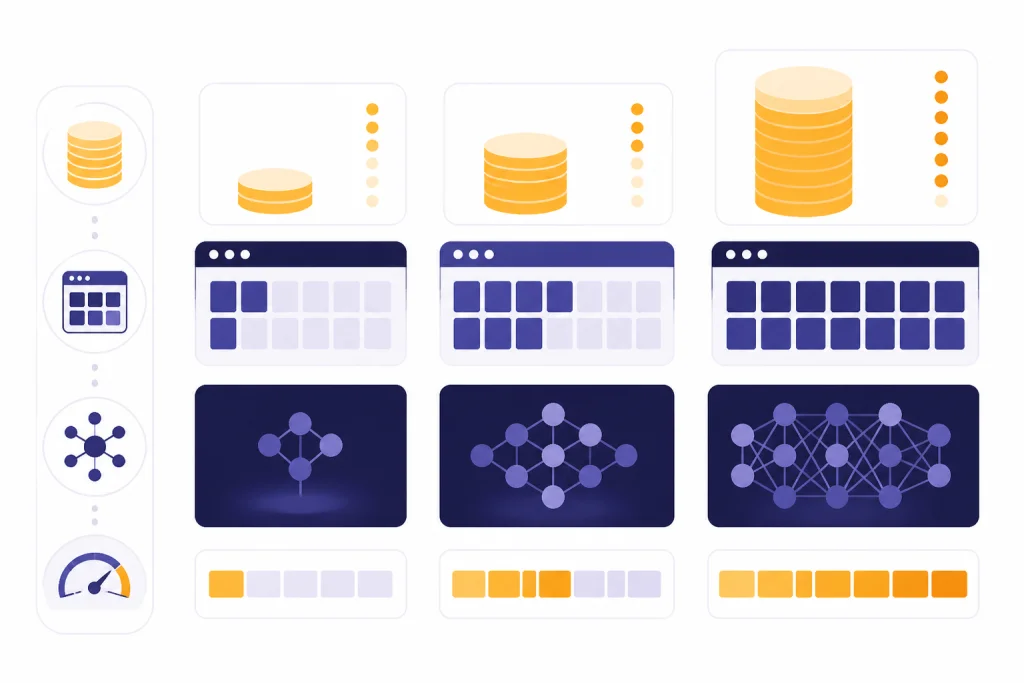
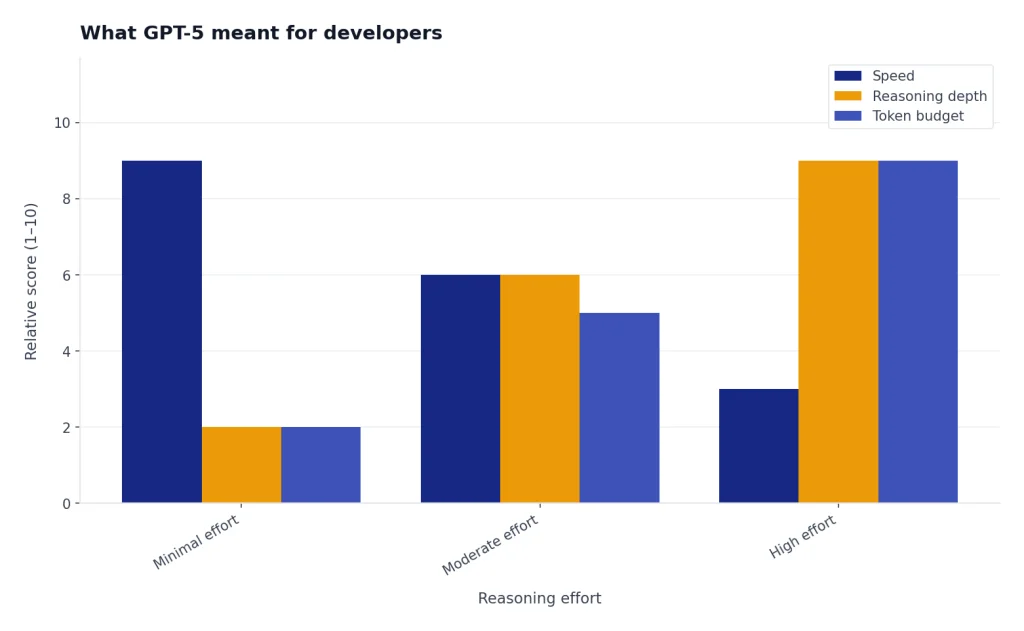
GPT-5 was a developer launch because it changed how OpenAI expected applications to use models. The API introduced three GPT-5 sizes: gpt-5, gpt-5-mini, and gpt-5-nano.[2] It also gave developers more controls over output length and reasoning effort.[2]
The new verbosity control let developers bias answers toward shorter or longer responses.[2] The reasoning_effort setting added a minimal option for faster answers when deep reasoning was not needed.[2] OpenAI also introduced custom tools so GPT-5 could call tools with plaintext rather than only JSON, including support for grammar constraints supplied by developers.[2]
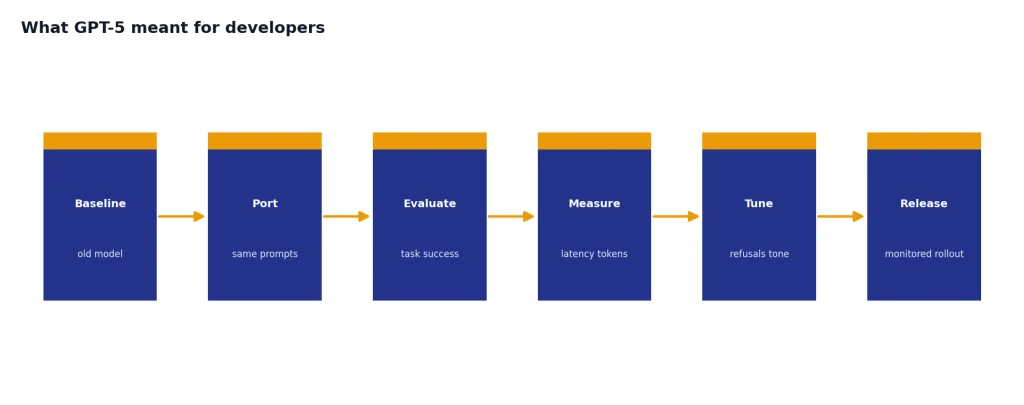
The practical migration lesson was clear. Do not move a production prompt from GPT-4o or o3 to GPT-5 and assume the same behavior. Test task success, refusal behavior, latency, token use, and tone. GPT-5 could be more capable and still break a workflow if the old prompt depended on a specific model style.
- For coding agents: benchmark bug fixing, repository search, test generation, and tool-call recovery.
- For support agents: test handoffs, escalation rules, grounded retrieval, and refusal language.
- For writing products: test tone controls and avoid overfitting prompts to one model personality.
- For data-heavy apps: measure total cost per completed task, not only token price.
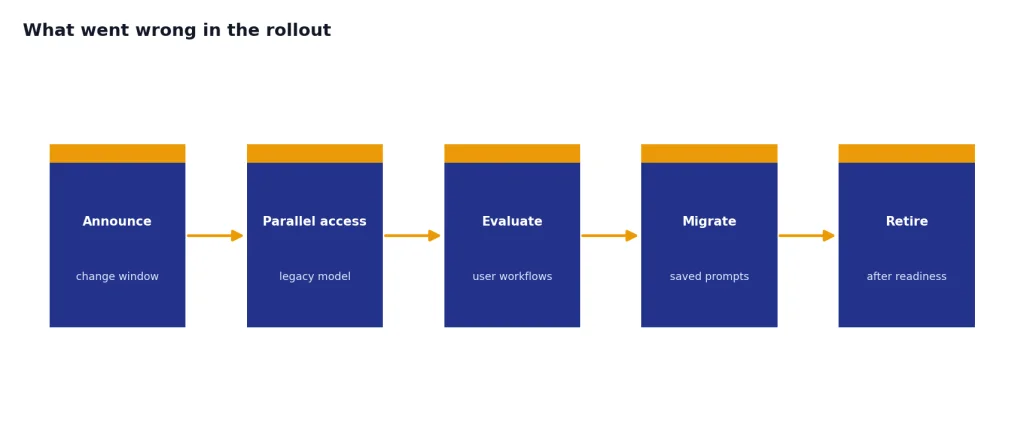
What went wrong in the rollout
The GPT-5 launch problem was not only model quality. It was also change management. OpenAI replaced several familiar models at once, reduced visible model choice, and expected automatic routing to feel like an improvement. For many users, it did. For others, it removed a familiar tool without enough transition time.
OpenAI later acknowledged the issue in its January 2026 retirement post.[10] The company said it brought GPT-4o back after feedback from a subset of Plus and Pro users who needed more time to transition creative workflows and preferred GPT-4o’s conversational style and warmth.[10] OpenAI also said that feedback shaped GPT-5.1 and GPT-5.2, including personality, creative ideation, and customization improvements.[10]
That history is why GPT-5.1 and GPT-5.2 matter when evaluating the original GPT-5 launch. See our GPT-5.1 update notes and GPT-5.2 release coverage for the follow-up changes. The launch made GPT-5 the foundation, but the later updates repaired parts of the user experience.
The lesson for AI product teams is straightforward. Model upgrades should ship with migration controls, legacy access, and clear communication. A technically stronger model can still feel worse if it changes tone, removes choices, or breaks saved workflows.
Current status on May 1, 2026
As of May 1, 2026, original GPT-5 is historical in ChatGPT but still relevant in the API.[11] OpenAI’s Help Center says GPT-5 Instant and GPT-5 Thinking were retired from ChatGPT on February 13, 2026.[11] It also says GPT-5.1 Instant, GPT-5.1 Thinking, and GPT-5.1 Pro were retired from ChatGPT on March 11, 2026.[11]
Current ChatGPT documentation centers on GPT-5.3 and GPT-5.5.[8] OpenAI’s Help Center describes GPT-5.3 as the default for logged-in users and GPT-5.5 Thinking as the more capable reasoning option for difficult work.[8] OpenAI launched GPT-5.5 on April 23, 2026, and described it as stronger for coding, research, data analysis, document and spreadsheet creation, computer use, and multi-step tool work.[9]
| Question | Answer on May 1, 2026 |
|---|---|
| Is GPT-5 out? | Yes. It launched on August 7, 2025.[1] |
| Is original GPT-5 still the ChatGPT default? | No. Original GPT-5 ChatGPT models were retired on February 13, 2026.[11] |
| Is GPT-5 still available through the API? | OpenAI’s retirement notices say API access was unchanged when ChatGPT retired original GPT-5.[11] |
| What is the current GPT-5 family in ChatGPT? | OpenAI’s current Help Center page describes GPT-5.3 and GPT-5.5 as the active ChatGPT generation.[8] |
| Is GPT-5.5 the newest model? | OpenAI launched GPT-5.5 on April 23, 2026, making it the current headline GPT-5.x release at the time of this article.[9] |
There is one documentation wrinkle. OpenAI’s Help Center page still contains launch-day wording that GPT-5.5 was not launching to the API that day, while the GPT-5.5 launch post was updated on April 24, 2026 to say GPT-5.5 and GPT-5.5 Pro are available in the API.[9] OpenAI’s API pricing page also lists GPT-5.5 prices.[7] For billing and production planning, treat the pricing page and developer docs as the live reference.
What users and teams should do now
If you are a regular ChatGPT user, do not look for the original GPT-5 selector. Use the current Instant, Thinking, and Pro choices available in your account. For routine writing, search, and summaries, Instant is usually the starting point. For analysis, coding, planning, and multi-file work, use Thinking if your plan includes it.
If you are a developer, decide whether you need stability or frontier performance. Existing applications can keep using a stable GPT-5 API target if it meets your needs and remains supported. New complex workflows should be tested against the newer GPT-5.x models, especially if tool use, long-running agents, or code execution matter.
If you manage a team, audit prompts, Custom GPTs, saved workflows, and evaluation suites after every model retirement. The GPT-5 launch showed that tone and routing changes can affect user trust even when benchmarks improve. Track ongoing changes in our 2026 ChatGPT changelog, and use the OpenAI funding timeline for context on why model launches are tied to large infrastructure spending.
Frequently asked questions
When did GPT-5 launch?
GPT-5 launched on August 7, 2025.[1] OpenAI released it in ChatGPT and the API on the same day, with ChatGPT rollout beginning across Free, Plus, Pro, and Team users.[1]
Is GPT-5 available now?
Original GPT-5 is no longer available as a selectable ChatGPT model.[11] OpenAI retired GPT-5 Instant and GPT-5 Thinking from ChatGPT on February 13, 2026.[11] API access was not changed by that ChatGPT retirement notice.[11]
What was the biggest GPT-5 launch change?
The biggest change was the unified ChatGPT system.[1] GPT-5 combined fast answers, deeper reasoning, and automatic routing, so most users did not need to choose between several models.[1]
Was GPT-5 better than GPT-4o?
OpenAI’s benchmarks showed GPT-5 ahead in many areas, including coding, math, factuality, multimodal tasks, and health evaluations.[1] Some users still preferred GPT-4o’s conversational style.[10] OpenAI later said feedback about GPT-4o shaped GPT-5.1 and GPT-5.2.[10]
What were the GPT-5 API model names?
The launch API models were gpt-5, gpt-5-mini, and gpt-5-nano.[2] OpenAI also exposed the non-reasoning ChatGPT model as gpt-5-chat-latest.[2]
Should developers start new projects on GPT-5?
Developers should test the current GPT-5.x family before starting a new production project. Original GPT-5 can still make sense for stable workloads, but newer models may be stronger for agentic coding, tool use, and long-context work. Always compare accuracy, latency, and total cost per successful task.