
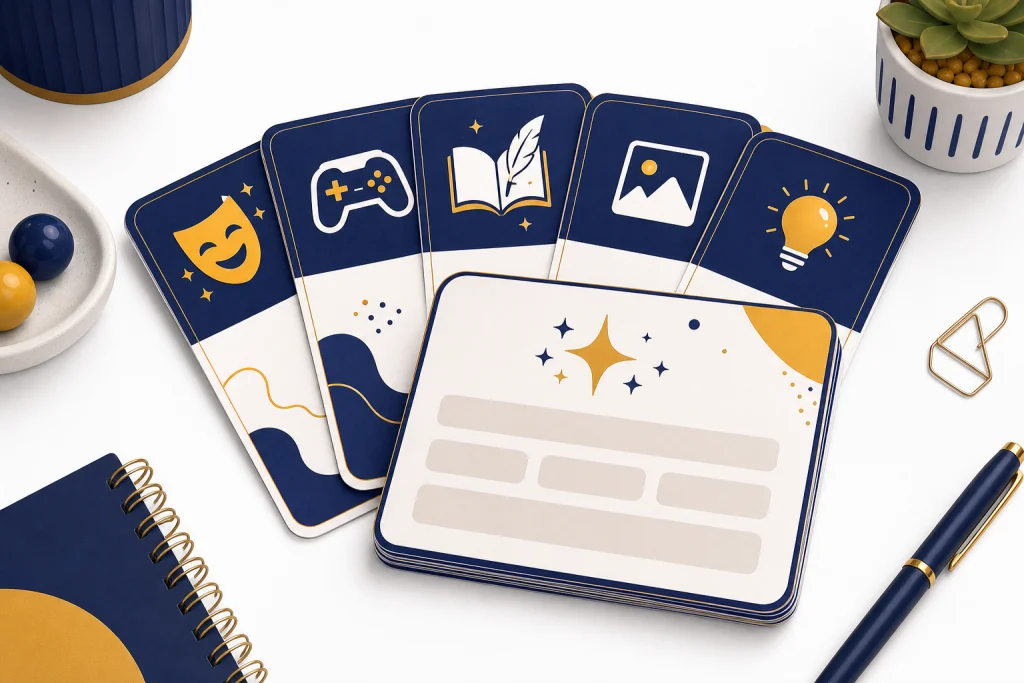
ChatGPT fun prompts work best when they give the model a playful role, a clear task, and a specific output style. This guide gives you copy-paste prompts for games, jokes, stories, imaginary debates, party ideas, image concepts, learning challenges, and low-stakes creative experiments. ChatGPT can help with writing, brainstorming, image-related tasks, files, and other conversational workflows, so the best fun prompts treat it like an improv partner rather than a search box.[1] Use these prompts as starting points. Change the topic, tone, difficulty, age range, and boundaries until the result fits the moment.
How to make funny prompts work
A fun prompt still needs structure. The model can be playful, but it cannot read the joke you have in your head. OpenAI’s prompt guidance recommends clear instructions, useful context, and a defined output format; those habits matter even when the task is silly.[2] A vague prompt like “be funny” often gives generic jokes. A stronger prompt says who the joke is for, what style to use, what to avoid, and what the finished answer should look like.
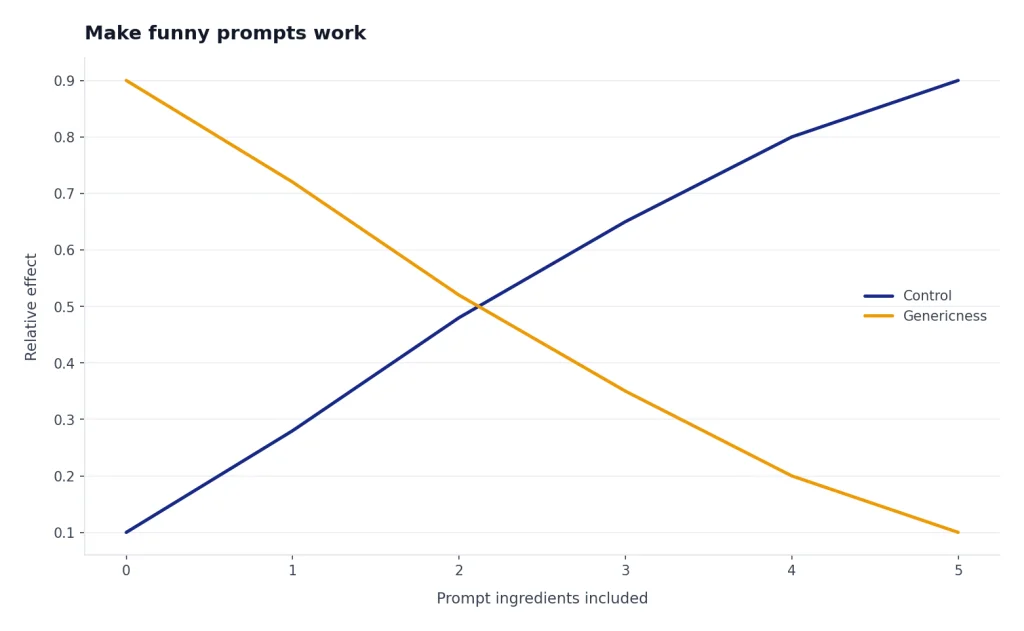
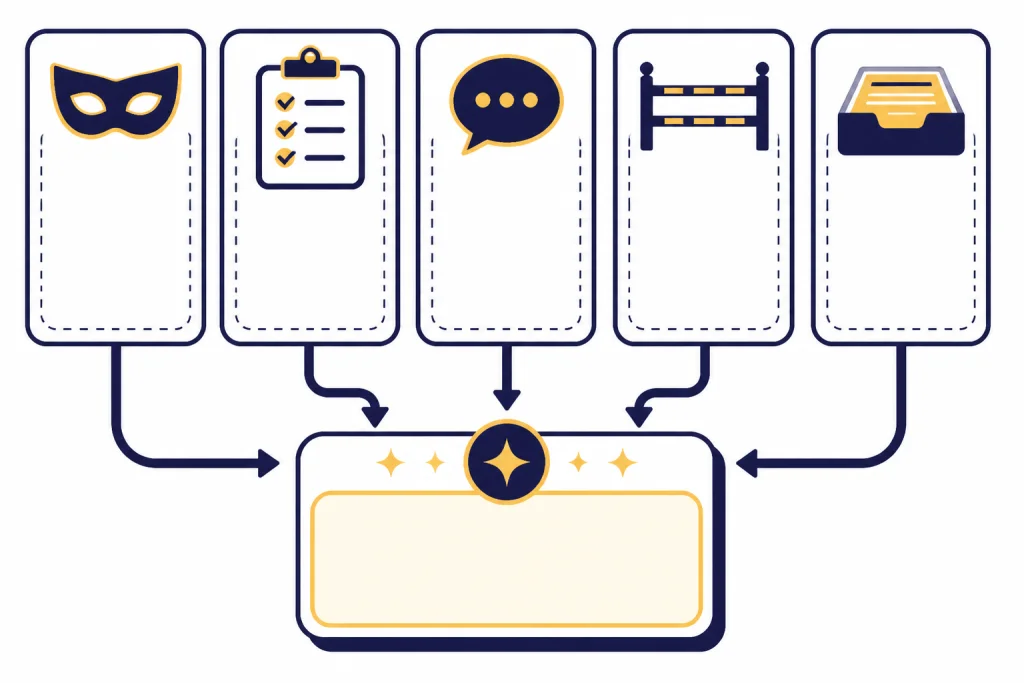
Use this simple pattern: role + task + topic + constraints + format. The role gives ChatGPT a point of view. The task tells it what to make. The topic gives it material. The constraints keep the answer usable. The format tells it whether you want a list, dialogue, quiz, mini-game, script, caption, table, or scene.
Reusable fun prompt formula: Act as [playful role]. Create [type of output] about [topic]. Make it [tone]. Avoid [boundaries]. Format it as [list, script, quiz, game, table, or scene].
For example, do not ask, “Make my dinner sound funny.” Ask, “Act as a dramatic sports announcer. Describe my ordinary Tuesday dinner of soup and toast like it is the final seconds of a championship. Keep it family-friendly. Format it as a short play-by-play.” That extra context gives the model a lane to stay in.
If you want more control over your own templates, use a chatgpt prompt generator after you test the ideas below. If you want a more serious creative-writing library, pair this article with our take on chatgpt creative prompts.
Copy-paste ChatGPT fun prompts
These prompts are written to be pasted directly into ChatGPT. Replace bracketed details with your topic. Keep the prompts short if you want quick output. Add more context if you want a more specific result.
Quick laughs
- The over-serious announcer: Describe [ordinary activity] like a high-stakes documentary narrator. Make it dramatic, clean, and slightly ridiculous.
- The tiny inconvenience trial: Put [minor annoyance] on trial in a fake courtroom. Include an opening statement, witness testimony, and a verdict.
- The fake product pitch: Pitch [useless object] as if it is a premium luxury product. Include a slogan, target customer, and absurd selling points.
- The office horoscope: Write a fake horoscope for someone whose main personality trait is [trait]. Keep it affectionate, not mean.
- The apology tour: Write a public apology from [object, pet, or fictional creature] for causing [small problem]. Make it charming and over-polished.
Games and party prompts
- Invent a party game: Create a simple party game for [group type] using only [available items]. Include rules, scoring, and a tiebreaker.
- Would-you-rather ladder: Give me a sequence of would-you-rather questions about [theme]. Start easy and get stranger, but keep everything safe for mixed company.
- Two truths and a lie coach: Help me write playful two-truths-and-a-lie options about [hobby, job, trip, or era of life]. Make the lie believable.
- Trivia with fake confidence: Create a trivia round about [topic]. Include plausible wrong answers and explain the correct answer after each question.
- Conversation rescue kit: Give me conversation starters for [event]. Sort them by casual, funny, thoughtful, and weird-but-safe.
Story and imagination prompts
- Genre swap: Retell [ordinary event] as a [genre] story. Keep it concise and give it a satisfying ending.
- Object monologue: Write a first-person monologue from [household object] after a long day. Make it witty and oddly philosophical.
- Mini mystery: Create a cozy mystery where the missing item is [object] and the suspects are [people, pets, or objects]. Reveal a harmless twist.
- Fake folklore: Invent a local legend explaining why [place or object] is the way it is. Make it sound like something a grandparent would tell.
- Time-travel review: Write a review of [modern item] from the perspective of a traveler from [past era]. Mix confusion with admiration.
Personalized fun
- Personality menu: Turn my personality traits into a restaurant menu. Use [traits] and make each menu item sound appetizing but funny.
- Life as a board game: Turn my current week into a board game. Include spaces, power-ups, setbacks, and a victory condition.
- Theme song brief: Write a fake theme song concept for me based on [job, hobby, pet, and habit]. Include the style and chorus idea, but do not write copyrighted lyrics.
- Compliment generator: Give me sincere but funny compliments for someone who is [description]. Avoid sarcasm and insults.
- Alternate universe bio: Write a short alternate-universe biography where I became [unlikely profession]. Keep it warm and playful.
Learning that feels like play
- Explain it as a sport: Teach me [concept] as if it were a sport with teams, rules, penalties, and winning strategies.
- Quiz show host: Act as a game show host teaching [topic]. Ask one question at a time and wait for my answer before revealing hints.
- Memory palace comedy: Help me remember [list or process] by turning each part into an absurd visual scene.
- Debate club: Stage a friendly debate between [concept A] and [concept B]. Make each side persuasive and funny.
- Explain badly, then fix it: Explain [topic] in the most hilariously wrong way possible, then correct every mistake clearly.
For study-first uses, see ChatGPT Learning Prompts for Self-Study or ChatGPT Student Prompts for Better Grades. For kitchen experiments, chatgpt for cooking can help turn the “fake restaurant menu” idea into real meal planning.
Pick the right fun prompt format
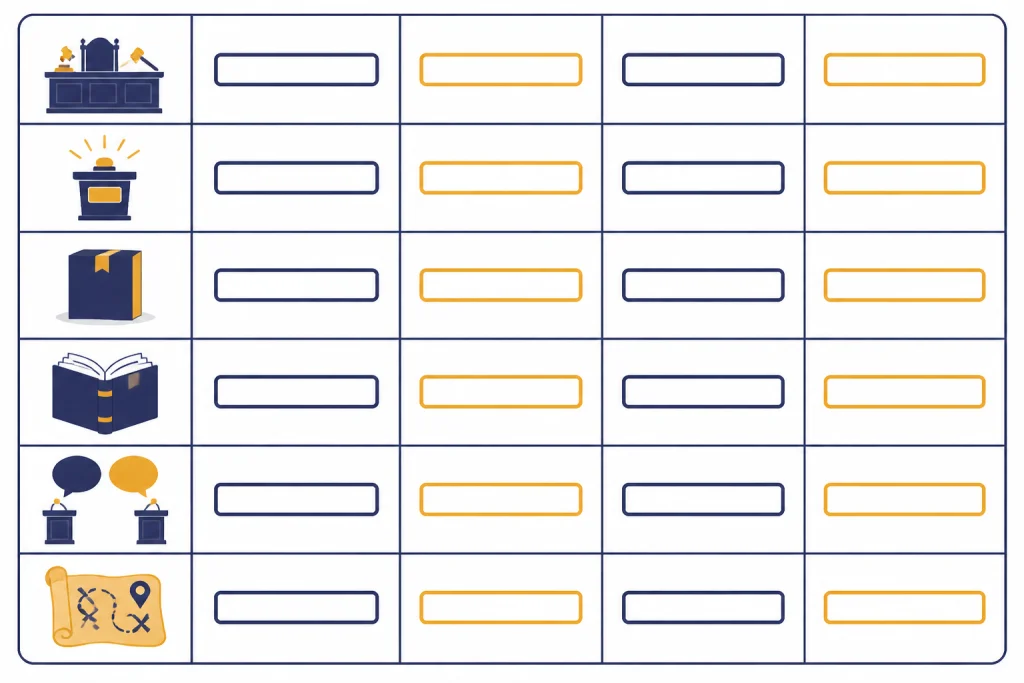
The same idea can land very differently depending on the format. “Make this funny” is less useful than “turn this into a mock trial,” “turn this into a quiz,” or “turn this into a dramatic narrator scene.” Use the table below when you know the mood you want but not the prompt shape.
| Prompt format | Best when you want | What to include | Starter line |
|---|---|---|---|
| Mock trial | A harmless roast of an object, habit, or inconvenience | Defendant, charge, witnesses, verdict | Put [minor problem] on trial for [offense]. |
| Game show | Interactive fun with friends or learning | Theme, difficulty, rules, answer style | Host a game show about [topic] and ask me one question at a time. |
| Fake product pitch | Absurd marketing humor | Product, audience, benefits, disclaimers | Pitch [ordinary item] like a premium invention. |
| Genre swap | Creative writing without a blank page | Original event, genre, tone, ending | Rewrite [event] as a [genre] scene. |
| Persona debate | Two viewpoints with comic contrast | Characters, topic, boundaries, winner rule | Stage a friendly debate between [A] and [B]. |
| Mini quest | A playful task list or motivation boost | Goal, obstacles, rewards, tone | Turn [task] into a tiny adventure quest. |
Format also controls how much work you need to do after the answer arrives. A table is easy to skim. A dialogue is better for roleplay. A quiz becomes interactive. A script can become a video, a party bit, or a social post. If you want to adapt a funny result for public platforms, use chatgpt social media prompts for every platform or ChatGPT for YouTubers as the next step.
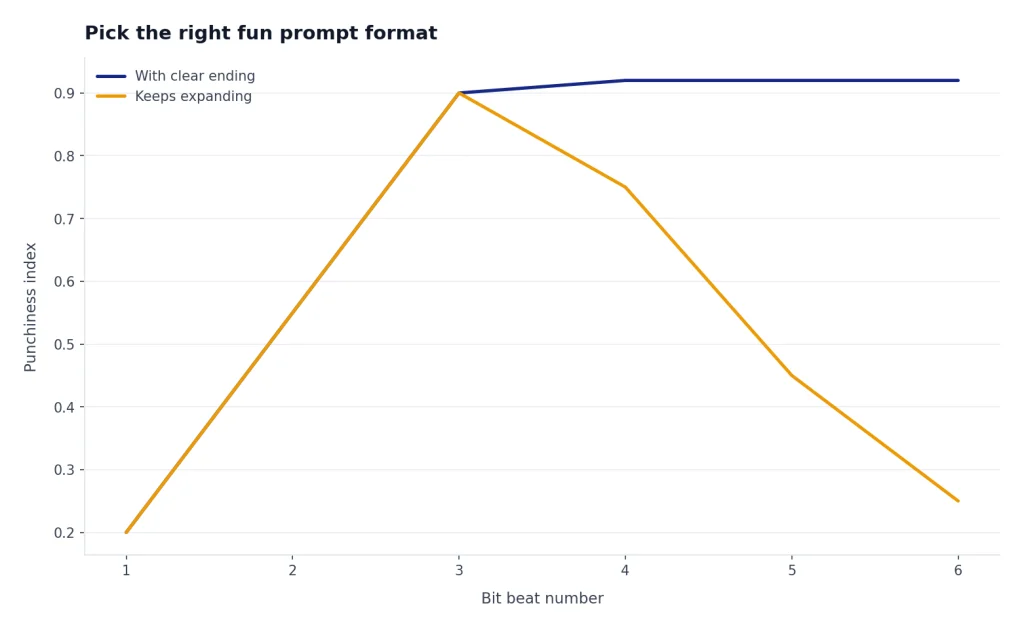
The best format is usually the one with a clear stopping point. Ask for a verdict, a final score, a punchline, a closing line, or a “next move.” Otherwise, ChatGPT may keep expanding the bit past the point where it is still funny.
Fun image and roleplay prompts
ChatGPT can also support visual ideation. OpenAI’s image help explains that users can ask ChatGPT to create images and can upload an existing image to request edits.[3] For a fun prompt, that means you can ask for a silly poster concept, a fictional product package, a mascot, a room makeover idea, or a visual gag. Keep the image prompt concrete. Name the subject, setting, action, style, composition, and anything to avoid.
- Fictional poster: Create an image prompt for a vintage-style poster advertising [ordinary chore] as if it were an epic expedition. Include composition, mood, color palette, and visual details. Avoid real brand names.
- Pet as a CEO: Create an image prompt for [pet description] as the confident CEO of a tiny company. Make it whimsical, polished, and not photorealistic unless I ask for realism.
- Impossible restaurant: Create an image prompt for a restaurant where the entire menu is based on [theme]. Describe the storefront, signature dish display, and atmosphere.
- Board game box: Create an image prompt for a fake board game called [title] about [daily struggle]. Include box art, tokens, and a playful visual style. Do not include readable text.
- Museum exhibit: Create an image prompt for a museum exhibit dedicated to [mundane object]. Make it look respectfully overproduced.
Roleplay prompts are different. They do not need image details. They need roles, rules, and turn-taking. A strong roleplay prompt tells ChatGPT when to respond, when to ask questions, and how to keep the scene moving.
Act as the host of a cozy fantasy tavern. I am a traveler looking for a harmless quest. Ask me about my skills, offer three silly quest options, and narrate only one scene at a time. Keep the story light, funny, and safe for all ages.
For more visual prompt ideas, see Best ChatGPT Image Prompts, ChatGPT Caricature Prompts, and ChatGPT Action Figure Prompts. Those are better fits when the final output should be an image concept rather than a text joke.
Safety and taste checks
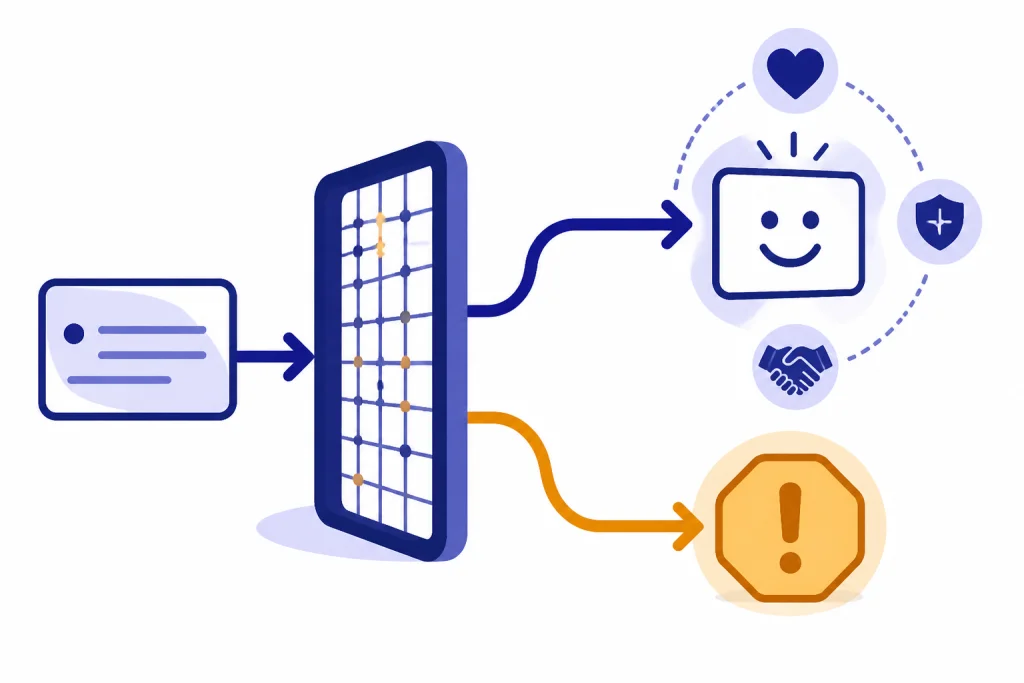
Funny prompts should not become harassment, deception, or unsafe content. OpenAI’s usage policies prohibit uses such as threats, harassment, defamation, deception, scams, impersonation, certain unlawful activity, and attempts to infringe intellectual property rights.[4] That matters for “roast me” prompts, parody prompts, fake ads, and celebrity-style requests. Keep the target low-stakes. Punch up at situations, objects, habits, or fictional setups rather than real private people.
A useful taste check is to add a boundary directly inside the prompt: “Make it affectionate, not cruel,” “avoid protected traits,” “do not imitate a living person’s private identity,” “keep it classroom-safe,” or “make the joke about the situation, not the person.” You can still get sharp humor without asking for personal attacks.
For roast-specific examples, use ChatGPT Roast Prompts. For work settings, be more careful. A joke that works in a private chat may not work in a team channel, hiring process, customer message, or classroom. If the audience includes coworkers, students, clients, or children, ask ChatGPT to rewrite the output in a kinder style before sharing it.
- Safer roast prompt: Roast my messy desk like a disappointed interior designer. Keep it affectionate. Do not insult me personally.
- Safer parody prompt: Write a parody of overcomplicated tech marketing without copying any real company’s slogan, product name, or brand voice.
- Safer party prompt: Create funny awards for a family gathering. Make every award kind enough that the person would smile when receiving it.
- Safer classroom prompt: Turn [topic] into a silly quiz for students. Avoid embarrassment, personal callouts, or jokes about appearance.
Turn a fun prompt into a reusable template
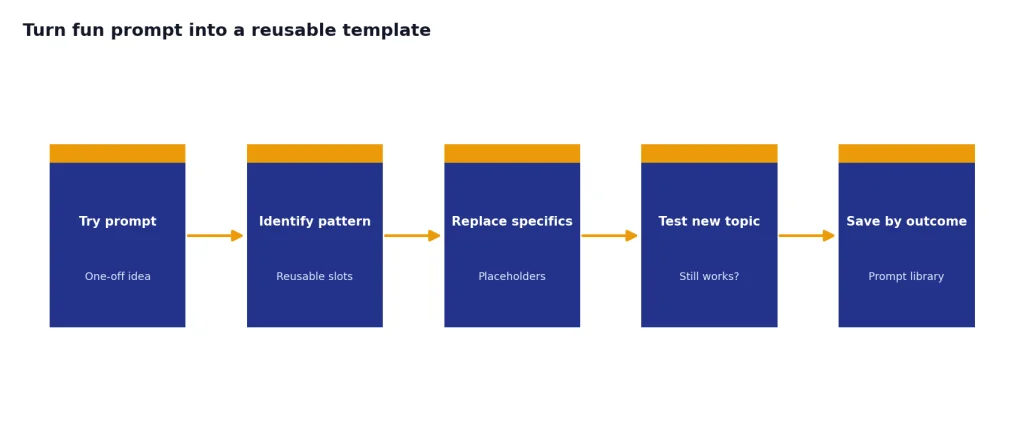
When a fun prompt works, save the structure. The exact joke may not repeat, but the pattern will. Turn the best parts into fields you can swap later: audience, topic, tone, boundaries, format, and length. This helps you build a personal prompt library instead of starting over every time.
Act as [playful role]. Create [format] about [topic] for [audience]. Make the tone [tone]. Include [required elements]. Avoid [boundaries]. End with [type of ending].
You can also ask ChatGPT to reverse-engineer the template from an answer you liked. Paste the output and say: “Turn this into a reusable prompt template. Keep the structure, but replace the specific topic with bracketed placeholders.” Then test the template on a different topic. If it still works, save it.
Prompt libraries become more useful when they are organized by outcome. Keep separate folders or notes for games, stories, image concepts, work icebreakers, learning, and social posts. If your fun prompt starts to become useful for actual work, route it to a more focused library such as chatgpt productivity prompts for daily workflow, ChatGPT Teacher Prompts, or ChatGPT Business Prompts for Owners.
Finally, keep a “tone rescue” line handy. Add it after any result that feels too bland or too intense: “Make this more surprising, but keep it kind and specific.” That one follow-up often turns a generic answer into something worth keeping.
Frequently asked questions
What are the best ChatGPT fun prompts?
The best ChatGPT fun prompts give the model a clear role, a playful task, and a specific format. Try mock trials, fake product pitches, genre swaps, party games, mini mysteries, and game-show prompts. The more concrete the setup, the less generic the answer will feel.
How do I make ChatGPT funnier?
Ask for a specific style of humor instead of saying “be funny.” For example, request dry humor, cozy absurdity, dramatic narration, gentle satire, or playful exaggeration. Add boundaries so the humor stays on target.
Can I use these prompts with friends?
Yes. The party, trivia, would-you-rather, and conversation-starter prompts work well in groups. If you are using them with mixed ages or coworkers, add “keep it safe for all ages” or “make it workplace-safe” to the prompt.
Can ChatGPT create fun image prompts?
Yes. Ask ChatGPT to write a visual prompt with subject, setting, action, style, composition, and constraints. If you plan to generate an image, avoid real brand names, copyrighted characters, or requests that imitate a living person without permission.
Why do my funny prompts sound generic?
Generic results usually come from generic setup. Add a role, audience, topic details, and a stronger format. You can also paste an answer back into ChatGPT and ask for a more specific, less predictable revision.
Should I save fun prompts that work?
Yes. Save the pattern, not only the final output. Replace the topic with placeholders so you can reuse the prompt for parties, writing warmups, social posts, classroom activities, or creative breaks.