
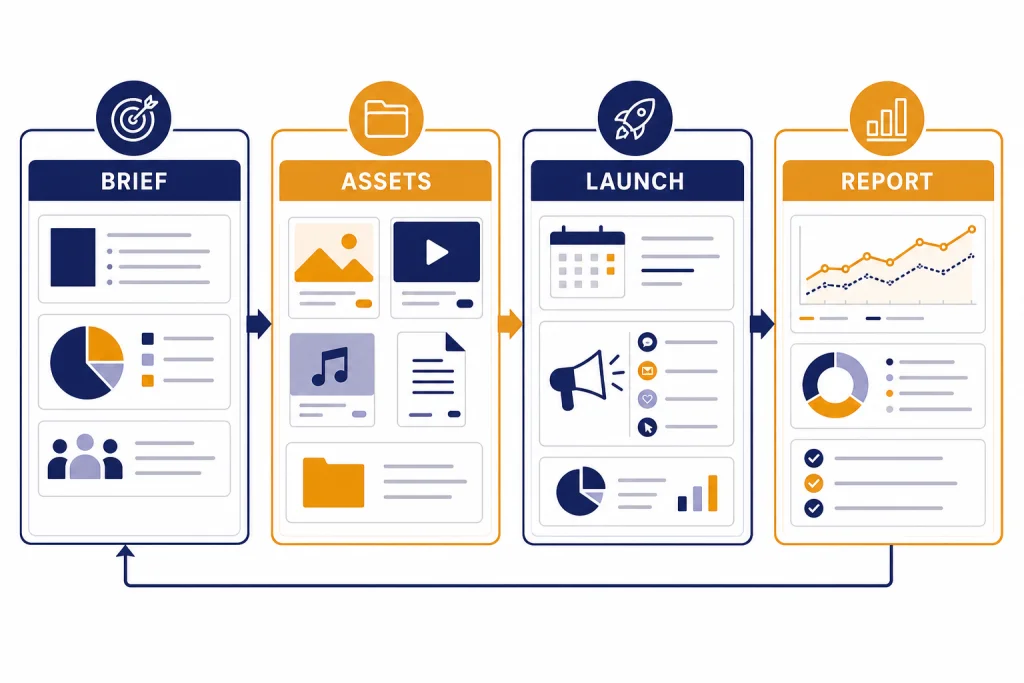
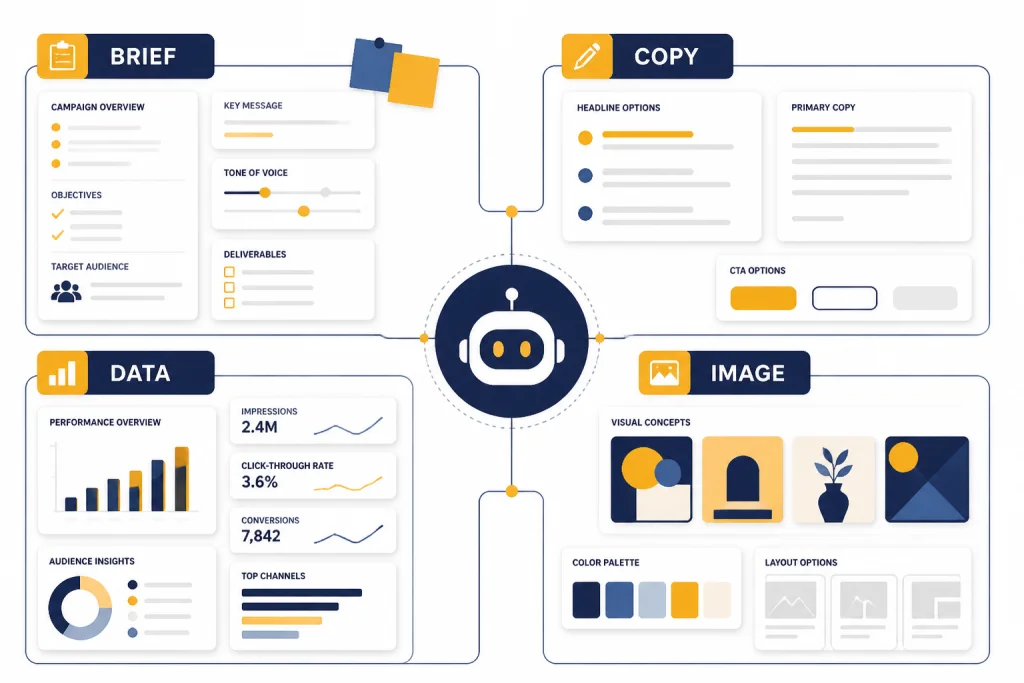
ChatGPT for marketing works best as a campaign operating layer: it helps turn scattered notes into briefs, drafts channel-specific copy, adapts messages for different audiences, summarizes research, and explains campaign data in plain English. It should not replace strategy, brand judgment, customer knowledge, or legal review. The strongest marketing teams use it to move faster through the first draft, variation, synthesis, and reporting stages while keeping humans in charge of positioning, claims, approvals, and final creative direction. This guide shows a practical workflow you can use for launches, lifecycle campaigns, content programs, paid experiments, and post-campaign analysis.
What ChatGPT can do for marketing
OpenAI’s own marketing-team guidance describes ChatGPT as useful across the path from idea to brief, assets, launch, and review. It can help marketers organize messy inputs, clarify messaging, draft first-pass content, generate variations for testing, and summarize performance into next steps.[1] That makes it a good fit for campaign work because most campaigns require repeated translation: strategy into a brief, brief into copy, copy into channel variants, and results into decisions.
The key is to treat ChatGPT as a collaborator, not an autopilot. Give it positioning, audience context, offer details, prior examples, brand rules, and success metrics. Then ask for structured outputs that your team can review. If you ask for “a campaign,” you will get generic marketing language. If you ask for a launch brief for a specific audience, with objections, proof points, channels, exclusions, and approval risks, you will get a much more useful starting point.
For many teams, ChatGPT fits between strategy and production. It can make the blank page less expensive. It can also turn long documents into usable working materials. OpenAI says ChatGPT can work with uploaded files in conversations, including common business formats such as CSV, XLSX, PDF, DOCX, JPEG, PNG, and TXT.[3] That matters for marketers because product notes, sales call summaries, survey exports, and campaign reports rarely arrive in a clean creative format.
If your work is heavily visual, pair this guide with ChatGPT for Designers. If your campaign depends on organic distribution, also read chatgpt for social media content creation and chatgpt for seo. Marketing work crosses channels, so the best ChatGPT workflow connects brief, content, data, and review instead of treating each output as a separate prompt.
A practical campaign workflow
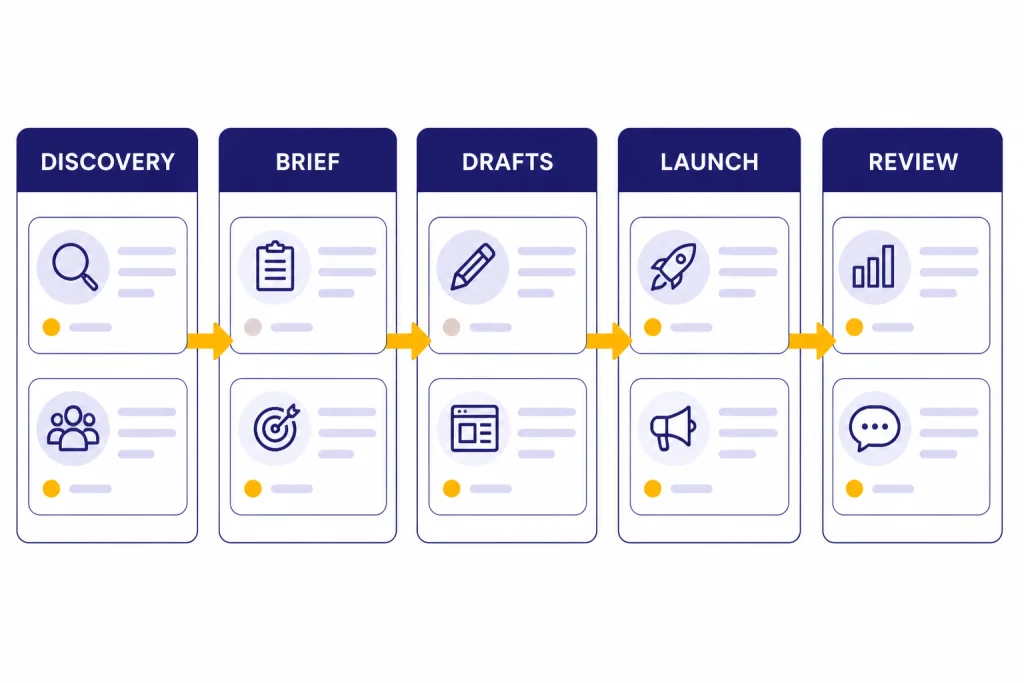
A reliable ChatGPT marketing workflow starts before copy. First, gather the campaign inputs. Include the product or offer, audience segments, objections, proof, channels, timing, constraints, and examples of past work. Ask ChatGPT to find gaps before it drafts. This step reduces the risk of polished copy built on weak assumptions.
Next, ask for the brief. A good brief should force choices. It should name the audience, primary message, reason to believe, desired action, campaign promise, and what the campaign must avoid saying. Then use ChatGPT to turn that brief into channel variants. Separate ideation from approval. Let the model produce options, but let your team decide what is strategically correct.
| Workflow stage | Use ChatGPT for | Human team owns | Best output |
|---|---|---|---|
| Discovery | Summarizing notes, extracting objections, grouping audience needs | Customer truth and business priority | Input summary with gaps |
| Brief | Turning inputs into a campaign direction | Positioning and approvals | One-page campaign brief |
| Drafting | Generating copy variations and angles | Brand voice and claim accuracy | Editable draft set |
| Launch prep | Adapting assets by channel and format | Final creative and media plan | Channel-ready checklist |
| Review | Summarizing results and suggesting tests | Interpretation and next investment | Post-campaign readout |
This workflow also gives you a natural approval trail. You can keep the brief, draft set, feedback, and reporting notes in one place. OpenAI’s Projects feature is designed to keep related chats, files, and context together, and OpenAI notes that project memory draws from conversations inside the same project rather than unrelated projects.[10] For a recurring campaign type, that can help keep launches from scattering across disconnected conversations.
Prompts for better campaign briefs
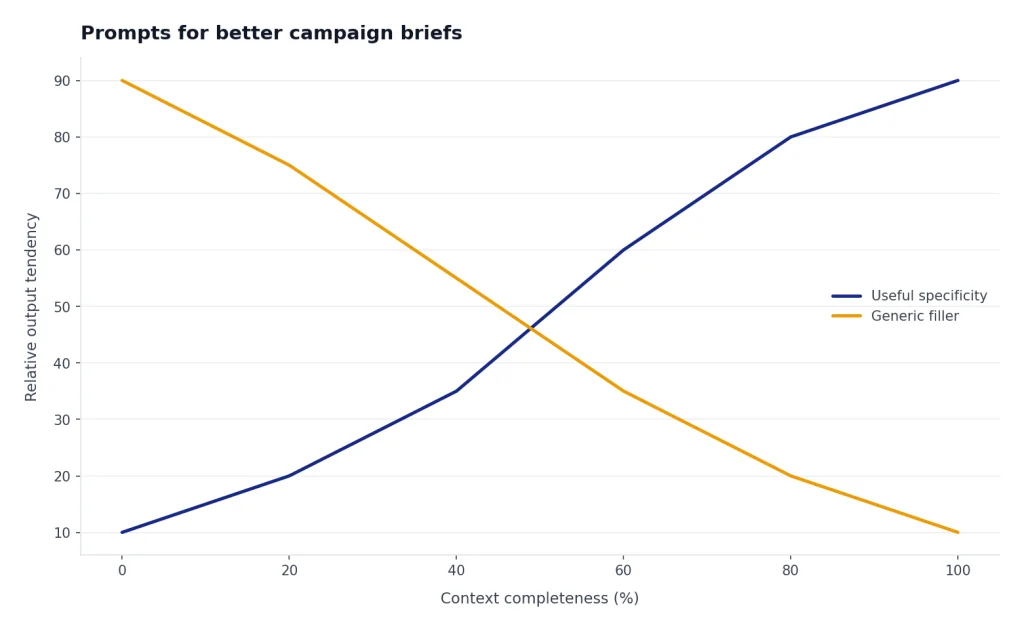
The best prompt for marketing is not a magic sentence. It is a reusable briefing format. Give ChatGPT the same information you would give a strategist, copywriter, designer, or agency partner. If the model lacks context, it will fill gaps with safe but forgettable claims.
You are helping prepare a campaign brief.

Context:
- Product or offer: [insert]
- Target audience: [insert]
- Customer problem: [insert]
- Main objection: [insert]
- Proof points: [insert]
- Channels: [insert]
- Brand voice: [insert]
- Claims to avoid: [insert]
- Success metric: [insert]

Task:
Create a concise campaign brief with audience insight, core message, supporting proof, channel approach, content ideas, risks, and open questions. Do not write final copy yet. First identify missing information that could change the strategy.
Use that prompt before every serious campaign. Then ask follow-up questions. Ask ChatGPT to pressure-test the message against customer objections. Ask it to rewrite the brief for a skeptical sales leader, a designer, or a legal reviewer. This helps you see where the idea is strong and where it depends on weak language.
For prompt systems that you can reuse across a team, see our chatgpt prompt generator. For long campaign documents, canvas can be useful because OpenAI says it supports drafting and editing longer or structured content, including selecting text and asking for targeted edits.[4] That makes canvas a better fit than a plain chat when you are revising a launch narrative, landing page draft, or campaign brief across several rounds.
Content and channel workflows
Once the brief is approved, move from strategy to channel production. Do not ask ChatGPT to write every asset in one pass. Ask it to create a message map first. A message map connects the audience, pain point, promise, proof, and call to action. From there, you can generate landing page sections, email sequences, social posts, ad concepts, webinar outlines, and sales enablement snippets without losing the main idea.
For email, ask ChatGPT to separate subject-line testing, preview text, opening hook, body copy, and call to action. For a deeper workflow, use ChatGPT for Email Writing That Converts. For organic search, ask it to turn the campaign angle into topic clusters, page outlines, title alternatives, and internal linking ideas; then verify search intent with real search data and editorial judgment. For long-form content, chatgpt for blog writing covers the editorial workflow in more detail.
For paid social and organic social, use ChatGPT to create variations by audience awareness. A cold prospect needs context. A retargeting audience may need proof. Existing customers may need a reason to expand use. If the campaign includes video, you can adapt the same brief into hooks, scene outlines, and short scripts. Teams that publish on video platforms can pair this workflow with ChatGPT for YouTubers.
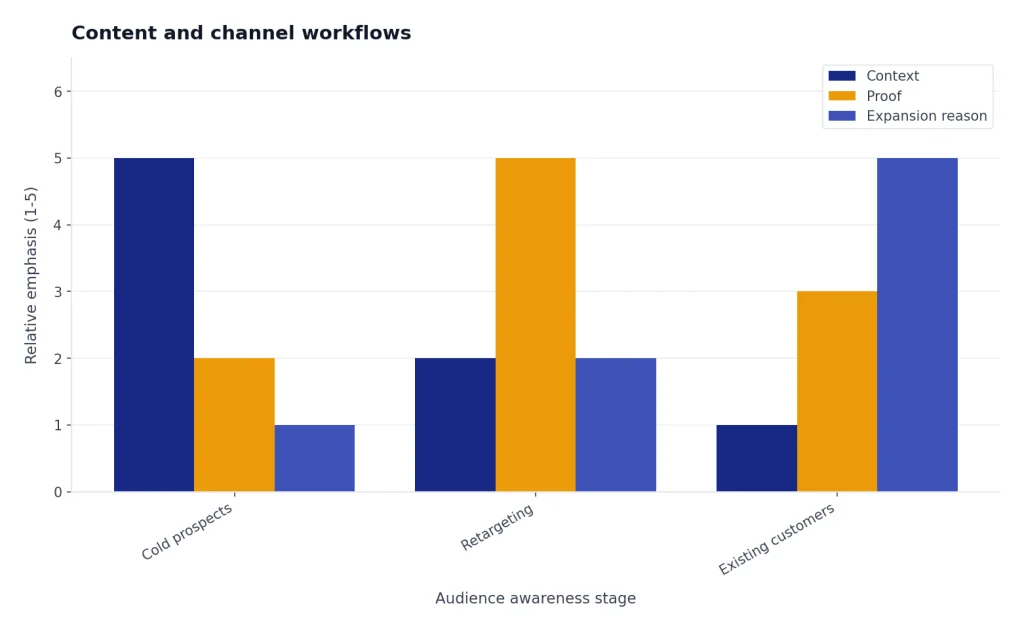
A strong channel prompt says what must stay consistent and what can change. Keep the promise, proof, and call to action stable. Let the hook, format, and length vary by channel.
Market research and customer insight
ChatGPT is useful for synthesizing research, but you need to separate analysis from evidence. It can group themes from customer interviews, summarize survey comments, draft competitive comparison questions, and turn sales notes into objection patterns. It should not invent market facts or replace primary research. If you need a dedicated research workflow, read ChatGPT for Market Research and Surveys and chatgpt for research.
A practical research prompt is simple: upload the source material, describe the decision, and ask for themes with supporting excerpts or references to the input. OpenAI’s data-analysis guidance recommends starting with the decision you are trying to support, then using uploaded files, pasted tables, or connected data sources where available to explore the information.[2] That approach keeps the research tied to a business question instead of turning into a generic summary.
I uploaded customer interview notes and survey comments.

Decision we need to support:
Should this campaign lead with speed, cost savings, quality, or ease of use?

Task:
Group the strongest customer pains and desired outcomes. For each theme, include representative evidence from the uploaded material, likely objections, and campaign messaging implications. Separate what the data supports from what is only a hypothesis.
This is also where marketing and sales should work together. Sales teams hear objections before marketers see them in campaign data. If your campaign supports pipeline creation, combine this article with ChatGPT for Sales Professionals so the message map and sales follow-up language stay aligned.
Campaign data and reporting
Campaign reporting is one of the strongest practical uses for ChatGPT because marketers often need to explain mixed signals. A campaign can have strong clicks, weak conversion, high engagement, low qualified pipeline, or uneven results by audience. ChatGPT can help structure the readout before you decide what to change.
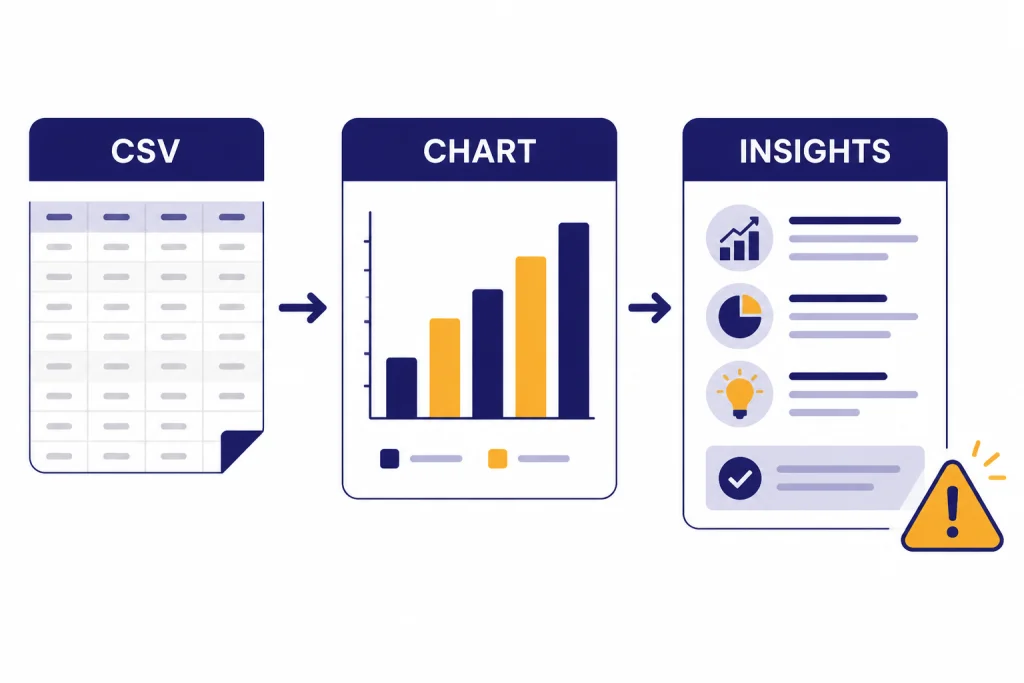
OpenAI says ChatGPT can help clean tables, generate simple visualizations, identify anomalies, and translate findings into summaries that others can review and act on.[2] The file workflow matters here. OpenAI’s file guidance says you can upload files directly in a conversation and ask ChatGPT to summarize, compare, extract, or visualize information from them.[3] For marketers, that can mean uploading a campaign export, asking for a funnel summary, and then asking for a readout written for leadership.
I uploaded a campaign performance spreadsheet.

Task:
Create a post-campaign readout with:
- Executive summary
- What performed best
- What underperformed
- Possible explanations
- Data quality cautions
- Recommended next tests
- Questions we need answered before changing budget

Do not overstate causation. Flag any conclusion that needs more evidence.
If the report depends on spreadsheet work, chatgpt for excel can help with formulas and workbook cleanup. The important habit is to ask ChatGPT to show assumptions. A confident summary is not the same as a correct conclusion. Always compare the output against the source data, attribution model, campaign dates, and known tracking issues.
Guardrails for marketers
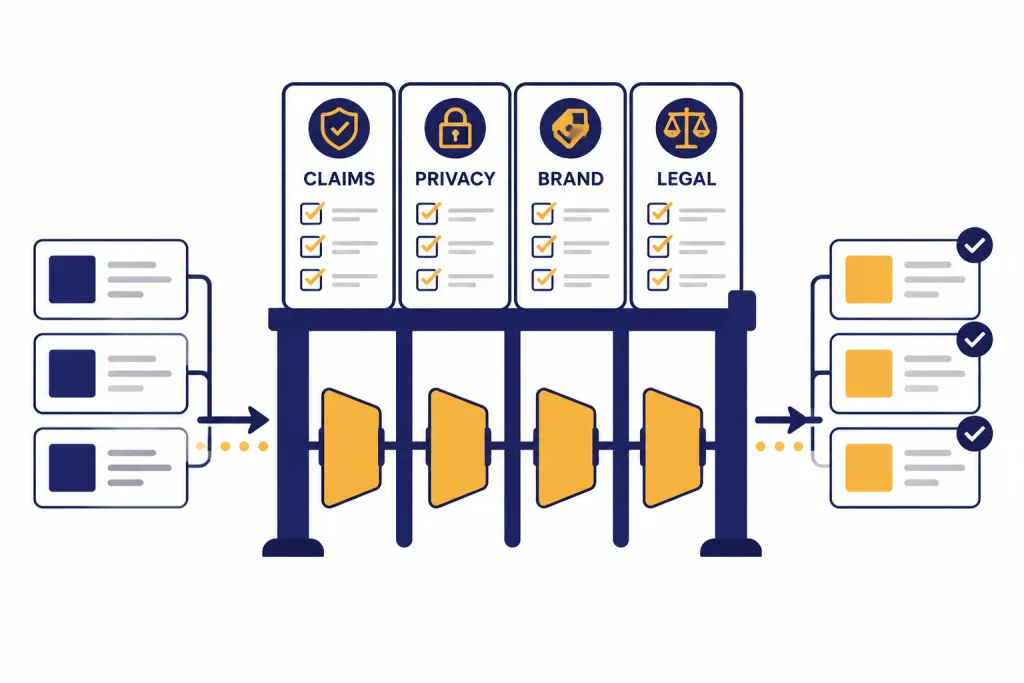
Marketing teams need guardrails because ChatGPT can produce language that sounds polished before it is verified. Build a review checklist around claims, privacy, brand, legal, and audience fit. Do not publish invented customer quotes, unsupported performance claims, fake testimonials, or undisclosed sponsored language. The FTC’s advertising and endorsement guidance emphasizes that marketers using reviews, influencers, endorsements, and native advertising remain subject to truthful advertising standards.[7]
Reviews deserve special care. The FTC’s Rule on the Use of Consumer Reviews and Testimonials went into effect on October 21, 2024, and addresses deceptive and unfair conduct involving consumer reviews and testimonials.[8] If ChatGPT helps draft review-request emails, testimonial pages, influencer briefs, or comparison content, your team still needs to verify that the campaign does not misrepresent the source, independence, or experience behind the endorsement.
| Use case | Good use | Risky use | Required review |
|---|---|---|---|
| Claims | Draft claim options based on approved proof | Invent performance promises | Substantiation and legal review |
| Testimonials | Edit approved customer quotes for length with permission | Create fake quotes or implied customer experiences | Source verification |
| Segmentation | Adapt message emphasis by audience need | Use sensitive assumptions without policy review | Privacy and targeting review |
| Competitive copy | Summarize known differentiators | Make unverified superiority claims | Competitive and legal review |
| Reporting | Explain observed results and caveats | State causation from weak data | Analytics review |
Privacy rules also depend on your workspace and plan. OpenAI says ChatGPT Business workspace data is excluded from training by default and encrypted in transit and at rest.[6] That does not mean every team should upload every customer file. Your company still needs its own rules for personal data, confidential launches, customer lists, ad account exports, and regulated claims.
How to roll it out across a team
Start with a narrow workflow, not a broad mandate. Pick one recurring campaign type, such as a webinar launch, product feature announcement, nurture sequence, or quarterly content push. Build a standard prompt pack for that workflow. Include the input checklist, campaign brief prompt, message map prompt, channel adaptation prompt, and reporting prompt.
Then create a shared review standard. Every AI-assisted campaign should answer the same questions. What source material did the prompt use? Which claims require proof? Which outputs are drafts only? Who approved brand voice? Who checked compliance? This keeps ChatGPT from becoming an invisible shortcut that nobody can audit.
Custom GPTs can help when a team repeats the same task. OpenAI says GPTs can be built from the GPTs area in ChatGPT, with instructions, knowledge, capabilities, apps, actions, and version history, and that GPTs support common document, spreadsheet, image, text, and code file types.[5] For a marketing team, a custom GPT might hold brand voice rules, campaign brief structure, approved boilerplate, and review reminders. Keep sensitive material out unless your workspace policies allow it.
Measure the rollout by outcomes. OpenAI’s marketing guidance suggests leaders should look beyond logins or prompt volume and ask whether campaigns move faster, content ships more quickly, teams test more ideas, and rework declines.[1] Those are better signals than raw usage. A team can send many prompts and still produce weak work. A useful rollout improves the quality, speed, and consistency of decisions.
End with a reusable library. Save the prompts that produced approved work. Save before-and-after examples. Save checklists for claims, data, and approvals. Over time, your ChatGPT marketing workflow should become less about clever prompting and more about disciplined campaign operations.
Frequently asked questions
Can ChatGPT create a full marketing campaign?
It can create a strong first-pass campaign plan if you provide the audience, offer, proof points, channels, constraints, and success metric. It should not be the final decision-maker. Use it to draft, compare, and refine options, then have your team approve the strategy, claims, creative, and budget.
Is ChatGPT good for marketing copy?
Yes, especially for first drafts, variants, headlines, email options, landing page sections, and tone adjustments. The output improves when you provide brand examples and tell it what not to say. Always edit for specificity, proof, and voice before publishing.
Can I use ChatGPT for customer research?
You can use it to summarize interviews, group survey themes, extract objections, and turn research into campaign implications. Do not use it as a substitute for real customer evidence. Ask it to separate supported findings from hypotheses.
Can ChatGPT analyze campaign spreadsheets?
Yes, when file tools are available in your workspace. OpenAI says ChatGPT can help with uploaded tables, simple visualizations, anomaly detection, and summaries for action.[2] You still need to verify the source data, attribution assumptions, and tracking quality.
What should marketers avoid doing with ChatGPT?
Avoid publishing unsupported claims, fake testimonials, invented customer stories, private customer data, or unreviewed regulated claims. Treat AI-assisted copy like any other marketing draft. It needs substantiation, brand review, and legal review when the topic requires it.
Should a marketing team build a custom GPT?
A custom GPT can help if your team repeats the same campaign, content, or review workflow. It is most useful when you have stable brand rules, prompt templates, and approved reference materials. Start with a simple prompt library before building anything complex.