
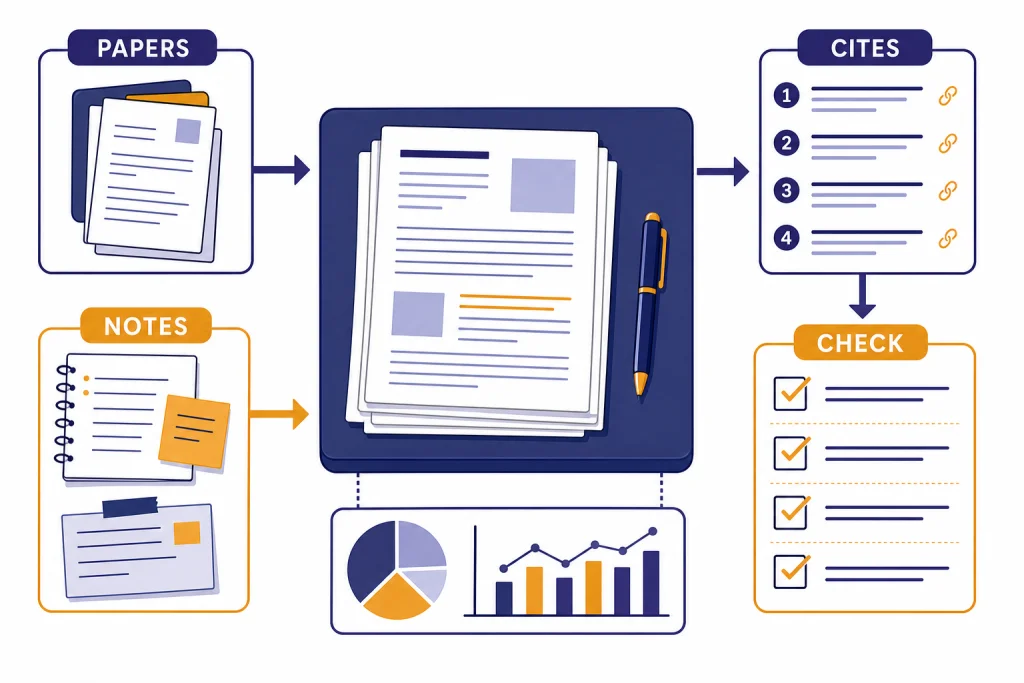
ChatGPT can help researchers move faster, but it should not replace scholarly judgment, source retrieval, peer review, or your institution’s academic integrity rules. The best use of ChatGPT for research is as a thinking partner: narrowing a topic, turning messy notes into research questions, summarizing papers you provide, comparing theories, drafting outlines, checking methods logic, and explaining statistical results. The weakest use is asking it to invent sources or write a paper from scratch. Treat every output as provisional. Keep a source-first workflow, verify citations in databases, disclose AI assistance when required, and never upload confidential, restricted, or participant-identifiable data unless your university has approved the tool and plan.
What ChatGPT can do for research
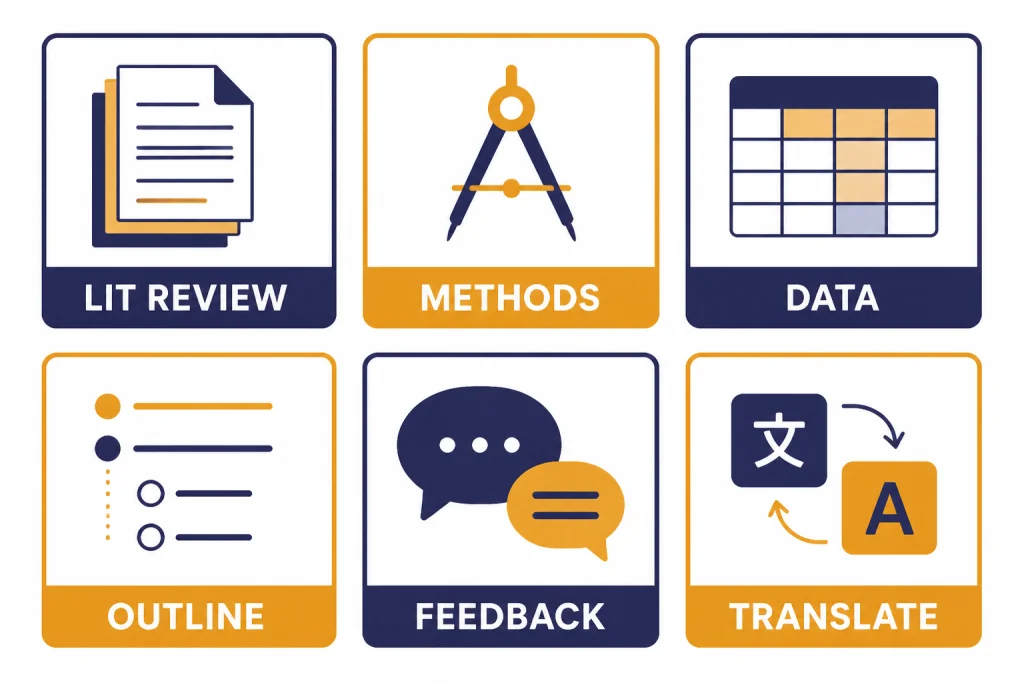
ChatGPT is useful in academic work when the task is language-heavy, comparison-heavy, or structure-heavy. It can help you refine a research question, generate alternative search terms, summarize a PDF you upload, turn interview notes into candidate themes, explain a statistical concept, or critique the logic of an argument. OpenAI’s help materials say ChatGPT can upload files such as PDFs and spreadsheets, and can run code in a secure environment to analyze and visualize structured files such as CSVs.[5]
That does not make ChatGPT a source of truth. It is not a library database, a peer reviewer, a principal investigator, or a substitute for reading the papers yourself. It can compress and reframe information, but you still need to inspect the original sources, confirm quotations, check page numbers, review methods, and decide whether a claim belongs in your work.
OpenAI launched deep research on February 2, 2025, as a ChatGPT capability that can search, analyze, and synthesize large sets of online material into a cited report.[1] OpenAI also updated deep research on February 10, 2026, with source controls, progress tracking, and the ability to restrict searches to trusted sites.[1] For academic users, that means it can be useful for a first-pass map of a field. It still does not remove the need to verify sources in Google Scholar, PubMed, JSTOR, Scopus, Web of Science, your library catalog, or the publisher’s site.
Academic use cases that work well
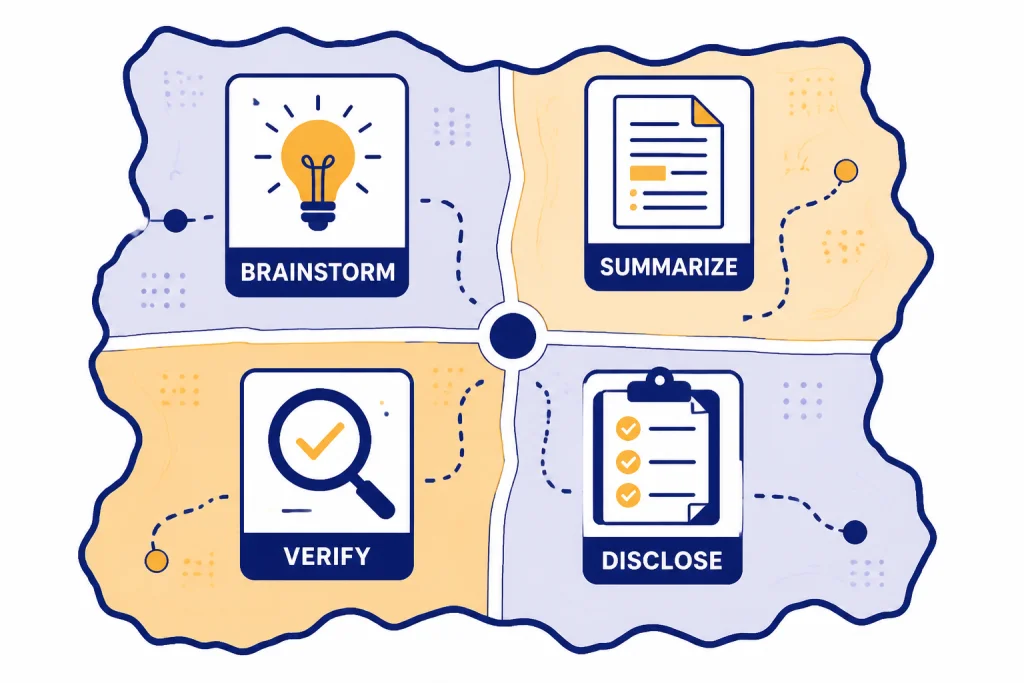
The strongest academic uses keep the human researcher in control. ChatGPT works best when you provide the source material, define the task, and ask for a transparent output that you can audit.
Topic narrowing and research questions
Start with a broad interest and ask ChatGPT to separate it into variables, populations, methods, and possible debates. For example, “I am interested in first-generation college students and belonging. Give me five researchable questions, each with a possible qualitative method and a possible quantitative method.” Then choose the question that you can actually support with available literature and data.
Search strategy design
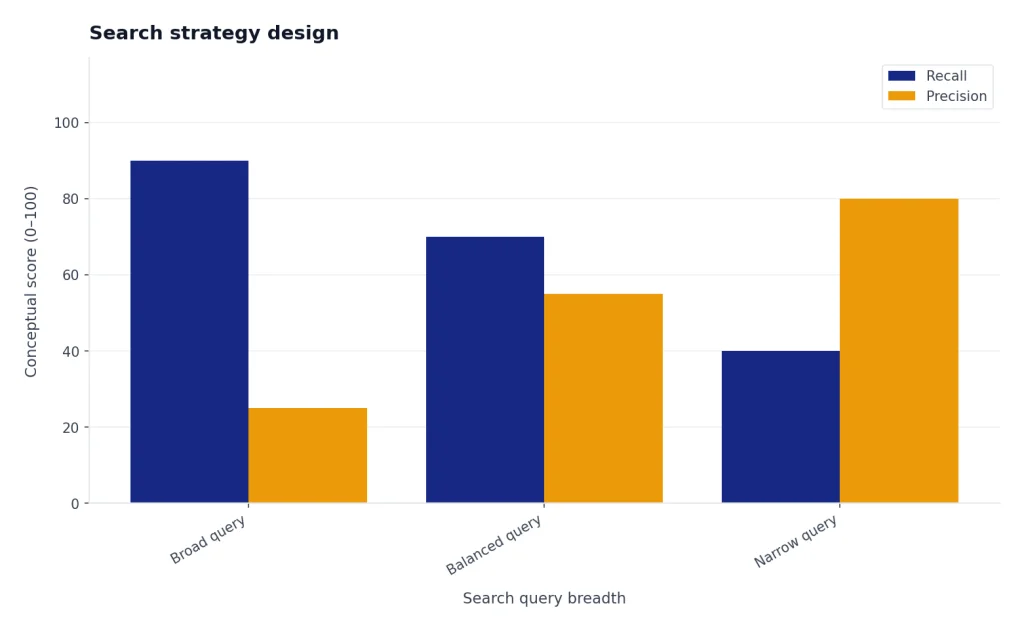
ChatGPT can help you create keyword families before you search. Ask for synonyms, narrower terms, broader terms, and database-specific Boolean strings. Do not ask it to “find the best sources” unless browsing or deep research is enabled, and even then, treat the list as a lead list rather than a bibliography.
Literature review organization
After you collect real papers, use ChatGPT to organize them by theory, method, sample, geography, period, or finding. This is where the tool is often better than a blank document. Upload notes or abstracts and ask for a matrix. Then correct the matrix by checking every row against the original article.
Method planning
ChatGPT can compare methods at a high level. It can explain why an interview design may fit an exploratory question, why a regression model needs specific assumptions, or why a survey item may be leading. If your project involves human subjects, clinical decisions, legal risk, or protected data, use it only within approved institutional rules. For field-specific caution, compare this article with ChatGPT for Doctors and Healthcare Professionals and ChatGPT for Lawyers, where privacy and professional duties are stricter.
Data cleaning and analysis support
For spreadsheets, survey exports, or small coded datasets, ChatGPT can explain variables, suggest cleaning steps, write formulas, draft SQL queries, and produce charts. If your work is spreadsheet-heavy, pair this workflow with chatgpt for excel. If your dataset lives in a database, see chatgpt for sql queries and database work.
Draft review and argument testing
ChatGPT can mark unclear transitions, identify unsupported claims, suggest counterarguments, and ask questions a skeptical reviewer might ask. It is especially helpful after you already have a draft. For broader writing workflows, see chatgpt for writing and the chatgpt tutorial for building documents in Canvas.
A safe research workflow
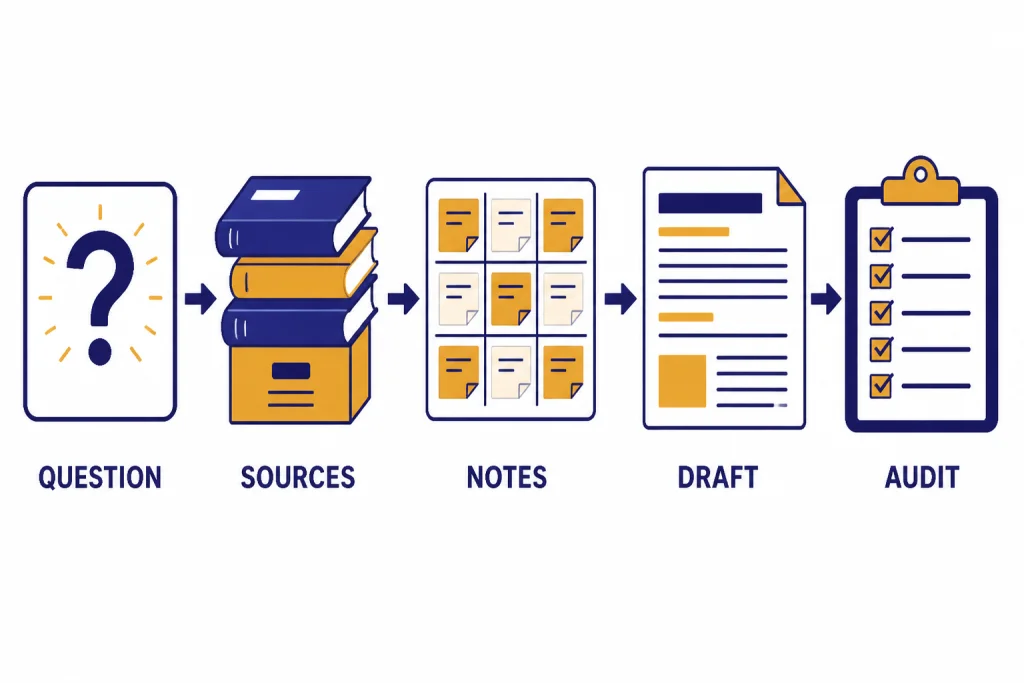
A reliable ChatGPT research workflow starts with sources, not prose. The goal is to make the tool support your reading and reasoning rather than replace it.
- Define the research question. Write the topic, population, time frame, and discipline. Ask ChatGPT to point out ambiguous terms.
- Build a search plan. Ask for keywords and Boolean strings. Run the searches yourself in scholarly databases.
- Collect real sources. Save PDFs, DOIs, abstracts, and citation records from trusted databases or publishers.
- Ask ChatGPT to summarize only provided material. Use prompts that say “use only the uploaded papers” or “flag any point not supported by the excerpts.”
- Create a synthesis matrix. Compare methods, claims, limitations, and gaps across papers.
- Draft in your own voice. Use ChatGPT for outline options, transition checks, and clarity edits, not undisclosed ghostwriting.
- Audit the final paper. Verify every citation, quotation, page number, statistic, and paraphrase against the original source.
Projects can help when the work spans weeks. OpenAI describes ChatGPT Projects as a way to group chats, upload reference files, and add custom instructions so recurring work stays on topic.[6] A dissertation chapter, grant proposal, or multi-paper review can benefit from that structure. Keep one project per research question or manuscript, not one giant project for every class or study.
If you need reproducible analysis, ask ChatGPT to explain the steps and provide code or formulas. Then run the code yourself, save the script, and document changes. For quantitative work, the chatgpt tutorial on Code Interpreter is the better companion than a general writing guide.
Prompts for academic research
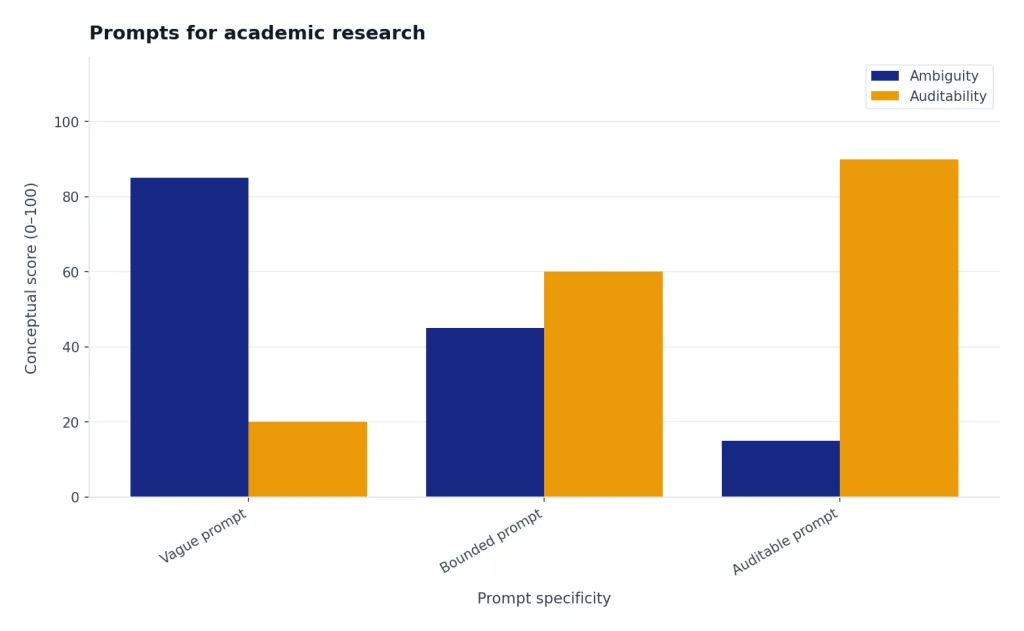
Good research prompts constrain the answer. They name the discipline, source boundary, output format, and verification requirement. Avoid vague prompts such as “write my lit review.” Use prompts that produce auditable intermediate work.
Research question prompt
I am studying [topic] in [discipline]. My current question is: [question]. Identify the independent variables, dependent variables, population, setting, and likely theoretical lenses. Then give me three tighter versions of the question and explain what evidence each version would require.Search strategy prompt
Create a search plan for a literature review on [topic]. Give me keyword families, synonyms, exclusion terms, and three Boolean strings for an academic database. Do not invent citations. The output should be a table I can use while searching.PDF synthesis prompt
Use only the uploaded papers. Create a synthesis matrix with columns for research question, theory, method, sample, key finding, limitation, and relevance to my project. If a field is not stated in the paper, write "not stated" instead of guessing.Counterargument prompt
Read this draft section. Identify the three strongest objections a reviewer could raise. For each objection, tell me whether I need a source, a clearer definition, a methods caveat, or a narrower claim. Do not rewrite the section yet.Data analysis prompt
I uploaded a de-identified CSV. First inspect the columns and propose a cleaning plan. Do not run statistical tests until I approve the plan. After approval, produce reproducible code and explain each step in plain English.For multilingual research, ChatGPT can help translate abstracts, interview guides, and coding labels. You still need human review when wording affects meaning, consent, or publication quality. See ChatGPT for Translators and chatgpt translation prompts for quality output for a more detailed workflow.
Which ChatGPT mode to use
Different research tasks need different ChatGPT setups. Regular chat is enough for brainstorming. File upload is better for summarizing papers you provide. Data analysis is better for structured datasets. Deep research is better for broad, multi-source scouting when you need a cited report and source controls.[2]
| Research task | Best setup | What to provide | Human check |
|---|---|---|---|
| Narrow a topic | Regular chat | Topic, course, discipline, constraints | Confirm the question is feasible |
| Build search terms | Regular chat or deep research | Draft question and target databases | Run searches yourself |
| Summarize papers | File upload | PDFs, abstracts, notes | Compare summaries to the papers |
| Synthesize a field | Deep research plus manual review | Scope, inclusion rules, trusted sites | Verify every cited source |
| Analyze survey data | Data analysis | De-identified CSV or spreadsheet | Review code, assumptions, and outputs |
| Improve a draft | Regular chat or Canvas | Your own draft and rubric | Accept only edits you understand |
Do not use the most powerful mode by default. A short conceptual question does not need deep research. A sensitive dataset should not be uploaded just because file analysis is convenient. A rough outline does not need a full project space. Match the tool to the risk and the task.
Privacy, citations, and academic integrity
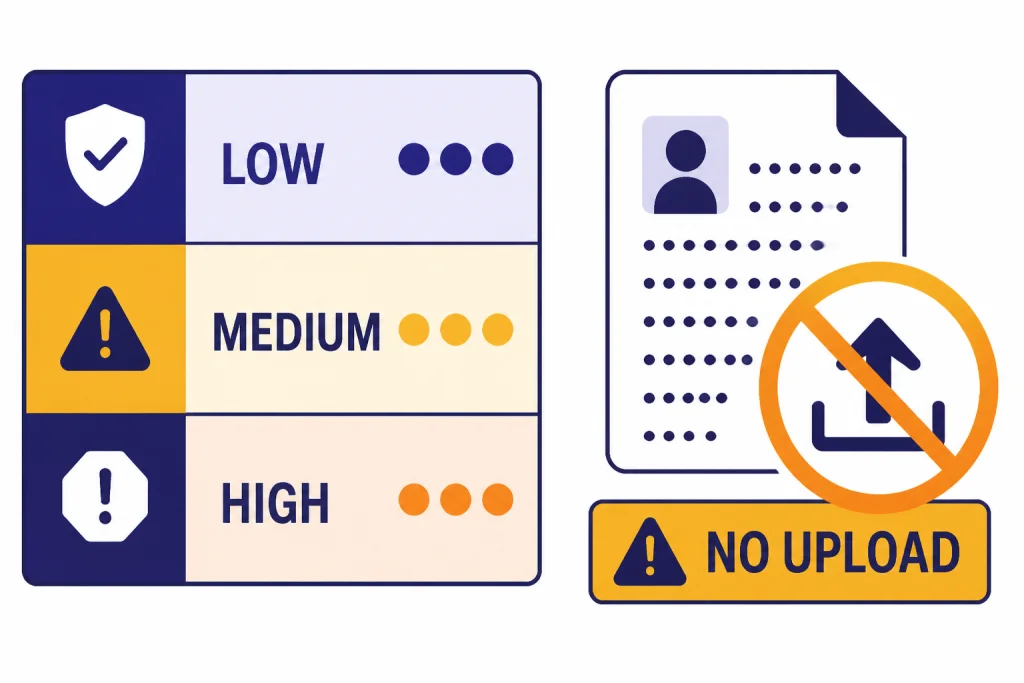
Academic research often includes unpublished ideas, copyrighted PDFs, restricted datasets, interview transcripts, grant material, reviewer comments, or participant information. Do not upload that material casually. OpenAI says ChatGPT Edu is built for universities and includes advanced tools such as data analysis, web browsing, and file uploads, plus administrative controls such as group permissions, SSO, SCIM, and GPT management.[4] OpenAI also says ChatGPT Edu supports over 50 languages.[4] Institutions still need their own policies for consent, retention, data classification, and disclosure.
OpenAI says it does not train models on ChatGPT Enterprise, ChatGPT Business, ChatGPT Edu, ChatGPT for Teachers, or API inputs and outputs by default.[7] That is a useful distinction, but it does not mean every dataset is safe to upload. Human-subjects data, health records, student records, legal records, and proprietary sponsor data may be governed by rules outside the tool’s privacy statement.
UNESCO’s guidance on generative AI in education and research emphasizes a human-centered approach and the need for policy, validation, and capacity building rather than uncritical adoption.[8] In practical terms, that means your institution’s policy comes first. If an instructor, IRB, journal, funder, or lab handbook prohibits a use, do not rely on a general ChatGPT article to override it.
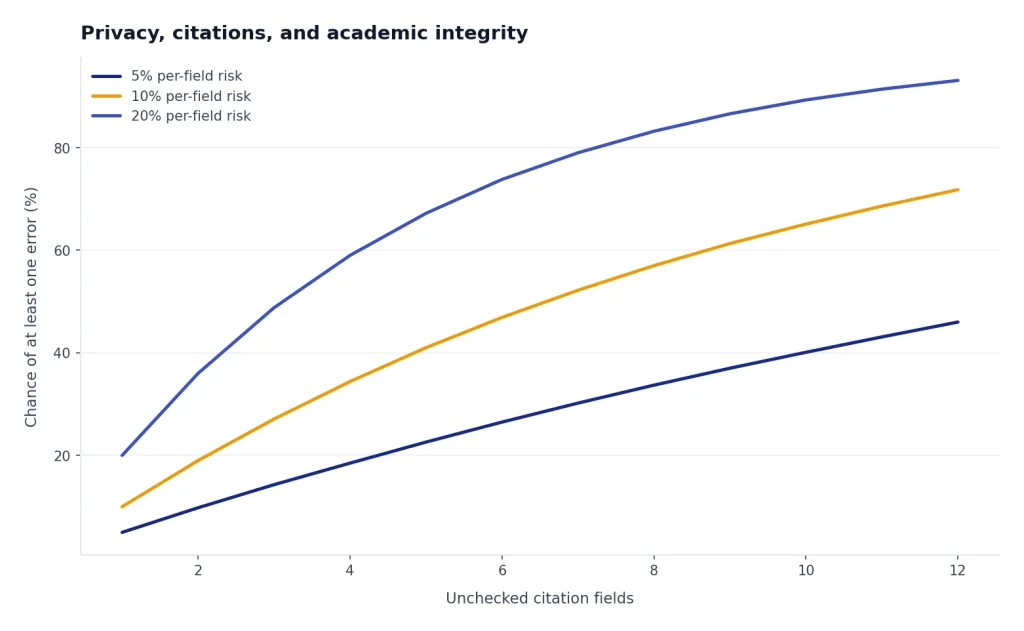
Citation is the highest-risk part of using ChatGPT for research. The MLA Style Center says writers should cite a generative AI tool when they paraphrase, quote, or incorporate content created by it.[9] Other styles and journals vary, so check the exact rule for your assignment, thesis, manuscript, or conference.
Do not ask ChatGPT to generate a reference list from memory. A Scientific Reports article on ChatGPT bibliographic citations found fabrication and substantive citation errors in generated references.[10] The safer rule is simple: ChatGPT may help format or check a citation record you already obtained from a real database, DOI page, library catalog, or publisher site. It should not be the origin of the citation.
Be careful with shared links. OpenAI’s Shared Links FAQ says viewers may be able to import a shared conversation into their own chat history, and deleting the original conversation does not necessarily remove imported copies.[11] Do not share chats that include unpublished research, private feedback, participant details, or confidential lab material.
Researchers outside academia face similar issues. If your project overlaps with customers, competitors, or survey design, ChatGPT for Market Research and Surveys may help. If your work becomes public-facing content, compare your workflow with chatgpt for blog writing so you do not blur research notes with publishable prose.
Frequently asked questions
Can I use ChatGPT to write a literature review?
You can use ChatGPT to organize, summarize, and compare sources for a literature review. You should not use it to invent sources or produce an undisclosed review that you submit as your own work. The safest workflow is to collect real papers first, upload or excerpt them, and ask ChatGPT for a synthesis matrix you can verify.
Can ChatGPT find scholarly sources?
ChatGPT with browsing or deep research can help discover leads and summarize online sources. It should not be your only search tool. Confirm scholarly sources through academic databases, library catalogs, DOI records, and publisher pages before citing them.
Is it plagiarism to use ChatGPT for research?
It depends on the rules for your course, institution, journal, or funder. Brainstorming, outlining, and editing may be allowed in one context and restricted in another. If you use AI-generated wording, analysis, images, or summaries in submitted work, check whether you must cite or disclose that use.
Can I upload journal articles to ChatGPT?
Technically, ChatGPT can work with uploaded files, including PDFs. Legally and ethically, you need to consider copyright, license terms, institutional policy, and data sensitivity. If the article is licensed through your university library, do not assume you can upload it to any external tool without checking the rules.
Should I cite ChatGPT as a source?
Cite or disclose ChatGPT when your style guide, instructor, journal, or funder requires it. Do not cite ChatGPT as evidence for factual claims about the world. Use primary sources, peer-reviewed sources, datasets, official statistics, or archival records for evidence.
Can ChatGPT analyze my research data?
ChatGPT can help inspect, clean, visualize, and explain structured data when you provide an appropriate file. Remove direct identifiers and confirm that upload is allowed before using it. For serious analysis, save the code, document each step, and have a qualified person review the assumptions.