
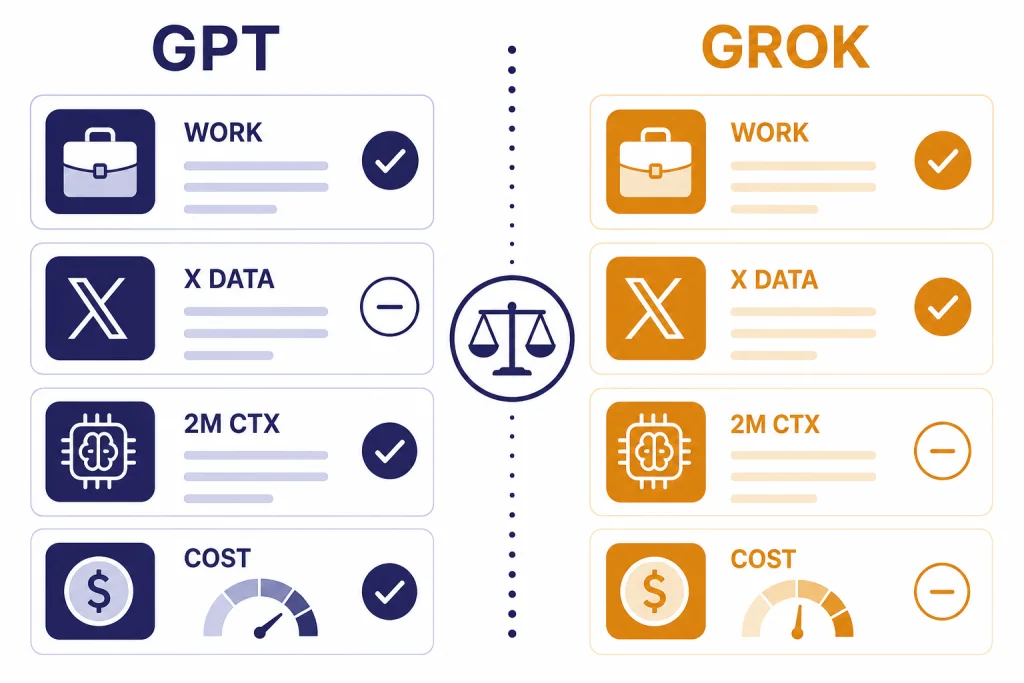
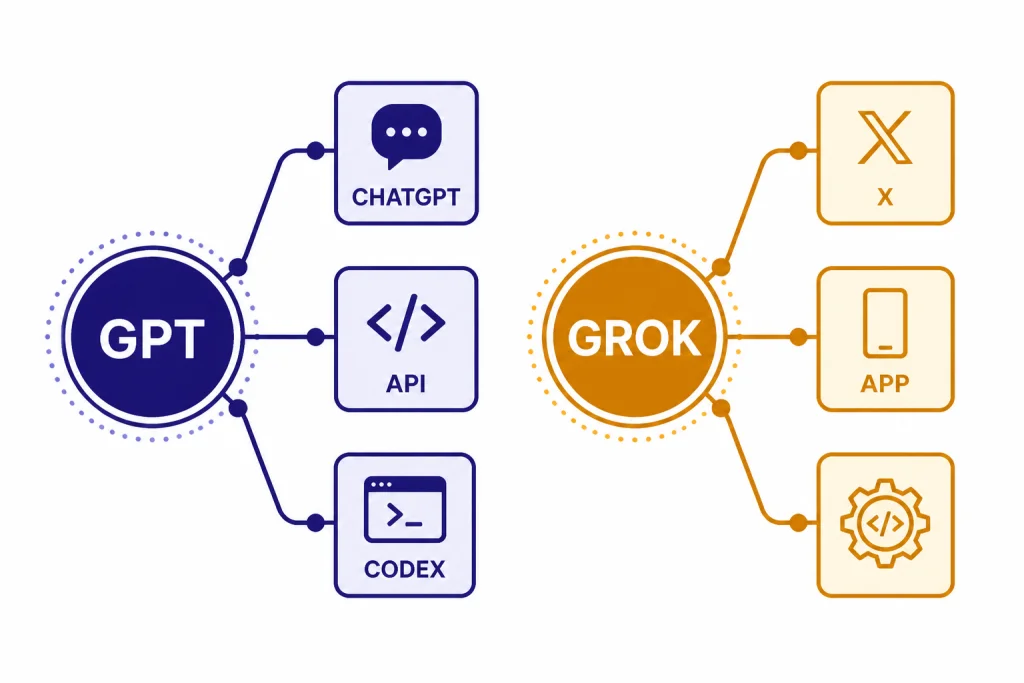
GPT is the safer default for most work, while Grok is the sharper pick for X-aware research, huge-context API jobs, and teams optimizing output cost. In this comparison, “GPT” means OpenAI’s GPT family in ChatGPT, the API, and Codex, with GPT-5.4 as the current flagship for professional work as of April 3, 2026.[1] “Grok” means xAI’s Grok family across grok.com, X, and the xAI API, with Grok 4.20 live in the API by March 10, 2026.[5] The verdict: choose GPT for reliability, polished work, and enterprise fit; choose Grok for X context, long-context ingestion, and lower direct API output pricing.
Quick verdict
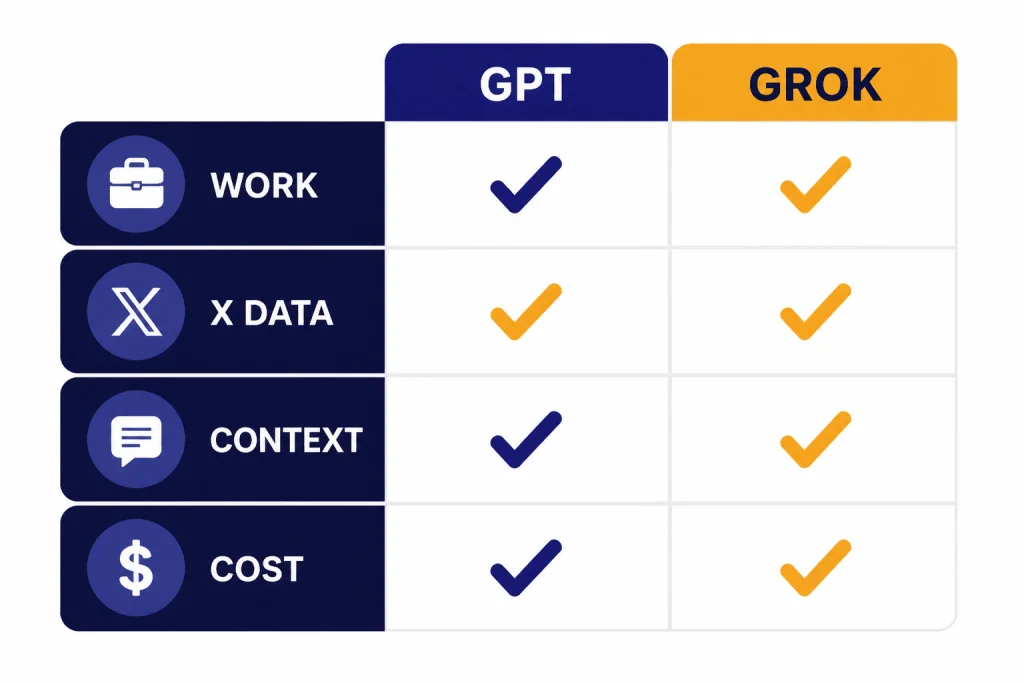
GPT vs Grok is not a single-model contest. It is a choice between two product ecosystems. GPT is better if you want a dependable assistant for writing, coding, analysis, files, spreadsheets, presentations, and team use. Grok is better if your work depends on fast-moving public conversation, X-native context, very large prompts, or lower output-token costs in the direct API.
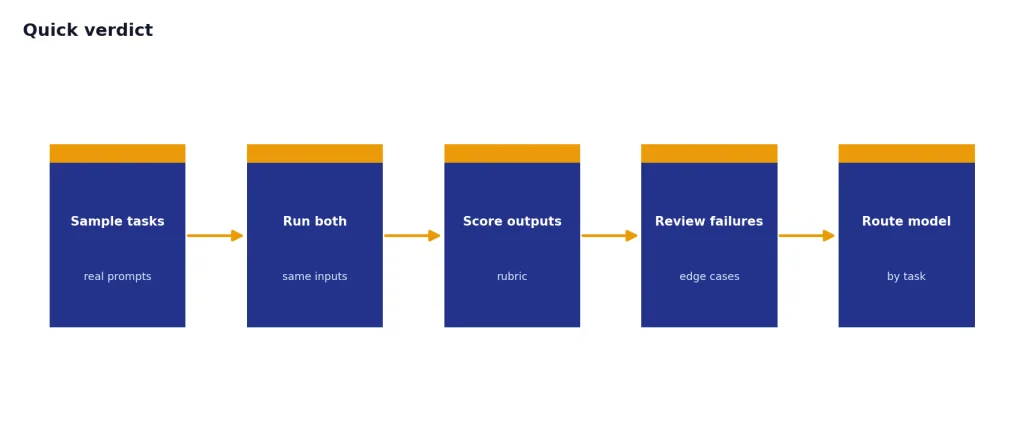
If you need one default assistant for a company, GPT is the safer pick. If you are building a research or monitoring workflow around X, Grok deserves serious testing. If you are building a production app, do not choose by brand. Run your own prompt set through both. Start with our GPT model family guide and the OpenAI API pricing guide if your decision depends on model routing or token budgets.
| Category | Better pick | Reason |
|---|---|---|
| Everyday reliable assistant | GPT | More predictable for mixed writing, analysis, coding, and file work. |
| Professional knowledge work | GPT | OpenAI tuned GPT-5.4 around coding, documents, spreadsheets, presentations, and agents.[1] |
| X-aware research | Grok | Grok is closely tied to X and xAI’s real-time search surface.[4] |
| Huge-context API prompts | Grok | xAI lists Grok 4.20 with a 2M context window.[4] |
| Team governance | GPT | ChatGPT Enterprise has the more mature documented workspace, connector, and business-data story.[11] |
| Output-heavy API generation | Grok | xAI lists Grok 4.20 output at $6.00 per 1M tokens, below GPT-5.4’s $15.00 per 1M output tokens.[4][2] |
What we are comparing
In this article, GPT means OpenAI’s current GPT product stack, not one fixed model. OpenAI released GPT-5.4 in ChatGPT as GPT-5.4 Thinking, in the API as gpt-5.4, and in Codex on March 5, 2026.[1] ChatGPT also uses GPT-5.3 Instant for fast everyday work, while paid users can manually select deeper GPT-5.4 options depending on plan and availability.[3] For plan-level details, use the ChatGPT plan comparison, then check Pro vs Team cost split if you are buying for more than one person.
Grok means xAI’s Grok product stack. It includes Grok on X, grok.com, mobile apps, and the xAI API. xAI’s release notes say Grok 4.20 and Grok 4.20 Multi-agent went live on March 10, 2026.[5] xAI also says an X account subscription can be linked to xAI and used on grok.com, which matters if you already pay through X rather than a separate Grok subscription.[8]
We are not using parameter counts as a decision factor. OpenAI has not published an official figure for this for GPT-5.4, and xAI has not published an official figure for this for Grok 4.20 in the official sources reviewed here. Model behavior, tool support, cost, governance, and your own evals are more useful than rumored size claims.
Where GPT is stronger
Polished professional work
GPT’s strongest advantage is consistency across ordinary professional tasks. GPT-5.4 was built for work that spans documents, spreadsheets, presentations, coding, agents, and tool use. OpenAI reported GPT-5.4 scores of 83.0% on GDPval, 57.7% on SWE-Bench Pro, 75.0% on OSWorld-Verified, and 82.7% on BrowseComp.[1] Those numbers do not guarantee your task will succeed, but they align with the practical pattern: GPT is usually better when the output must be polished, structured, and ready to share.
ChatGPT is a fuller workbench
ChatGPT’s product surface is a major part of the answer. OpenAI’s ChatGPT help material lists support for tools such as web search, data analysis, image analysis, file analysis, canvas, image generation, memory, and custom instructions for GPT-5.3 Instant and GPT-5.4 Thinking.[3] That makes GPT easier to use as a general workbench. You can upload a report, ask for a chart, revise the copy in canvas, and continue in the same workspace. If you care about reasoning model selection, read the reasoning-vs-speed primer.
Enterprise controls are clearer
OpenAI documents ChatGPT Enterprise as a managed plan with centralized admin controls, connectors, advanced capabilities, and a default commitment not to use ChatGPT Enterprise business inputs or outputs for training.[11] That does not remove the need for security review. It does make GPT the easier default recommendation for teams that need procurement, admin, data handling, and support documentation before deployment. Teams comparing workplace plans should also read the Enterprise upgrade guide.
Where Grok is stronger
X-native and real-time research
Grok’s clearest advantage is its connection to X and current public conversation. xAI describes its API search capabilities as pulling from the web and X in real time.[4] That makes Grok attractive for prompts like “summarize the main objections to this product launch on X,” “find the first public complaints about this outage,” or “compare how developers and investors are reacting to this announcement.” GPT can browse the web, but Grok’s native X angle is the differentiator.
Long-context API work
xAI lists Grok 4.20 with a 2M context window and direct API prices of $2.00 per 1M text input tokens and $6.00 per 1M output tokens.[4] TokenCost’s March 26, 2026 write-up independently framed the same Grok 4.20 trade-off as low price, 2M context, and strong instruction-following, while still noting that it trailed GPT-5.4 on its overall benchmark index.[10] In plain English: Grok is compelling for large ingestion and output-heavy workflows, but you should still test reasoning quality.
Multi-agent mode
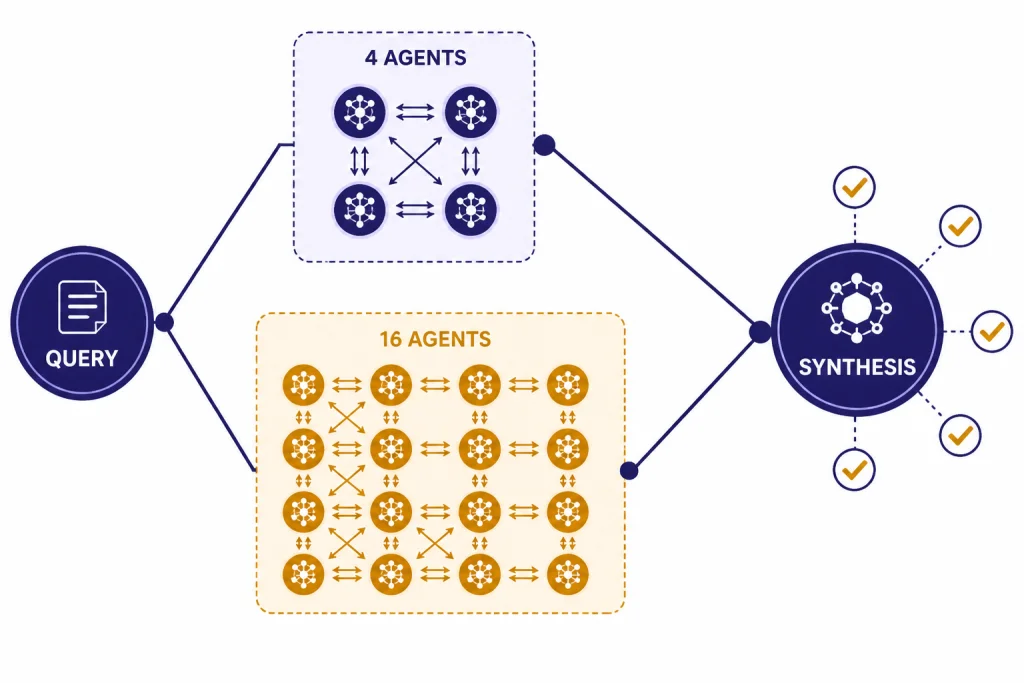
Grok 4.20 Multi-agent is the most distinctive Grok feature for deep research. xAI’s release notes list Grok 4.20 Multi-agent as live on March 10, 2026.[5] xAI’s reasoning documentation says the multi-agent model uses a reasoning setting to choose between 4 agents for quicker focused work and 16 agents for deeper, more complex research.[6] This is not automatically better than a single strong model, but it is a useful architecture for broad searches, competing hypotheses, and synthesis tasks.
Weaknesses and trade-offs
GPT can cost more in the API
GPT’s biggest weakness in this comparison is cost for high-volume generation. OpenAI’s GPT-5.4 model page lists $2.50 per 1M input tokens, $0.25 per 1M cached input tokens, and $15.00 per 1M output tokens.[2] It also says prompts above 272K input tokens on GPT-5.4 and GPT-5.4 Pro are priced at 2x input and 1.5x output for the full session.[2] If your app produces long answers all day, those details matter.
Grok raises different data questions
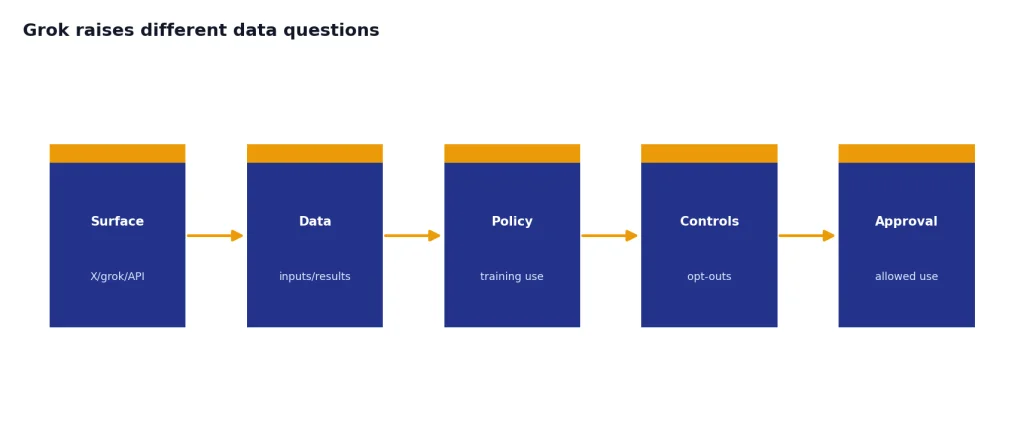
Grok’s connection to X is useful, but it is also a privacy review item. X says it may share public X data plus user interactions, inputs, and results with Grok on X with xAI to train and fine-tune Grok and other generative AI models, with opt-out controls in X settings.[7] That does not mean every Grok deployment has the same data policy. It does mean teams should separate Grok on X, grok.com, and xAI API use when reviewing data handling.
Benchmarks do not settle the argument
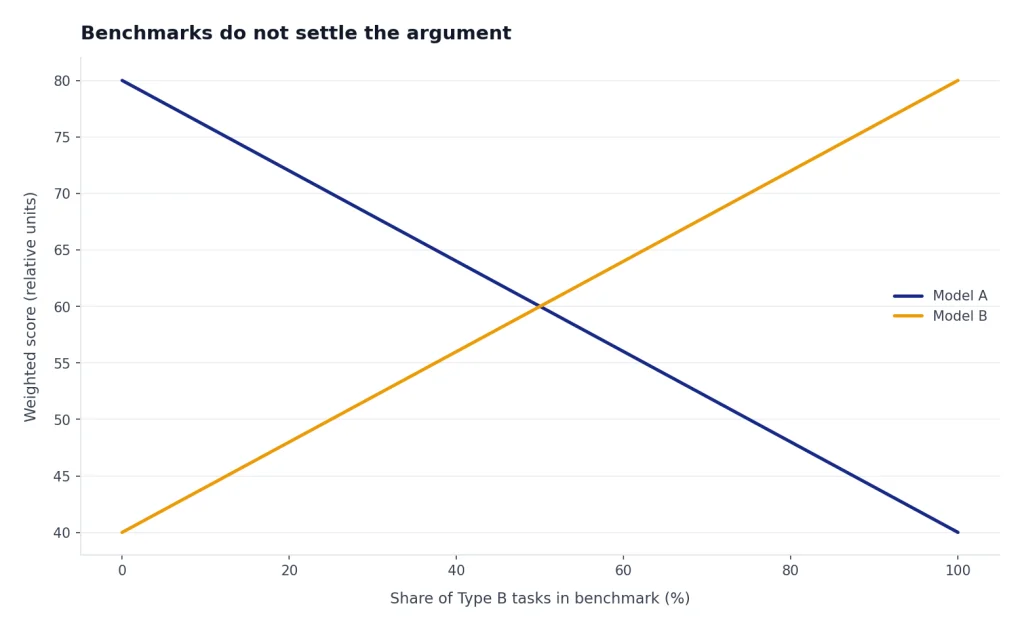
Official benchmarks are useful, but each lab chooses its own evaluation mix. Independent leaderboards also change when prompts become more expert, more conversational, or more tool-heavy. LMArena’s Arena Expert analysis used data from December 1, 2025 and found that expert prompts separated models differently from general prompts; it also showed Grok 4.1 underperforming in that expert slice.[9] That study predates GPT-5.4 and Grok 4.20, so use it as a warning about benchmark sensitivity, not as a direct verdict.
- Do not choose GPT only because OpenAI reports strong GPT-5.4 benchmarks. Test your real workflows.
- Do not choose Grok only because xAI advertises low hallucination and long context. Check answer quality on your documents.
- Do not compare ChatGPT subscriptions directly with API token prices. They solve different buying problems.
API cost and context window comparison
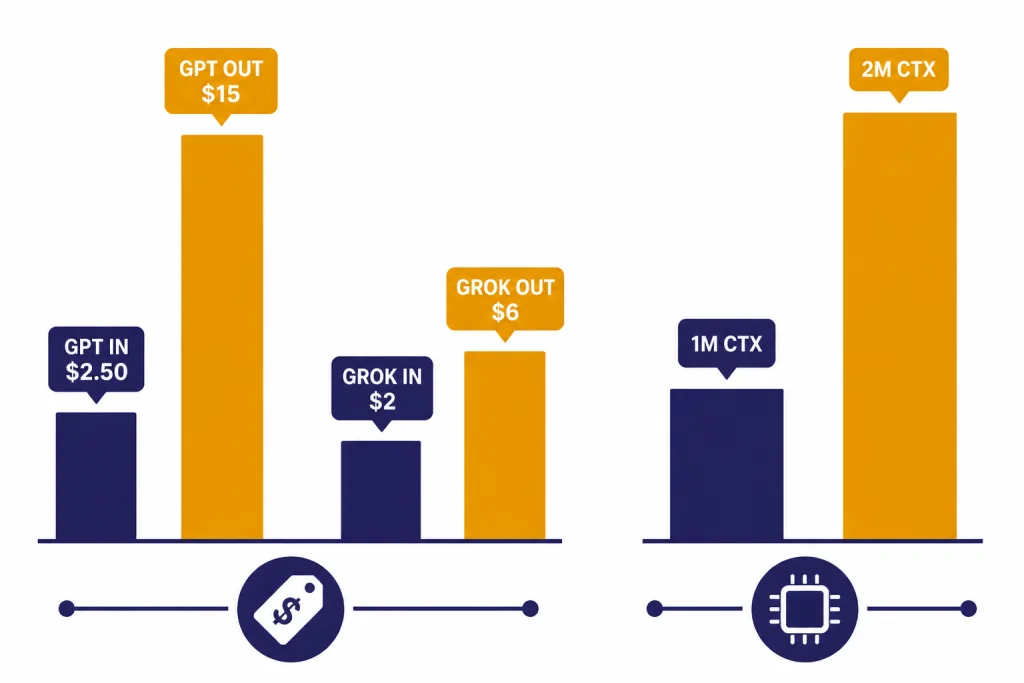
The API comparison favors Grok on output cost and context size. GPT remains stronger if you value OpenAI’s workbench, enterprise integrations, and professional-task tuning. For more model-by-model limits, use our context window reference.
| Item | GPT-5.4 API | Grok 4.20 API | Practical meaning |
|---|---|---|---|
| Main API model compared | gpt-5.4[1] | grok-4.20-reasoning and grok-4.20-non-reasoning[4] | Use exact model IDs in production tests. |
| Input price | $2.50 per 1M tokens[2] | $2.00 per 1M tokens[4] | Grok is cheaper for direct input at listed prices. |
| Output price | $15.00 per 1M tokens[2] | $6.00 per 1M tokens[4] | Grok is more attractive for long generations. |
| Listed context | 1.05M context window, with surcharge above 272K input tokens[2] | 2M context window[4] | Grok has the simpler huge-context story. |
| Consumer access path | ChatGPT, Codex, and OpenAI API[1] | Grok on X, grok.com, apps, and xAI API[7][8] | Subscription access and API access are separate decisions. |
Which one to choose
Choose GPT if your output must look finished. GPT is the better default for reports, strategy memos, spreadsheet cleanup, code review, slide outlines, legal summaries, and data analysis. It is also the easier choice when a team needs documented admin controls and a familiar ChatGPT workflow.
Choose Grok if X is part of the job. Grok is the better fit for social listening, creator research, public sentiment checks, market chatter, and fast-moving event analysis. If your prompt starts with “what are people saying on X,” Grok should be in the test set.
Choose Grok first for huge-context ingestion. A support team analyzing a long archive, a legal team scanning a large record, or an engineering team loading a large codebase may get better economics from Grok’s listed 2M context window and lower output price. Then compare against GPT for final reasoning and polished synthesis.
Choose GPT for team rollout. If you are deploying across departments, GPT has the edge because ChatGPT is easier to explain to nontechnical users and has a deeper set of documented business controls. Start with GPT for the shared assistant, then add Grok for specialized research.
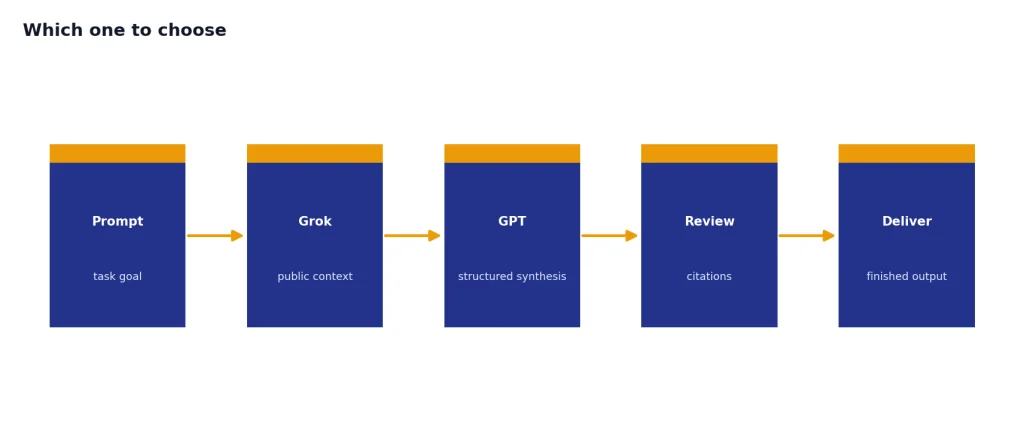
Use both if the stakes justify it. A strong workflow is to ask Grok to gather fast-moving public context, then ask GPT to structure, verify, and turn it into a client-ready deliverable. If you are comparing more than these two, see our AI chatbot alternatives list and ChatGPT vs Google Search comparison.
Final verdict
GPT wins the overall GPT vs Grok comparison for most readers. It is the better default assistant, the safer team rollout, and the stronger pick for polished professional work. Its weakness is cost at scale, especially when you generate lots of output or push long contexts through the API.
Grok wins narrower but important categories. It is stronger for X-native research, huge-context direct API work, and output-heavy workflows where cost matters. Its weakness is that its strongest advantages are specialized. A person who mainly writes, codes, analyzes files, and prepares business documents will usually get more value from GPT. A developer building a social research, monitoring, or large-document ingestion system should test Grok seriously.
The practical answer is simple. Use GPT as your default. Add Grok when you need X context, very large prompts, or cheaper long-form generation. Route between them when accuracy, coverage, and cost all matter.
Frequently asked questions
Is GPT better than Grok?
GPT is better for most everyday and professional work. It is stronger for polished writing, coding help, data analysis, files, and team deployment. Grok is better when you need X-aware research, large-context API prompts, or lower output pricing.
Is Grok cheaper than GPT?
For direct API use, Grok 4.20 is cheaper on listed output pricing: xAI lists $6.00 per 1M output tokens, while OpenAI lists GPT-5.4 at $15.00 per 1M output tokens.[4][2] Subscription plans are different. Do not compare a monthly ChatGPT plan with per-token API pricing unless you know your expected usage.
Does Grok use X data?
Grok on X can use X-related data, and X says it may share public X data plus Grok interactions, inputs, and results with xAI for training and fine-tuning, subject to user controls.[7] That is one reason Grok can be useful for X-aware research. It is also a reason businesses should review settings and data policies before using it with sensitive information.
Which is better for coding?
GPT is the safer coding pick for most users because GPT-5.4 was released across ChatGPT, the API, and Codex, with OpenAI reporting gains on coding and agentic workflows.[1] Grok can still be attractive for large-codebase context and tool-heavy research. The best test is a small benchmark from your own repo.
Which is better for research?
GPT is better for structured research reports and polished synthesis. Grok is better when the research depends on X, public sentiment, or very recent social context. For high-stakes research, use both and compare citations, assumptions, and missing evidence.
Should I replace ChatGPT with Grok?
Most users should not replace ChatGPT outright. GPT remains the better general-purpose assistant. Add Grok when you have a specific need that GPT does not cover as well: X context, very long prompts, or lower direct API output costs.