
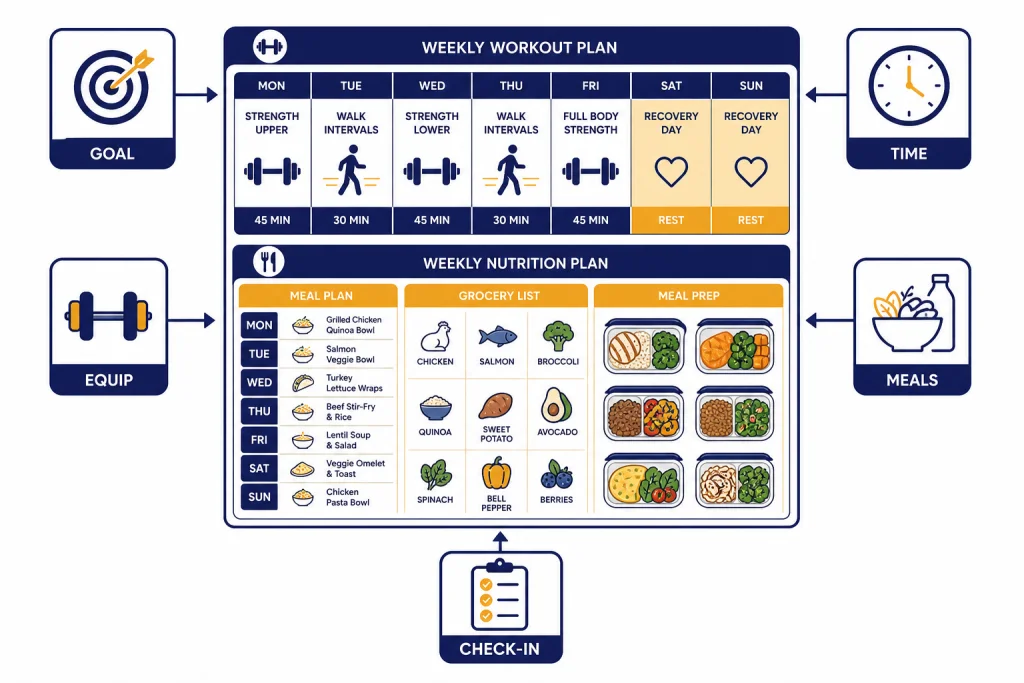
ChatGPT can help with fitness by turning your goals, schedule, equipment, food preferences, and constraints into a practical workout and meal-planning system. It is useful for drafting weekly training plans, creating grocery lists, modifying exercises, building habit checklists, and reviewing progress notes. It is not a substitute for a doctor, registered dietitian, physical therapist, or certified coach. The safest way to use ChatGPT for fitness is to give it clear context, ask for conservative plans, verify the health claims it makes, and treat each answer as a draft you can adapt. This guide shows the workflow, prompts, tables, and guardrails that make the output more useful.
What ChatGPT can and cannot do for fitness
ChatGPT is strongest as a planner, organizer, and explanation tool. It can turn messy fitness goals into a structured plan. It can adapt a workout for a hotel gym, create a higher-protein grocery list, explain the difference between sets and reps, and rewrite a meal plan for a tighter budget. It is especially helpful when you already know the broad direction but need structure.
It is weakest when you ask it to diagnose pain, prescribe treatment, identify an eating disorder plan, or give precise nutrition advice for a medical condition. OpenAI says ChatGPT can produce incorrect or misleading outputs and recommends verifying important information from reliable sources.[1] That warning matters more in fitness than in many casual use cases because a confident but wrong answer can lead to overtraining, under-eating, injury, or delayed medical care.
OpenAI also describes ChatGPT Health as a dedicated space for health and wellness questions that is designed to support, not replace, medical care.[2] That distinction is the right mindset for ordinary fitness prompts too. Use ChatGPT as an assistant. Keep responsibility with qualified professionals and with your own judgment.
A good use of ChatGPT for fitness is: “Create a beginner strength plan using dumbbells, three sessions per week, with form cues and easier substitutions.” A poor use is: “My knee hurts when I squat. Tell me what injury I have and how to fix it.” The first asks for general planning. The second asks for diagnosis.
| Use ChatGPT for | Be careful with | Use a professional for |
|---|---|---|
| Workout structure | High-intensity plans after a long break | Injury diagnosis or rehabilitation |
| Exercise substitutions | Pain during movement | Physical therapy decisions |
| Meal ideas and grocery lists | Large calorie deficits | Medical nutrition therapy |
| Habit tracking templates | Obsessive tracking patterns | Eating disorder support |
| Progress reviews | Interpreting symptoms | Medication, labs, or disease management |
If you want food ideas more than training plans, pair this article with our guide to chatgpt for cooking. If your question involves patient care, clinical notes, or medical responsibility, read ChatGPT for Doctors and Healthcare Professionals instead.
Start with a fitness brief
Most weak fitness outputs come from weak inputs. “Make me a workout plan” gives ChatGPT too much room to guess. A fitness brief gives it the facts it needs before it suggests anything.
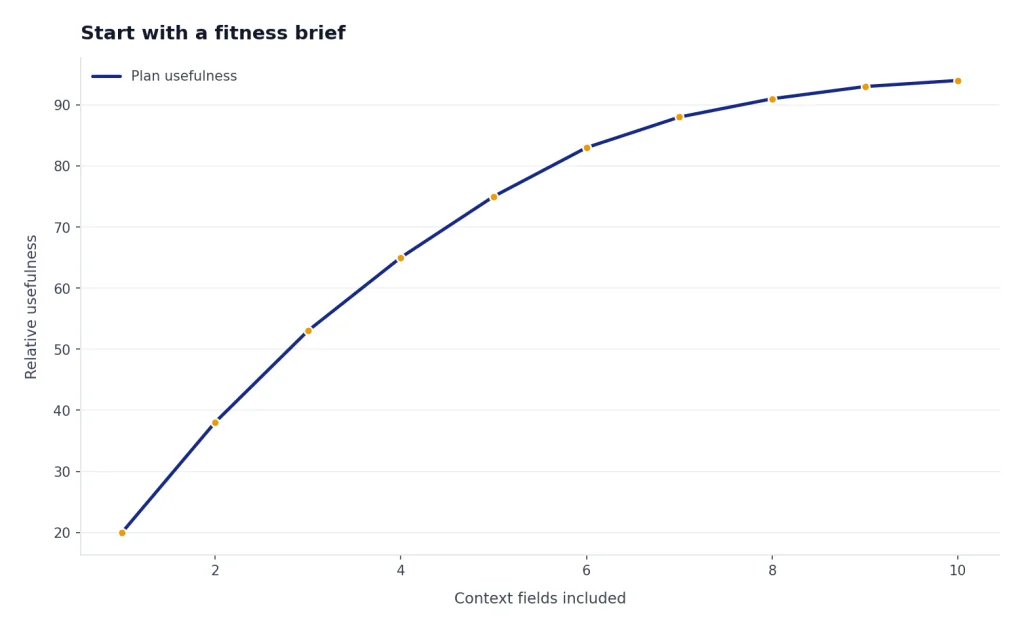
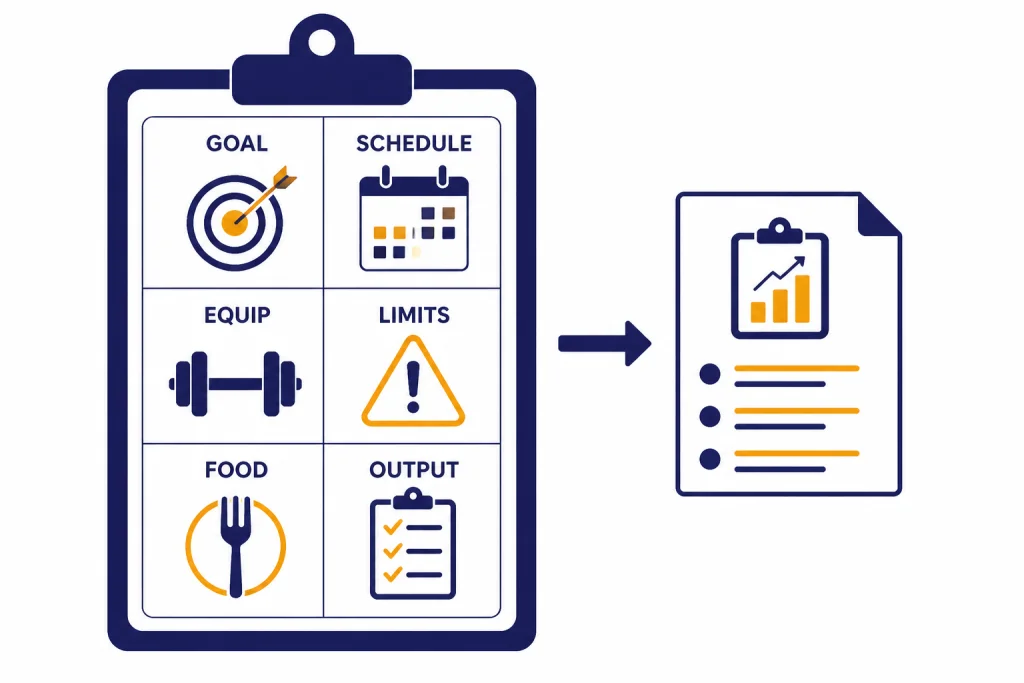
Your brief should include your goal, current activity level, available days, session length, equipment, exercise dislikes, injuries or limitations, food preferences, schedule constraints, and what you do not want. If you do not want burpees, say that. If you only have adjustable dumbbells, say that. If you cook once on Sunday and need leftovers, say that.
Use this starter brief:
I want you to act as a conservative fitness planning assistant, not a doctor.
Goal: [fat loss, muscle gain, general health, endurance, mobility, strength]
Experience: [beginner/intermediate/advanced]
Current routine: [what I do now]
Schedule: [days and minutes available]
Equipment: [none, bands, dumbbells, gym, treadmill, bike]
Limitations: [pain, injuries, movements to avoid, medical conditions already cleared]
Preferences: [activities I like and dislike]
Diet context: [cooking skill, budget, food restrictions, allergies, meals per day]
Output: Ask clarifying questions first. Then draft a 4-week plan with easy substitutions and safety notes.
Ask ChatGPT to question you before it drafts the plan. That one instruction prevents many generic answers. It also makes the plan feel less like a template copied from the internet and more like a practical schedule you can follow.
You can also keep a reusable prompt library for fitness, food, and habit tracking. If you already organize work prompts, the same method applies here. See our ChatGPT prompt generator for a broader system you can adapt.
Generate a weekly workout plan
A useful workout plan needs more than exercise names. It should specify training days, warmups, movements, sets, reps, rest periods, intensity, progression, and fallback options. It should also leave space for recovery.
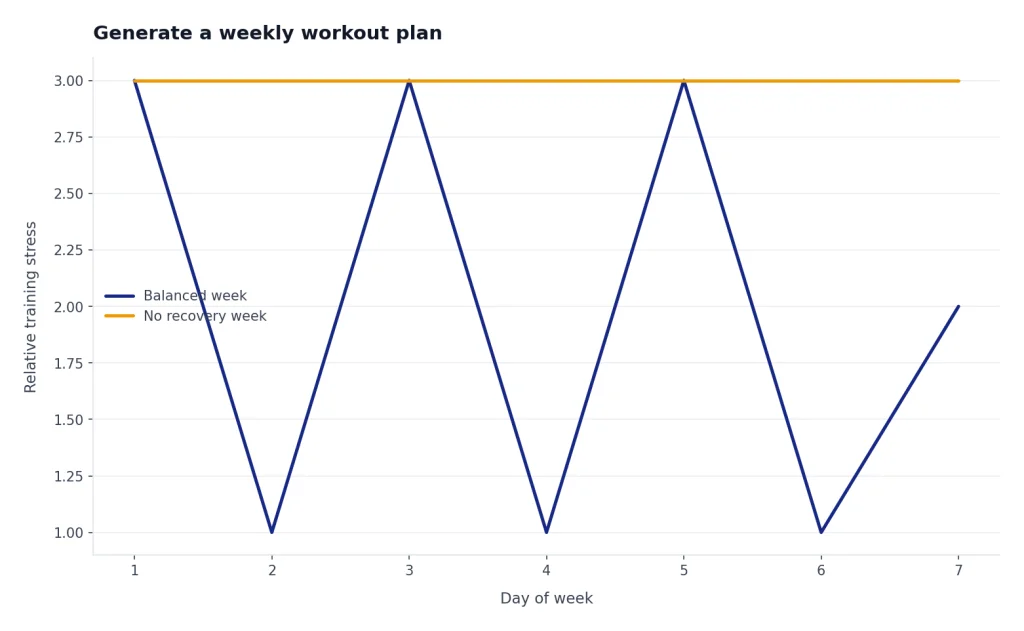
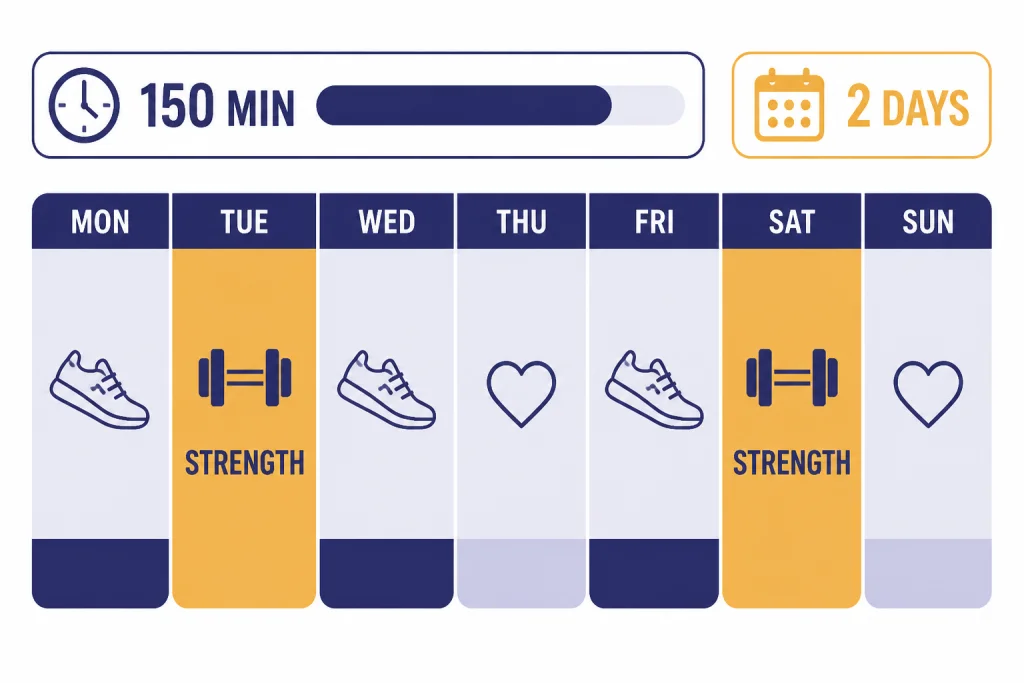
For general adult health, the CDC says adults need at least 150 minutes of moderate-intensity physical activity per week and muscle-strengthening activity on 2 days per week.[3] A second CDC page repeats the same weekly target and notes that the activity can be broken up across the week.[4] Use that as a public-health baseline, not as a personalized prescription. Your plan may need less at first if you are returning after a long break, or more if you are training for a sport.
Ask ChatGPT to build the week around your real calendar. Do not ask for the “best” plan in the abstract. Ask for the best plan you can actually do. A realistic 35-minute session after work beats a perfect 90-minute routine you skip.
Here is a sample prompt:
Create a weekly workout plan for a beginner who can train Monday, Wednesday, Friday, and Saturday.
Equipment: adjustable dumbbells, yoga mat, and a treadmill.
Goal: improve general fitness and build strength without high-impact jumping.
Use a conservative plan. Include warmup, main work, cooldown, effort level, and an easier substitution for each movement.
Keep weekday sessions under 40 minutes and Saturday under 60 minutes.
The first answer should not be final. Ask follow-up questions. Tell ChatGPT which exercises look intimidating, which days feel crowded, and which muscle groups feel too sore. Then ask it to revise the plan without increasing total time.
| Plan type | Best for | What to ask ChatGPT for |
|---|---|---|
| Beginner full-body | New or returning exercisers | Simple compound movements, low volume, clear form cues |
| Upper/lower split | People training four days per week | Balanced muscle groups and recovery spacing |
| Cardio plus strength | General health and weight management | A weekly mix of walking, intervals, and resistance work |
| Home minimal equipment | Small spaces and tight schedules | Bodyweight, bands, dumbbells, and substitutions |
| Travel plan | Hotels, vacations, and work trips | Short workouts with no fixed equipment |
Travel is a common reason fitness plans fall apart. If your schedule changes often, combine this workflow with chatgpt for travel planning so your trip itinerary includes realistic training windows, walking routes, and grocery stops.
Use ChatGPT for diet and meal planning
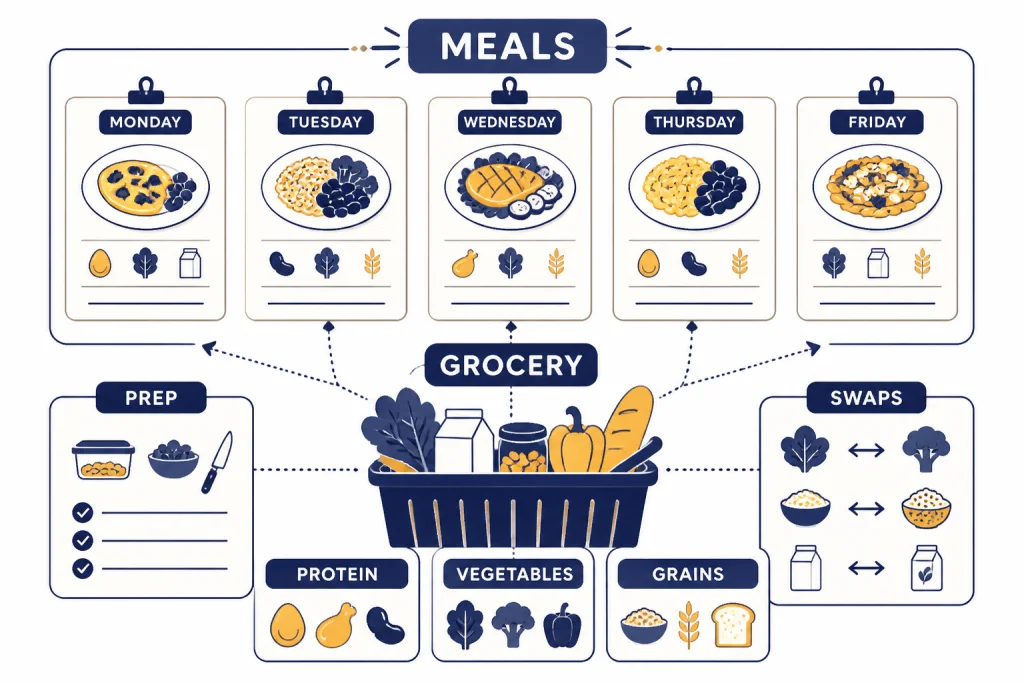
ChatGPT can make diet planning less repetitive. It can suggest breakfasts that use the same ingredients, convert a meal plan into a grocery list, rewrite dinners for a slow cooker, and adjust recipes around allergies. It can also help you plan around a training schedule by putting easy meals on busy days and prep-heavy meals on weekends.
Use it for structure, not strict medical nutrition advice. The current U.S. Dietary Guidelines for Americans, 2025–2030, were released in January 2026 and provide federal nutrition guidance for what to eat and drink to meet nutrient needs, promote health, and help prevent disease.[5] HHS said the 2025–2030 guidelines were released on January 7, 2026.[6] For a general meal plan, ask ChatGPT to align with official guidance and then verify anything that sounds extreme.
Protein is a common example. Harvard Health states that the Recommended Dietary Allowance for protein is 0.8 gram per kilogram of body weight, or about 0.36 gram per pound.[7] The National Academies’ RDA text also lists 0.8 grams per kilogram per day for adults after rounding.[8] Active people, older adults, and people with specific goals may need different targets, but ChatGPT should not invent a number without explaining the basis and uncertainty.
A good diet prompt gives constraints:
Create a 5-day meal plan for a person training 4 days per week.
Goal: support consistent energy and enough protein without strict dieting.
Constraints: no shellfish, budget-conscious, 20-minute breakfasts, packed lunches, dinners that make leftovers.
Output: meals, grocery list by category, prep steps, and swaps for vegetarian days.
Do not give medical nutrition advice. Flag anything I should verify with a registered dietitian.
Ask for ranges and options instead of rigid rules. For example, ask for “three breakfast options that include a protein source and fruit” rather than “tell me exactly what to eat every day.” Rigid plans often fail when work, family, appetite, or food availability changes.
ChatGPT is also useful for recipe adaptation. You can paste your pantry list and ask for meals that support your training week. For detailed recipe workflows, use the chatgpt for cooking breakdown.
Track progress and adjust the plan
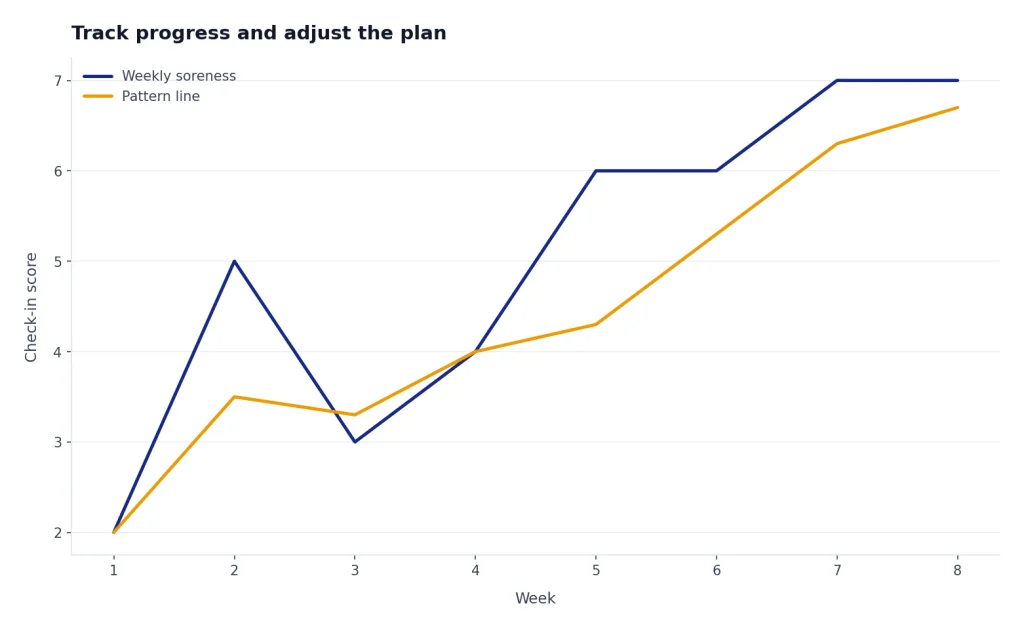
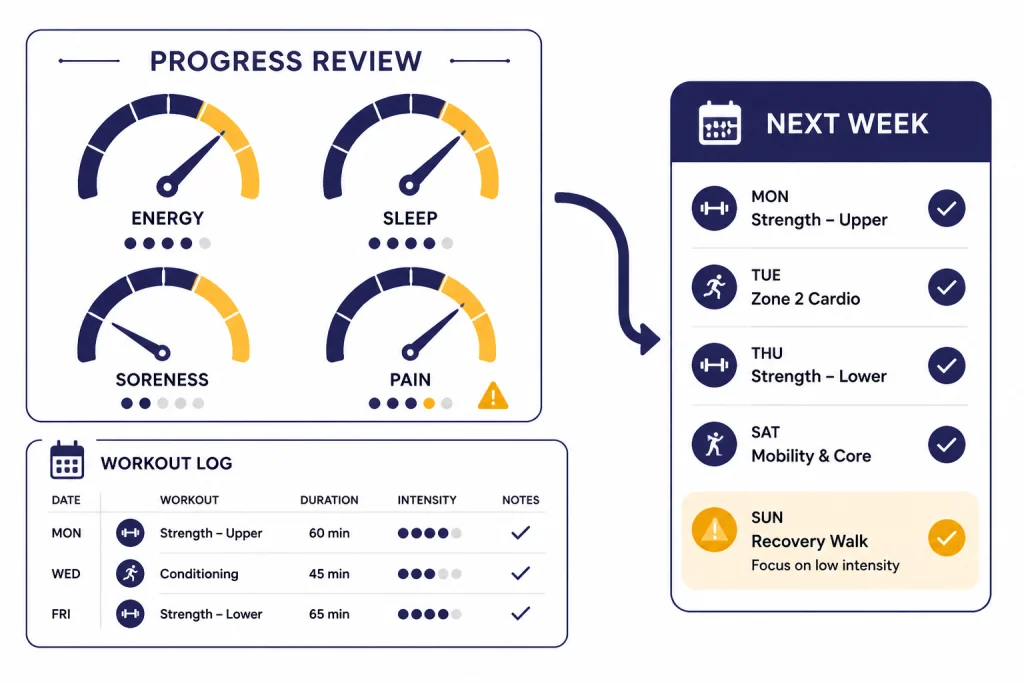
Fitness progress is easier to manage when you track a few signals consistently. You do not need a complex dashboard. A short weekly check-in can tell ChatGPT whether the plan is too easy, too hard, too boring, or too time-consuming.
Track the basics: completed workouts, energy, sleep quality, soreness, pain, mood, hunger, and schedule friction. If you track body weight, measurements, or performance numbers, keep the context. One bad workout does not require a new plan. A repeated pattern may.
Use this weekly review prompt:
Review my training week and suggest small adjustments.
Completed workouts: [list]
Missed workouts: [list and why]
Energy: [1-10]
Sleep: [hours and quality]
Soreness: [where and how intense]
Pain: [none or details]
Meals: [what went well and what did not]
Request: Make the smallest useful change for next week. Do not increase volume if recovery looks poor.
The phrase “smallest useful change” is important. ChatGPT tends to be helpful, and helpful can become too ambitious. A plan does not need a full redesign every week. It may only need a shorter Thursday workout, an easier lower-body day, or a better lunch plan.
If you log workouts in a spreadsheet, ChatGPT can help summarize patterns, clean up notes, and build simple formulas. For that side of the workflow, see chatgpt for excel or a deeper ChatGPT tutorial for data analysis.
Best ChatGPT fitness prompts
The best prompts are specific, bounded, and easy to revise. They tell ChatGPT what role to play, what information to use, what to avoid, and what format you want.
Beginner workout prompt
Act as a conservative fitness planning assistant. Create a beginner 3-day full-body strength plan using dumbbells and bodyweight only. Each session should include warmup, 5 main exercises, rest times, form cues, and easier substitutions. Keep the tone practical and avoid extreme claims.Workout substitution prompt
Replace the exercises in this plan that require a barbell. Keep the same movement pattern where possible. Give me dumbbell, machine, and bodyweight options. Add a note on when to skip the movement and ask a professional.Meal plan prompt
Create a 7-day meal plan for someone who wants simple meals, leftovers, and steady energy for workouts. Include breakfast, lunch, dinner, snacks, grocery list, and Sunday prep steps. Avoid strict dieting language.Habit coaching prompt
Help me build a 2-week habit plan around walking, strength training, hydration, and meal prep. Use tiny habits, not motivation speeches. Include a fallback version for stressful days.Plan critique prompt
Review this workout plan for balance, recovery, and realism. Identify what is missing, what may be too much, and what questions you need answered before revising it. Do not diagnose injuries.You can save these as reusable snippets. If you use ChatGPT across different areas of life, a saved prompt library is more reliable than starting from scratch every time. The same principle applies to writing, planning, and content work, as shown in chatgpt for writing and ChatGPT for social media content creation.
Safety checklist before you follow the plan
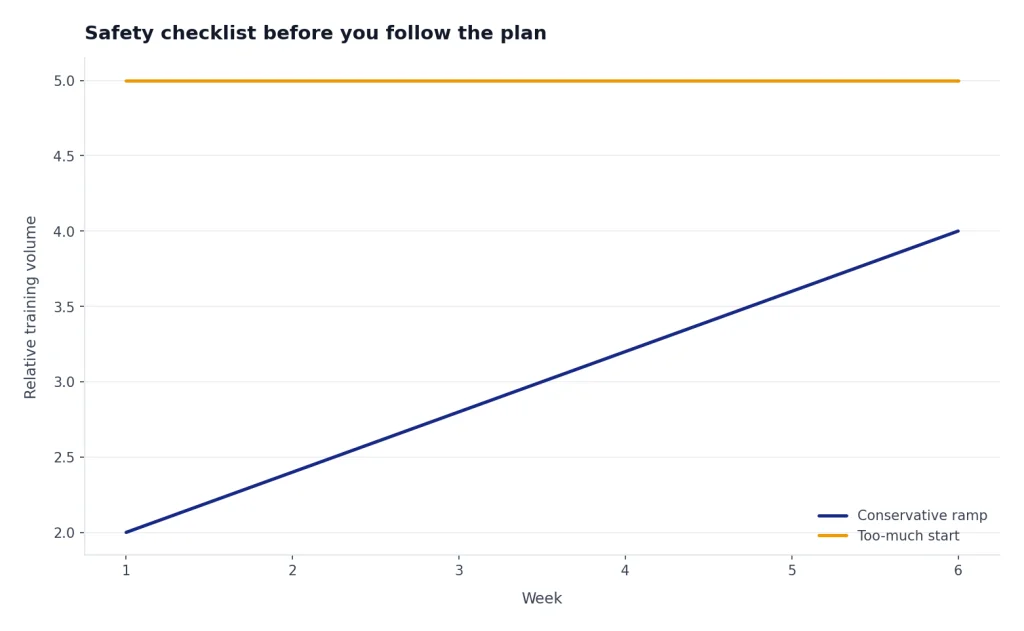
Before you follow any AI-generated fitness plan, slow down and check the risk points. A plan can look polished and still be inappropriate for your body, goals, or medical history.
- Check the starting point. If the plan assumes more training than you currently do, ask ChatGPT to reduce the first week.
- Look for pain triggers. Do not push through sharp, worsening, or unusual pain because an AI plan says to finish the set.
- Review recovery. A plan with hard sessions every day is not automatically better.
- Question extreme diet rules. Be cautious with very low-calorie plans, banned food lists, detox claims, and supplement-heavy advice.
- Verify numbers. Ask for sources when ChatGPT gives nutrition, supplement, or training-volume claims.
- Use qualified help. Bring the plan to a coach, dietitian, doctor, or physical therapist when the stakes are high.
Mayo Clinic advises people with an injury or medical condition to talk with a health care professional or fitness professional before starting a fitness program.[9] That is a sensible threshold for AI-generated plans. If you have a medical condition, recent surgery, pregnancy-related considerations, chest pain, dizziness, unexplained symptoms, or an injury history, do not outsource the decision to ChatGPT.
Privacy also matters. Do not paste sensitive medical records, lab results, or identifiable health information into a general chat unless you understand the product’s data settings and risks. When in doubt, summarize only the minimum context needed, and remove names, addresses, record numbers, and other identifiers.
The bottom line is simple. ChatGPT can help you make a plan you understand and can follow. It should not be the authority that overrides pain, clinical advice, or common sense.
Frequently asked questions
Can ChatGPT make a good workout plan?
Yes, ChatGPT can draft a useful workout plan if you give it your goal, schedule, equipment, experience level, and limitations. The plan still needs review. Treat it as a first draft, then adjust based on recovery, pain, and real-life adherence.
Can ChatGPT replace a personal trainer?
No. ChatGPT cannot watch your form, assess movement quality, spot safety issues in real time, or understand your full health history. It can help you prepare questions for a trainer or organize a plan between coaching sessions.
Can I use ChatGPT for weight loss?
You can use it for meal ideas, grocery lists, habit planning, and workout structure. Be careful with strict calorie targets or aggressive timelines. If you have a medical condition, a history of disordered eating, or symptoms that concern you, work with a qualified professional.
What should I tell ChatGPT before asking for a fitness plan?
Tell it your goal, current routine, available days, session length, equipment, injuries or limitations, exercise preferences, food restrictions, and what you want the output to include. Ask it to clarify missing details before making the plan.
Is ChatGPT safe for diet plans?
It can be safe for general meal planning when you use common-sense constraints and verify health claims. It is not a registered dietitian. Avoid using it as the sole source for medical diets, supplement protocols, eating disorder recovery, diabetes management, kidney disease diets, or pregnancy nutrition.
How often should I ask ChatGPT to revise my plan?
A weekly review works well for most people. Give it what you completed, what you missed, how recovery felt, and what got in the way. Ask for small changes rather than a complete overhaul unless your schedule or goal has changed.