

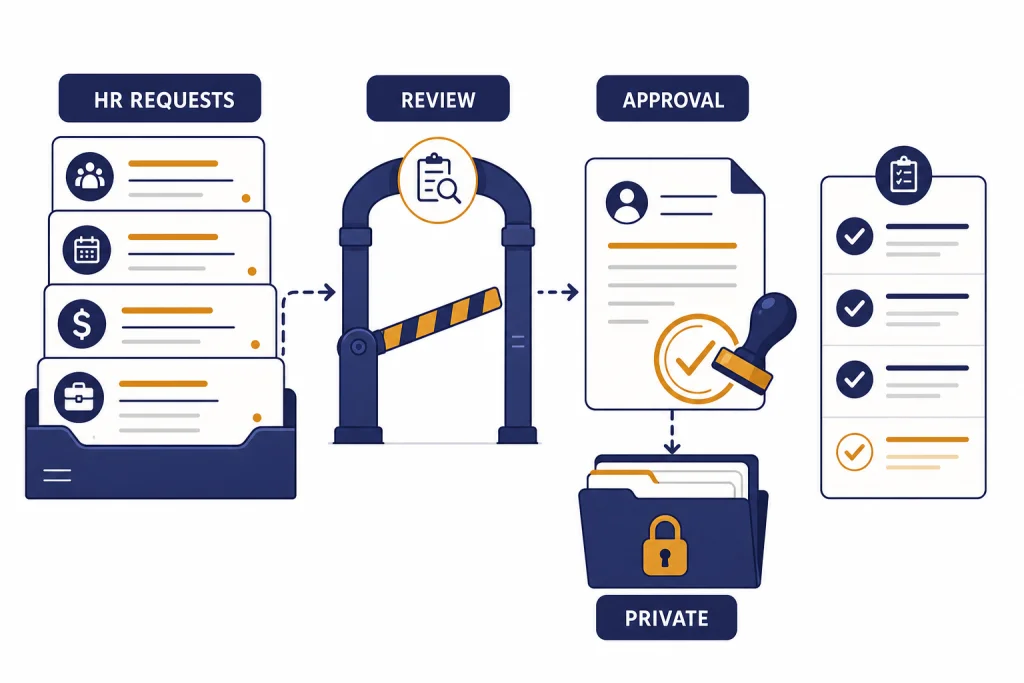
ChatGPT can help HR departments draft clearer employee communications, summarize policy documents, prepare interview materials, analyze survey themes, build onboarding checklists, and turn messy notes into usable HR workflows. It should not replace HR judgment, legal review, compensation governance, or validated selection procedures. The best use of ChatGPT for HR is as a drafting and analysis assistant inside a controlled process: redact sensitive data, give it narrow instructions, verify every output, and keep a human decision-maker accountable. For recruiting-specific workflows, pair this article with ChatGPT for Recruiters and HR Teams. For broader employment-law risk, see ChatGPT for Lawyers.
What ChatGPT can safely do in HR
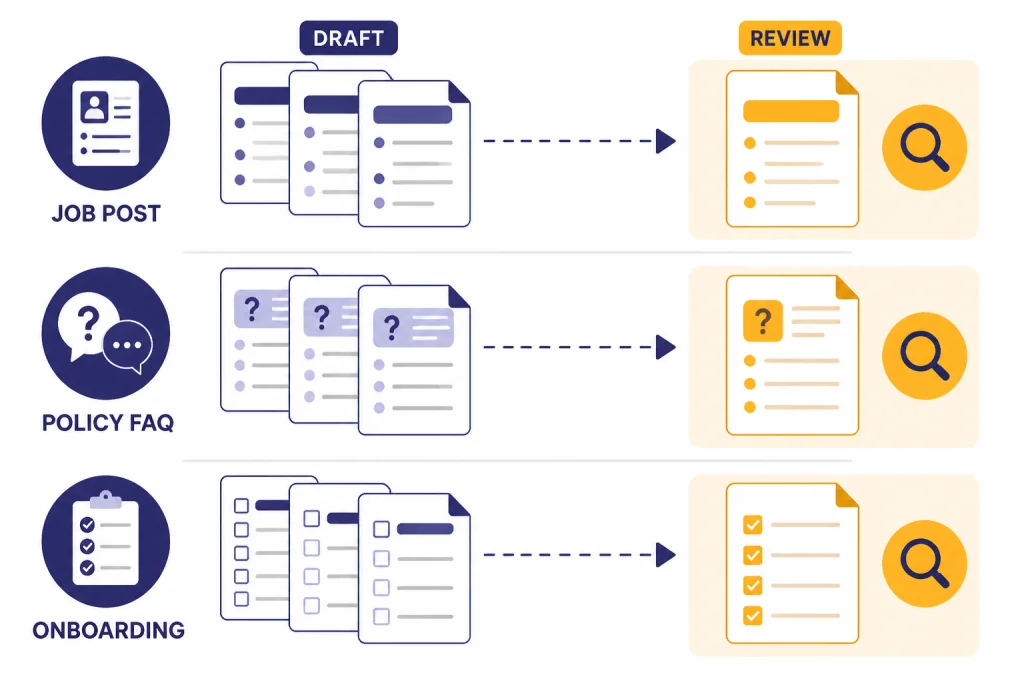
ChatGPT works best in HR when the task is language-heavy, policy-adjacent, repetitive, or analytical but not decision-final. That includes drafting a manager memo, rewriting an onboarding email, turning benefits notes into an FAQ, summarizing open-text survey comments, or creating a first draft of a job description for human review.
Use ChatGPT as a document accelerator, not as an authority. HR work depends on company policy, local law, bargaining obligations, accommodations, privacy rules, and culture. ChatGPT can help structure the work. HR owns the result.
The safest early wins are internal communications, onboarding support, policy search, training outlines, and manager enablement. These tasks still need review, but they usually do not ask the model to make an employment decision about a specific person.
| HR task | Good ChatGPT use | Human review required | Risk level |
|---|---|---|---|
| Employee communications | Draft announcements, simplify policy language, change tone | HR business partner or communications owner | Low to medium |
| Onboarding | Create checklists, welcome emails, role-based first-week plans | Hiring manager and HR operations | Low |
| Policy support | Summarize handbook sections and draft FAQs | HR, legal, and policy owner | Medium |
| Employee surveys | Cluster themes from anonymized comments | People analytics and HR leadership | Medium |
| Recruiting | Draft job posts and interview guides | Recruiter, hiring manager, legal if needed | Medium to high |
| Employee relations | Organize notes and prepare neutral question lists | Experienced HR professional and counsel where appropriate | High |
| Selection decisions | Do not let ChatGPT decide who advances, is hired, promoted, disciplined, or terminated | Human decision-makers using approved procedures | High |
OpenAI says business data from ChatGPT Enterprise, ChatGPT Business, ChatGPT Edu, ChatGPT for Healthcare, ChatGPT for Teachers, and the API platform is not used to train or improve models by default.[1] That matters for HR because employee records, compensation notes, investigations, accommodation discussions, and performance materials can contain sensitive information. Still, a privacy commitment is not a substitute for internal data-minimization rules.
Where HR needs stronger controls
HR departments handle information that can affect a person’s job, pay, leave, safety, reputation, and legal rights. That raises the bar for accuracy, privacy, fairness, and recordkeeping. A casual ChatGPT workflow that works for brainstorming social posts is not enough for an HR department. If your team also works closely with communications or campaign teams, keep the boundary clear between employee communications and public messaging; our guide to chatgpt for marketing covers a different risk profile.
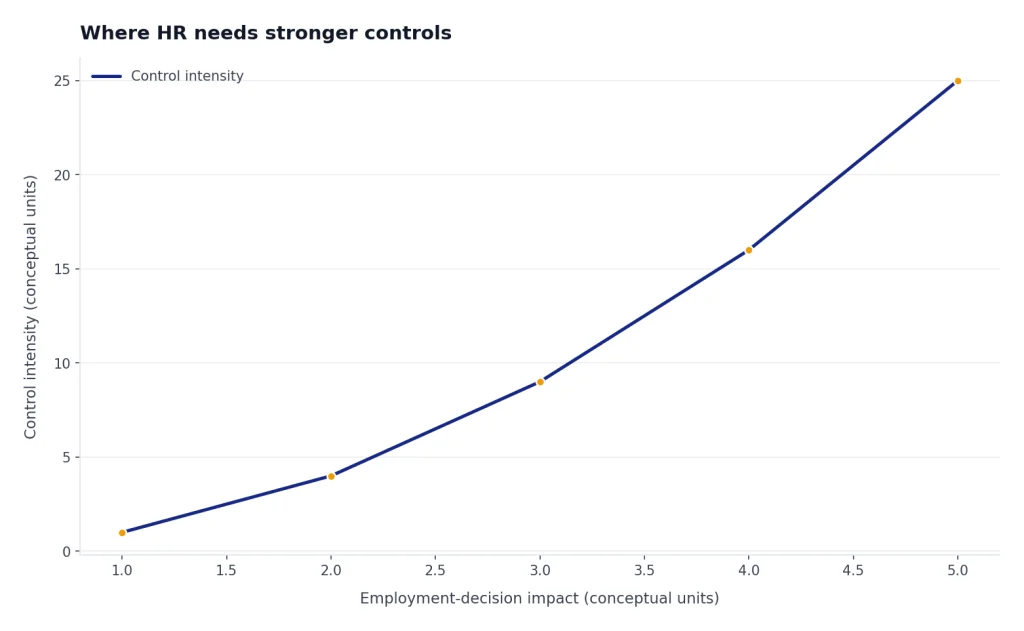
Start with a simple rule: ChatGPT may help prepare information, but it should not make employment decisions. Do not ask it to rank employees, predict attrition for named individuals, score candidates, infer protected traits, decide discipline, or recommend termination. These uses create legal, ethical, and employee-trust risks.
The EEOC’s 2023 Annual Performance Report states that Title VII applies when employers use automated systems, including AI, to make or inform selection decisions, and it notes that the four-fifths rule does not guarantee that a procedure is lawful.[4] The EEOC’s technical assistance on employment tests and selection procedures also says employers should ensure tests and selection procedures are validated for the positions and purposes for which they are used.[5]
New York City’s Local Law 144 of 2021 adds another concrete example of the compliance direction. The city says employers and employment agencies may not use an automated employment decision tool unless the tool has had a bias audit within one year of use, information about that audit is publicly available, and required notices are provided to employees or candidates; the city also notes that notice must be provided 10 business days before use.[6]
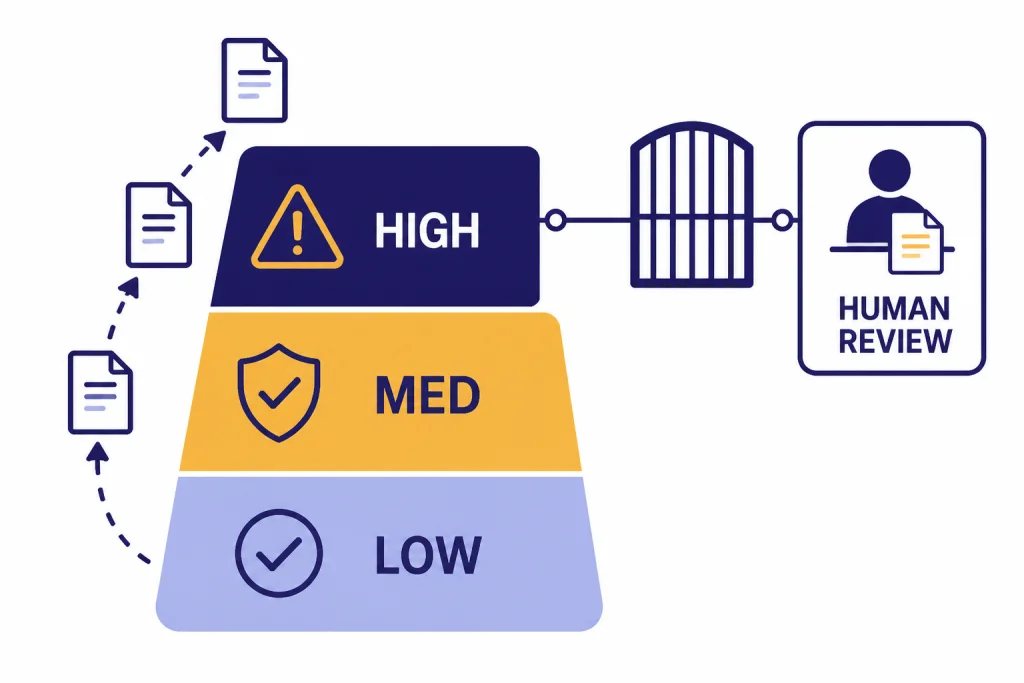
That does not mean every HR use of ChatGPT is an automated employment decision tool. Drafting a benefits FAQ is different from using a model to screen applicants. But HR should classify use cases before rollout. Put each use case into one of three buckets: allowed with ordinary review, allowed only with enhanced controls, or prohibited unless approved by legal, compliance, and executive leadership.
- Allowed with ordinary review: drafting training outlines, onboarding checklists, meeting agendas, and manager communication templates.
- Allowed with enhanced controls: summarizing anonymized survey responses, drafting policy FAQs, preparing interview question banks, and analyzing workforce trends.
- Restricted or prohibited: candidate scoring, employee ranking, performance ratings, termination recommendations, accommodation determinations, pay decisions, and disciplinary conclusions.
A practical workflow for common HR tasks
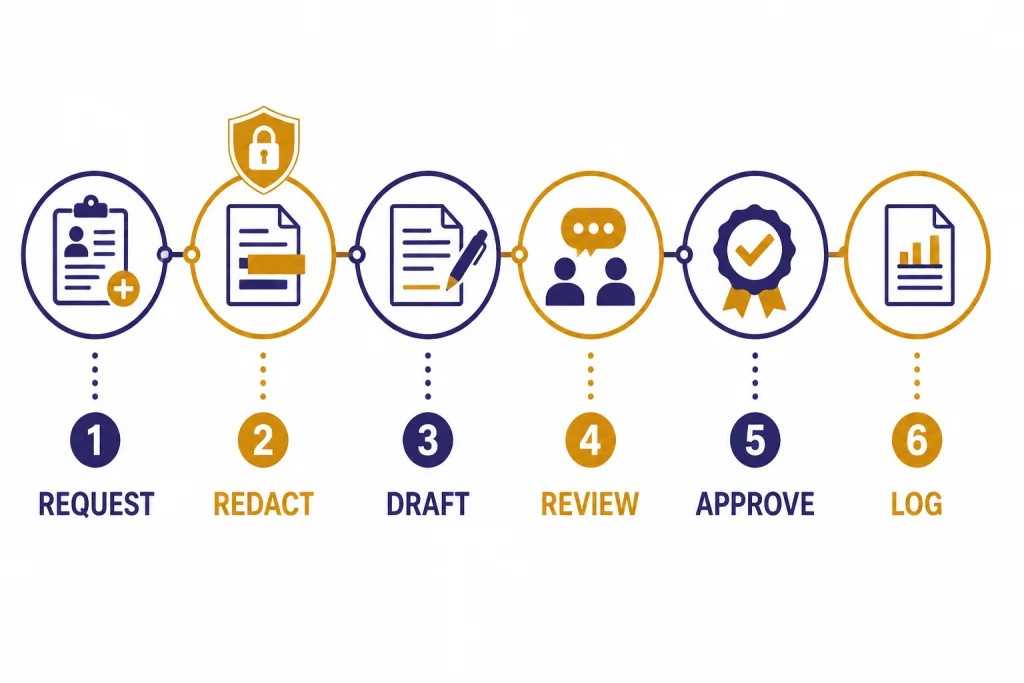
A strong HR workflow keeps ChatGPT away from unnecessary personal data and keeps humans in charge of the final work product. The process below works for most drafting and summarization tasks.
- Define the task. Write down the purpose, audience, risk level, reviewer, and final owner before prompting.
- Remove sensitive details. Replace names, employee IDs, medical details, salary figures, and investigation facts unless the approved enterprise workflow requires them.
- Provide source material. Give the model only the policy excerpt, manager notes, or anonymized comments needed for the task.
- Ask for a constrained output. Specify format, tone, reading level, exclusions, and what the model must not do.
- Review against source documents. Check every policy statement, date, eligibility rule, and legal reference.
- Log the final decision. Keep a record of who reviewed the output and what source documents governed the final version.
Here is a practical example. Suppose HR needs an onboarding checklist for a remote finance hire. The prompt should not include the employee’s personal details. It should include the role type, location category, start-date timing, required systems, training modules, and manager responsibilities. The model can draft a checklist, but HR operations and the hiring manager should confirm the systems, deadlines, and required training.
For spreadsheet-heavy HR work, ChatGPT can help write formulas, explain pivot tables, and clean text fields before analysis. Use the same redaction rule. If your team works in Excel, chatgpt for excel is useful for formulas, macros, and data-cleaning prompts. For more sensitive HR analytics, use approved internal datasets and validated reporting methods.
For employee emails, ChatGPT is useful when the policy answer is already known and the hard part is clarity. Ask it to produce a plain-language version, a manager version, and a short employee version. Then compare each draft against the actual policy. Our guide to ChatGPT for Email Writing That Converts is written for external email, but the same clarity principles apply to internal HR messages.
Prompts HR teams can adapt
Good HR prompts are narrow. They state the source, audience, output, and review requirement. They also tell ChatGPT not to invent policy, law, eligibility rules, or facts.
Policy FAQ prompt
You are helping an HR team draft an employee-facing FAQ. Use only the policy excerpt below. Do not add legal advice, eligibility rules, deadlines, or exceptions that are not in the excerpt. Write in plain American English at an eighth-grade reading level. Include a final section titled "When to contact HR" for situations the FAQ does not answer.

Policy excerpt:
[Paste approved policy excerpt]
Manager coaching prompt
Create a manager discussion guide for the situation below. Keep the tone neutral, respectful, and documentation-focused. Do not make findings of fact. Do not recommend discipline. Provide open-ended questions, listening tips, and reminders to follow company policy.

Situation summary with names removed:
[Paste anonymized summary]
Job description improvement prompt
Revise this job description for clarity and consistency. Preserve the essential functions and required qualifications. Flag any wording that may be vague, inflated, exclusionary, or unrelated to the role. Do not add new requirements. Return a table with: original wording, suggested revision, and reason.

Draft job description:
[Paste draft]
Survey theme prompt
Analyze the anonymized employee survey comments below. Group themes without identifying individuals. Do not infer protected characteristics. Provide: top themes, representative paraphrases, risks to investigate, and questions for HR leaders. Do not treat the themes as proven facts.

Comments:
[Paste anonymized comments]
If your team needs repeatable prompts, build a shared prompt library with approved language, standard disclaimers, and examples. A chatgpt prompt generator can help teams create consistent prompt templates, but HR should still approve the final versions before broad use.
Governance checklist before rollout
HR should not roll out ChatGPT by telling employees to “use AI responsibly” and hoping for the best. A workable governance model is specific. It names approved tools, approved data types, prohibited uses, review standards, logging rules, and escalation points.
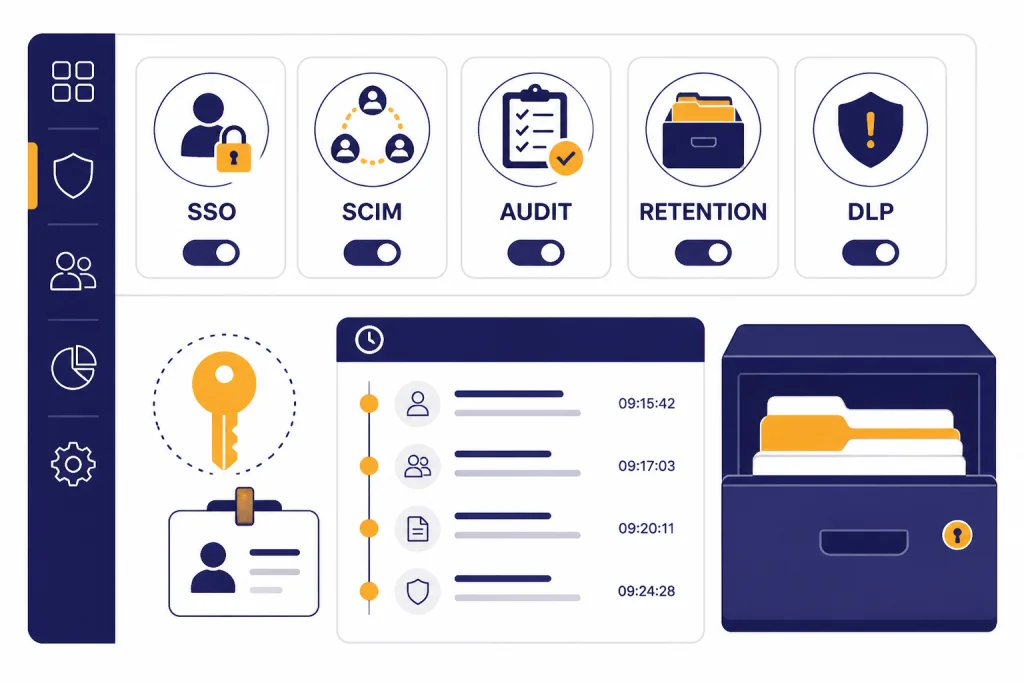
OpenAI says business data is encrypted at rest with AES-256 and in transit with TLS 1.2 or higher.[1] OpenAI also says its data protection practices align with SOC 2 Type 2 Trust Services Criteria and ISO/IEC 27001, 27017, 27018, and 27701 certifications.[1] Those controls can help enterprise review, but HR still needs internal controls around who may use the system and what they may enter.
ChatGPT Enterprise includes admin controls such as SAML SSO, SCIM provisioning, role-based access controls, custom roles, and real-time analytics, according to OpenAI.[3] Those features matter because HR access should not be unmanaged. People data should sit behind identity controls, role boundaries, and offboarding workflows.
- Approved-tool rule: Tell HR which ChatGPT workspace or enterprise AI tool is approved. Do not allow sensitive HR work in personal accounts.
- Data-classification rule: Define what may be entered, what must be redacted, and what is never allowed.
- Decision rule: State that ChatGPT cannot be the final decision-maker for hiring, firing, promotion, pay, discipline, leave, or accommodation decisions.
- Review rule: Assign reviewers by use case. Communications may need HR review. Policy content may need legal review. Analytics may need people analytics review.
- Record rule: Decide when prompts, outputs, and final edited versions must be retained.
- Vendor rule: Review AI features inside ATS, HRIS, engagement, learning, and performance tools. Do not assume embedded AI is lower risk.
- Employee notice rule: Decide when employees or candidates should be told that AI helped prepare a communication or process.
Memory and personalization features need extra attention in HR. If a workspace allows persistent context, HR should decide whether that is appropriate for people work. For more on how memory changes behavior across sessions, see this guide to ChatGPT tutorial memory.
How to choose between ChatGPT and HR systems
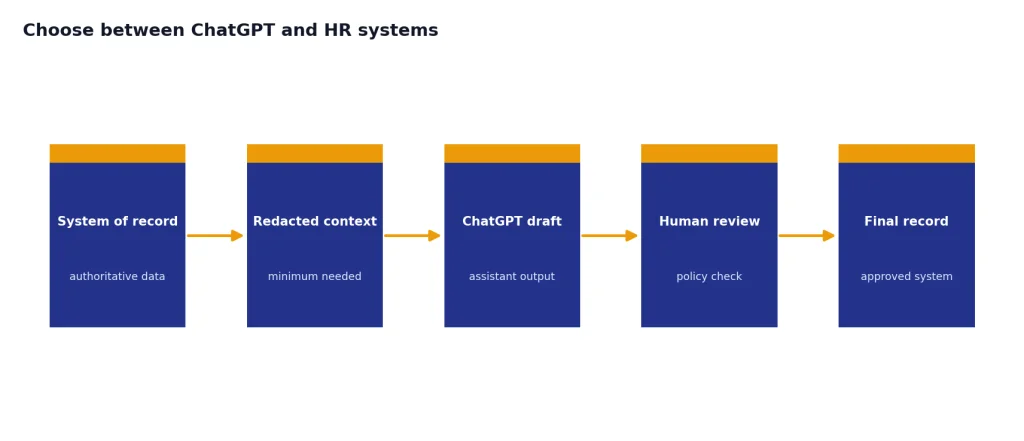
ChatGPT is not an HRIS, ATS, payroll system, benefits platform, case-management system, or learning management system. It can sit beside those systems as a writing, summarization, and reasoning assistant. It should not become the unofficial database of record for HR decisions.
Use the system of record for transactions. Use ChatGPT for drafts and analysis when the data is appropriate and the output is reviewed. This separation avoids a common failure mode: HR teams copy sensitive details into a chat, receive a polished answer, and then lose track of source data, assumptions, and approval history.
| Need | Use ChatGPT when | Use HR software when | Do not skip |
|---|---|---|---|
| Job posting | You need clearer wording, inclusive language review, or a first draft | You need requisition approval, posting, candidate tracking, or audit trail | Review essential functions and required qualifications |
| Benefits question | You need a plain-language explanation from an approved plan excerpt | You need eligibility, enrollment, or claim-specific answers | Verify against official plan documents |
| Employee relations | You need a neutral note summary or interview question outline | You need case tracking, evidence retention, or privileged legal workflow | Escalate serious matters to counsel or trained ER staff |
| Learning content | You need a draft outline, quiz questions, or facilitator guide | You need enrollment, completion tracking, or compliance training records | Validate policy and legal content |
| People analytics | You need help explaining trends or drafting a narrative | You need official headcount, attrition, compensation, or DEI reporting | Use governed datasets and approved metrics |
For regulated or high-stakes departments, learn from adjacent professions. ChatGPT for Accountants and Bookkeepers shows how review, source documents, and audit trails matter when numbers drive decisions. ChatGPT for Doctors and Healthcare Professionals shows why sensitive personal information requires stricter controls. HR sits closer to those workflows than to casual content generation.
SHRM’s 2026 AI in HR research describes practical HR use cases such as chatbots for common questions, document and policy management, auto-responders, notetakers, and self-service platforms.[7] That is the right lens for most HR teams: start with service delivery, documentation, and communication. Move slowly near selection, evaluation, discipline, pay, and accommodations.
Frequently asked questions
Can HR use ChatGPT to write employee policies?
HR can use ChatGPT to draft policy language, simplify wording, create FAQs, and compare versions. It should not publish a policy without review by the policy owner and, when needed, legal counsel. ChatGPT may miss local requirements, bargaining obligations, or company-specific exceptions.
Can ChatGPT screen resumes?
Do not use ChatGPT as an informal resume screener unless your legal, compliance, and recruiting leaders have approved the process. Resume screening can become an employment selection procedure, which raises validation, bias, audit, and notice concerns. It is safer to use ChatGPT to improve job descriptions and interview guides than to score candidates.
What HR data should not be entered into ChatGPT?
Do not enter sensitive employee data unless your organization has approved the tool, the data type, and the workflow. Common redaction categories include names, employee IDs, medical information, disability accommodation details, pay data, investigation records, and performance documentation. When in doubt, summarize the issue without identifiers.
Is ChatGPT Enterprise enough for HR compliance?
No. Enterprise controls can support privacy, identity, access, and administration, but they do not make every HR use case compliant. HR still needs use-case review, data minimization, human approval, documentation, and legal guidance for high-risk employment decisions.
Should employees know HR is using ChatGPT?
Often, yes. Transparency builds trust, especially when AI affects employee-facing communications, recruiting, performance processes, or self-service answers. At minimum, HR should have an internal policy that explains approved uses, prohibited uses, review standards, and escalation paths.